The most common reason AI evaluator feedback gets flagged or scored low is not wrong answers. It is unclear reasoning. An evaluator who picks the right response but cannot explain why in specific, observable terms is less useful to a model trainer than an evaluator who occasionally picks the wrong response but explains their reasoning with precision. The reasoning is training data. It needs to be legible.
Writing clearer evaluation answers is a learnable skill. It does not require special technical knowledge. It requires a consistent method: understand the prompt first, identify what the user actually wanted, and then explain which response satisfied that want better — with specific evidence, not impressions. This guide breaks that method down step by step.
The Four-Part Evaluation Answer Structure
Most AI evaluation tasks — whether they involve ranking two responses, selecting the better one, or writing a detailed rubric-based review — benefit from the same basic structure. Not every evaluation requires all four parts in formal written form, but having the structure in your head makes every evaluation faster and more consistent.
Part 1: Restate what the prompt asked. Before you judge anything, make sure you understand the original task. What did the user want? What format did they request? What constraints did they set? Restating the prompt objective — even informally in your own mind — protects against the most common error in AI evaluation: judging responses against your own preferences rather than the user's request.
Part 2: Identify which response better satisfied the prompt. Make a decision. Do not hedge. If one response is clearly better at fulfilling the user's request, say so. If both are weak, say which is less weak and why. The decision comes before the explanation.
Part 3: Explain the key reason with specific evidence. This is the most important part. The explanation needs to be observable — something anyone reading both responses could verify. Do not say "Response A is clearer." Say "Response A answers the question directly in the first sentence, while Response B buries the answer in the third paragraph after two sentences of preamble the user did not ask for." The first version is an impression. The second is evidence.
Part 4: Note any secondary factor if relevant. If there is a second important difference between the responses — a factual error in one, a safety issue, an instruction that was ignored — note it briefly. Secondary factors should support your primary reasoning, not replace it. One strong reason with a supporting secondary factor is more useful than two half-explained reasons.
Start With the Prompt, Not the Responses
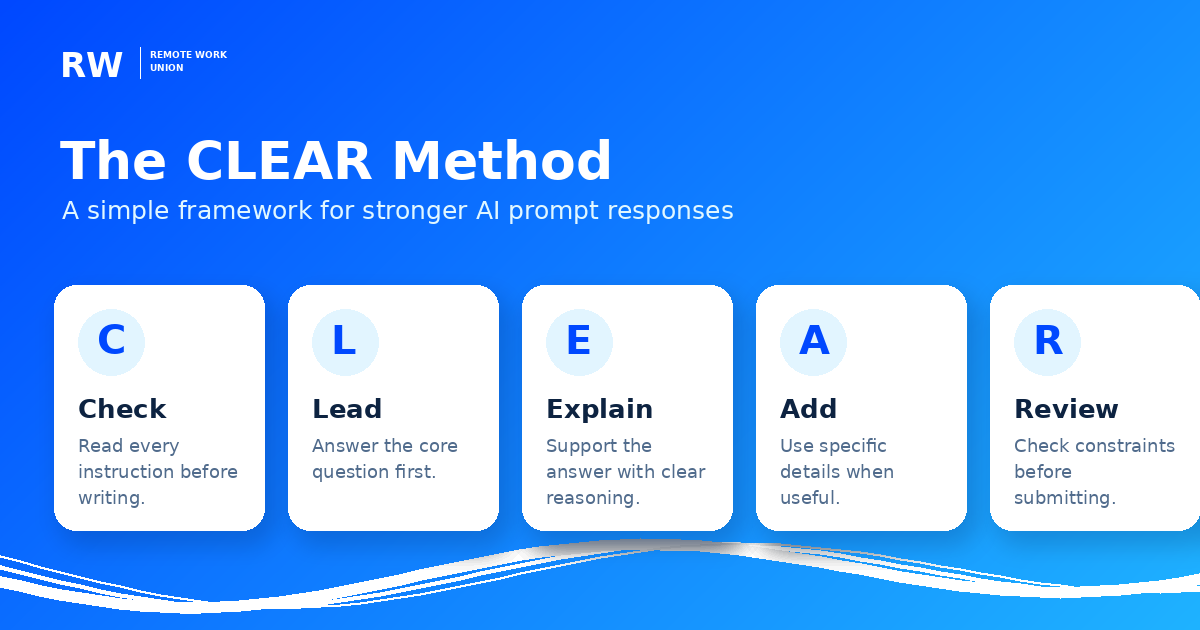
The single most reliable improvement most evaluators can make is to read the prompt carefully and completely before looking at the responses at all. Most evaluators do the opposite — they skim the prompt, read the first response, and form an impression before they have properly understood what the user was asking.
When you read the responses first, you start anchoring to whatever the first response said. If Response A is confident and detailed, you may unconsciously score Response B against Response A rather than against the prompt. If Response A makes a mistake, you may not notice it because you are comparing tone and length rather than accuracy and instruction-following.
Reading the prompt first — and fully — resets the frame. After reading the prompt, ask yourself: what does a good answer to this prompt actually look like? What format does the user want? What constraints did they set? What would make them satisfied with the response? Write a one-sentence answer to that question before you read either response. Then compare.
Practical habit: Before opening Response A, finish reading the full prompt and pause for three seconds. Ask yourself: "What would a correct answer look like?" Then read the responses. This pause alone catches dozens of evaluation errors per hundred tasks.
Weak vs. Strong Answer Examples
The difference between a weak and a strong evaluation answer is almost always specificity. Here are direct comparisons across several task types.
Example 1 — Response ranking task:
Weak
"Response A is better because it is more helpful and easier to read."
Strong
"Response A is better because it directly addresses the format constraint the user specified — three bullet points — while Response B ignores that constraint and gives prose. Response B also includes a disclaimer the user did not ask for, which adds length without adding value."
Example 2 — Factual accuracy task:
Weak
"Response B seems more accurate."
Strong
"Response B is more accurate. Response A states that the Treaty of Versailles was signed in 1920; it was signed in 1919. Response B gives the correct year and also correctly names the location as the Hall of Mirrors, which Response A omits."
Example 3 — Writing evaluation task:
Weak
"Response A has a better tone and flows better."
Strong
"Response A matches the professional but approachable tone the user requested for their cover letter. Response B uses casual language ('Hey there,' 'no problem') that is inconsistent with a formal job application context. The user explicitly said 'professional tone' in the prompt — Response B does not follow that instruction."
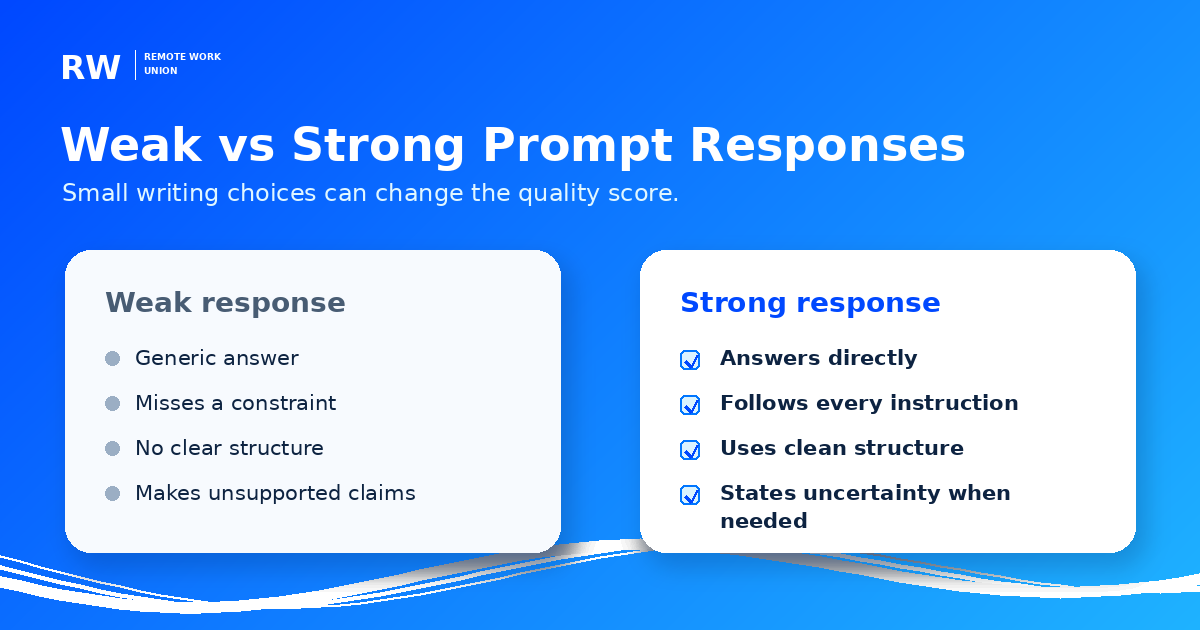
Notice that in every strong example, the explanation is tied to something observable in the text and grounded in what the user actually asked for. Anyone reading both responses could verify the claim. That is the test: if you cannot point to a specific sentence, feature, or error to support your evaluation, the reasoning is not strong enough yet.
Common Mistakes That Weaken Evaluations
Most evaluation errors fall into one of five categories. Recognizing these patterns in your own work is the fastest way to improve.
Length bias. Longer responses feel more thorough. They are not always more accurate, more helpful, or better at following instructions. Many evaluators score longer responses higher simply because more words create an impression of effort. Length should only factor into your evaluation when the user's prompt specified length requirements or when one response is so long that it becomes harder to use than a shorter version.
Confidence bias. Responses that sound confident are not necessarily more accurate than responses that acknowledge uncertainty. In many cases, the opposite is true — a response that confidently states something incorrect is worse than a response that correctly expresses uncertainty. Evaluate accuracy, not confidence tone.
Style preference. If a user asks for a formal explanation and both responses are roughly equal in formality, personal stylistic preference for one writing style over another is not a valid evaluation criterion. Focus on whether the response satisfied the prompt — format, content, tone, constraints — not whether it matches your writing style.
Vague rationale. Using words like "clearer," "better," "more helpful," or "higher quality" without explaining what specific observable feature makes it so is the most common weakness in evaluation feedback. Every time you write an evaluative word, ask yourself: what am I pointing to? If you cannot answer that question, the word is doing no work.
Ignoring instructions. This is the subtlest and most consequential mistake. Many evaluation tasks involve prompts with explicit constraints — a word count, a required format, a specific tone, a constraint on what not to include. A response that is generally well-written but ignores an explicit instruction should score lower than a response that is slightly rougher but follows the instructions correctly. Instruction-following is often the most important evaluation criterion, and it is the one that evaluators most commonly overlook.
The Prompt Analysis Workflow
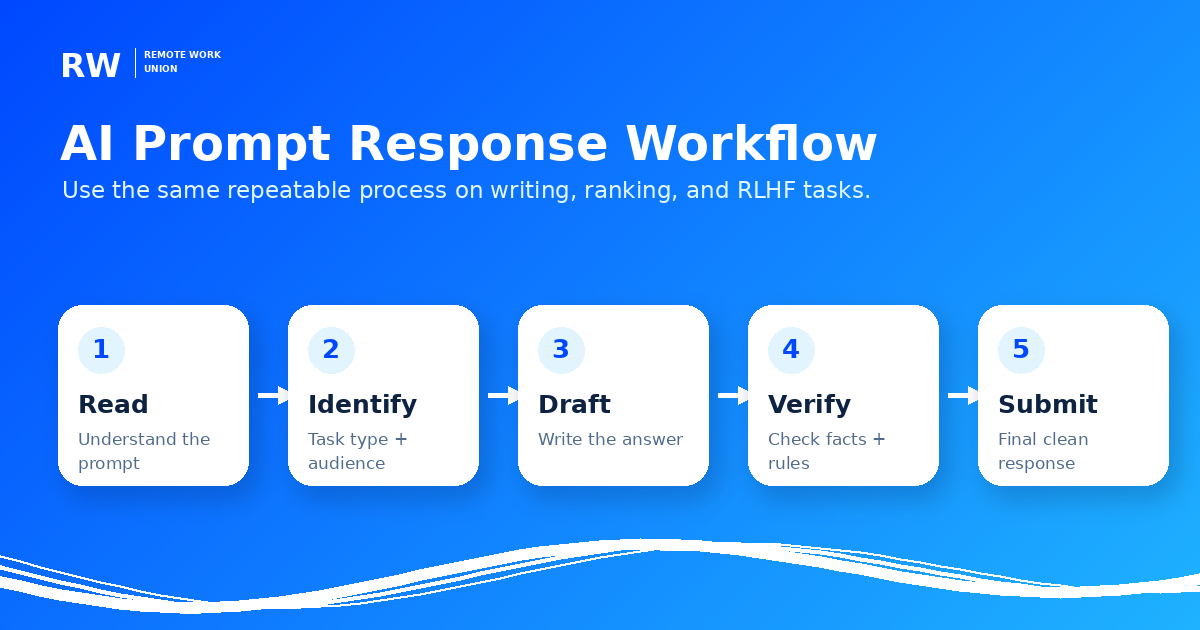
Before evaluating any task, extract the following information from the prompt. This takes about sixty seconds and catches the majority of errors before they happen.
Task type: What is the user actually asking for? Information, a creative output, code, an explanation, a decision, a comparison, a rewrite? The task type tells you what the response needs to do to succeed.
Format requirements: Did the user specify a format? Bullet points, numbered list, paragraph, table, specific section headers? A response that delivers correct content in the wrong format has failed a meaningful part of the task.
Constraints: Did the user place explicit limits on the response? Word count, reading level, tone, what not to include, required sources, required caveats? These are not suggestions — they are evaluation criteria.
Tone and register: Did the user signal a tone? "Keep it casual," "write professionally," "explain it like I'm five," "use technical language" — these are all tone signals that a good response needs to honor.
Implicit need: What does the user actually need, beyond what they literally wrote? This is the hardest part of prompt analysis. A user asking "how do I fix this error?" in a code snippet probably needs not just the fix but a brief explanation — most evaluators reward responses that catch the implicit need. But be careful: inferring too much beyond what the user asked is its own error. Strong responses address the explicit request first and the implicit need only if it genuinely helps.
Remote Work Union connects you to legitimate remote AI training and evaluation roles across multiple platforms. Apply for free.
Find Roles Hiring Now →How to Handle Close Calls
Close calls — tasks where both responses are roughly equivalent in quality — are where many evaluators spend too much time and ultimately produce their weakest feedback. The temptation is to overthink it, to hedge, or to declare them equal when the task requires a ranking.
The right approach for close calls is to find the differentiating factor. There is almost always one, even when both responses seem similar. Look for:
- Instruction-following compliance: Did one response miss a constraint the other honored?
- Opening effectiveness: Which response gets to the point faster? For most user tasks, the opening sentence matters more than the conclusion.
- Factual precision: Did one response introduce any ambiguity, hedging, or mild inaccuracy that the other avoided?
- Unnecessary content: Did one response include disclaimers, caveats, or preamble the user did not ask for, while the other was cleaner?
- Usefulness for the stated goal: Which response is actually more actionable for what the user said they were trying to do?
If you genuinely cannot find a differentiating factor after working through this list, choose the response that is slightly cleaner or more direct, note that the difference is minor, and explain the tiebreaker you used. Do not produce a hedged non-answer. "Both are equal" is rarely the right conclusion — it usually means the analysis is not complete.
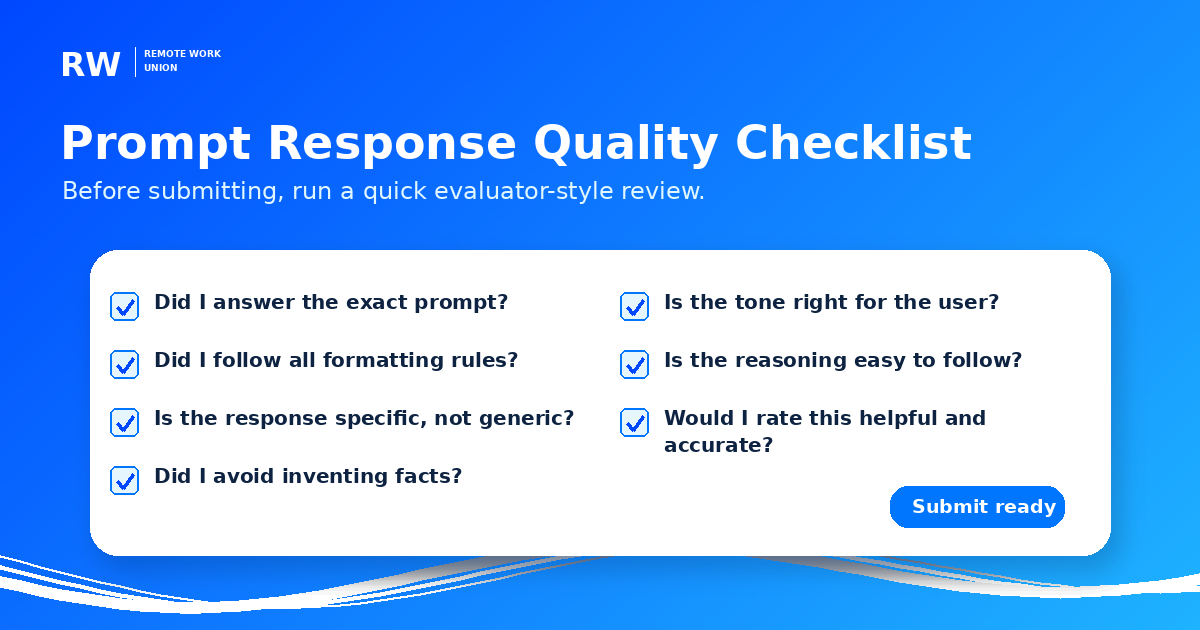
Quality Checklist Before Submitting
Before submitting any evaluation answer, run through this checklist. It takes less than sixty seconds and catches the majority of flaggable errors.
- Does my answer reference the prompt explicitly? Make sure your evaluation is grounded in what the user asked, not just a general impression of which response you prefer.
- Is my primary reason specific and observable? Can someone else read both responses and verify the claim I made? If not, make it more specific.
- Did I check for instruction-following? Review the original prompt one more time for any explicit constraints — format, tone, length, what to include or exclude. Did both responses follow them? Did one follow them better?
- Am I rewarding the right things? Check for length bias (did I score a longer response higher just because it's longer?), confidence bias (did I score a confident response higher even if accuracy is uncertain?), and style preference (am I rewarding my writing preferences rather than the user's stated requirements?).
- Is my rationale concise? Good evaluation feedback does not need to be long. A focused two-to-four sentence explanation is almost always more useful than a long paragraph that buries the key point.
- Did I note any secondary factors if they matter? A factual error, a safety issue, or a significant secondary difference is worth noting briefly — but only if it is genuinely relevant and does not dilute your primary point.
How These Skills Apply Across Platforms
One of the most valuable things about developing strong AI evaluation skills is that they transfer directly across every major platform. The four-part answer structure, the prompt-first discipline, and the habit of grounding rationale in observable evidence apply equally to:
- Outlier AI — Outlier uses structured evaluation tasks across writing, coding, math, and research. Strong rationale quality is one of the most consistent differentiators between evaluators who get more work and those who plateau.
- Mercor — Mercor's expert-matched work often involves domain-specific evaluation where the stakes of weak rationale are higher. A finance evaluator who can write precise, evidence-based reasoning will consistently outperform one who can't.
- Handshake AI — Fellowship-style projects often involve rubric-based evaluation with structured feedback fields. The four-part structure maps directly onto most Handshake AI evaluation rubrics.
- micro1 — Technical and professional evaluation work on micro1 frequently involves comparing AI outputs on complex domain tasks. The same prompt-analysis workflow that works for general writing tasks also works for engineering explanations, code review, or medical content.
Because evaluation skills transfer, improving your evaluation clarity on one platform is an investment in your standing on every other platform you work on. This is the compounding return that the best remote AI workers use to their advantage.
Final Takeaway
Clear AI evaluation answers share a common structure: they start with the prompt, make a decision, and explain that decision with specific observable evidence. Weak evaluations start with the response and offer impressions. Strong evaluations start with the user's intent and offer observations anyone can verify.
The mistakes that undermine most evaluators — length bias, confidence bias, style preference, vague rationale, and ignored instructions — are all correctable with practice and a consistent method. Use the four-part structure, run the prompt analysis workflow before evaluating, apply the quality checklist before submitting, and treat every close call as a skill-building exercise rather than an obstacle. The improvement compounds quickly.
Frequently Asked Questions
How do you write clear AI evaluation answers?
Start with the prompt, identify what the user asked for, then explain which response satisfied it better with a specific, evidence-based reason. Avoid vague words like "better" or "clearer" without evidence. The explanation should be specific enough that someone else reading both responses could verify it.
What makes an AI evaluation answer weak?
Vague rationale, rewarding style over substance, ignoring instruction-following, and length bias are the most common weaknesses. A weak answer says a response is better without explaining why in observable terms. "Response A is clearer" is an impression, not an explanation.
What is the best structure for AI evaluator feedback?
Restate the task, identify the better response, explain the key reason with evidence, and note secondary factors if relevant. Keep it concise but specific. Two to four focused sentences is usually more useful than a long paragraph that buries the point.
How do I improve my AI evaluation answer quality?
Practice comparing AI responses and writing short rationales. Focus on observable differences — instruction-following, factual accuracy, helpfulness, safety — rather than stylistic preferences. Run through the prompt analysis workflow before evaluating each task, and use the quality checklist before submitting.