AI data annotation is one of the most accessible entry points into remote AI work. At its core, it means labeling, categorizing, and organizing information so that AI systems can learn from it. Without annotated data, machine learning models cannot be trained. That is why annotation work is consistently in demand across the AI industry — and why it can be done remotely by people with a wide range of backgrounds.
If you are looking for flexible online work that does not require programming skills or a computer science degree, annotation is worth understanding. This guide explains what AI data annotation actually is, how it differs from simpler data entry work, what types of annotation jobs exist, and how to find and apply for legitimate positions.
What AI Data Annotation Actually Is
AI data annotation is the process of labeling data — text, images, audio, video, or other content — so that machine learning models can be trained to recognize patterns, respond to prompts, make predictions, or perform tasks.
Here is what that looks like in practice. An annotator might be asked to label whether a sentence expresses positive or negative sentiment. They might mark which parts of a paragraph are factually correct and which are unsupported. They might categorize images by subject matter, transcribe spoken words from audio recordings, or rank two AI-generated answers by quality and explain which is better and why. Each labeled example becomes a data point. Enough data points, combined and used in model training, teach an AI system what good answers look like — and what bad ones look like too.
Annotation is the infrastructure of modern AI. Without it, models cannot learn to understand language, follow instructions, reason through problems, or produce helpful outputs. That is why the demand for annotation work has grown in step with the growth of AI — and why annotation roles exist at every stage of the AI development process, from initial training to ongoing quality improvement.
Key point: Annotation is not a peripheral activity. It is a core part of how modern AI systems are built, evaluated, and improved. Every major language model has been shaped, in part, by annotation work done by people working remotely.
How AI Annotation Differs from Basic Data Entry
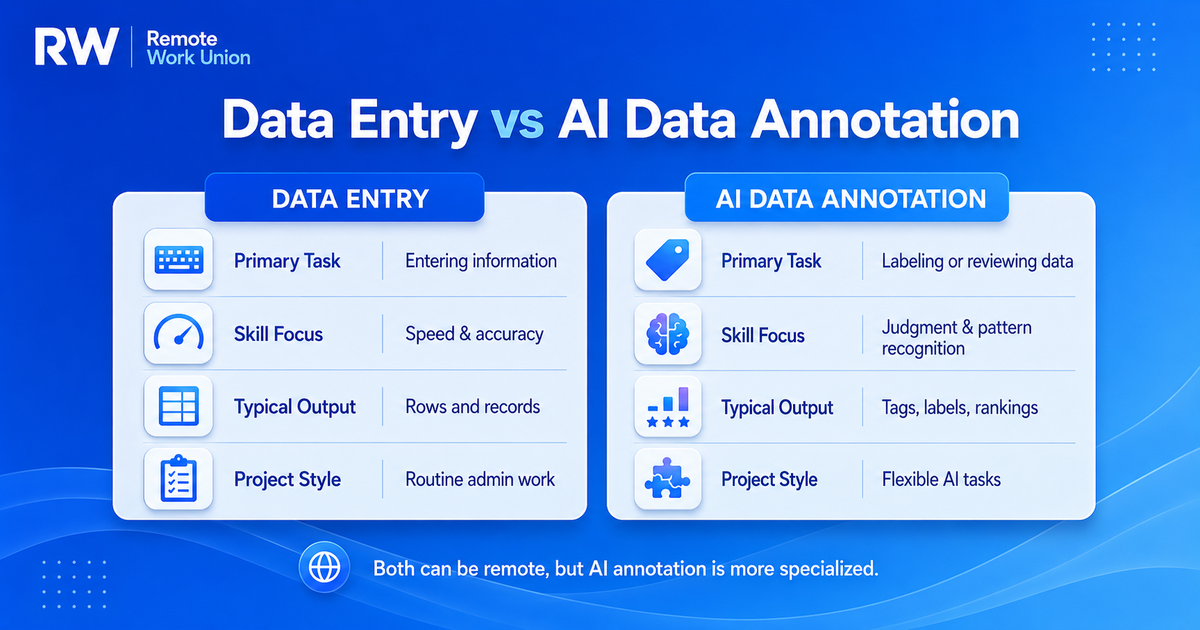
Basic data entry involves copying information from one place to another with minimal judgment. You might transfer numbers from a paper form into a spreadsheet, or move records from one database format to another. The task is primarily mechanical — accuracy matters, but the decisions you make are simple.
AI data annotation requires something different: judgment, consistency, and guideline compliance. You are not just filling in boxes — you are making decisions about quality, category, intent, tone, or correctness, and those decisions must be consistent across hundreds or thousands of examples.
Consider the difference between these two tasks:
- Data entry: Copy the customer's name and order number from a paper form into the company's database.
- AI annotation: Read two AI-generated explanations of the same concept, decide which one is more accurate, more helpful, and better organized, and then write a clear explanation of why you chose it — referencing the specific criteria in the project's guidelines.
The annotation task requires you to read carefully, apply a rubric, form a judgment, and communicate that judgment clearly. It demands more from you, which is why it generally pays more than basic data entry and why it is genuinely useful work rather than rote copying.
The most important skill in annotation work is guideline compliance. Every annotation project comes with a set of instructions — sometimes short, sometimes extensive. Your ability to read those instructions carefully, apply them consistently, and flag situations where the guidelines are unclear is what separates a strong annotator from a weak one. Inconsistency is the most common reason annotators fail quality review.
Common AI Data Annotation Job Types
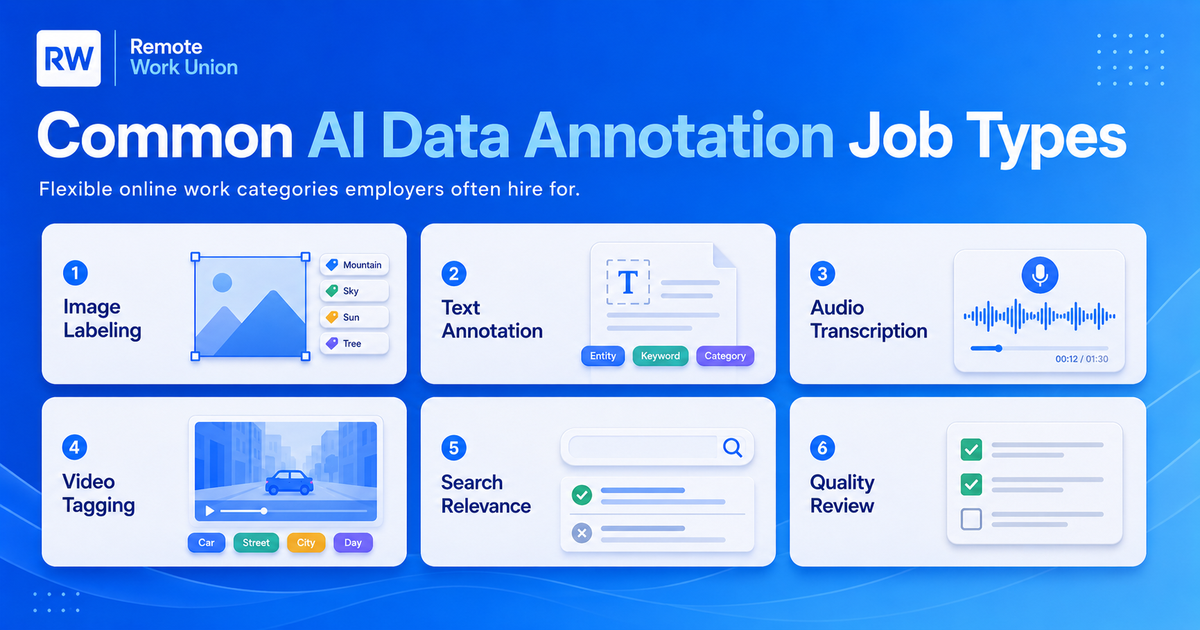
The annotation field covers a wide range of task types. Here are the most common ones you will encounter when looking for remote annotation work:
1. Text Classification
Categorize text by topic, intent, sentiment, tone, or quality. You might be asked to label customer reviews as positive, negative, or neutral, or to categorize news headlines by subject. Text classification tasks are often entry-level and can be completed quickly once you understand the category definitions.
2. Response Ranking and Preference Annotation
Compare two or more AI-generated outputs and rank them by quality. This is one of the most common annotation tasks used to train and improve large language models. You read the prompt, read both responses, and decide which is better — then explain your reasoning. The explanation is often as important as the ranking itself.
3. Named Entity Recognition (NER)
Label entities in text — people, organizations, locations, dates, products, and other specific categories. For example, in the sentence "Apple announced a new product in Cupertino last Tuesday," you would label "Apple" as an organization, "Cupertino" as a location, and "last Tuesday" as a date. NER annotation is widely used for training models that need to extract structured information from unstructured text.
4. Instruction Following Review
Check whether an AI response correctly followed the prompt. Did the model answer the actual question asked? Did it respect the format instructions, the word count, the tone requirement? Instruction following review requires close reading of both the prompt and the response, with attention to details that a casual reader might miss.
5. Safety and Content Review
Identify harmful, misleading, or policy-violating content in AI outputs. Safety annotators need to understand the platform's content policies and apply them consistently, even when the violations are subtle. This work can be sensitive — some platforms provide additional support resources for annotators working on high-exposure safety tasks.
6. Image and Video Annotation
Label objects, scenes, and actions in visual media. Tasks range from simple bounding boxes around objects in a photo to complex scene understanding in video footage. Image annotation is heavily used in computer vision — training models that recognize objects, detect motion, or interpret visual environments.
7. Audio Transcription and Review
Transcribe spoken words from audio recordings, or review and correct AI-generated transcriptions. Accuracy matters here — a transcription that looks close but misses key words or punctuation patterns can cause downstream training errors. Language-specific transcription work is available for many languages beyond English.
8. Fact-Checking and Claim Verification
Identify supported versus unsupported claims in AI outputs. Given a paragraph, you might be asked to check each factual claim against a reference document, a search result, or your domain knowledge, and label each claim as verified, unverified, or incorrect. This task type tends to pay well and often requires genuine research ability.
Who Annotation Work Is Best For
Annotation work suits a specific kind of worker well. It is not the right fit for everyone, but for the right person it can be an excellent remote income source — and a genuine pathway into the broader AI industry.
Annotation work tends to be a good match for:
- Detail-oriented workers who can apply rules consistently over long task sessions without losing accuracy. The ability to maintain focus across repetitive structured work is genuinely valuable in annotation roles.
- People comfortable with judgment-dependent repetition. Unlike creative freelance work, annotation is often repetitive in structure but requires real judgment on each individual task. If you find that combination satisfying rather than frustrating, annotation can be a productive long-term role.
- Writers and researchers who already understand quality distinctions. If you can explain why one paragraph is clearer than another, or why one source is more reliable than another, you have the core skill for many annotation tasks.
- Domain experts in law, finance, medicine, education, science, or other specialized fields. Expert annotation is often higher-paying than general text labeling because fewer people can do it accurately. A nurse who can review medical reasoning, a lawyer who can check legal explanations, or an accountant who can evaluate financial guidance all have a significant advantage in the annotation market.
- Multilingual speakers. Language-specific annotation work is available in dozens of languages. If you can write and reason fluently in a language other than English, there are annotation opportunities that specifically need your skills.
- People who work well independently. Most annotation platforms are asynchronous — you receive tasks, work through them, and submit, without a manager directing each step. If you can self-manage and stay on track without heavy oversight, annotation is a good structural fit.
How the Annotation Workflow Works
Understanding the typical annotation workflow before you start will save you time and help you avoid the most common early mistakes.
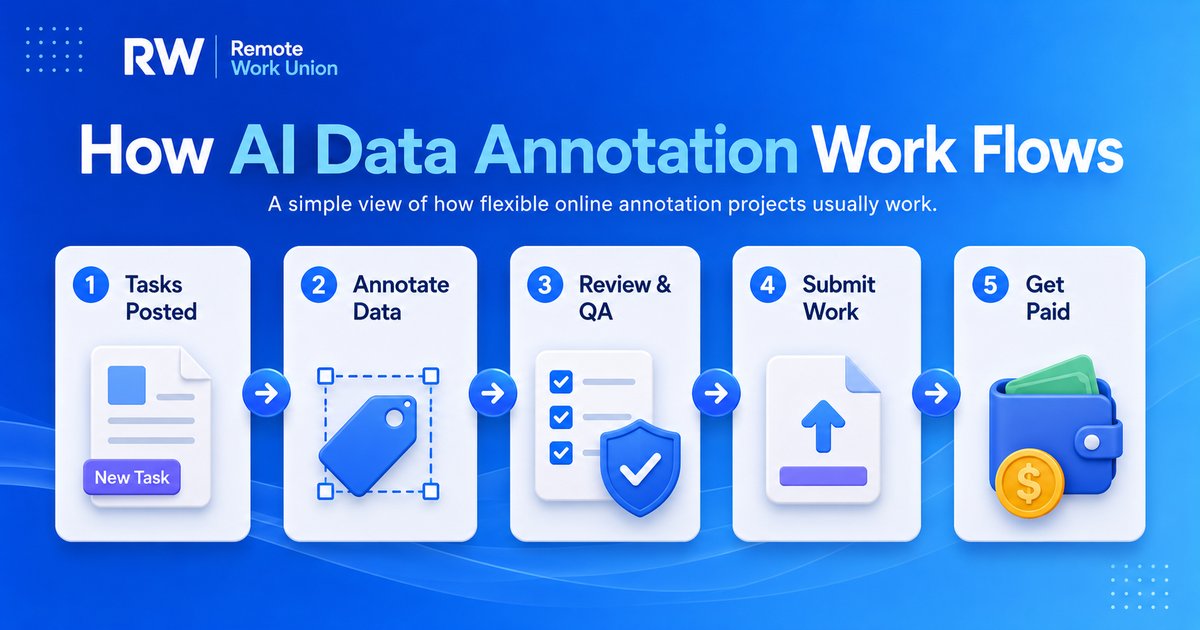
Most annotation projects follow a similar pattern:
- Receive a task batch. The platform assigns you a set of tasks — anywhere from a handful to several hundred, depending on the project and your capacity.
- Read the guidelines. Every annotation project has a guideline document. These range from five pages to thirty pages or more for complex projects. Reading the guidelines carefully before you start is the single most important thing you can do. Annotators who skip this step consistently produce lower-quality work and fail quality review.
- Complete the annotation. Work through each task in the batch, applying the guidelines consistently. When you encounter an edge case — a situation the guidelines do not clearly cover — note how you handled it. Most platforms want you to flag ambiguous cases rather than guess.
- Submit for quality review. Your completed work goes through a quality check. This may be automated, peer-reviewed, or reviewed by a senior annotator or project manager. Your accuracy rate determines whether you receive more work, get placed on higher-value projects, or need to go through additional calibration.
- Receive feedback. Good platforms provide feedback when your work is below standard. This feedback is specific: it will tell you which decisions were incorrect and why. Take this seriously. Annotators who improve based on feedback tend to qualify for better projects over time.
- Adjust and continue. Apply what you learned from feedback to the next batch. Over time, your understanding of the guidelines deepens, your consistency improves, and your quality scores reflect that.
The guideline document is the center of the entire workflow. Annotation quality depends almost entirely on how well you understand and apply the project's rules. When in doubt, return to the guidelines rather than relying on intuition.
Remote Work Union connects you to legitimate remote AI annotation and training roles across multiple platforms. Apply for free.
Find Roles Hiring Now →Skills and Tools That Help
You do not need a technical background to start annotation work, but certain skills and habits will make you more effective and more competitive as an applicant.
Skills that help most:
- Careful reading. Annotation is fundamentally a reading job. The ability to read closely — catching subtle distinctions, noticing what is and is not stated — is more useful than any technical credential.
- Consistency. Your decisions must be repeatable. If you label a sentence as negative sentiment in one task, you need to apply the same standard to equivalent sentences throughout the batch. Inconsistency is the most common quality failure in annotation work.
- Patience with structured repetition. Annotation sessions can be long and the task format is often similar across the batch. The ability to maintain your standard without drifting is a real professional skill in this field.
- Ability to distinguish subtle quality differences. Especially in response ranking and evaluation tasks, the difference between two AI outputs might be small. The best annotators can articulate exactly why one is better, even when the gap is narrow.
- Written communication. Many annotation tasks require you to explain your decisions in writing. A clear, specific explanation — using the language of the guidelines — is more useful than a vague justification.
- Subject matter expertise. For specialized review roles in law, medicine, finance, science, or education, genuine professional knowledge makes you dramatically more accurate and more valuable.
Tools and platforms you may encounter:
- Labelbox — a widely used annotation platform for text, image, and video tasks.
- Scale AI — works with contractors through its Remotasks platform for various annotation and data labeling tasks.
- Surge AI — focuses on natural language annotation tasks for AI training.
- Prolific — often used for research-oriented annotation and survey tasks.
- Many platforms use their own internal tools, which you learn during onboarding.
Familiarity with these tools is helpful but not required for entry-level positions. Most platforms provide guided onboarding for their specific interface.
How to Find Legitimate Annotation Jobs
The annotation job market has grown significantly alongside the AI industry. There are now many legitimate platforms offering remote annotation work, but there are also low-quality listings and some outright scams. Knowing where to look and what to avoid makes a meaningful difference.
Search terms to use:
- AI data annotation jobs remote
- data labeling jobs from home
- text annotation jobs remote
- AI training data jobs
- content annotation jobs
- RLHF annotation jobs
- online annotation jobs
- response ranking jobs remote
Platforms worth checking:
- Handshake AI, Mercor, and micro1 — the core platforms Remote Work Union recommends for AI training and evaluation work, spanning entry-level annotation through expert review at up to $50–$200/hr.
- Outlier AI — one of the larger platforms for text annotation, response evaluation, and AI training tasks. Accepts applicants globally.
- Scale AI / Remotasks — offers a range of annotation task types including text, image, audio, and video.
- DataAnnotation.tech — focuses on AI training tasks with flexible hours and task-based pay.
- Surge AI — natural language annotation for AI companies, with a focus on quality.
- Appen — a long-established platform with a wide range of annotation and data collection projects.
- iMerit — works with enterprise clients on specialized annotation including medical imaging and document processing.
- Sama — enterprise-focused annotation platform with a range of task types.
- CloudFactory — offers data processing and annotation work through a managed workforce model.
- Cogito — provides annotation services for enterprise AI projects.
What to watch out for:
- Never pay to access annotation tasks. Legitimate platforms do not charge application fees.
- Be cautious of listings that promise unusually high pay for vague "data entry" or "AI training" tasks without a clear platform name or company behind them.
- Research any platform before submitting personal information. Check for reviews on sites like Trustpilot, Reddit, or the platform's own community pages.
- Legitimate platforms always make their payment structure clear before you start work.
How to Apply and Stand Out
Most annotation platforms use a qualification test to assess new applicants. The test is designed to see whether you can apply the project's guidelines correctly and consistently. Here is how to approach it effectively.
Read the annotation guide completely before starting the test. This is the step most applicants skip, and it is the most important one. The qualification test is designed to catch exactly the errors that careful guide-reading would prevent. Annotators who read the guide once, thoroughly, before touching the first task outperform those who skim and dive in.
Treat the qualification test as paid work. The test gives you a real preview of what the project tasks look like. Approach each item with the same focus and care you would give a paid batch. The difference between applicants who pass and those who do not is usually not knowledge — it is attention and consistency.
Apply the same rule consistently. Inconsistency is the most common rejection reason in annotation qualification. If you make a decision about how to handle a specific pattern in task three, apply the same logic in task twelve. The platform's quality reviewers look specifically at consistency across similar items.
Note edge cases and how you resolved them. When you encounter a situation that the guidelines do not clearly address, note how you handled it. If the platform allows written comments on tasks, use them for ambiguous cases. This shows that you read the guidelines carefully enough to recognize when they are silent on a situation.
Use the platform's language when explaining decisions. When the task asks you to explain a ranking or a label, use the terminology from the project guidelines. This signals to the reviewer that you have internalized the project's standards rather than applying your own personal judgment.
Tip: After qualifying on one platform, the same skills transfer directly to others. The core habit — read the guidelines, apply them consistently, flag edge cases — works across every annotation platform and project type. Build the habit once and it compounds.
Frequently Asked Questions
Is annotation the same as data entry?
No. Data entry involves copying information from one source to another with minimal judgment. AI data annotation requires you to make consistent decisions about quality, category, intent, tone, or correctness based on a detailed set of guidelines. The judgment requirement is what makes annotation more skilled and, in many cases, better compensated than basic data entry.
How much does annotation pay?
Pay varies widely depending on the task type, platform, required expertise, and your location. General text labeling and image annotation tasks typically pay less than expert-level annotation in law, medicine, finance, or software. Specialized review roles that require domain knowledge can pay significantly more per task or per hour than general labeling projects.
Can I do annotation part-time?
Yes. Many annotation projects are task-based, meaning you take on batches of work at your own pace within project deadlines. This structure makes it well-suited to part-time or flexible schedules. Some platforms allow you to work as few or as many hours as you choose, depending on available project volume.
Do I need special software for annotation jobs?
Most annotation platforms are browser-based and do not require any special software installation. Some platforms have their own proprietary tools that you learn during onboarding. Familiarity with common annotation platforms like Labelbox, Scale AI, or similar tools can be helpful but is not usually required for entry-level positions.
Is annotation stable work?
Annotation work is typically project-based, which means availability fluctuates depending on what projects the platform has active. It is common to have steady work for several weeks or months, followed by slower periods. The most effective approach is to qualify on multiple platforms simultaneously, so that when one slows down, others may still have active projects.
Final Takeaway
AI data annotation is real work that real AI systems depend on. It is not glamorous, but it is consistent, learnable, and available globally. The skills it requires — careful reading, consistent judgment, guideline compliance, and clear written reasoning — are accessible to people with many different backgrounds, not just technical ones.
If you can follow instructions carefully, apply rules consistently across hundreds of tasks, and explain your reasoning clearly when asked, annotation is a practical starting point for a career in remote AI work. It is also a genuine contribution to the AI systems that millions of people use every day.