Remote writing work is one of the clearest paths into flexible work-from-home income because the core skill is portable. A writer does not need a specific office, a local employer, or a phone-heavy schedule to produce useful work. If you can read a brief, understand what an audience needs, organize information, revise clearly, and meet deadlines, you can apply those skills across many types of remote jobs.
The problem is that not all online writing jobs are equal. Some are low-paid content mills with unrealistic volume demands. Some are freelance marketplaces where beginners spend more time pitching than earning. Others are full-time corporate roles that say "remote" but still require live meetings, fixed hours, and constant availability. Writers who want flexible hours need to look for roles where output matters more than being online at a specific time.
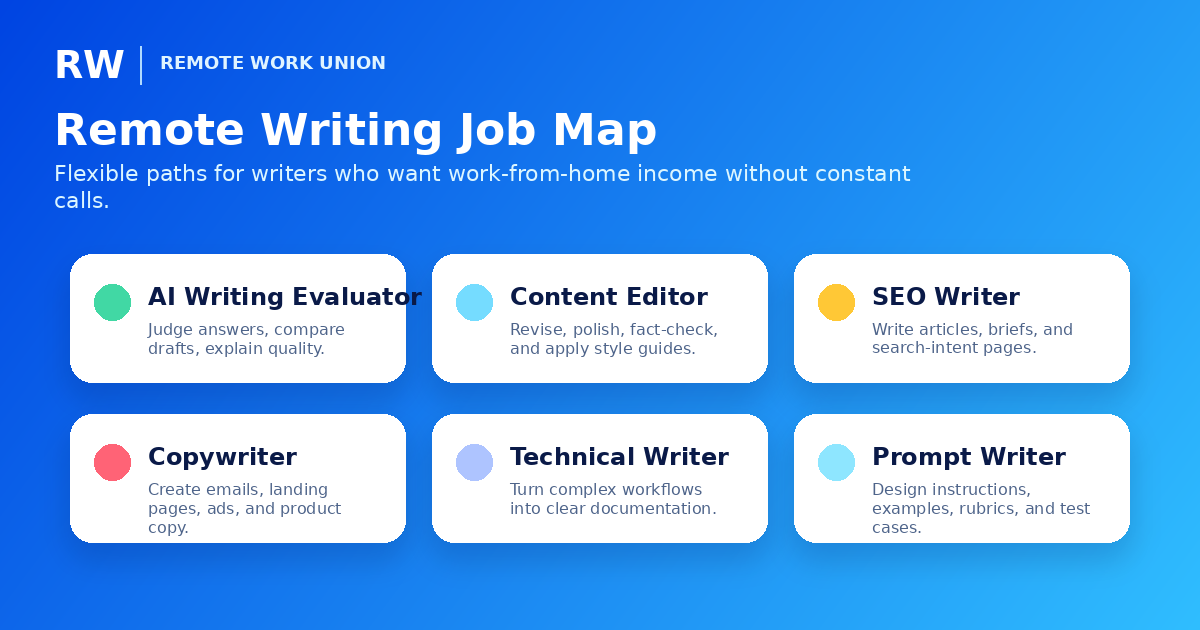
The best opportunities usually sit in a few categories: AI writing evaluation, content editing, SEO content, copywriting, technical documentation, prompt writing, research writing, and specialist writing for industries like finance, legal, healthcare, software, education, and business operations. In 2026, the strongest remote writing path for many people is not only "write articles from home." It is using writing judgment to help companies create, evaluate, improve, and organize information.
What Flexible Remote Writing Work Actually Means
Flexible does not mean effortless. It means the work is usually asynchronous, deadline-based, and measured by quality of output. A flexible writing role may still require reliability, strong attention to detail, and careful communication. The difference is that you may be able to complete the work early in the morning, late at night, during lunch breaks, or in focused blocks around another job.
For writers, the most flexible remote jobs tend to have these traits:
- The work is document-based instead of call-based.
- Tasks can be completed independently after reading instructions.
- The employer or platform cares about finished work, not constant online presence.
- Feedback is written, not delivered through repeated meetings.
- The role rewards judgment, editing, research, and clarity.
- The schedule is task-based, project-based, contract-based, or deadline-based.
This is why AI writing evaluation has become so relevant for writers. AI companies and AI training platforms need people who can judge whether answers are accurate, helpful, safe, well-structured, and aligned with instructions. That is a writing skill, not just a technical skill.
1. AI Writing Evaluator
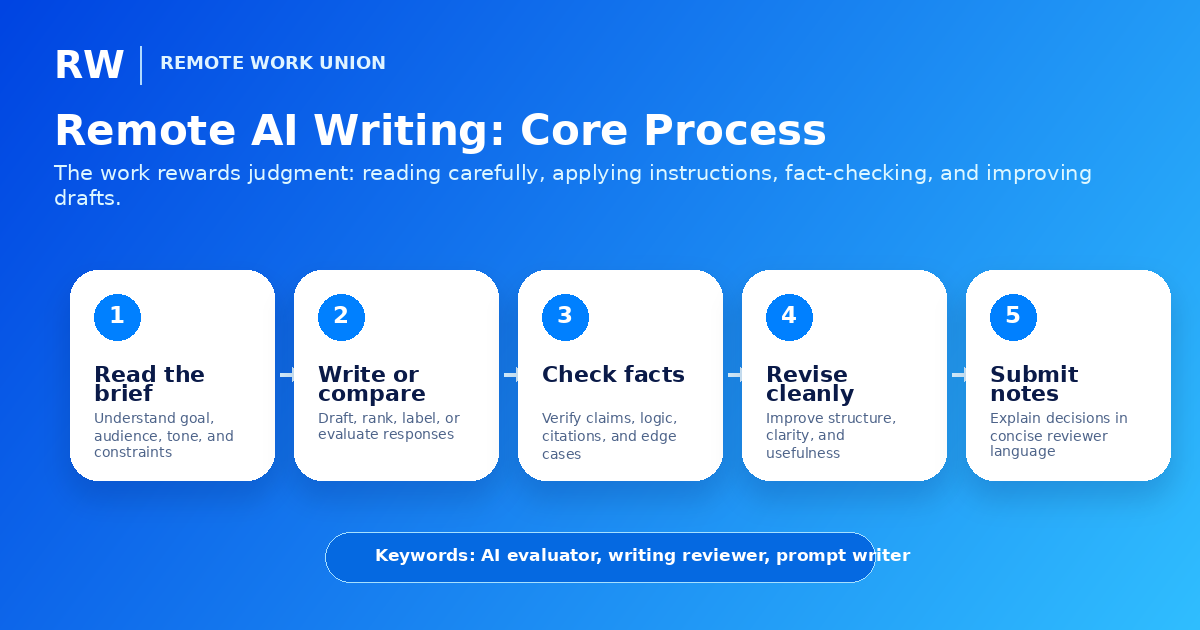
AI writing evaluator roles are some of the most relevant remote jobs for writers who want flexible hours. These roles usually involve reading AI-generated responses and judging which one is better, editing an answer to make it more useful, checking whether a response follows instructions, or writing examples that help train a model.
This type of work may appear under many job titles, including AI evaluator, AI response reviewer, AI writing reviewer, AI trainer, AI data annotator, language model evaluator, or AI content quality analyst. Platforms and companies in the AI work ecosystem may include names such as micro1, Mercor, Handshake AI, and other remote AI training platforms. The larger AI ecosystem around companies such as OpenAI, Anthropic, Google, Meta, and Grok also creates demand for better writing, evaluation, safety review, and content quality work, even when the worker is hired through vendors, platforms, or specialized teams.
For writers, the advantage is that the work often uses the same skills required for editing and analysis: reading carefully, spotting weak logic, improving clarity, judging tone, and explaining why one answer is better than another. You do not necessarily need to code. Many tasks are based on language, reasoning, instructions, examples, and quality standards.
This work is a strong fit if you are good at:
- Comparing two drafts and explaining which is stronger.
- Spotting vague, incorrect, or unsupported claims.
- Rewriting awkward answers into clear language.
- Following detailed rubrics without ignoring nuance.
- Maintaining consistency across repetitive tasks.
- Giving concise written feedback.
The biggest mistake writers make when applying is describing themselves only as "creative." AI evaluator work often rewards disciplined clarity more than pure creativity. Your profile should show that you can follow instructions, evaluate objectively, and improve content for usefulness.
2. AI Content Editor
AI content editor roles are closely related to AI evaluator roles, but the work may be more focused on rewriting, polishing, and improving drafts. A company may need editors who can turn rough AI output into readable explanations, product copy, summaries, help center articles, training examples, or knowledge base content.
This is useful for writers who want flexible hours because editing can often be completed in blocks. You receive a draft, apply standards, fix structure, improve accuracy, reduce fluff, and submit the revised version. Some roles are full-time jobs, while others are contract or project-based.
Strong AI content editors know how to preserve meaning while improving the final result. That matters because careless editing can introduce errors. A good editor improves clarity without changing facts. They also know when a sentence sounds polished but is not actually useful.
If you apply for these jobs, use keywords such as content editing, copy editing, line editing, AI content review, AI quality assurance, response editing, factual accuracy, content QA, style guide, and editorial review.
3. Prompt Writer and Prompt Reviewer
Prompt writing is another strong remote job category for writers. A prompt is an instruction given to an AI model, but good prompt writing is more than typing a question into a chatbot. It requires clear task design, precise constraints, examples, edge cases, and an understanding of what makes an output useful.
A prompt writer might create instructions for a model to follow. A prompt reviewer might evaluate whether prompts are clear, fair, and likely to produce the intended result. A prompt engineer may need more technical skill, but many prompt writing and prompt evaluation jobs are language-heavy rather than code-heavy.
Writers are often a good fit because they already understand audience, tone, structure, and instruction design. The same ability that makes someone good at writing a strong brief can make them good at designing AI tasks.
This path is especially good for writers who are analytical. If you like writing instructions, testing outputs, comparing drafts, and finding edge cases, prompt work may be more flexible and better paid than traditional content writing.
4. SEO Content Writer
SEO writing remains one of the most common work-from-home writing jobs. It can be flexible because the work is usually deadline-driven rather than meeting-driven. A remote SEO writer may create blog posts, landing pages, product pages, comparison articles, how-to guides, glossary pages, and content briefs.
The best SEO writers are not keyword stuffers. They understand search intent. They know why someone searched a phrase, what answer they need, and how to organize an article so the reader can act quickly. They can also write in a way that is useful to both people and search engines.
For flexible hours, SEO writing can be good because assignments are often batched. You may receive a list of topics and deadlines, then complete them on your own schedule. However, quality varies widely. Some SEO jobs pay poorly and expect fast volume. Better jobs require subject knowledge, research, structure, and strong editing.
Writers can stand out by showing samples that include headings, concise explanations, internal linking ideas, FAQs, meta descriptions, and a clear understanding of the reader's problem.
5. Content Strategist
Content strategy is a step above basic writing. A content strategist plans what should be written, why it matters, who it targets, and how it fits into a company's larger goals. This can include keyword research, editorial calendars, content audits, landing page planning, and performance analysis.
This role is often more stable than one-off writing gigs because companies need ongoing planning. It may be less flexible than pure freelance writing because strategists often work with marketing teams, but many strategy tasks are still remote-friendly and asynchronous.
A writer who wants flexible hours can move into content strategy by learning how to create content briefs, evaluate search intent, organize topic clusters, and explain why a page should exist. This is especially valuable for writers who understand business, marketing, software, finance, education, health, legal services, or recruiting.
Want to turn your writing skills into steady remote income? Find writing-focused AI roles hiring now.
Find Roles Hiring Now →6. Copywriter
Copywriting is writing designed to persuade. Remote copywriters may write emails, ads, landing pages, sales pages, product descriptions, onboarding flows, and website copy. It can be flexible because many projects are deliverable-based.
Copywriting is a strong option for writers who like short, direct, high-impact language. It rewards clarity, positioning, and understanding what makes someone take action. The challenge is that copywriting jobs often require a portfolio. Beginners should create sample landing pages, sample email sequences, or before-and-after rewrites to demonstrate skill.
If you want flexible hours, look for copywriting roles that are project-based or async. Avoid roles that are really sales jobs disguised as writing jobs. If the listing emphasizes cold calling, commission-only pay, or constant meetings, it may not match your goal.
7. Technical Writer
Technical writing is one of the strongest remote writing paths for people who can explain complex information clearly. Technical writers create documentation, user guides, help center articles, API docs, internal process docs, onboarding guides, and product instructions.
Some technical writing jobs require software knowledge, but not all require coding. Many companies need writers who can interview subject matter experts, understand a workflow, and turn messy information into clean instructions. This is useful in software, healthcare, finance, operations, logistics, education, and compliance.
Technical writing can offer more stable income than general content writing because documentation is an operational need. It also tends to be less trend-dependent than social media writing. For flexible hours, contract documentation projects can be especially good because they are structured around deliverables.
To apply, emphasize clarity, process writing, documentation, knowledge bases, SOPs, help articles, user guides, research, version control, and attention to detail.
8. Research Writer
Research writing is a good fit for writers who enjoy learning new topics. A research writer may create briefs, summaries, reports, explainers, competitive research, market overviews, or source-backed articles. In remote AI work, research skills can also help with fact-checking, response evaluation, and domain-specific writing tasks.
The key skill is not just finding information. It is knowing what matters, what is credible, what is missing, and how to explain it clearly. Good research writers can take a confusing topic and turn it into a usable memo.
This path is especially useful for writers with strong general knowledge or subject matter expertise. If you have experience in business, finance, law, real estate, healthcare, science, education, policy, recruiting, or technology, your background can help you qualify for better writing and AI evaluation roles.
9. Grant Writer and Proposal Writer
Grant writing and proposal writing can be flexible because projects are deadline-based. These roles involve creating applications, proposals, statements of need, budgets, program descriptions, and supporting documents. They require structure, accuracy, and the ability to write persuasively without sounding vague.
This is not always beginner-friendly, but it can be a strong remote path for writers who are organized and detail-oriented. Nonprofits, education organizations, agencies, consultants, and government contractors may need this type of writing. Many projects can be completed remotely, though some clients may require occasional meetings.
Writers who want flexible hours should look for part-time contract proposal support, grant research, grant editing, and RFP response writing. These can be more professional and better paid than general blog writing, but they require careful deadline management.
10. Script Writer and Social Content Writer
Short-form video, YouTube, podcasts, newsletters, and social media all create demand for writers. A remote script writer may create hooks, outlines, talking points, captions, short scripts, newsletter sections, or repurposed content from longer material.
This can be flexible, but it can also become chaotic if the client expects constant availability. The best setup is a recurring content system: batch the ideas, write several scripts at once, revise asynchronously, and deliver on a schedule.
Writers who understand internet culture, hooks, retention, and concise storytelling can do well here. The portfolio matters. Instead of saying you can write social content, show examples of hooks, scripts, captions, and before-and-after improvements.
How Writers Should Choose the Best Remote Path
The best remote writing job depends on your skill profile.
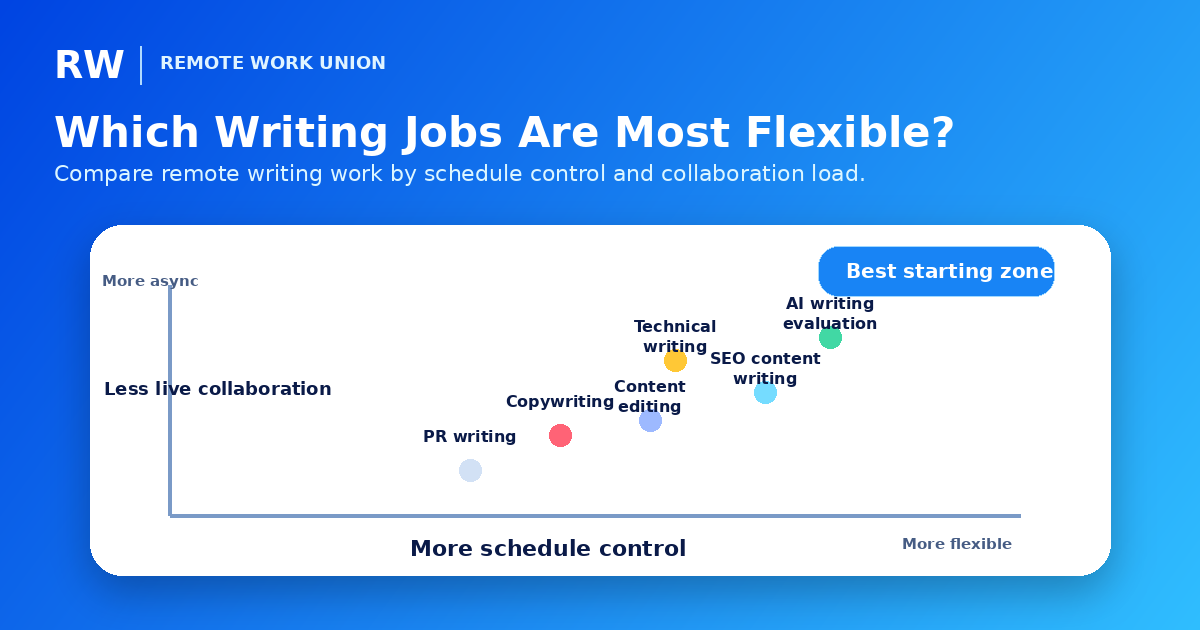
If you want the most flexible, task-based work, start with AI writing evaluator, AI content reviewer, SEO writing, or editing. If you want more stable professional work, look at technical writing, content strategy, documentation, or proposal writing. If you want higher upside and have a portfolio, copywriting and specialized writing can be strong. If you are a generalist, AI evaluation may be the easiest way to turn broad writing judgment into paid remote work.
A simple way to choose is to ask three questions:
- Do I want to create new content, edit existing content, or judge content quality?
- Do I want freelance clients, platform-based tasks, or a remote job with a company?
- Do I have a niche that makes me more valuable than a general writer?
A writer with no niche can still apply, but a writer with a niche has an advantage. For example, a writer who understands finance, real estate, law, recruiting, healthcare, science, software, or education can often qualify for more specialized projects.
How to Build a Remote Writing Profile That Gets Responses
Your profile should not only say "writer." It should show what type of writing judgment you can provide. Remote platforms and hiring teams often scan for specific keywords, so your profile should include the language of the work you want.
Use phrases like:
- AI writing evaluator
- AI response reviewer
- AI content editor
- Prompt writer
- Content QA
- Remote writing jobs
- SEO content writer
- Copywriter
- Technical writer
- Research writer
- Fact-checking
- Content editing
- Style guide
- Search intent
- Documentation
- Rubric-based evaluation
- Written feedback
- Async remote work
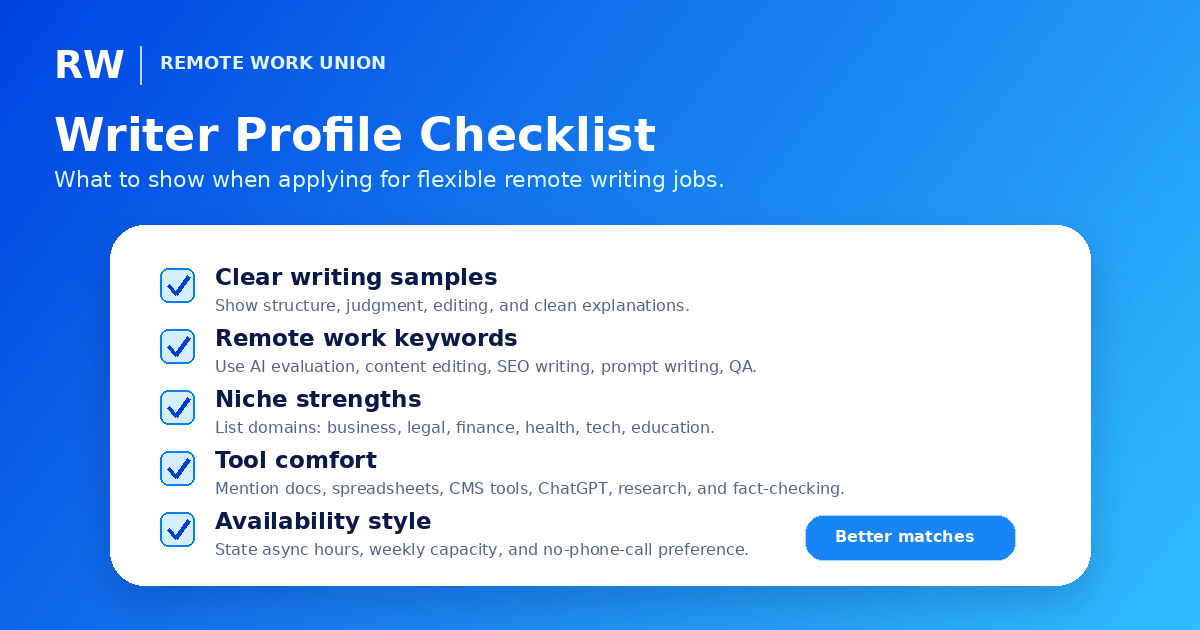
Then support those keywords with evidence. Include short samples, clear subject areas, tools you use, and the kind of schedule you can commit to. If you want flexible work, say how many hours per week you can reliably complete. Flexibility does not replace reliability. It depends on it.
What Writing Samples Should You Use?
You do not need a massive portfolio to start. A small, focused portfolio is better than a messy folder of random writing. For remote AI and writing evaluation roles, the best samples show clarity and judgment.
Useful samples include:
- A short article that explains a topic clearly.
- A before-and-after editing sample.
- A comparison of two responses with notes on which is better.
- A product explanation or help article.
- A content brief with headings, keywords, and reader intent.
- A concise research memo with sources and takeaways.
- A landing page or email sequence if you want copywriting roles.
If you do not have client work, create samples. A sample does not need to be published by a major company to show that you can write well. It needs to be clean, relevant, and easy to evaluate.
Avoiding Low-Quality Remote Writing Jobs
Writers should be careful with remote job listings that sound flexible but are actually exploitative. Red flags include unpaid test assignments that look like real client work, vague promises of exposure, jobs that require you to pay to access work, unrealistic daily word counts, commission-only writing roles, and listings that avoid explaining how payment works.
Real remote work platforms should not charge you to start. A legitimate writing role should have a clear application process, clear expectations, and a reasonable explanation of how work is assigned and paid. Not every platform will have constant work, but the basic terms should be understandable.
For AI training platforms, it is also normal for work volume to change. Passing an assessment does not always mean there will be tasks immediately. That is why writers should avoid relying on one platform only. A better approach is to build a multi-platform pipeline: apply to several legitimate remote AI and writing platforms, keep your profile updated, and continue building samples.
A Practical Weekly Setup for Flexible Writing Work
A writer who wants flexible hours should design the week around focused blocks instead of scattered attention. For example, you might reserve two hours in the morning for AI evaluation tasks, one evening for applications and profile updates, and one longer block on the weekend for samples or client work.
The goal is to separate earning time from setup time. Earning time is when you complete paid tasks or client deliverables. Setup time is when you improve your profile, apply to roles, build samples, and track platforms. Many beginners spend too much time browsing and not enough time applying or completing focused work.
A simple weekly system could look like this:
- Apply to three to five relevant remote writing or AI evaluator roles.
- Improve one profile section with stronger keywords.
- Create or revise one writing sample.
- Complete paid tasks when available.
- Track which platforms respond and which roles match your skills.
This is not complicated, but consistency matters. Remote writing opportunities often reward people who keep showing up, improving their profile, and applying to better-matched roles.
The Best Starting Point for Most Writers
For most writers who want flexible hours, the best starting point is a combination of AI writing evaluation, content editing, and SEO writing. AI writing evaluation can convert your writing judgment into remote task work. Content editing can show practical value quickly. SEO writing can help you build samples and understand online publishing.
From there, you can specialize. If you like structured information, move toward technical writing or documentation. If you like persuasion, move toward copywriting. If you like research, move toward research writing or AI fact-checking. If you like planning, move toward content strategy.
The strongest writers do not depend on one label. They build a profile around a core promise: they can make information clearer, more accurate, more useful, and easier to act on. That is valuable across remote writing jobs, AI training work, content teams, startups, agencies, and online platforms.
Final Thoughts
Remote writing work is not limited to blog posts. Writers can work as AI evaluators, AI content editors, prompt writers, SEO writers, copywriters, technical writers, research writers, proposal writers, and content strategists. The most flexible roles are usually asynchronous and output-based, which makes them a strong fit for people who want to build remote income around their own schedule.
The best path is to position yourself as more than a writer. Show that you can evaluate, edit, research, organize, and improve information. Use the right keywords, build a small portfolio, apply to multiple platforms, and focus on roles where your judgment matters.
Frequently Asked Questions
What are the best remote jobs for writers who want flexible hours?
The best flexible remote jobs for writers include AI writing evaluator roles, AI content editor work, prompt writing, SEO content writing, copywriting, technical writing, and research writing. AI writing evaluation is especially relevant because it is task-based, asynchronous, and rewards the same judgment skills writers already use — reading carefully, spotting weak logic, improving clarity, and explaining why one answer is better.
Do I need technical skills to get remote AI writing jobs?
Not for most writing-focused AI roles. Many AI writing evaluator, AI content editor, and prompt reviewer jobs are language-heavy rather than code-heavy. Platforms like micro1, Mercor, and Handshake AI have roles specifically designed for writers, editors, researchers, and generalists who can evaluate, compare, and improve AI-generated content without coding.
How do I build a remote writing profile that gets responses?
Include specific keywords like AI writing evaluator, AI response reviewer, content QA, prompt writer, SEO content writer, technical writer, and rubric-based evaluation. Then support those keywords with evidence: short samples, clear subject areas, tools you use, and the type of schedule you can reliably commit to. A small focused portfolio is better than a large unfocused one.
How much can remote AI writing evaluators earn?
Pay varies by role type and platform. General writing evaluation and content review tasks often start around $20/hr or more. Expert-tier evaluation roles that require domain knowledge in areas like law, finance, healthcare, or software engineering can pay $50–$200/hr. Pay depends on the complexity of the evaluation task and the depth of expertise required.
What writing samples should I use when applying for remote AI writing jobs?
Useful samples include a short article that explains a topic clearly, a before-and-after editing sample, a comparison of two responses with notes on which is stronger, a product explanation or help article, a content brief with headings and reader intent, and a concise research memo. If you do not have client work, create samples — they do not need to be published by a major company to show writing judgment.