AI writing evaluator jobs are remote contractor roles where writers, editors, and language professionals review AI-generated content for quality, accuracy, clarity, helpfulness, instruction-following, and safety. These jobs exist because AI companies need people who can judge whether a model's writing output actually serves the user — and explain what could be better.
For experienced writers, editors, copywriters, journalists, academic writers, content strategists, and marketing professionals, AI writing evaluation is one of the most natural fits in remote AI training work. The skills you already have — reading carefully, judging clarity and structure, noticing when a response misses the point — are exactly what these jobs require. Platforms like Outlier AI, Mercor, Handshake AI, and micro1 all have evaluation work well-suited to writers.
What AI Writing Evaluator Jobs Are
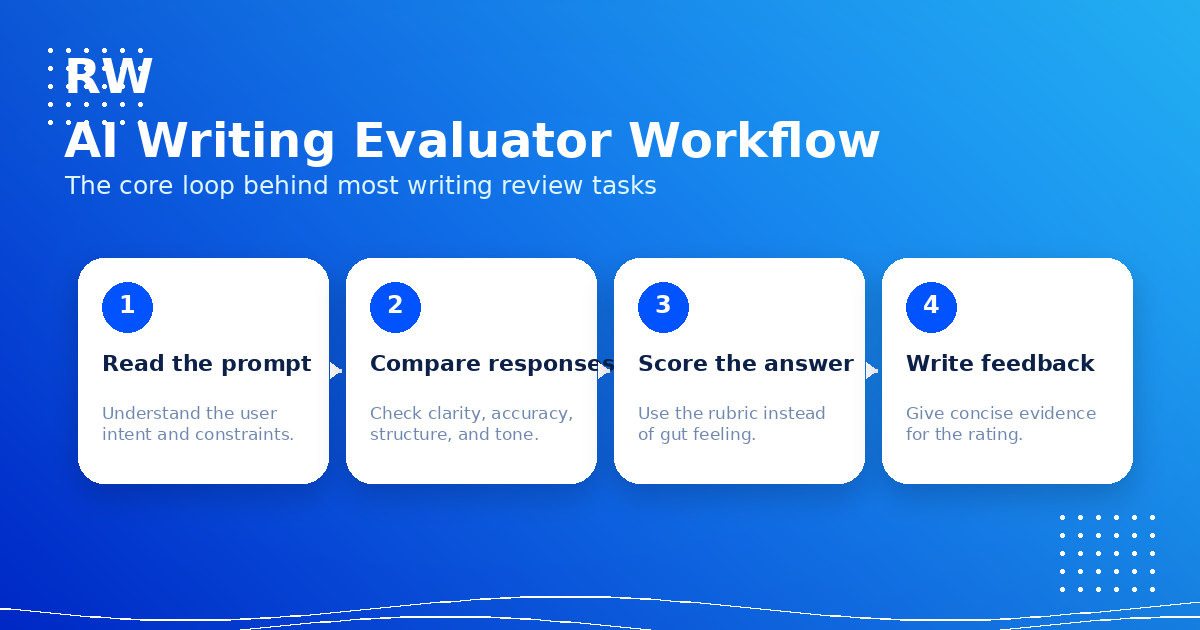
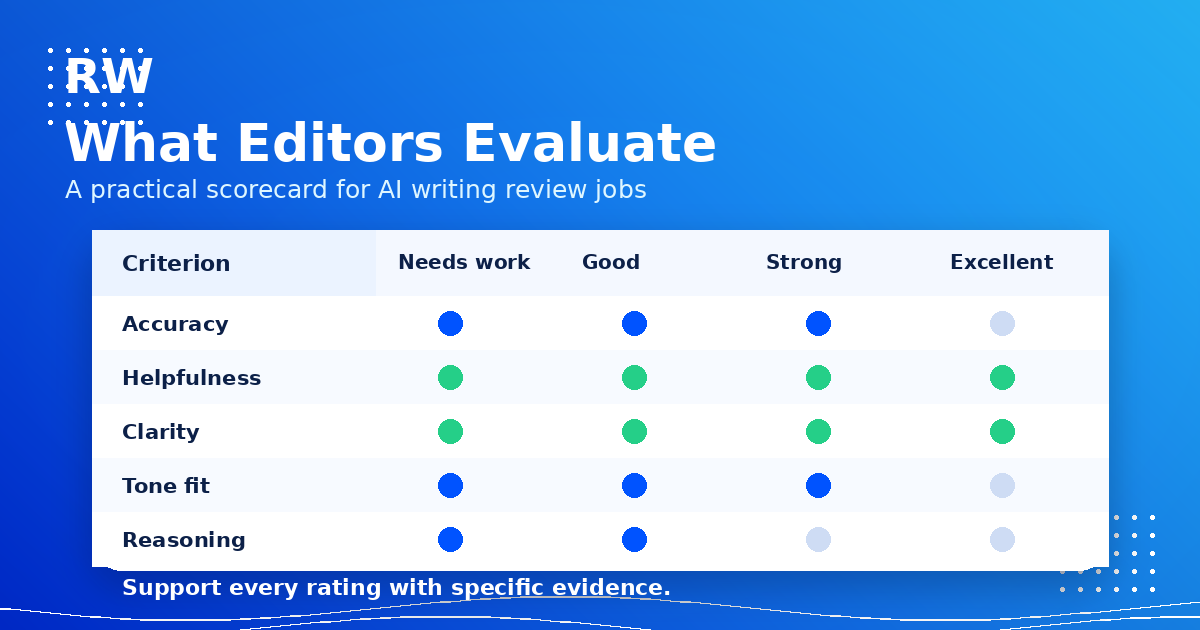
An AI writing evaluator reviews model outputs and judges their quality across dimensions like clarity, tone, structure, accuracy, instruction-following, helpfulness, and safety. You may be asked to compare two AI-generated responses and choose the better one, rate a single response on a quality scale, identify specific problems in a piece of AI writing, write feedback explaining what should change, or review whether an AI editing task preserved or improved the original text.
The key difference from other evaluation tasks is the emphasis on writing quality specifically. You are not just asking whether the response is factually accurate or safe. You are also asking whether it is well-written, clear, appropriately structured, and useful as communication.
Why Writers and Editors Are a Natural Fit
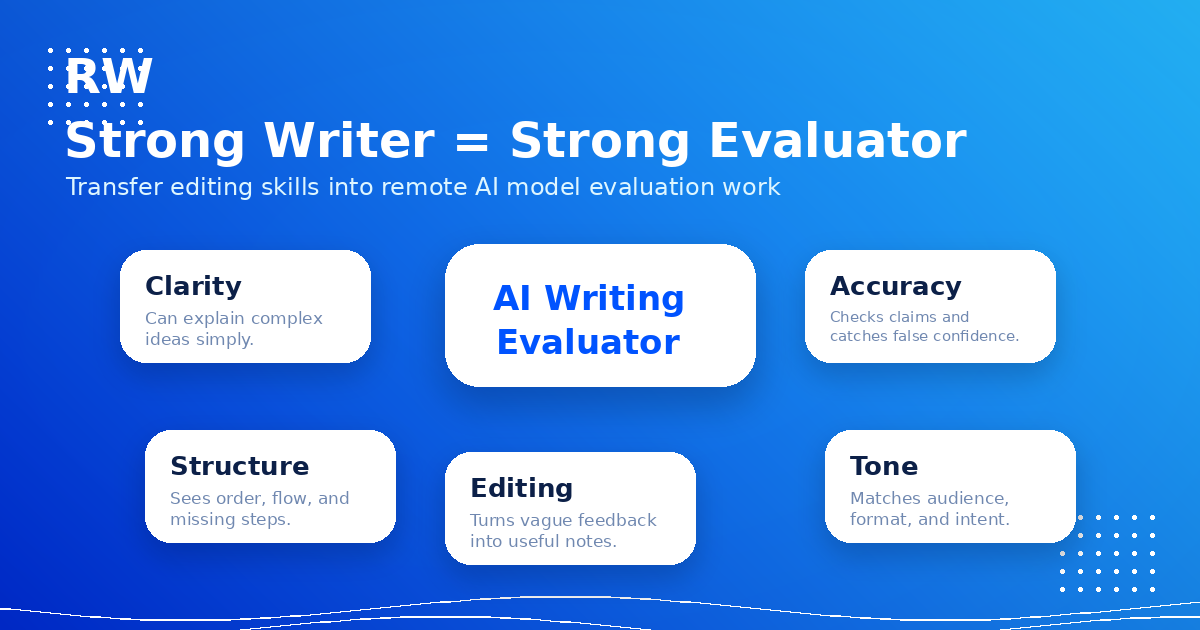
Writers and editors already have the instincts that AI writing evaluation requires. You are trained to notice when a sentence buries its main point, when a paragraph loses its thread, when a response gives too much background and not enough substance, when tone is wrong for the audience, and when a piece sounds polished but says nothing useful.
These are exactly the kinds of problems AI models produce. AI-generated text often has a confident, smooth style that can obscure weak reasoning, ignored instructions, or missing information. Writers and editors are uniquely positioned to see through the polish to the underlying quality problems.
Strong writers also tend to be good at writing feedback. AI evaluation platforms need reviewers who can explain their judgments clearly. "This is bad" is not useful training data. "This response ignores the user's request for a conversational tone and delivers formal business language instead" is useful training data.
What the Day-to-Day Work Looks Like
Most AI writing evaluation work is asynchronous and self-paced. You log in to a task queue, pick up available tasks, complete them according to the rubric, and submit. Task volume varies by platform, project, and evaluator performance. Some projects have daily or weekly task minimums; many are purely flexible.
A typical session might involve reading 10–20 prompts, reviewing the corresponding AI responses, making comparison ratings or writing brief feedback notes, and submitting your work. Quality reviewers periodically check your calibration. If your ratings drift from the platform's standard, you may receive calibration guidance or see your task availability change.
Core Skills for AI Writing Evaluation
Reading prompts carefully: Before judging a response, you must understand exactly what the user asked. Many writing quality failures are really instruction-following failures — the writing may be technically clean but the response did not address the right question, the right format, the right tone, or the right scope.
Accuracy judgment: Good writing that contains false information is not a good response. AI writing evaluators must check factual claims, especially specific statistics, citations, dates, and professional advice.
Concise feedback: Your written explanations must be specific, actionable, and brief. The goal is not an editorial critique. The goal is a clear note about the most important quality failure or success.
Consistency: AI evaluation platforms track evaluator quality over time. Inconsistent ratings reduce your reliability. Use the same criteria across tasks.
Examples of AI Writing Evaluator Tasks
- Compare two AI responses to a creative brief and choose the one that better follows the tone and format requested.
- Rate a single AI-written blog introduction on clarity, audience fit, and alignment with the topic prompt.
- Review an AI editing task where the user asked for light copyedits and assess whether the model changed too much or too little.
- Evaluate whether an AI email rewrite preserved the sender's voice while correcting grammar and improving clarity.
- Rate an AI summary for completeness, concision, and fidelity to the source material.
- Check whether an AI-generated product description includes all the features mentioned in the prompt and avoids false claims.
Remote Work Union connects you to legitimate remote AI writing evaluation roles. Apply for free to find roles hiring now.
Find Roles Hiring Now →AI Writing Evaluator vs Search Quality Rater vs Data Labeling
Search quality rater work focuses on whether search results match user intent and whether source pages are trustworthy and useful. It involves less writing judgment and more web research skills.
Data labeling is usually about categorizing or tagging raw information — assigning labels, transcribing audio, tagging images. It requires less language expertise and is more mechanical.
AI writing evaluation sits between these two in terms of complexity. It requires language skill and judgment, but does not require domain expertise in the same way that specialized RLHF projects might. For writers and editors, AI writing evaluation is usually the strongest starting point because it directly rewards the skills you already have.
Where to Search for AI Writing Evaluator Jobs
Platforms that regularly offer AI writing evaluation work include Outlier AI, Mercor, Handshake AI, and micro1. When searching, use terms like AI writing evaluator, AI content reviewer, AI response rater, LLM evaluator, RLHF rater, prompt response reviewer, AI writing quality analyst, and remote AI training jobs for writers.
You can also find these roles through specialized AI training vendors, staffing firms that support AI companies, and general freelance platforms where AI evaluation projects are occasionally posted.
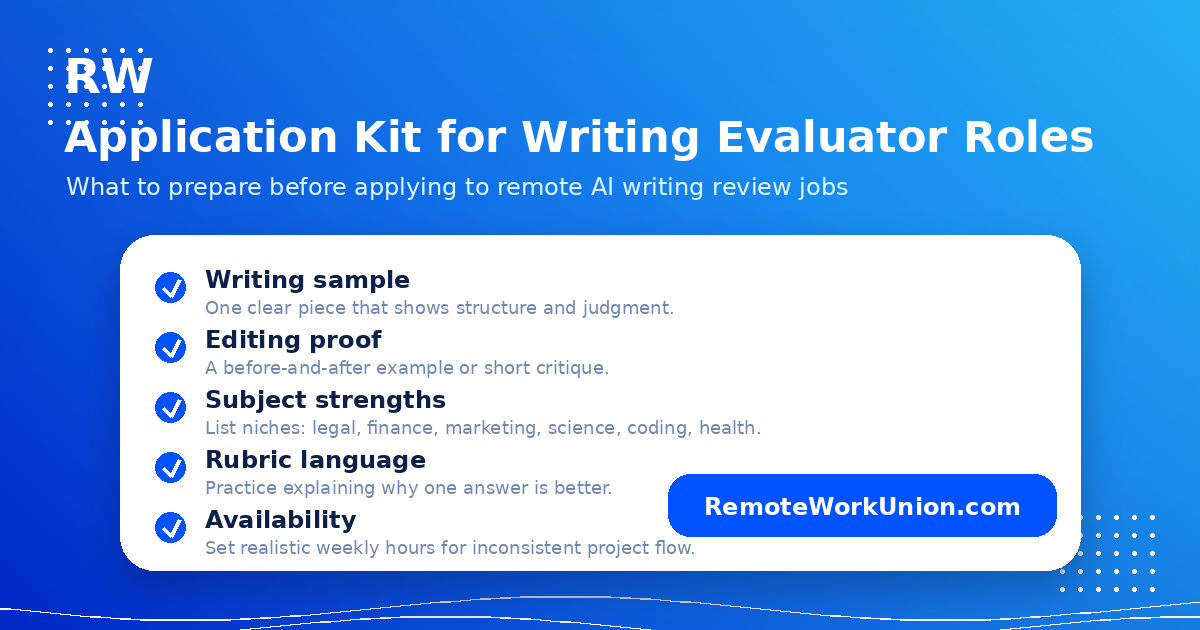
How to Make Your Application Stronger
Tailor your resume to emphasize writing quality judgment rather than just writing output. Mention editing experience, proofreading, content strategy, fact-checking, audience analysis, and any rubric-based evaluation work you have done. Include keywords from the job posting in your profile. When assessments are part of the application, treat them like real work, not quick tests. Most platforms use assessment performance to filter applicants at scale.
Tip: A strong assessment response shows that you read the instructions carefully, applied the rubric correctly, and wrote feedback that would be clear to a stranger. That is the standard platforms use to evaluate your evaluation skills.
Mistakes to Avoid
Do not rate based on writing style alone. A polished-sounding response that ignored the user's format request should score lower than a plainer response that followed instructions correctly. Do not over-penalize an AI response for being concise when the user asked for brevity. Do not under-penalize a hallucinated claim because the surrounding writing is elegant. Do not write feedback that only expresses personal preference without tying it to the rubric.
How to Improve Once You Start
Review any calibration feedback you receive carefully. When your ratings diverge from the platform standard, understand why before you submit more tasks. Track which types of tasks you find hardest and practice that judgment. Build a personal checklist for the dimensions most commonly evaluated: instruction-following, clarity, accuracy, completeness, tone, and safety.
Who Fits Best
AI writing evaluator jobs are a strong fit for copywriters, content strategists, editors, journalists, marketing writers, academic writers, grant writers, technical writers, and instructional designers. Social media managers, communications professionals, and anyone who regularly judges content quality for an audience can also adapt quickly.
Frequently Asked Questions
What is an AI writing evaluator?
An AI writing evaluator is a remote contractor who reviews AI-generated writing for quality, accuracy, clarity, helpfulness, instruction-following, and safety. They may compare two AI responses, rate a single response, write feedback about what could improve, or flag specific problems in AI outputs. Strong writers and editors are a natural fit for this work.
What writing skills matter most for AI writing evaluator jobs?
The most important skills are reading prompts carefully, judging writing quality against the user's request, writing concise feedback that explains the issue, and applying evaluation rubrics consistently across many tasks. Editing instincts, research ability, and a clear understanding of audience and tone all transfer directly to AI writing evaluation.
How is AI writing evaluator work different from data labeling?
Data labeling is usually about categorizing or tagging raw data. AI writing evaluation is about judging the quality of model outputs. Writing evaluation typically requires more judgment, explanation, and language expertise. Data labeling can be more mechanical and rule-based. For writers and editors, AI evaluation is usually the better fit.
Where can I find AI writing evaluator jobs?
AI writing evaluator jobs appear on platforms like Outlier AI, Mercor, Handshake AI, and micro1. You can also find them through specialized AI training vendors. Search for AI evaluator, AI writing reviewer, prompt response evaluator, LLM evaluation, AI model reviewer, or RLHF rater to find these roles.