Paralegals and legal assistants are better positioned for remote work than many people realize. The work already depends on reading carefully, organizing information, following instructions, protecting confidential records, checking facts, and helping attorneys or legal teams move cases and projects forward. Those are also some of the exact skills that remote-first companies, legal tech teams, compliance departments, and AI training platforms need.
The best remote jobs for paralegals and legal assistants are not limited to traditional law firm openings. A legal background can translate into remote paralegal work, contract review, litigation support, legal research, compliance operations, legal intake, legal tech customer support, and AI model evaluation. Some roles are full-time jobs. Others are contract projects. The strongest strategy is to apply broadly while positioning your profile around the type of legal judgment you already use.
This guide is a job-search resource for people with legal support experience who want flexible remote work. It is not legal advice. Legal assistants and paralegals should not present themselves as attorneys or give legal advice unless independently authorized to do so in the relevant jurisdiction.
Why Paralegal and Legal Assistant Skills Work Remotely
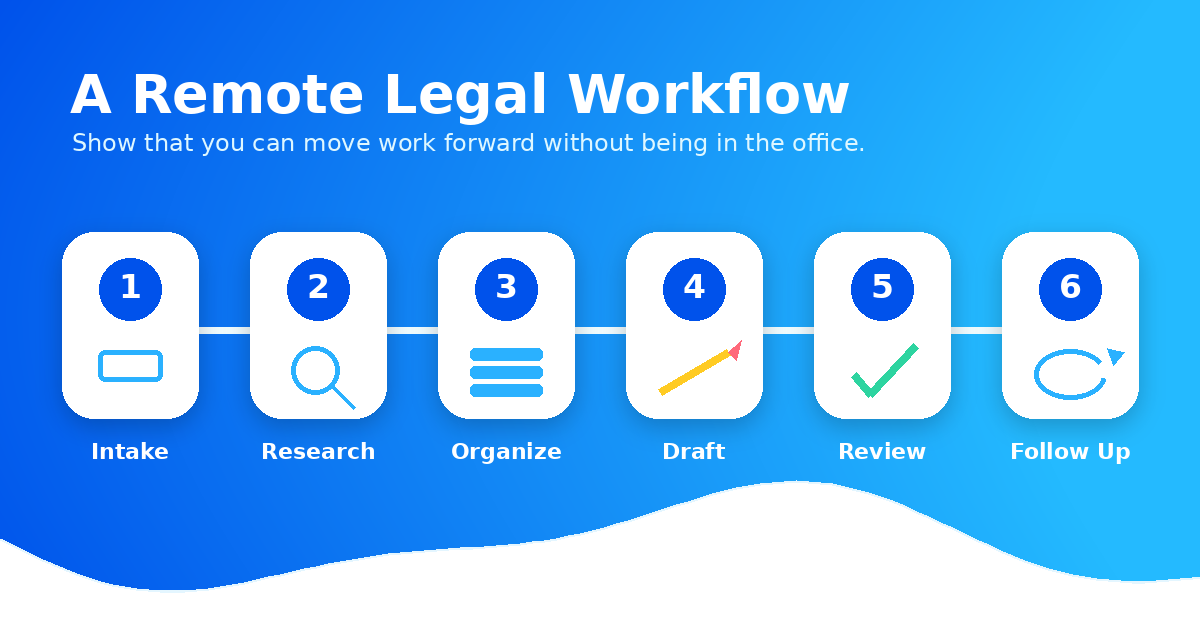
Remote legal work is possible because much of the modern legal workflow is document-based. Legal teams need help with case files, contracts, discovery material, filing calendars, intake records, research notes, correspondence, and internal checklists. A person who can read closely and keep information organized can often create value without sitting in the same office as the attorney.
The key is trust. Remote legal support involves sensitive information, deadlines, and precise instructions. Employers and platforms are not only looking for someone who can type quickly. They want someone who can follow a process, notice missing details, ask smart clarifying questions, and keep confidential information secure. That is why legal assistants, paralegals, case managers, docketing assistants, and contract administrators can be competitive applicants for remote work.
1. Remote Paralegal Jobs
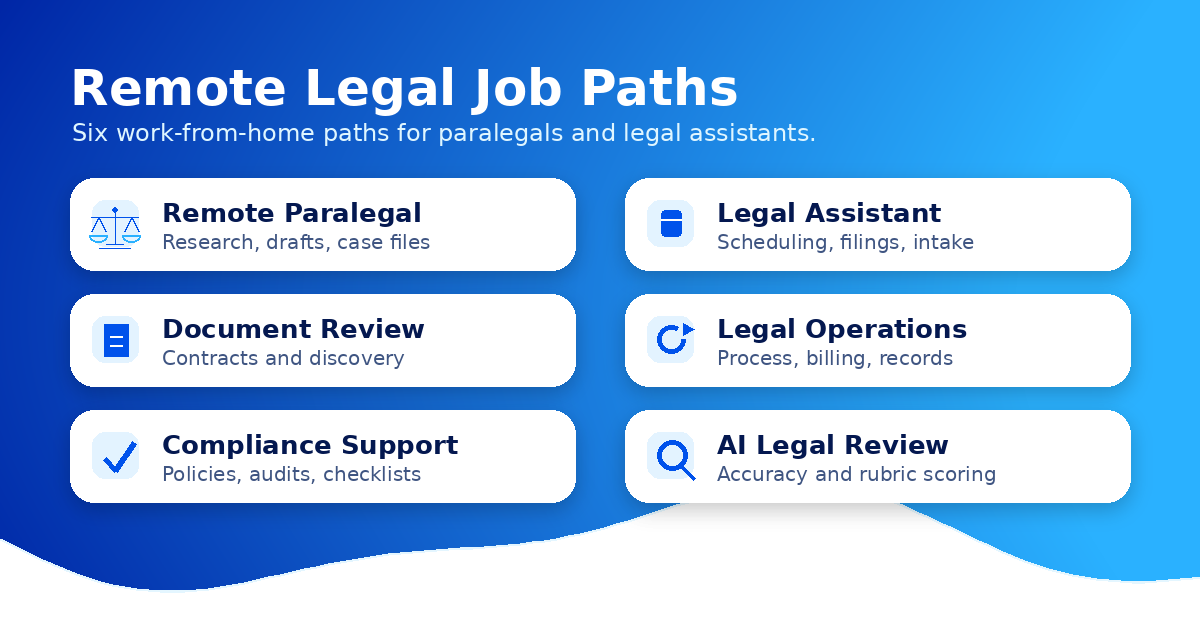
Remote paralegal jobs are the closest match for experienced paralegals who want to keep working in law while leaving the office. These roles may support litigation, family law, immigration, corporate law, real estate, personal injury, employment law, estate planning, intellectual property, or other practice areas. The exact duties depend on jurisdiction, firm structure, and attorney supervision.
Common tasks include preparing drafts, organizing case files, tracking deadlines, summarizing records, researching legal or factual issues, managing discovery documents, preparing exhibits, and coordinating with attorneys. Some remote paralegal jobs require prior law firm experience. Others are open to legal assistants who have handled case files, client communication, or administrative legal tasks.
To apply well, make your practice-area experience obvious. A vague resume line like "assisted attorneys with cases" is weaker than "organized discovery files, prepared draft correspondence, tracked filing deadlines, and summarized medical records for personal injury matters." Remote employers need to understand the exact workflows you can handle without constant supervision.
2. Remote Legal Assistant Jobs
Remote legal assistant jobs usually focus more on administration, scheduling, client communication, document preparation, filing support, billing support, and inbox management. These roles can be a good fit for people who worked in a law office but did not perform higher-level substantive paralegal tasks.
A remote legal assistant may schedule consultations, maintain calendars, prepare basic forms, collect client documents, update case management software, route messages to attorneys, and make sure the team has what it needs. These jobs reward organization, responsiveness, and discretion.
In applications, emphasize tools and processes. Mention case management platforms, calendar management, client intake, document naming systems, e-filing portals, Microsoft Word, Excel, Google Workspace, PDF editing, email triage, and billing software. For remote legal assistant jobs, the employer wants proof that you can keep the workflow moving.
3. Contract Review and Document Review Jobs
Document review is one of the clearest remote work paths for legal support professionals. These jobs can include reviewing contracts, discovery documents, internal company records, due diligence material, policies, claims files, or compliance documents. Some roles are legally focused. Others are business operations roles that prefer people who have handled precise written records before.
A contract review role may ask you to identify key clauses, compare terms, summarize obligations, flag missing information, or route documents for attorney review. An e-discovery role may involve coding documents by issue, privilege, responsiveness, date range, custodian, or relevance to a matter. These jobs are often deadline-driven, detail-heavy, and highly structured.
Paralegals and legal assistants should use keywords like document review, contract review, e-discovery, due diligence, privilege review support, issue coding, redaction, record summaries, deposition exhibits, and confidentiality. If you have worked with discovery databases, PDF tools, or contract repositories, include those tools clearly.
4. Legal Research Assistant Jobs
Legal research assistant roles can be remote when the work is structured around collecting, checking, and summarizing information. Not every legal research role requires a law degree, but many require strong judgment and the ability to separate reliable information from weak information. Paralegals who have researched statutes, regulations, court rules, agency guidance, or factual background can be strong candidates.
The safest way to position yourself is as a researcher and summarizer, not as someone giving legal advice. Employers value people who can find relevant information, organize citations or source notes, and prepare a clear summary for an attorney, compliance lead, or manager to review.
This is also where AI-related work becomes relevant. AI companies and legal tech teams need people who can evaluate whether a legal-sounding answer is accurate, unsupported, risky, incomplete, or written with too much confidence. A legal assistant who is good at spotting missing facts, checking citations, and noticing overbroad claims may be useful for AI model evaluation, legal data annotation, and prompt review.
5. Compliance Support and Policy Operations
Compliance support is a strong remote path for legal assistants and paralegals who like rules, procedures, and documentation. Compliance teams need help maintaining policy libraries, reviewing forms, tracking audits, preparing checklists, responding to information requests, and making sure internal records are complete.
These roles may appear under titles like compliance assistant, compliance analyst, policy operations specialist, risk operations associate, privacy operations coordinator, trust and safety analyst, or regulatory operations assistant. The job may not use the word paralegal, but the underlying work often rewards the same skill set: accuracy, documentation, confidentiality, and process discipline.
For remote work, compliance support can be especially valuable because it is often asynchronous. A team can assign a policy review, document checklist, audit spreadsheet, or risk queue and judge the work by accuracy rather than physical presence.
6. Legal Operations and Case Management Jobs
Legal operations roles sit between law, administration, finance, vendors, and technology. These jobs are common in larger companies, legal tech firms, insurance companies, and organizations with in-house legal teams. A legal operations assistant might track contracts, manage matter intake, update billing records, organize templates, monitor outside counsel invoices, and help maintain legal systems.
Case management roles are similar but often tied to active matters, claims, immigration cases, injury cases, benefits issues, or customer disputes. Remote case managers may collect documents, update clients, summarize file status, coordinate next steps, and make sure nothing gets lost.
If you are applying for these jobs, avoid presenting yourself only as an assistant. Present yourself as someone who can manage repeatable legal workflows. Use phrases like matter intake, file organization, deadline tracking, status updates, document collection, vendor coordination, billing review, and process improvement.
7. Legal Tech Customer Support
Legal tech companies sell software to law firms, corporate legal teams, compliance departments, and courts. They need customer support reps, implementation associates, onboarding specialists, training coordinators, and product support specialists who understand how legal users think. This can be a strong bridge for legal assistants who want remote work but do not want to stay in traditional law firm support.
A legal tech support job may involve helping customers use case management software, e-filing tools, contract management platforms, billing systems, intake forms, discovery platforms, or document automation products. Your legal background helps because you understand the pressure of deadlines, records, client communication, and attorney workflows.
In applications, connect your legal experience to customer outcomes. For example: "I understand how law firms use intake forms, case notes, templates, and filing deadlines, so I can help customers adopt software in a way that fits their daily workflow."
Ready to find remote legal and AI training roles? Remote Work Union connects you with legitimate work-from-home opportunities.
Find Roles Hiring Now →8. Remote AI Training and Legal Model Evaluation
AI training work can be a good fit for paralegals and legal assistants because many AI tasks require careful reading and judgment. AI platforms may need workers to compare responses, rate factual accuracy, rewrite unclear answers, check whether an answer follows instructions, identify unsafe legal advice, or evaluate whether a model is making unsupported claims.
This does not mean every AI training job is a legal job. Many are general writing, research, or evaluation projects. But applicants with legal support backgrounds can be especially useful on tasks involving policy, compliance, contracts, legal explanations, evidence summaries, risk language, user intent, and document analysis.
Major AI companies and AI ecosystems — including OpenAI, Anthropic, Google, Meta, Grok, and other model builders or vendors — all depend on human judgment in different ways. A paralegal or legal assistant should apply for both legal-specific remote roles and broader AI training roles that value writing, research, and careful review. Platforms like micro1, Mercor, Handshake AI, and Outlier can all be relevant starting points.
How to Position Your Legal Background for Remote Work
The best remote applications are specific. Do not make the employer guess what kind of legal work you can do. A strong profile explains the practice areas, document types, tools, and processes you know.
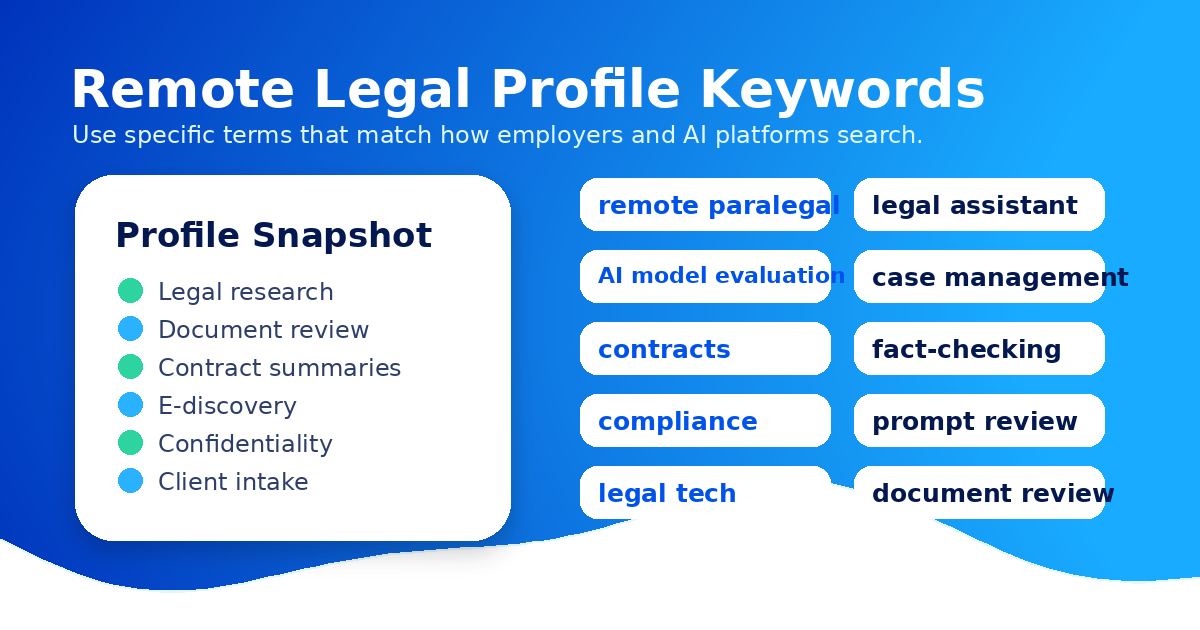
Instead of saying "legal experience," say things like: contract summaries, discovery organization, client intake, e-filing support, case management, document redaction, legal research summaries, calendar management, compliance checklists, billing review, policy review, record summaries, and confidential document handling.
Also include remote work signals. Employers want to know that you can manage deadlines, communicate clearly, work independently, protect sensitive data, and use digital tools. Mention secure file handling, written updates, deadline tracking, asynchronous communication, and remote collaboration tools if you have used them.
Skills That Matter Most
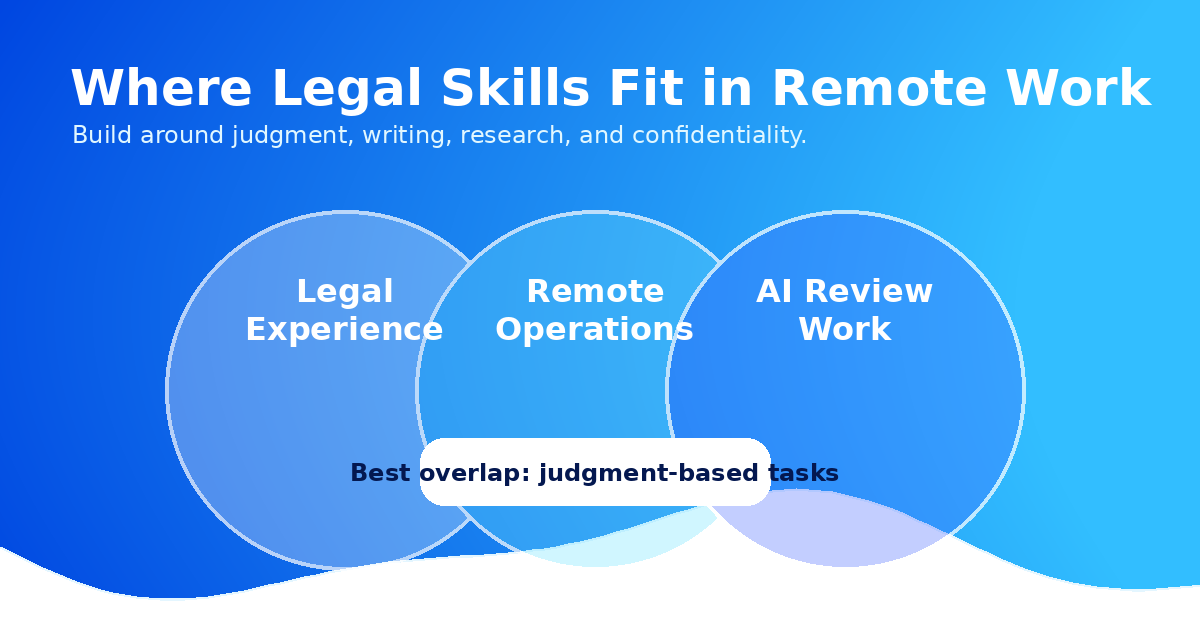
The strongest remote legal applicants usually show five skills: accuracy, organization, writing, judgment, and discretion. Accuracy means you do not skim past details. Organization means you can maintain files, calendars, notes, and task lists. Writing means you can summarize complex information clearly. Judgment means you know when to flag something instead of guessing. Discretion means you understand confidentiality.
For AI evaluation work, judgment may be the most important skill. The job is often not to know every answer from memory. The job is to notice when an answer sounds confident but lacks support, when it gives advice it should not give, when it misses jurisdictional context, or when it fails to follow instructions.
Tools Worth Mentioning
You do not need every legal software tool to apply for remote legal work, but you should list what you know. Useful tools may include Microsoft Word, Excel, Outlook, Google Workspace, Adobe Acrobat, PDF editing tools, DocuSign, Clio, MyCase, PracticePanther, NetDocuments, iManage, Relativity, Logikcull, contract management systems, e-filing portals, CRM tools, project management tools, and AI writing or research tools used responsibly.
Only list tools you can actually use. A remote employer may expect you to work independently after onboarding. It is better to be accurate than to inflate your profile.
A Practical Application Strategy
Start with the jobs that most closely match your background, then widen the search. If you have law firm experience, apply to remote paralegal and legal assistant roles. If you have contracts experience, apply to contract review and legal operations roles. If you have litigation experience, apply to document review and e-discovery roles. If you are strong at reading, writing, and spotting mistakes, apply to AI training and model evaluation platforms as well.
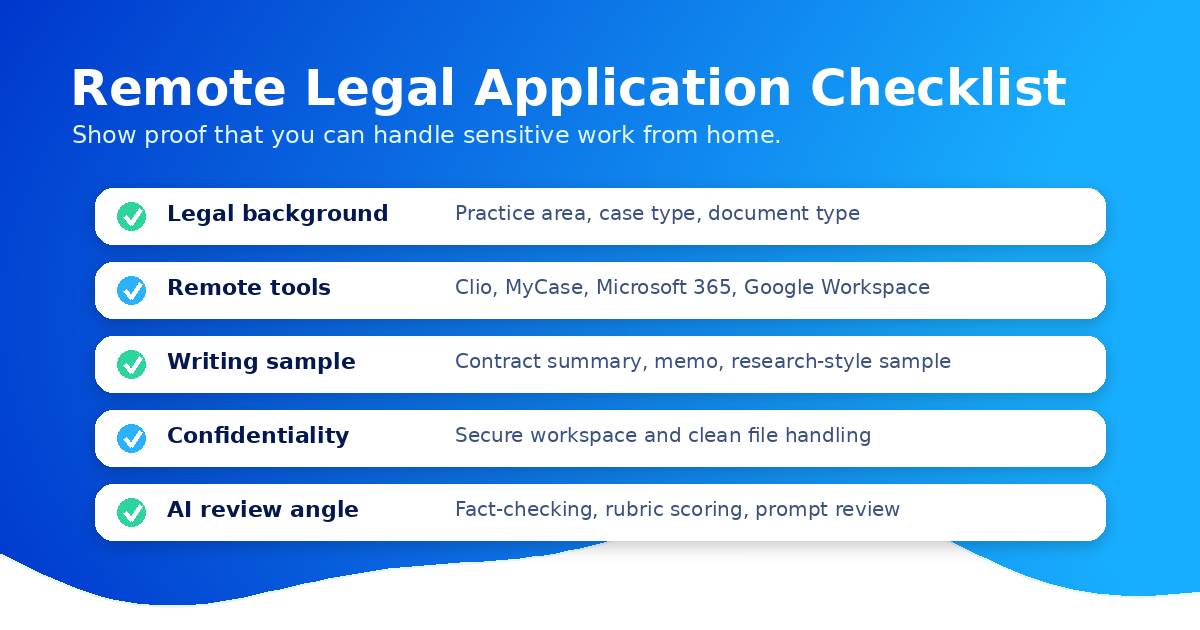
Your resume should include a simple skills section with legal workflows, tools, and remote work keywords. Your profile should mention the kind of tasks you want: document review, research summaries, legal operations, compliance support, contract review, or AI evaluation. Your writing sample should be clean, neutral, and free of confidential information.
The goal is not to chase one perfect platform. The goal is to build a pipeline. Apply to law firms, legal tech companies, compliance teams, AI training platforms, and remote job boards. Track where you applied, what keywords you used, and which profiles get responses.
Also avoid applying only to jobs with the title "remote paralegal." That is too narrow. Search for: legal assistant, case manager, document review, contract review, legal operations, compliance assistant, policy analyst, trust and safety, legal tech support, AI evaluator, AI trainer, model evaluator, research assistant, and data annotation roles.
Frequently Asked Questions
Can paralegals work remotely?
Yes. Many paralegal and legal assistant tasks are document-based and can be performed remotely: drafting correspondence, organizing case files, tracking deadlines, researching legal or factual issues, managing discovery documents, and coordinating with attorneys. Remote paralegal jobs are available at law firms, corporate legal teams, legal tech companies, compliance departments, and AI training platforms.
Do paralegals qualify for AI training jobs?
Yes. AI companies need people who can evaluate whether a legal-sounding answer is accurate, unsupported, risky, or incomplete. A paralegal who is good at spotting missing facts, checking citations, and noticing overbroad claims may qualify for AI model evaluation, legal data annotation, prompt review, and human feedback roles through platforms like micro1, Mercor, Handshake AI, and similar services.
What legal titles should I search for remote work?
Do not limit yourself to the exact title remote paralegal. Also search for: legal assistant, case manager, document review, contract review, legal operations, compliance assistant, policy analyst, trust and safety analyst, legal tech support, AI evaluator, AI trainer, model evaluator, research assistant, and data annotation roles. These titles often share the same underlying skill requirements.
What tools should remote legal workers know?
Useful tools include Microsoft Word, Excel, Outlook, Google Workspace, Adobe Acrobat, PDF editing tools, DocuSign, Clio, MyCase, PracticePanther, NetDocuments, iManage, Relativity, Logikcull, contract management systems, e-filing portals, CRM tools, and project management tools. Only list tools you can actually use independently.
What are the biggest mistakes remote legal applicants make?
The most common mistakes are being too vague, claiming legal advice authority you do not have, searching only for jobs titled remote paralegal, uploading confidential client documents as writing samples, and not connecting legal skills to remote-work signals like deadline tracking, asynchronous communication, and secure document handling.