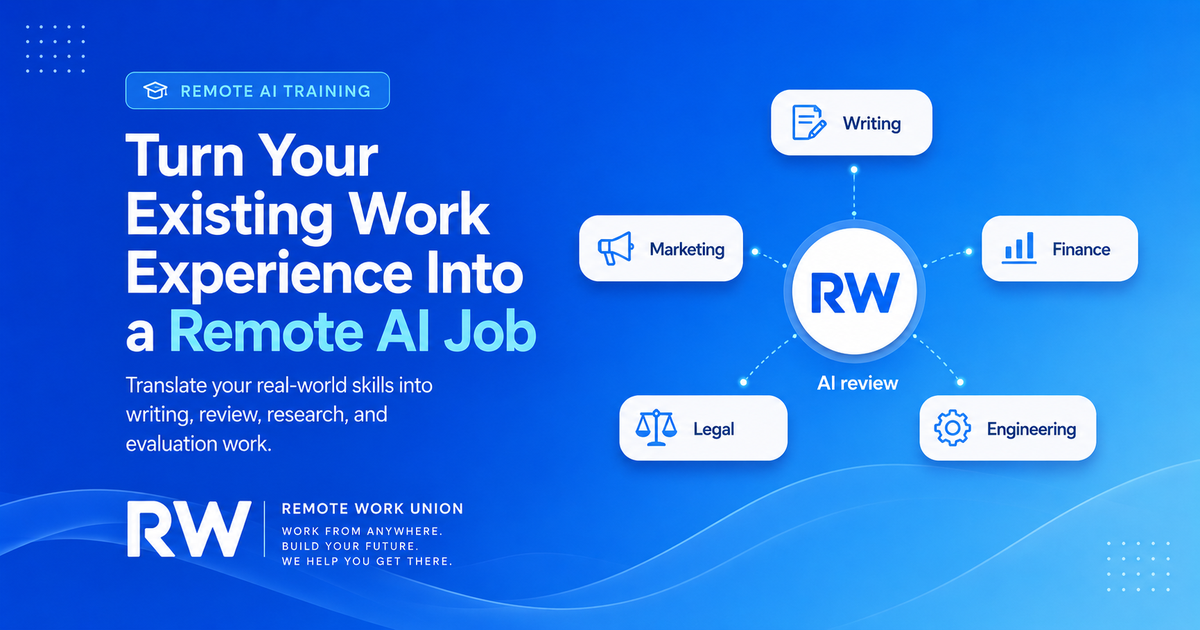
Many people are closer to a remote AI training job than they think. The biggest problem is not a lack of ability. It is a lack of translation. People with real work experience often undersell themselves because they assume AI training jobs require a technical background or formal AI credentials. In reality, many of the strongest remote workers in this category are people who already know how to write clearly, analyze information, follow instructions, review quality, and make good judgment calls.
That means your current experience may already be relevant. The key is learning how to present it in a way that makes sense to platforms, hiring teams, and project managers. If you can connect what you have already done to the tasks AI companies actually need completed, you become much more competitive for remote AI jobs.
Why Experience Translation Matters
Most applications fail because they stay too generic. Someone says they worked in marketing, law, finance, education, sales, writing, operations, or engineering, but they never explain how that background applies to AI training work. Reviewers do not want to guess. They want a clear line between your experience and the tasks in front of you.
That is why translation matters. A writer is not just a writer. They may be someone who edits for clarity, improves structure, and catches weak reasoning. A marketer may understand audience fit, messaging quality, and persuasive language. A teacher may know how to explain complex concepts clearly and evaluate whether an answer is understandable. A finance professional may be strong at checking assumptions, spotting errors, and evaluating logic. Once you translate your background this way, you stop sounding generic and start sounding useful.
How to Identify Your Strongest Fit
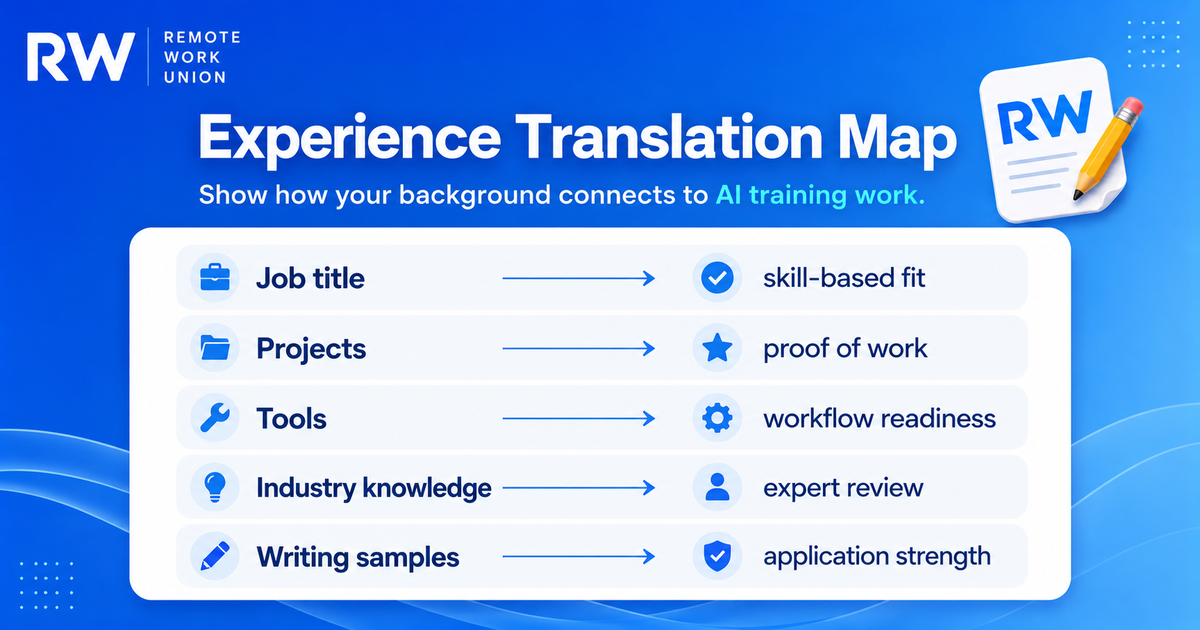
Start by looking at what you already do well. Think in terms of tasks, not job titles. Have you spent years writing, editing, reviewing, analyzing, researching, assessing, or explaining? Have you worked in environments where precision matters? Have you made decisions based on evidence, standards, or structured guidelines? Those are strong signals for remote AI training work.
Next, look at the kinds of AI tasks that overlap with those strengths. Common task categories include response evaluation, answer ranking, quality review, fact-checking, research support, rewriting, editing, prompt improvement, and domain-specific review. Your goal is to find where your work history overlaps most naturally with these categories.
How to Rewrite Your Resume for This Category
A resume for remote AI jobs should not read like a generic employment timeline. It should emphasize signal. Strong bullets usually highlight judgment, communication, analysis, process discipline, and output quality. Instead of listing broad responsibilities, focus on evidence that you can review work, improve clarity, assess quality, or produce structured written output.
For example, a content role can become evidence of editing, summarization, and audience awareness. A business role can become evidence of analytical reasoning, documentation, and structured decision-making. A legal role can show precision and language discipline. A technical role can show testing, evaluation, and debugging logic. Even a support or operations role can become useful if you highlight pattern recognition, issue triage, or process consistency.
How to Use Work Samples and Proof
Remote AI platforms often trust proof more than claims. If you say you are detail-oriented, that means very little. If you can point to writing samples, reports, analyses, policy documents, presentations, research notes, or portfolio pieces that show clear thinking, that is far more persuasive. The strongest applications often include some form of proof of work.
Your proof does not have to be fancy. It just has to show how you think. A polished article, a strategy memo, a legal-style brief, a code explanation, a spreadsheet analysis, or a research summary can all help. The goal is to show that you can handle structured knowledge work with clarity and care.
How to Answer Application Questions
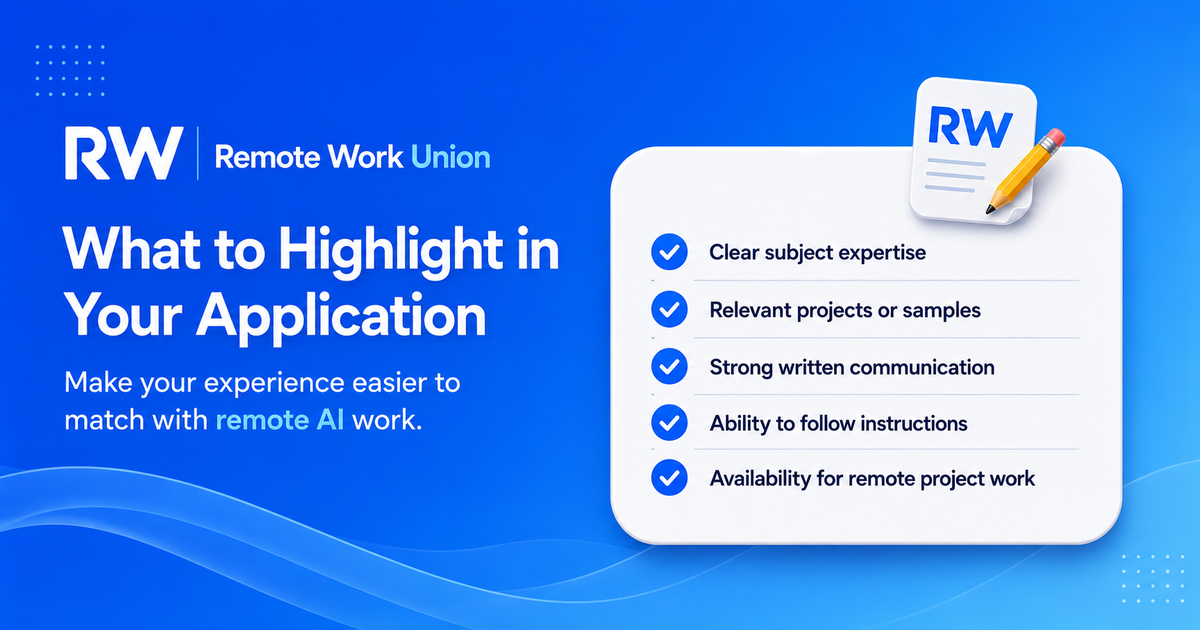
Application questions are often where remote workers either separate themselves or disappear into the pile. Strong answers are concrete, clear, and task-focused. Weak answers rely on buzzwords. If a platform asks why you are a fit, explain which parts of your background map directly to evaluation, writing, review, or research work. If they ask about attention to detail, give an example that shows careful review or error detection. If they ask about AI interest, connect that interest to the actual work rather than talking only about the future of technology.
The best answers make your thinking visible. They sound like someone who understands what the work requires.
How Nontraditional Backgrounds Can Still Work
You do not need a perfect white-collar pedigree to qualify. Many nontraditional backgrounds still build relevant skill. Customer-facing roles can build communication and judgment. Education can build explanation skill and evaluation. Operations can build process discipline. Sales can build persuasive communication and fast pattern recognition. Creative work can build editing, ideation, and language sensitivity.
What matters most is whether you can translate the experience honestly. Do not force it. Find the real overlap and present it clearly.
A Simple Positioning Formula
A useful formula is: background plus strength plus task fit. For example: "I have experience in finance, with a strength in analytical review and explanation quality, which makes me a strong fit for AI evaluation tasks involving business reasoning and numerical accuracy." That is much better than simply saying, "I am interested in AI and have a finance background."
This formula works across industries. It makes your positioning specific, and specificity is what raises application quality.
Key insight: The strongest applications do not describe general interest in AI. They describe specific overlap between your experience and the exact task types the platform needs covered. Specificity is what gets you matched to better projects.
Conclusion
Turning your existing work experience into a remote AI training job is mostly about clarity. The opportunity is already there for many people, but they miss it because they present their experience too loosely. If you identify your strongest overlap, rewrite your resume around signal, use proof of work, and answer application questions with precision, you put yourself in a much stronger position to land remote AI jobs.