Procurement and supply chain professionals are often better prepared for remote work than they realize. The job may have started in warehouses, offices, ERP systems, supplier calls, purchase orders, freight updates or plant meetings, but the core skill is not location-specific. The core skill is judgment.
Procurement teams decide which supplier is credible, whether pricing makes sense, whether a contract exposes the company to risk, and whether a request should be approved. Supply chain teams decide whether a forecast is realistic, whether inventory data is clean, whether a delay matters, and whether a logistics plan can actually work. Those are exactly the kinds of judgment-heavy skills that translate well into remote operations roles, business analysis jobs, AI training work and AI evaluation projects.
In 2026, remote work is no longer limited to customer support, virtual assistant work or basic data entry. Companies need people who can review complex business information from home. Major AI companies and AI-adjacent platforms, including companies connected to OpenAI, Anthropic, Google, Meta, Grok and other large model ecosystems, need experienced people who can evaluate whether AI outputs are accurate, practical and useful. A procurement or supply chain background can be a strong fit because the work often involves tradeoffs, constraints, risk, documentation and real-world business logic.
This guide breaks down the best remote work jobs for procurement and supply chain pros, how to position your experience, and how to apply without underselling yourself.
Why procurement and supply chain experience works well remotely
Procurement and supply chain jobs are built around systems. You already know how to work inside structured processes, track details, compare options and make decisions based on incomplete information. Those skills transfer into remote roles because remote teams need people who can communicate clearly without sitting next to everyone in an office.
A sourcing professional might compare vendor proposals, ask follow-up questions, check pricing assumptions and write a recommendation. A supply chain analyst might reconcile data from multiple systems, identify a bad forecast and explain the operational risk. A logistics coordinator might review exceptions, update stakeholders and document what happened. None of that depends on being physically present every day.
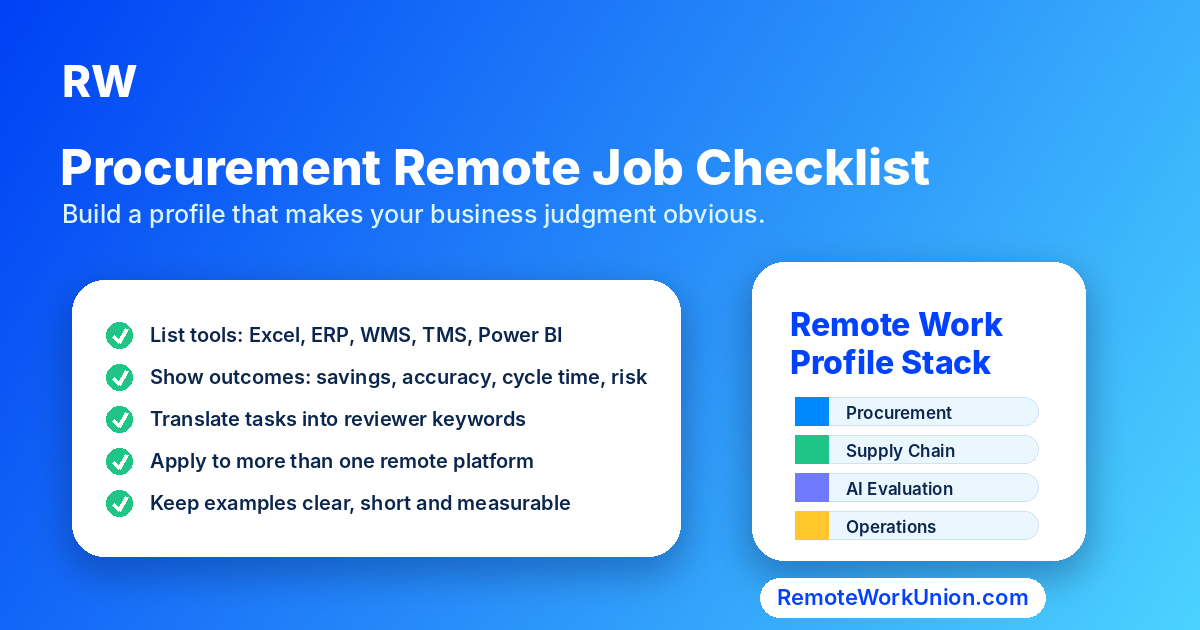
The strongest remote candidates in this field usually have experience with some combination of the following: purchase orders, RFPs, RFQs and supplier quotes; vendor onboarding, supplier scorecards and contract review; inventory management, demand planning and forecasting; freight, logistics, shipping exceptions and order tracking; ERP, WMS, TMS, Excel, Power BI, SAP, Oracle, NetSuite or similar systems; cost analysis, margin protection, risk reduction and process improvement; and cross-functional communication with finance, operations, sales and legal teams.
Even if your previous title was not remote, the work itself may already be remote-compatible.
1. Remote procurement analyst
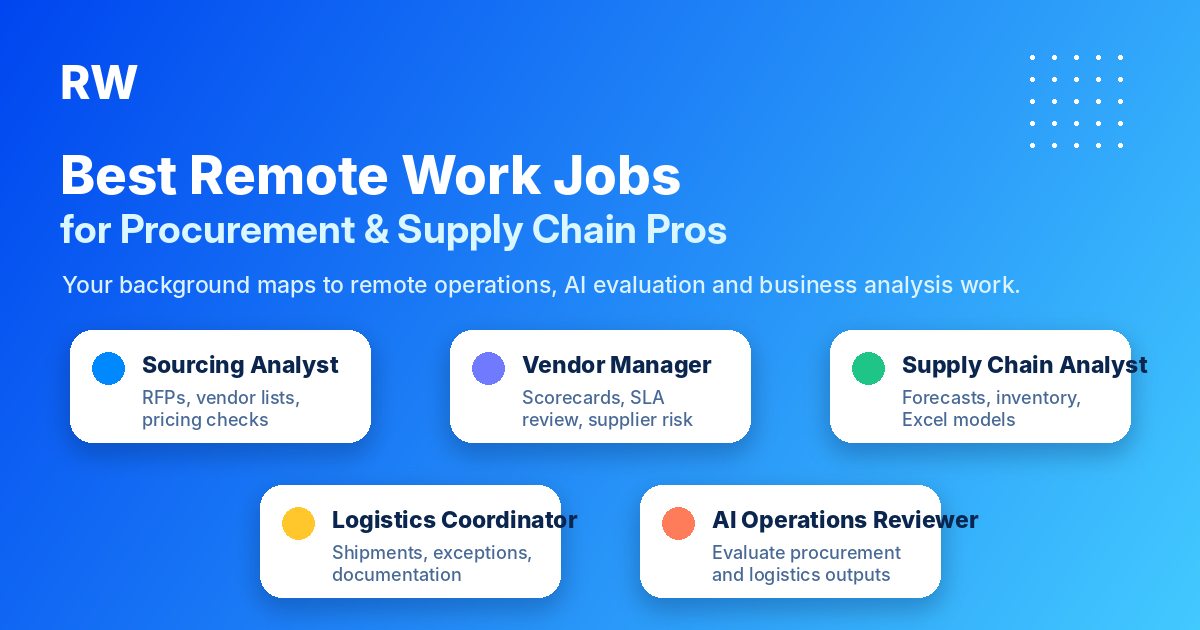
A remote procurement analyst helps companies review purchasing data, supplier pricing, purchase orders, contract terms and savings opportunities. This can be a full-time remote job, a part-time consulting role, or a project-based role for companies that need procurement support but do not want to hire a large in-house team.
This job is a strong fit if you are comfortable comparing numbers, spotting overpayment, reviewing supplier performance and explaining tradeoffs. You may review spend categories, look for duplicate vendors, analyze payment terms or help standardize purchasing workflows.
Useful keywords for your profile include procurement analysis, spend analysis, supplier management, purchase orders, RFP, RFQ, contract review, cost savings, vendor scorecards, strategic sourcing and Excel modeling.
2. Remote sourcing specialist
Sourcing specialists help companies find, compare and evaluate suppliers. This can work remotely because much of the job involves research, outreach, documentation and structured comparison.
Remote sourcing work may include building supplier lists, collecting quotes, comparing capabilities, reviewing minimum order quantities, checking lead times and organizing the decision process. In some companies, sourcing also overlaps with risk review and compliance because the cheapest supplier is not always the best supplier.
Procurement professionals who are good at research can also use this background for AI research and AI evaluation projects. For example, an AI system may produce a vendor comparison, sourcing recommendation or purchasing summary. A human reviewer with sourcing experience can judge whether the answer is realistic or missing important context.
3. Remote vendor manager
Vendor management is one of the most remote-friendly paths for procurement and supply chain professionals. The work depends on documentation, communication and follow-through more than physical presence.
A remote vendor manager may track service level agreements, monitor performance, organize business reviews, document supplier issues, handle renewals, review pricing changes and escalate risk. This is especially valuable for software, logistics, manufacturing support, staffing, facilities and professional services vendors.
Profile tip: For remote applications, emphasize measurable outcomes. Instead of writing "managed vendors," write something more specific: "Managed 35 active suppliers, tracked SLA performance and reduced invoice exceptions by standardizing monthly vendor review templates." Remote hiring managers respond to proof that you can own a process without constant supervision.
4. Remote supply chain analyst
Supply chain analysts are a natural fit for remote work because the job is heavily data-driven. You may analyze demand, inventory, purchase orders, supplier delays, fulfillment performance or logistics costs.
This role can involve Excel, SQL, Power BI, Tableau, ERP exports or forecasting tools. But you do not need to be a data scientist to be useful. Many supply chain teams need analysts who understand the business meaning behind the numbers. It is one thing to build a dashboard. It is another to know that a stockout, late inbound shipment or bad forecast will create a real operational problem.
This background is also useful for AI training jobs. AI models can summarize supply chain data, propose inventory strategies or explain logistics risks, but they need human reviewers who understand whether those answers make operational sense.
5. Remote logistics coordinator
Some logistics jobs still require on-site coordination, but many logistics coordinator tasks can be handled remotely. These include shipment tracking, exception management, appointment scheduling, freight documentation, carrier communication and customer updates.
The best remote logistics candidates are calm, organized and precise. Logistics work often involves problems that need fast triage: a missed pickup, wrong address, customs delay, damaged shipment, appointment conflict or late delivery. Remote teams need coordinators who can document the issue, communicate with the right parties and keep the process moving.
If you apply for this type of job, use keywords like freight coordination, shipment tracking, carrier management, 3PL, TMS, exception management, delivery documentation, routing, dispatch support and logistics operations.
6. Remote inventory analyst
Inventory analysts help companies understand what they have, what they need and where the gaps are. This can include stock levels, reorder points, SKU performance, cycle counts, slow-moving inventory and inventory accuracy.
Remote inventory work is common when the physical counting is handled by warehouse teams but the analysis is handled centrally. A remote inventory analyst may review reports, identify discrepancies, suggest reorder changes, monitor aging inventory or work with operations teams to correct system issues.
For procurement and supply chain pros, this role is especially useful because it connects purchasing decisions with operational reality. Ordering too much creates cash and storage problems. Ordering too little creates stockouts. A good inventory analyst understands both sides.
7. Remote demand planning analyst
Demand planning is another strong remote path. Demand planners review sales history, seasonality, market changes, forecast accuracy and inventory needs. Entry-level remote demand planning roles may be listed as planning assistant, supply planning coordinator, replenishment analyst or forecasting analyst.
This work rewards people who can think in probabilities rather than certainties. Forecasts are never perfect. The skill is knowing which assumptions matter, when a number looks unrealistic and how to explain uncertainty to the rest of the business.
AI tools are increasingly used in planning workflows, but human review still matters. A model can generate a forecast summary. A human with supply chain experience can judge whether the explanation ignores a supplier constraint, promotion, seasonal spike or logistics bottleneck.
8. Remote contract and purchasing reviewer
Procurement professionals often have useful contract instincts even if they are not lawyers. You may know what pricing terms, renewal clauses, delivery requirements, service levels, payment terms and penalty language should look like.
Remote contract reviewer roles may involve checking agreements for missing information, comparing terms to internal standards, summarizing risks or routing documents to legal and finance teams. This is a good fit for people who are detail-oriented and comfortable reading formal business language.
This background also overlaps with AI evaluation. AI systems are often asked to summarize contracts, compare terms or identify potential issues. A procurement professional can help evaluate whether the AI caught the commercial details that matter.
9. Remote operations analyst
Operations analyst roles are broader than procurement or supply chain, but they can be a strong fit for people who understand process, cost, throughput and bottlenecks. A remote operations analyst may help improve workflows, build reports, document standard operating procedures or analyze business performance.
This is a good transition role if you want to move beyond a narrow procurement title. It lets you present yourself as someone who understands how businesses actually run.
For your resume and remote work profile, use phrases like process improvement, operational reporting, workflow documentation, cross-functional coordination, business analysis, KPI tracking, root cause analysis and vendor operations.
Want to match supply chain expertise to remote AI training roles? Find opportunities hiring now.
Find Roles Hiring Now →10. Remote AI evaluator for business, procurement or logistics tasks
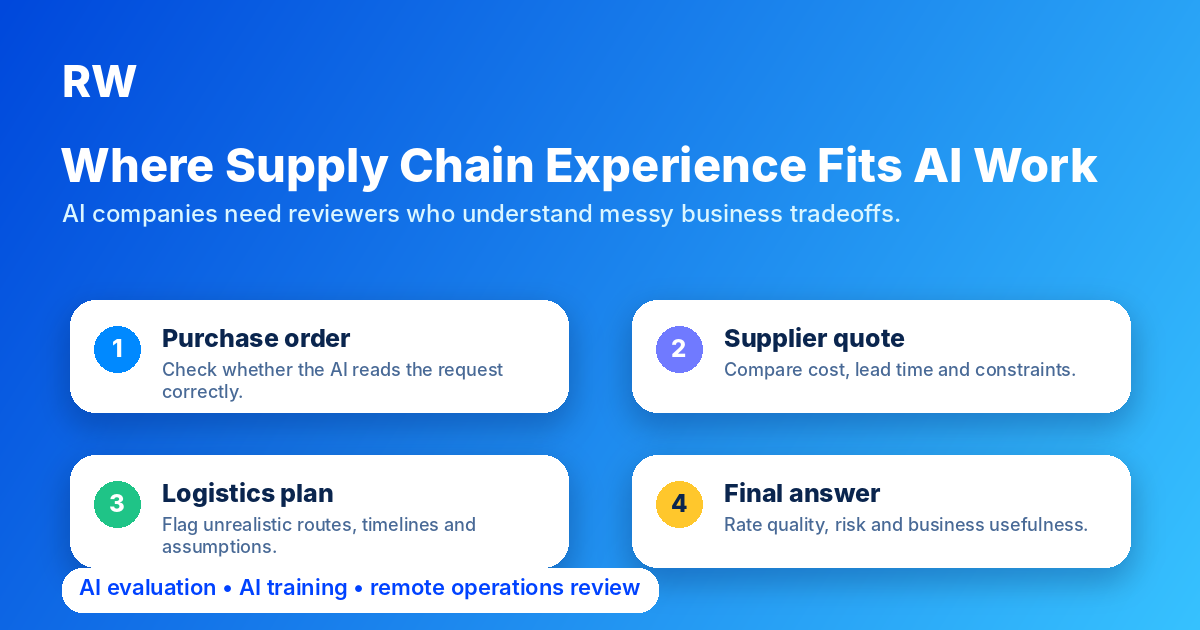
AI evaluation is one of the most important emerging remote work categories for non-technical professionals. You do not always need to code. Many AI training and AI evaluation projects need people who can judge whether an answer is accurate, helpful and realistic.
For procurement and supply chain pros, relevant AI evaluation tasks may include reviewing AI-generated vendor comparisons, checking purchasing recommendations for missing constraints, evaluating supplier risk summaries, rating logistics plans for realism, reviewing inventory or demand planning explanations, fact-checking business research, comparing two AI answers and choosing the stronger one, and writing clearer examples of how a procurement or supply chain expert would reason through a problem.
Platforms such as Mercor, micro1, Handshake AI and other AI training platforms often look for people with domain knowledge. The opportunity is not just "AI work." It is remote work that pays for expertise, judgment and the ability to explain why one answer is better than another. Pay rates for expert-tier evaluation work can reach $50–$200/hr depending on the platform and role.
How to position procurement and supply chain experience for remote work
The biggest mistake is describing your experience as a list of duties. Remote hiring managers and AI training platforms need to understand what decisions you can make independently.
Weak version
"Responsible for vendor communication and purchase orders."
Stronger version
"Reviewed purchase orders, supplier quotes and delivery constraints to identify pricing errors, reduce delays and escalate high-risk vendor issues."
Weak version
"Worked with inventory reports."
Stronger version
"Analyzed inventory reports to identify stockout risks, slow-moving SKUs and replenishment gaps across multiple locations."
Weak version
"Helped with logistics."
Stronger version
"Coordinated carrier updates, tracked shipment exceptions and documented delivery risks for internal operations teams."
The stronger versions show judgment, business impact and remote-friendly communication.
Keywords to include on your resume or AI platform profile
Use the keywords that match your real experience. Do not stuff your profile with every phrase. A focused, accurate profile is better than a generic one.
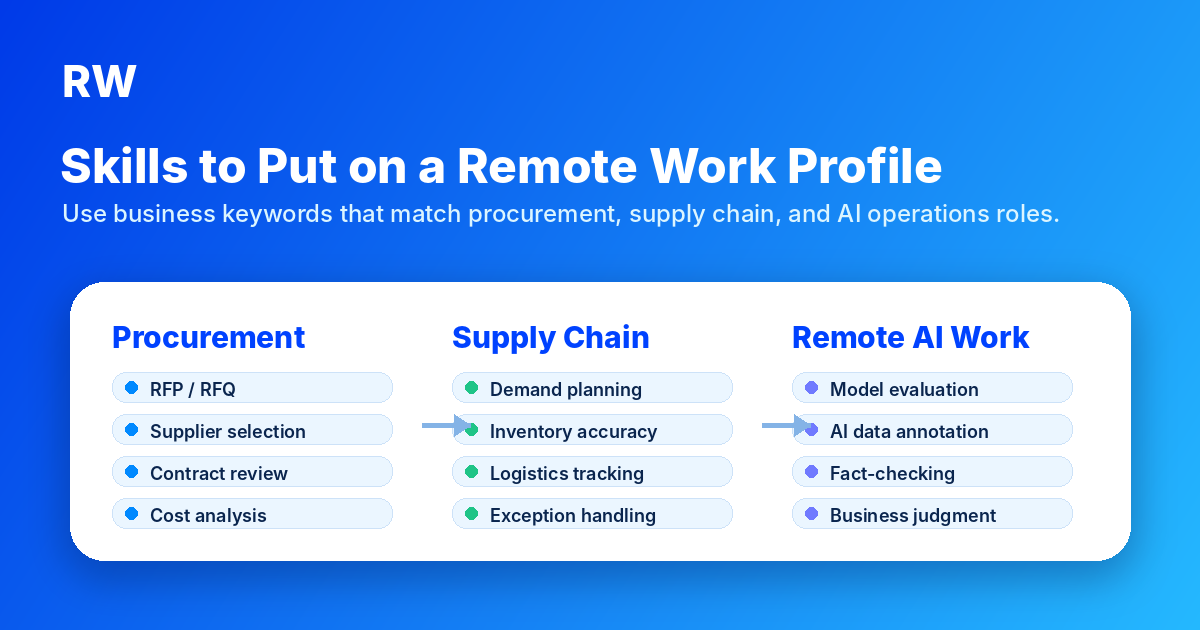
Strong keywords include: procurement, sourcing, strategic sourcing, supplier management; RFP, RFQ, purchase orders, vendor onboarding, vendor scorecards; contract review, pricing analysis, cost savings, payment terms; supply chain analysis, demand planning, supply planning, replenishment; inventory management, SKU analysis, stockout risk, cycle counts; logistics, freight, carrier management, 3PL, TMS, WMS; ERP, SAP, Oracle, NetSuite, Excel, Power BI, Tableau; process improvement, operations analysis, KPI reporting; and AI evaluation, AI training, AI data annotation, model evaluation, fact-checking.
For AI roles, make sure your profile connects your business experience to review work. Write that you can evaluate AI outputs involving procurement, sourcing, logistics, inventory, vendor risk, operations and business decision-making.
Best remote job titles to search
Start with these search terms: remote procurement analyst, remote sourcing specialist, remote vendor manager, remote supply chain analyst, remote logistics coordinator, remote inventory analyst, remote demand planning analyst, remote replenishment analyst, remote operations analyst, remote contract reviewer, remote AI evaluator, AI training procurement expert, AI data annotation business operations, AI model evaluator supply chain, and remote business analyst procurement.
Search broadly at first. Then narrow based on which roles actually respond.
What to avoid when applying
Avoid applying as if you are only looking for your exact old job title. Remote work categories are wider than traditional job boards. A procurement background can fit sourcing, vendor operations, business analysis, AI training, contract review, logistics support and operations research.
Also avoid underselling yourself as "non-technical." You may not be a software engineer, but procurement and supply chain work uses structured systems, data, documentation and risk analysis. That is technical enough for many business operations and AI evaluation roles.
Finally, avoid applying to only one platform. Remote work is uneven. One platform may have no projects this week while another is onboarding people with your background. A multi-platform strategy is safer.
Who this is best for
This path is best for procurement and supply chain professionals who can explain their reasoning. If you are good at spotting issues in a quote, noticing missing data, questioning a forecast, identifying vendor risk or explaining why a plan will not work, your skills may translate well into remote work.
It is also a strong path for mid-career professionals who do not want to start over. You do not need to pretend you are a coder. You need to present your domain knowledge in a way that remote companies, AI companies and AI training platforms can understand.
The bottom line
Procurement and supply chain professionals have practical experience that many remote teams need: judgment, process discipline, cost awareness, documentation, supplier knowledge and operational common sense. Those skills can lead to remote jobs in procurement analysis, sourcing, vendor management, supply chain analysis, logistics coordination, operations analysis, contract review and AI evaluation.
The key is to translate your background into remote-friendly language. Show the systems you know, the decisions you made, the risks you caught and the business outcomes you improved. Then apply across traditional remote job boards and AI training platforms so you are not dependent on one source of work.
Frequently Asked Questions
Can procurement professionals find remote work without starting over?
Yes. Procurement and supply chain experience translates directly into remote roles such as procurement analyst, sourcing specialist, vendor manager, supply chain analyst, and remote AI evaluator. You do not need to reinvent your career — you need to present your existing domain knowledge in remote-friendly language.
What AI training jobs are available for supply chain professionals?
Platforms such as Mercor, micro1, and Handshake AI look for people with domain knowledge who can evaluate whether AI-generated outputs are accurate, helpful, and realistic. For supply chain pros, relevant tasks include reviewing vendor comparisons, rating logistics plans, checking purchasing recommendations, and evaluating inventory or demand planning explanations.
Do I need coding skills to get remote AI evaluation work with a procurement background?
No. Many AI evaluation and AI training roles are designed for non-technical domain experts. Procurement and supply chain professionals bring structured business judgment, process knowledge, and real-world operational context — all of which are valuable for evaluating AI outputs in business, logistics, and operations tasks.
What are the best job titles to search for remote procurement work?
Start with searches like remote procurement analyst, remote sourcing specialist, remote vendor manager, remote supply chain analyst, remote logistics coordinator, remote inventory analyst, remote demand planning analyst, remote operations analyst, remote contract reviewer, and remote AI evaluator. Casting a wide net first, then narrowing based on response rates, is the most effective approach.
How should I describe procurement experience on a remote work profile?
Focus on decisions and outcomes rather than job duties. Instead of "responsible for vendor communication," write something like "Reviewed supplier quotes and delivery constraints to identify pricing errors and reduce delays." Remote teams and AI platforms respond to evidence that you can own a process independently and explain your reasoning clearly.