Remote reviewer work has become one of the most important categories inside the AI job market. When people talk about AI training jobs, AI evaluation jobs, data annotation, prompt review, or LLM evaluator work, they are usually describing the same broad function: humans review AI outputs so models become more accurate, helpful, safe, and useful.
The confusing part is that applicants often assume these roles are assigned randomly. One person gets a project. Another person passes an assessment but never sees tasks. A third person receives expert-tier work at a higher hourly rate. From the outside, it can look inconsistent. In reality, most AI companies and AI training platforms use a matching process. They are trying to decide who can be trusted with a specific type of review work at a specific moment.
This article explains how companies and platforms usually decide who gets remote reviewer work, what signals help you get matched, and how to improve your profile before applying to platforms such as micro1, Mercor, Handshake AI, and other remote AI work marketplaces.
What Remote Reviewer Work Actually Means
Remote reviewer work is not one single job. It is a category of work used by AI companies, research labs, and data providers that support large language models and other AI systems. The work may involve comparing two AI responses, ranking answer quality, checking factual accuracy, reviewing writing style, flagging unsafe outputs, improving prompts, or explaining why one answer is better than another.
Some reviewer tasks are general. A strong writer or researcher may be asked to judge whether an answer is clear, complete, and aligned with instructions. Other tasks are specialized. A lawyer, accountant, software engineer, medical professional, translator, teacher, marketer, or finance analyst may be asked to evaluate answers in a subject area where general reviewers would miss important details.
This is why remote AI reviewer work can pay very different rates. General AI evaluation may be easier to enter, while expert reviewer work often requires proof of subject matter expertise. The best applicants understand that they are not just applying for a generic online gig. They are applying to be trusted with judgment.
AI Companies Do Not Just Pick the First Applicant
The biggest misconception is that platforms simply accept applicants in order. That is rarely how serious remote AI work operates. AI companies need reviewers who can produce consistent, useful data. Bad reviews can damage training quality. Vague feedback can slow down model improvement. Inconsistent scoring can make a dataset less valuable.
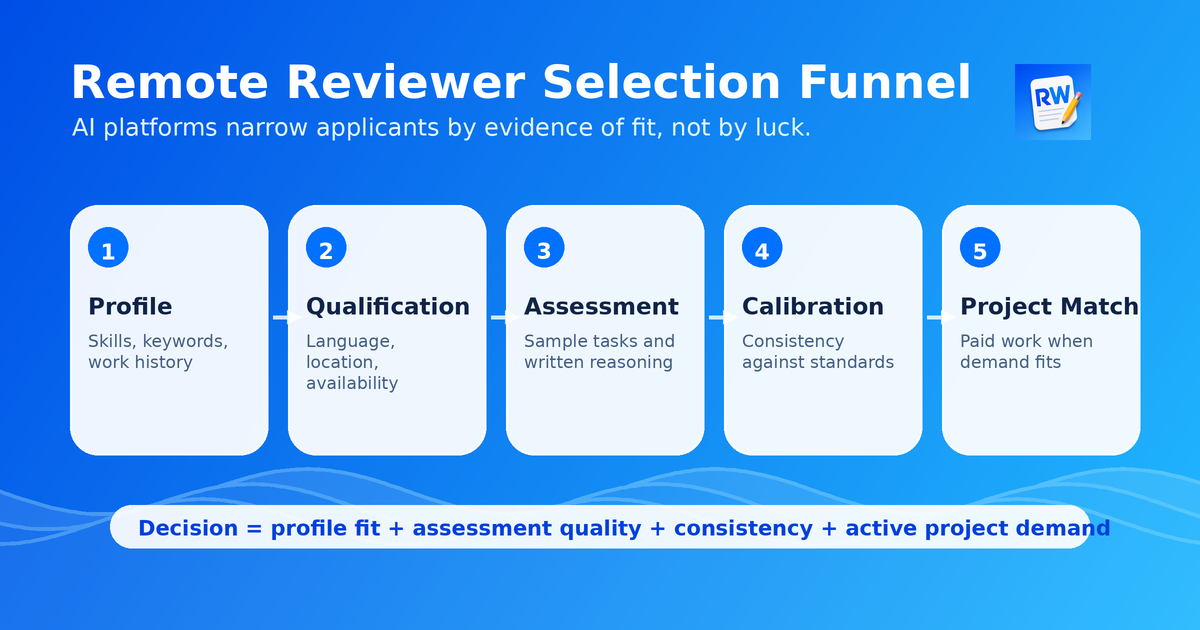
Because of that, platforms usually look at several signals at the same time. They consider your profile, your writing, your work history, your assessment results, your location, your availability, your domain expertise, and whether current projects need someone like you. Passing an application step may make you eligible, but it does not guarantee immediate work.
Think of the process less like a simple job application and more like a talent marketplace. You are being placed into a pool. The platform then decides whether your profile fits a project, whether you have proven enough quality, and whether there is active demand for your skill set.
The Main Signals That Decide Who Gets Matched
Most remote reviewer platforms use a combination of human review, automated screening, assessment scoring, and project demand. The exact process differs by company, but the same categories usually matter.
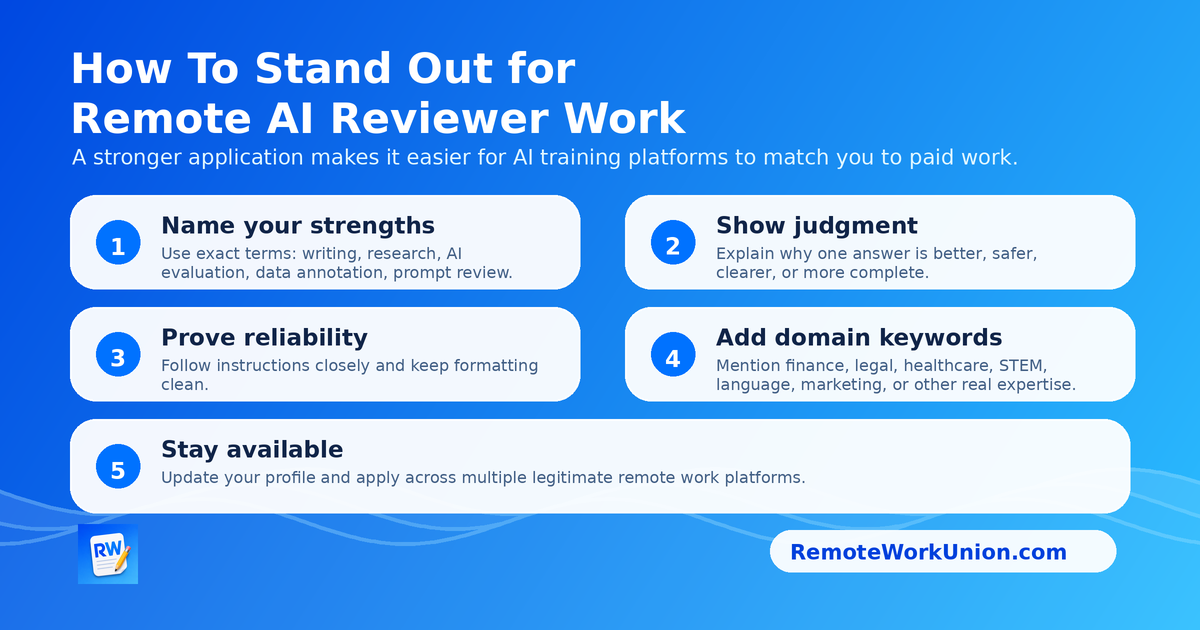
Profile fit is the first signal. Platforms need to understand what you can review. A profile that says only "remote work" or "open to opportunities" is weak. A profile that mentions writing, research, editing, customer analysis, finance, legal support, coding, healthcare, education, marketing, operations, bilingual work, or technical documentation gives the system more ways to match you.
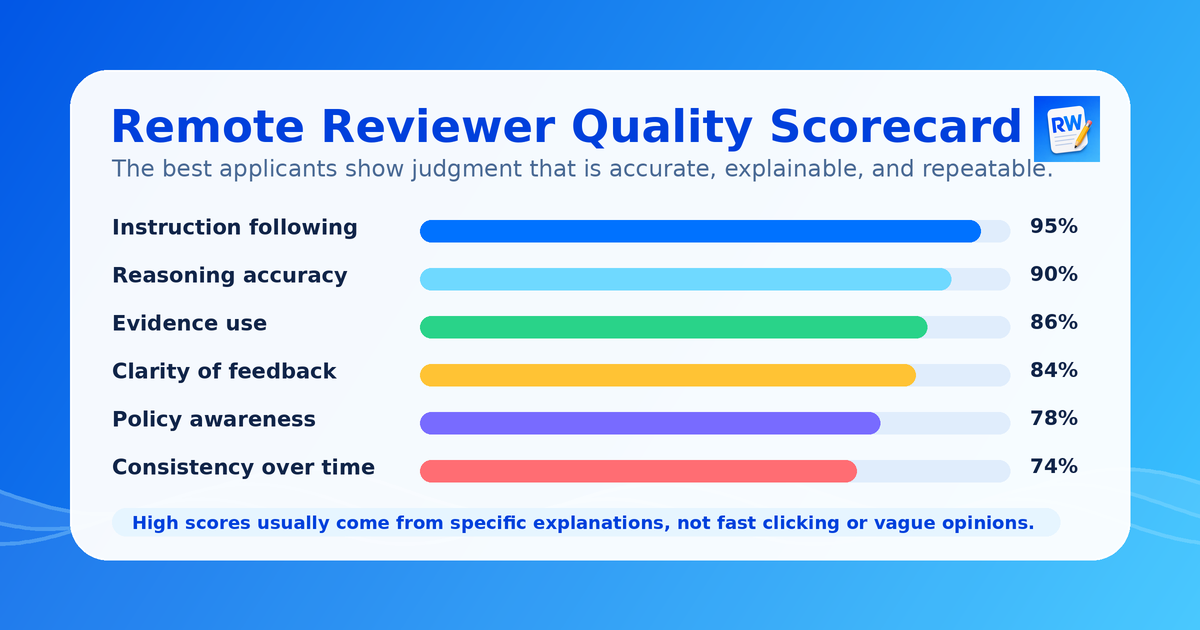
Writing quality is another major signal. Many AI reviewer jobs are writing-heavy even when the subject is technical. You may need to explain why one answer is stronger, identify missing context, or rewrite feedback in a clean format. Short, vague answers are usually weaker than specific, structured explanations.
Instruction following matters more than most beginners expect. AI review tasks often include detailed rubrics. A reviewer who ignores formatting rules, misses constraints, or gives personal opinions instead of rubric-based analysis is hard to trust. Platforms want reviewers who can slow down, read the task, and apply the standard exactly.
Consistency is also critical. One good answer is not enough. AI training data is useful only when reviewers apply criteria in a repeatable way. If your ratings swing randomly or your explanations contradict your scores, you may pass an initial screen but receive fewer projects later.
Domain expertise can move an applicant into a higher-value lane. A general reviewer can evaluate clarity. A subject matter expert can evaluate correctness. If you have experience in law, finance, software, medicine, science, education, analytics, sales, marketing, recruiting, operations, or another professional field, make that expertise obvious in your application.
Availability and responsiveness also matter. Some projects move fast. If two applicants are similarly qualified, the one who responds quickly, completes onboarding, and accepts tasks reliably may get the first opportunity. Remote AI work is flexible, but it still rewards dependability.
Why Two Similar Applicants Get Different Results
Two applicants may look similar on paper and still have very different outcomes. One may get accepted quickly. One may pass an assessment but receive no projects. One may be routed into low-volume tasks while another gets recurring reviewer work. That does not always mean one person is better. It often means the platform had a stronger project fit for one profile at that moment.
Project demand changes constantly. A platform may need English writing reviewers this week, finance experts next week, bilingual evaluators after that, and coding reviewers during another cycle. If your skills do not match the open project, you may sit in the pool even after passing the basic screen.
Location can also affect matching. Some AI reviewer projects are worldwide. Others are limited to specific countries because of client requirements, payment systems, language needs, compliance rules, or data handling restrictions. This is one reason applicants outside the United States may qualify for some remote AI jobs but not others.
Assessment performance can create another gap. A person who writes cleaner explanations, gives more balanced ratings, and follows the rubric closely may score higher even if both applicants have similar resumes. In AI evaluation, the quality of your sample work often matters more than your job title.
Finally, platforms may limit new reviewer volume. If there are too many qualified applicants and not enough active tasks, some people will wait. That waiting period is frustrating, but it does not always mean rejection. It may mean there is no current project that fits your profile.
Generalist Reviewer Work vs Expert Reviewer Work
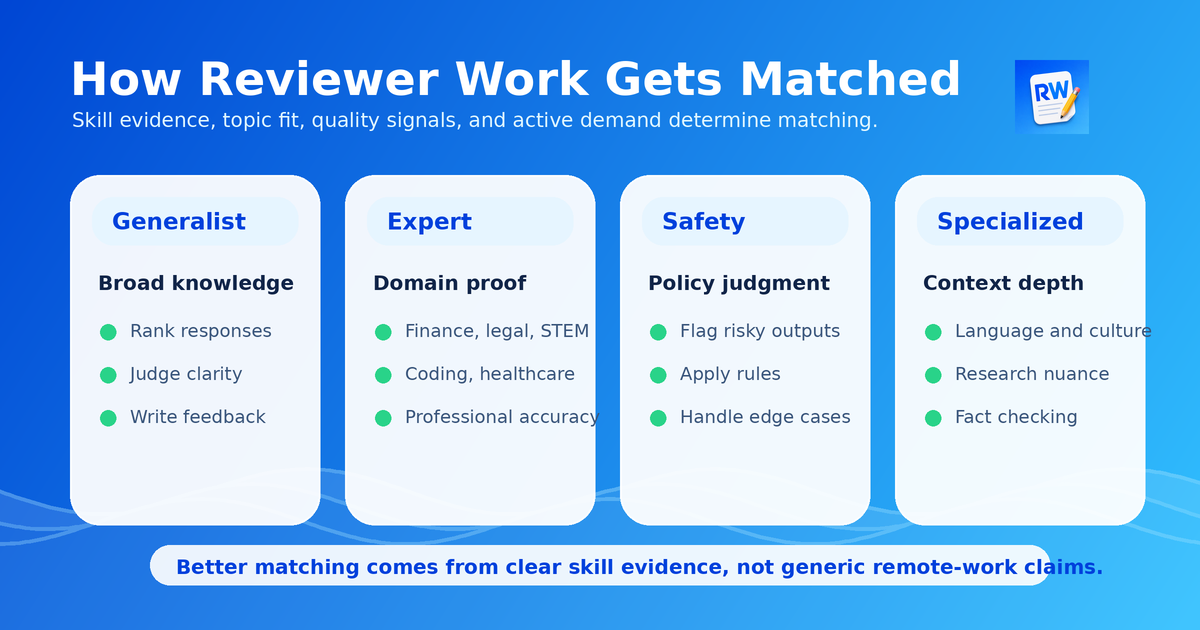
Remote AI reviewer jobs usually fall into two broad categories: generalist and expert. Generalist reviewer work may involve evaluating helpfulness, clarity, tone, completeness, instruction following, or factual plausibility. These roles can be a strong entry point for writers, researchers, editors, students, recent graduates, career changers, and people with strong general knowledge.
Expert reviewer work is different. It requires deeper subject knowledge. A finance reviewer may check whether an answer explains risk correctly. A legal reviewer may identify missing caveats. A software reviewer may inspect code quality. A medical reviewer may evaluate whether a response is careful and not overconfident. A bilingual reviewer may catch nuance that a machine translation misses.
AI companies want both types of reviewers. Generalists help models become clearer and more useful. Experts help models become more accurate in high-skill domains. If you can do both, make that visible. Do not hide professional experience behind a generic remote work profile.
How Your Application Gets Screened
Most applicants think the application is only a form. It is better to treat it as a matching document. Every answer should help the platform understand where you fit. Generic claims such as "I am hardworking" are weaker than specific evidence such as "I have three years of editing experience, regularly compare source material against final copy, and can explain why a response is inaccurate or incomplete."
A strong application usually answers four questions. What can you review? Why should the platform trust your judgment? Can you explain your thinking clearly? Are you likely to complete tasks reliably?
For remote AI training platforms, relevant keywords matter because they make your background easier to classify. Terms such as AI evaluation, AI response review, data annotation, prompt writing, research, editing, fact-checking, quality assurance, content moderation, policy review, customer insights, technical writing, financial analysis, legal research, and bilingual evaluation can help when they are truthful and connected to real experience.
The goal is not to stuff keywords into a profile. The goal is to make your real skills legible. If the platform cannot understand what you are good at, it cannot route you to the right work.
Want to improve your chances of getting matched with remote AI reviewer work? Find opportunities on RemoteWorkUnion.com.
Find Roles Hiring Now →What Test Tasks Are Really Measuring
Many platforms use test tasks or short assessments before assigning paid reviewer work. Beginners often treat these like school exams where the goal is simply to find the right answer. In reality, assessment tasks often measure several things at once.
They measure whether you read instructions carefully. They measure whether you can compare options instead of reacting emotionally. They measure whether you can give a rating and support it with a clear reason. They measure whether you notice hallucinations, missing constraints, unsafe advice, weak reasoning, or unsupported claims. They also measure whether your explanation would help an AI company improve the model.
The strongest assessment answers are usually specific, balanced, and evidence-based. They do not overstate. They do not rely on vague preferences. They point to the exact reason one response is better, worse, safer, more complete, or more aligned with the prompt.
The Quality Signals Platforms Keep Watching After You Start
Getting your first project is not the end of the selection process. Platforms may continue measuring quality after you begin. They may track agreement with expert reviewers, consistency against benchmark tasks, dispute rates, skipped tasks, completion time, feedback quality, and whether you follow project-specific rules.
This is why some reviewers receive more work over time while others see tasks slow down. If your output is reliable, platforms have more reason to trust you with additional projects. If your reviews are rushed, inconsistent, or hard to use, the system may reduce your access even if you were accepted earlier.
Speed matters, but only after quality. The best long-term reviewers usually learn to move efficiently without sacrificing judgment. They understand the rubric, keep explanations concise, and avoid unnecessary commentary.
Common Reasons Applicants Do Not Get Remote Reviewer Work
Not every stalled application is a rejection, but there are common reasons people fail to get matched. The first is a vague profile. If your background does not clearly connect to writing, research, analysis, domain expertise, or review work, the platform has less to work with.
The second is weak sample writing. AI reviewer work often depends on written explanations. If your application has typos, unclear sentences, or one-line answers where detail is needed, it may signal that you will struggle with reviewer tasks.
The third is overclaiming expertise. Platforms may test what you claim. If you say you are an expert in finance, coding, law, medicine, or another high-value domain, your answers need to reflect that level of care. It is better to be specific and honest than to inflate your background.
The fourth is ignoring instructions. If a task asks for a short explanation and you write a long essay, that can be a problem. If a task asks for a rating and reasoning and you provide only a rating, that can also be a problem. Remote reviewer work rewards precision.
The fifth is relying on only one platform. Even strong applicants can wait if one platform has limited demand. Applying across several legitimate remote AI work platforms gives you more chances to match with active projects.
How To Improve Your Odds Before Applying
Start by rewriting your profile around the work you want. If you want AI response reviewer work, say so clearly. Mention the types of judgment you can provide: writing quality, research accuracy, factual review, editing, prompt analysis, customer communication, policy reasoning, technical review, or subject matter evaluation.
Add proof. Proof can be a resume, portfolio, writing sample, domain credential, work history, project example, or a clear description of past responsibilities. Platforms do not need a perfect resume. They need evidence that your judgment is useful.
Practice explaining comparisons. A large amount of reviewer work comes down to deciding which response is better and why. Learn to write explanations that are short, specific, and tied to the prompt. Avoid empty phrases such as "this is better" unless you explain the reason.
Apply to roles that match your actual strengths. A beginner with strong writing may do better in general AI evaluation, content review, data annotation, or prompt review. A mid-career professional should also look for expert reviewer work in their field. A bilingual applicant should search for language evaluation, localization, translation review, and country-specific AI training tasks.
Finally, keep applying. Remote AI work is not always steady from one source. The best strategy is to build a profile across multiple platforms, track where you applied, follow up when appropriate, and stay ready when a project opens.
Frequently Asked Questions
Do you need coding experience for remote reviewer work?
No. Some AI reviewer jobs require coding, but many focus on writing, research, editing, fact-checking, customer judgment, policy review, or general knowledge. Coding helps for technical projects, but it is not required for every AI training role.
Why did I pass an assessment but receive no tasks?
Passing may put you into an eligible pool. Work still depends on project demand, your quality score, your profile fit, country restrictions, and whether active tasks need your skills.
Can beginners get remote AI reviewer work?
Yes, but beginners should target entry-level AI evaluation, data annotation, writing review, content quality, and prompt response comparison. Strong communication and careful instruction following matter.
What makes expert reviewer work pay more?
Expert work usually requires harder judgment. A subject matter expert can evaluate specialized answers that general reviewers cannot confidently assess. That makes expertise more valuable when a project needs it.
Should I apply to micro1, Mercor, Handshake AI, and similar platforms at the same time?
In most cases, yes. Remote AI work can be uneven, so using multiple legitimate platforms improves your chances of finding steady projects.
Final Takeaway
AI companies decide who gets remote reviewer work by looking for trust. They need people who can read instructions, apply judgment, explain decisions, and stay consistent across many tasks. The applicants who stand out are not always the people with the most impressive titles. They are the people who make their skills easy to understand and prove that their reviews will be useful.
If you want remote AI work, build a profile that shows exactly what you can review, why your judgment is reliable, and which projects match your background. Then apply broadly, keep your information current, and treat every assessment like a chance to show clear thinking.