Accounting and bookkeeping are two of the most practical paths into legitimate work from home jobs because the core work is already digital. Invoices, bank feeds, payroll records, spreadsheets, tax documents, expense reports, and financial statements can all be reviewed from a laptop. That makes remote work realistic for bookkeepers, accountants, payroll specialists, tax preparers, accounting clerks, controllers, and finance professionals who want more flexibility without abandoning their existing skills.
The best remote roles are not all the same. Some are steady employee jobs with a company. Some are contract jobs for a bookkeeping firm. Some are client-retainer roles for small businesses. Others are newer AI training and AI model evaluation opportunities where finance experts review accounting answers, check calculations, and explain what a model got wrong. The right choice depends on your background, your tolerance for client work, and whether you want flexible project income or a more traditional remote position.
Why Accounting and Bookkeeping Fit Remote Work
Remote accounting works because the output is measurable. A reconciled account is either correct or it is not. A payroll report either matches the underlying hours and deductions or it does not. A month-end close either produces clean numbers or leaves questions. Employers and clients do not need you sitting in an office to prove that you can be accurate, organized, and reliable.
Bookkeeping also fits remote work because many small businesses do not need a full-time accounting employee. They need someone who can keep records current, categorize transactions, send invoices, track bills, reconcile bank accounts, prepare reports, and communicate clearly. That creates demand for part-time remote bookkeepers, fractional finance support, and contract accounting help.
For experienced accountants, remote work can extend into higher-trust responsibilities: financial reporting, budget review, controller support, audit preparation, tax planning support, cash flow analysis, and advisory work. The more judgment and accountability a role requires, the more your background matters.
The Best Remote Roles for Accountants and Bookkeepers
1. Remote Bookkeeper
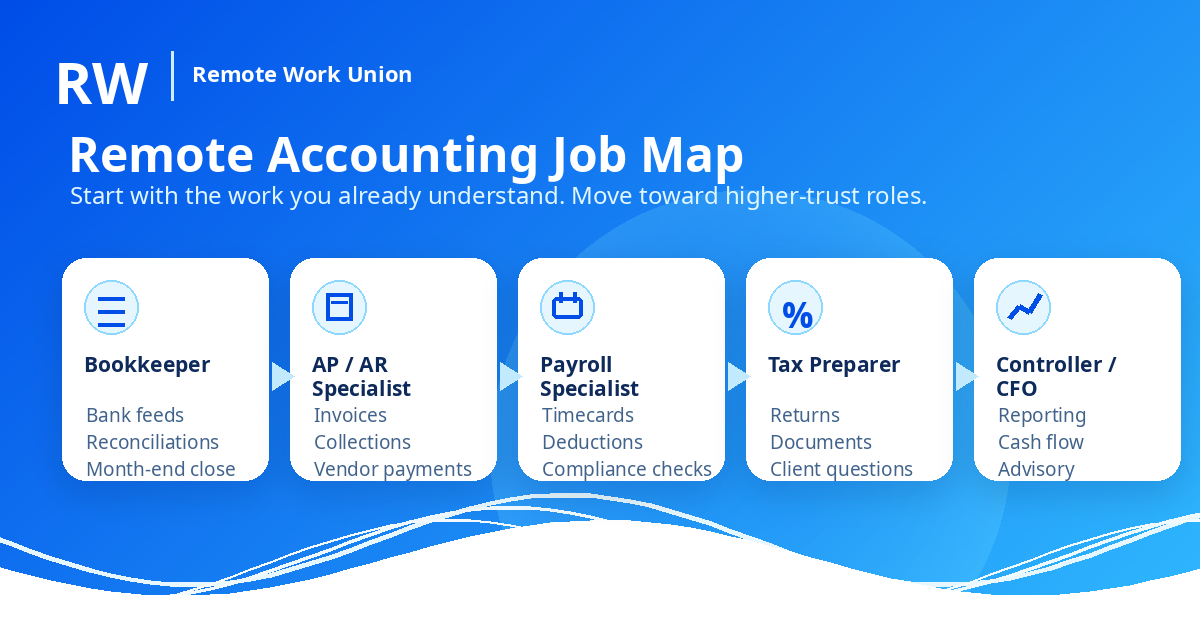
Remote bookkeeping is usually the most direct work from home role for people with accounting knowledge. Bookkeepers help businesses keep financial records organized. Common tasks include categorizing transactions, reconciling bank and credit card accounts, sending invoices, recording bills, preparing basic reports, and flagging unusual activity.
This role is a strong fit if you have experience with QuickBooks, Xero, Wave, FreshBooks, Excel, Google Sheets, or bank feed reconciliation. You do not always need a CPA license to get started, but you do need accuracy, consistency, and the ability to explain financial issues in plain language. Good keywords to use in your profile include remote bookkeeper, virtual bookkeeper, QuickBooks bookkeeper, Xero bookkeeper, bank reconciliation, month-end close, chart of accounts, accounts receivable, accounts payable, and financial statements.
2. Accounts Payable Specialist
Accounts payable roles focus on money going out of the business. Remote AP specialists review vendor invoices, match bills to purchase orders, confirm approvals, schedule payments, resolve discrepancies, and keep vendor records clean. This is a practical remote role because most AP workflows are already handled through accounting software, email, document storage, and approval systems.
This job can be a good fit for detail-oriented applicants who are not trying to sell, cold call, or constantly speak on the phone. Search terms include remote accounts payable specialist, AP coordinator work from home, invoice processing remote, vendor payments, purchase order matching, and expense review.
3. Accounts Receivable Specialist
Accounts receivable is the opposite side of the ledger: money coming in. Remote AR specialists send invoices, track payments, follow up on overdue balances, post deposits, reconcile customer accounts, and help businesses understand cash collection. The role can involve customer communication, but it is not the same as a general customer service job — the focus is on billing accuracy and payment status.
Keywords include remote accounts receivable, billing specialist remote, collections coordinator, invoice follow-up, cash application, and revenue operations support.
4. Payroll Specialist
Payroll is one of the best remote niches for accounting and bookkeeping professionals because it is recurring, deadline-sensitive, and important to every business with employees. Payroll specialists review timecards, process wages, check deductions, handle payroll reports, coordinate with HR, and help ensure employees are paid correctly. Experience with Gusto, ADP, Paychex, QuickBooks Payroll, Rippling, Workday, or BambooHR can make your profile stronger.
Search for remote payroll specialist, payroll coordinator work from home, payroll processor, payroll analyst, benefits deductions, timekeeping review, and payroll compliance support.
5. Remote Tax Preparer or Tax Associate
Tax preparation is often seasonal, but it can be a strong work from home option for accountants, enrolled agents, tax associates, and experienced preparers. Remote tax roles may include reviewing client documents, preparing individual or business returns, answering tax questions, organizing deductions, checking forms, and escalating complex cases. If you have worked with individual returns, small business taxes, Schedule C income, 1099 contractors, state returns, bookkeeping cleanup, or tax software, make that visible in your profile.
Good keywords include remote tax preparer, work from home tax associate, tax reviewer, seasonal tax job, enrolled agent remote, CPA tax remote, small business tax, and tax document review.
6. Staff Accountant
Remote staff accountant jobs are a step above basic bookkeeping. These roles may include journal entries, reconciliations, accruals, prepaid expenses, fixed assets, variance analysis, financial statements, month-end close, and support for audits or budgets. A staff accountant role is often a better fit for someone with a degree in accounting, prior corporate accounting experience, or a strong bookkeeping background. Your resume should include the accounting systems you used, the size or type of business you supported, and the processes you handled.
7. Accounting Cleanup Specialist
Many small businesses fall behind on their books. Their bank feeds are messy, categories are inconsistent, invoices are missing, credit card transactions are duplicated, and old reconciliations were never completed. Cleanup work is a valuable remote niche because it is project-based, specific, and urgent. A cleanup specialist may fix a chart of accounts, recategorize transactions, reconcile multiple months, close out old periods, prepare clean reports, and get the file ready for tax preparation. Search terms include bookkeeping cleanup, QuickBooks cleanup, catch-up bookkeeping, month-end cleanup, financial records cleanup, and remote accounting project work.
8. Remote Controller or Accounting Manager
Remote controller and accounting manager roles are better suited for experienced professionals. These jobs involve oversight, not just task completion. A controller may review the work of bookkeepers, manage month-end close, prepare financial reports, build internal controls, support budgets, work with tax professionals, and advise leadership on cash flow or margins. Leadership teams care about timely, accurate reporting more than physical presence, which makes this role well-suited to remote work. Use keywords like remote controller, fractional controller, accounting manager remote, financial reporting, internal controls, cash flow management, month-end close leadership, and small business finance operations.
9. Fractional CFO and Advisory Work
Fractional CFO work is one of the highest-leverage paths for experienced accountants, controllers, and finance operators. Instead of only recording what happened, you help a business decide what to do next. That can include forecasting, budgeting, pricing analysis, cash flow planning, profitability review, and investor or lender reporting. Small businesses often do not need a full-time CFO, but they do need help understanding whether they can hire, cut costs, raise prices, manage debt, or prepare for growth. If you can combine accounting accuracy with business judgment, advisory work can become a long-term remote career.
Remote Work Union connects accountants and bookkeepers to legitimate remote finance roles and AI evaluation work. Apply for free.
Find Roles Hiring Now →10. AI Finance Evaluator and Accounting Model Reviewer
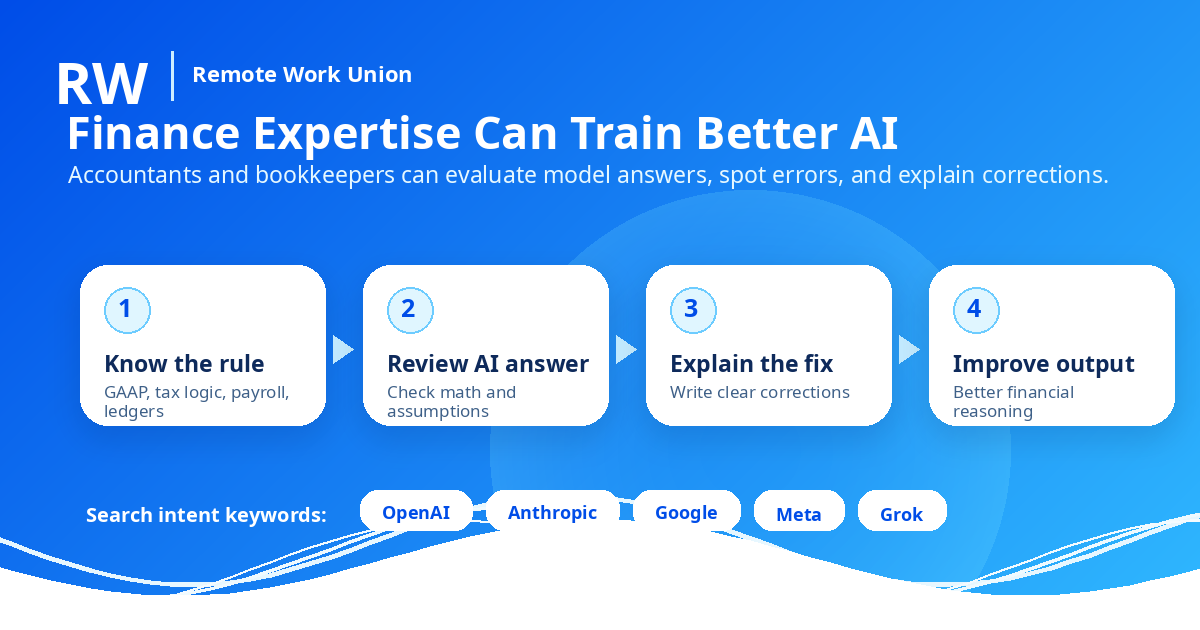
AI training work is a newer remote path for people with accounting and bookkeeping knowledge. AI companies and AI training platforms need humans who can review model answers, catch mistakes, compare outputs, write better examples, and explain why one answer is more accurate than another. For finance-related tasks, accounting experience can be more valuable than generic writing ability.
These roles may appear under names like AI trainer, AI evaluator, AI data annotator, finance expert, accounting reviewer, model response evaluator, or subject matter expert. The work can involve checking spreadsheet logic, reviewing tax explanations, judging accounting advice, identifying hallucinated numbers, or rewriting a response so it is more accurate and useful.
People searching for remote AI jobs often overlook this point: you do not always need to code to contribute. In many cases, the valuable skill is subject matter judgment. Accountants and bookkeepers already have that advantage when the task involves ledgers, taxes, payroll, invoices, financial statements, or compliance logic.
The Skills That Make a Remote Accounting Profile Stronger
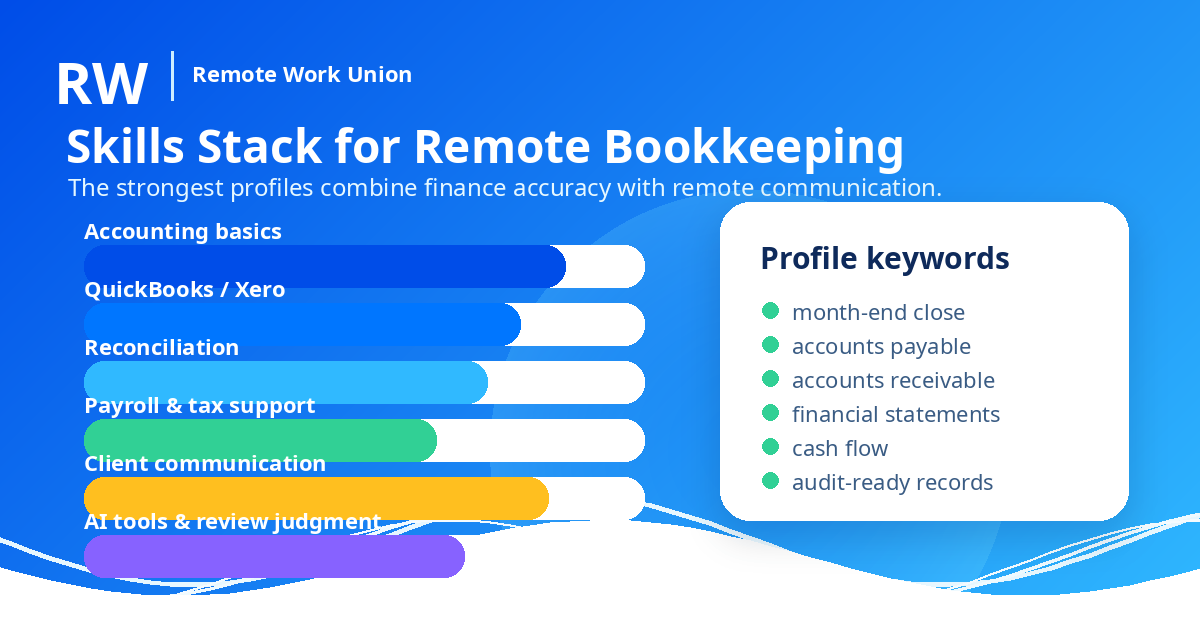
A strong remote accounting profile should not only say that you are detail-oriented. It should show what kind of details you handle. List the systems you know, the accounting processes you have completed, the size of clients or companies you supported, and the level of responsibility you carried.
Useful skill keywords include QuickBooks Online, Xero, payroll, accounts payable, accounts receivable, bank reconciliation, credit card reconciliation, invoice processing, month-end close, tax preparation, financial reporting, journal entries, Excel, Google Sheets, pivot tables, VLOOKUP or XLOOKUP, audit support, cash flow reporting, budget tracking, and expense management.
Remote employers also look for communication discipline. They want someone who can update a task board, leave clear notes, document assumptions, explain discrepancies, and ask precise questions. In remote finance work, silence can create risk. Clear written communication is part of the job.
How to Choose the Right Role for Your Background
If you are new to accounting, start with bookkeeping assistant, AP clerk, AR specialist, billing coordinator, payroll assistant, or tax seasonal support. These roles help you build proof without requiring you to own the entire finance function.
If you already have bookkeeping experience, look for remote bookkeeper, full-charge bookkeeper, QuickBooks specialist, Xero specialist, bookkeeping cleanup, payroll specialist, or small-business accounting support. These roles let you use practical experience directly.
If you have a degree, CPA track experience, public accounting background, or corporate accounting history, search for staff accountant, senior accountant, accounting manager, remote controller, audit support, financial reporting analyst, tax reviewer, and finance AI evaluator roles.
If you have senior experience, consider fractional controller, CFO advisory, business finance consultant, cash flow consultant, and higher-level AI evaluation work where accounting judgment matters most.
How to Make Your Application Stand Out
Remote accounting applications should be specific. Instead of saying "managed bookkeeping," say that you reconciled bank and credit card accounts, maintained the chart of accounts, prepared monthly reports, processed payroll, cleaned up historical transactions, or supported tax filing. Specific work builds trust.
Your profile should also match the type of role you want. A tax preparer profile should emphasize tax forms, document review, client intake, deductions, filing support, and seasonal deadlines. A payroll profile should emphasize timekeeping, deductions, payroll systems, compliance, and accuracy. An AI finance evaluator profile should emphasize accounting judgment, error detection, written explanations, and the ability to compare answers.
Tip: Remote hiring is often keyword-driven. Use the language employers search for, but only include skills you can actually support. Good keywords help you get matched; accuracy helps you keep the role.
Where to Find Work From Home Accounting Jobs
Look in multiple categories instead of searching only one phrase. Search for remote accountant, remote bookkeeper, virtual bookkeeper, QuickBooks remote, Xero remote, payroll specialist remote, AP specialist remote, AR specialist remote, billing specialist remote, tax preparer remote, staff accountant remote, controller remote, and finance AI evaluator.
Also look beyond traditional job boards. Bookkeeping firms, tax platforms, accounting software companies, small-business service providers, startups, and AI training platforms may all hire people with finance knowledge. A person with accounting judgment can fit more roles than they may realize.
The best approach is to build a profile that can work across several lanes: traditional remote accounting, contract bookkeeping, seasonal tax work, payroll support, and AI model evaluation. This gives you more chances to find steady work instead of waiting for one perfect job.
Red Flags to Avoid
Legitimate remote accounting jobs should not ask you to pay to start. Be cautious with any company that charges training fees, asks you to buy equipment from a specific vendor, sends a suspicious check, avoids written job details, or promises high income for vague work. Accounting and bookkeeping roles involve sensitive financial information, so real employers usually have structured onboarding, security expectations, and clear responsibilities.
Also be careful with roles that describe themselves as bookkeeping but are actually commission-only sales, crypto promotion, payment forwarding, or personal assistant work involving unusual bank activity. If the job requires you to move money through your own account, treat it as a serious warning sign.
Final Takeaway
The best work from home jobs for accountants and bookkeepers are the ones that use the trust you have already built: accuracy with numbers, patience with records, comfort with financial systems, and judgment around business decisions. Remote bookkeeping can be a starting point. Payroll, AP, AR, tax, staff accounting, controller support, and AI finance evaluation can become higher-value paths over time.
You do not need to chase every remote job. Focus on roles where your skills are obvious, your keywords match the work, and your experience gives you an advantage. For accountants and bookkeepers, the remote job market is broad because every business still needs clean records, reliable reporting, and people who can spot mistakes before they become expensive.
Frequently Asked Questions
Can accountants and bookkeepers really work from home?
Yes. Accounting and bookkeeping are well-suited to remote work because the core output is measurable. Reconciled accounts, payroll reports, and financial statements can all be delivered digitally. Employers and clients do not need you in an office to verify accuracy, consistency, and reliability.
What remote bookkeeping tools should I know?
The most useful tools include QuickBooks Online, Xero, Wave, FreshBooks, Excel, Google Sheets, and bank feed reconciliation platforms. For payroll, Gusto, ADP, Paychex, Rippling, and BambooHR are commonly used. Knowing multiple platforms makes your profile stronger for remote roles.
What is AI finance evaluation work for accountants?
AI training platforms need humans who can review model answers, catch mistakes, compare outputs, write better examples, and explain why one answer is more accurate than another. For finance-related tasks, accounting experience can be more valuable than generic writing ability. These roles may appear under names like AI trainer, AI evaluator, model response evaluator, or subject matter expert.
Do I need a CPA license to get remote accounting work?
Not always. Many remote bookkeeping, AP/AR, payroll, and accounting cleanup roles do not require a CPA license. More advanced roles such as staff accountant, controller, or tax reviewer may prefer or require credentials. AI finance evaluation roles typically value accounting judgment and clear communication more than specific credentials.
How do I find legitimate remote accounting jobs?
Search for specific role types rather than just "remote accounting." Try remote bookkeeper, virtual bookkeeper, QuickBooks remote, payroll specialist remote, AP specialist remote, AR specialist remote, tax preparer remote, staff accountant remote, and finance AI evaluator. Also look beyond job boards at bookkeeping firms, tax platforms, accounting software companies, and AI training platforms.