Customer research and insights roles are a strong fit for work from home because the core work is not tied to a physical office. The job is to understand what customers want, what they complain about, how they describe problems, how they make decisions, and what companies should do with that information. Much of that work happens through surveys, interviews, product feedback, reviews, support tickets, transcripts, analytics dashboards, and written recommendations.
That makes customer research one of the better remote work categories for people who are observant, analytical, and good at turning messy feedback into clear judgment. It also overlaps with remote AI jobs, AI training jobs, AI evaluation jobs, data annotation, product testing, UX research, market research, and customer experience analysis. Many AI systems are trained or evaluated on whether they can understand user intent, give helpful answers, explain tradeoffs, respond appropriately to frustrated customers, and make information easier to use. Those are customer insights problems as much as technical problems.
This guide breaks down the best work from home jobs for customer research and insights roles, what each role actually does, which skills matter, how these roles connect to AI companies and AI training platforms, and how to position yourself when applying.
In This Article
- Why customer research translates well to remote work
- 10 best remote roles for customer research professionals
- Career map: from research skills to remote work
- How to position customer research experience for remote AI jobs
- The remote insights workflow
- Skill-to-job fit matrix
- Resume keywords to include
- Portfolio ideas that can help you stand out
- Application checklist and 30-day action plan
- Frequently Asked Questions
Why customer research translates well to remote work
Customer research is usually digital-first. A researcher may review survey results in a spreadsheet, listen to interview recordings, tag support tickets, summarize customer calls, compare feedback across product categories, or prepare a short report for a product, marketing, sales, or customer success team. None of that requires sitting in the same building as the customer or the company.
The remote advantage is even stronger when the role involves written analysis. A strong insights worker can receive raw material, identify patterns, create categories, explain what the patterns mean, and recommend next steps. That is valuable for startups, enterprise software companies, e-commerce businesses, consumer apps, marketplaces, agencies, and AI companies building better products from user feedback.
The best candidates are not just people who can read a survey. They are people who notice what is missing, catch contradictions, separate loud opinions from meaningful patterns, and explain customer behavior in plain English. Those abilities fit traditional remote jobs and newer remote AI work.
10 best remote roles for customer research professionals
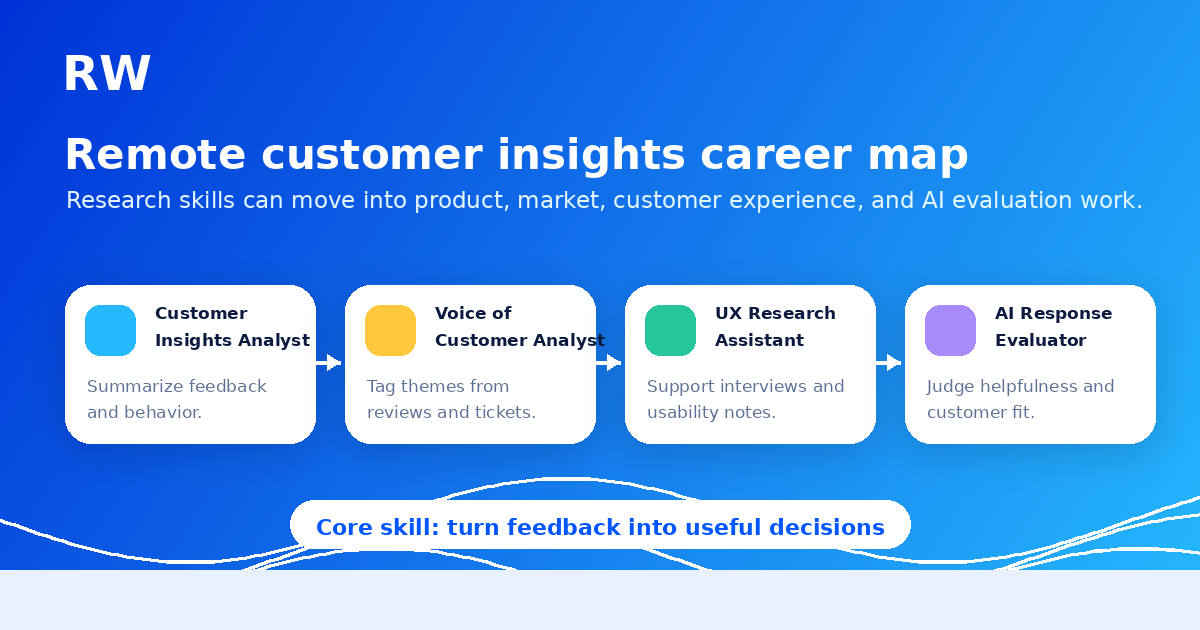
1. Customer insights analyst
A customer insights analyst studies feedback from customers and turns it into useful business recommendations. This can include survey data, product reviews, support tickets, cancellation reasons, onboarding notes, app store reviews, customer interviews, and social comments. The analyst looks for recurring themes such as price concerns, confusing features, unmet needs, trust issues, buying objections, or reasons customers choose a competitor.
This is one of the most natural work from home jobs for people with research, marketing, customer success, product, or operations experience. It rewards pattern recognition and clear writing. You do not always need advanced statistics, but you do need to be comfortable organizing information and explaining what it means.
Good resume keywords for this role include customer insights, voice of customer, survey analysis, qualitative research, feedback analysis, user behavior, customer experience, product feedback, segmentation, reporting, and stakeholder recommendations.
2. Voice of customer analyst
A voice of customer analyst focuses on what customers are saying in their own words. The raw material may come from reviews, support tickets, chat logs, sales calls, cancellation notes, or customer interviews. The job is to tag themes, surface trends, explain customer language, and show which problems are repeated often enough to matter.
This role is especially relevant to remote AI jobs because AI models are often evaluated on how well they understand intent, tone, frustration, ambiguity, and context. A voice of customer analyst can be good at judging whether an AI response actually answers the customer, whether it misses the emotional context, or whether it gives technically correct but unhelpful advice.
Portfolio tip: A useful portfolio example for this role is a short voice of customer report. Take 30 to 50 sample reviews from a public product category, group them into themes, identify the top pain points, and write three recommendations. Keep it simple and clean.
3. UX research assistant or research coordinator
A UX research assistant helps with user interviews, usability tests, research operations, note-taking, participant scheduling, transcript review, and synthesis. This can be a good remote role for people who are not yet senior researchers but understand how users think and how products are tested.
The work may include preparing interview guides, organizing research folders, cleaning notes, tagging findings, building highlight reels, tracking participant status, or summarizing usability problems. For remote work, the most important traits are reliability, attention to detail, strong written communication, and the ability to follow a research plan.
This role can also lead into product research, customer experience research, and AI product evaluation. If you can explain why a user got confused during a task, you can often explain why an AI answer failed to satisfy a user request.
4. Market research analyst
Market research analysts study customers, competitors, pricing, demand, and category trends. The work is often remote-friendly because it relies on secondary research, survey tools, spreadsheets, public data, interviews, reports, and written summaries.
For customer insights professionals, market research can be a broader version of the same skill. Instead of only asking what current customers think, the analyst may study who the ideal customer is, how a market is changing, why buyers choose one product over another, or what messaging would make a new product easier to understand.
This is a strong category for people with business, marketing, finance, consulting, e-commerce, product, or startup backgrounds. It can also overlap with AI training work when tasks require fact-checking, comparing sources, evaluating reasoning, or judging whether a model response makes sense for a business audience.
5. Survey research specialist
Survey research specialists design surveys, clean survey responses, interpret results, and present findings. Some roles are technical, but many remote jobs need practical survey judgment more than advanced math. Can the question be misunderstood? Is the answer choice biased? Are customers selecting an option because it is accurate or because the survey is poorly written? Those are judgment calls.
Survey skills are valuable in remote work because companies constantly need to understand customer satisfaction, product demand, churn risk, pricing sensitivity, feature preferences, and user expectations. Survey specialists can work for research agencies, software companies, consumer brands, healthcare organizations, education companies, and AI platforms that need human feedback at scale.
6. Product feedback reviewer
A product feedback reviewer evaluates comments, feature requests, bug reports, usability complaints, and customer suggestions. The reviewer may classify feedback, identify duplicates, prioritize themes, or send findings to product managers. This can be a contract role, a part-time remote job, or a responsibility inside customer success, operations, QA, or product teams.
This type of work is a strong bridge into remote AI evaluation. AI companies and AI training platforms often need people who can compare outputs, detect missing context, follow a rubric, and explain why one answer is better than another. Product feedback reviewers already do something similar: they judge whether feedback is valid, important, repeated, and actionable.
7. Customer journey analyst
Customer journey analysts study how people move from first awareness to signup, purchase, onboarding, repeat usage, upgrade, support, and renewal. They look for friction points. Where do customers get confused? Where do they abandon the process? Where does the message not match the experience? Where does support volume spike?
This role often works well remotely because the inputs are digital: funnels, analytics reports, support data, surveys, customer interviews, session notes, and product usage summaries. It is a good fit for people with backgrounds in customer success, marketing, sales operations, product operations, or support leadership.
For remote AI work, this skill helps when evaluating AI agents, chatbots, support flows, onboarding assistants, and recommendation systems. The question is not only whether the answer is correct. The question is whether the response helps the user move forward.
8. AI response evaluator for customer experience tasks
AI response evaluation is one of the most relevant remote job categories for customer research and insights professionals. In these roles, workers review AI-generated answers and decide which response is more helpful, accurate, safe, clear, or aligned with the user request. Some tasks are general. Others focus on business, writing, support, sales, product questions, customer service, or consumer behavior.
Customer research experience can be useful because many AI tasks are really about understanding users. What did the user intend? What information did they need? Did the answer address the real concern? Was the tone appropriate? Did the response overpromise? Did it ignore a constraint? Did it create confusion?
Major AI companies and AI ecosystems such as OpenAI, Anthropic, Google, Meta, and Grok-related products are useful keywords because the broader AI industry depends on human feedback, evaluation, and expert review. Applicants should still apply through legitimate platforms and specific job listings rather than assuming every company hires directly for every task. Platforms like Mercor, Handshake AI, micro1, and Outlier AI are the practical access points for most remote AI evaluation work.
9. AI training specialist for support, sales, and consumer behavior
AI training work can involve writing examples, rating model responses, labeling data, checking factual accuracy, reviewing conversations, improving prompts, or explaining why an answer is weak. For customer research professionals, the best-fit tasks are often support conversations, customer service quality, sales objections, product recommendations, review analysis, user intent, and consumer decision-making.
This is where a non-technical background can still be valuable. You do not need to code to recognize that an answer sounds robotic, misses the complaint, invents a policy, ignores a price concern, or fails to ask a useful follow-up question. Human judgment is the core skill.
When building your profile for AI training jobs, use terms like AI evaluation, data annotation, response rating, rubric-based review, user intent, customer support quality, product feedback, qualitative analysis, and prompt evaluation. These keywords help connect traditional insights experience with newer remote AI jobs. Pay for expert-tier evaluation work typically ranges from $50 to $200 per hour depending on the platform and role.
10. Customer research writer or insights report writer
Some companies need people who can write clean research summaries more than they need a full-time researcher. An insights report writer turns interview notes, survey findings, customer quotes, or analyst notes into readable reports. This is a strong work from home job for people who combine research judgment with writing ability.
The best reports do not dump every detail. They explain the main finding, why it matters, what evidence supports it, and what action the team should consider. This is also useful for AI work because many evaluation tasks require concise written explanations. A worker who can explain why one answer is better than another will often produce higher-quality review work.
Want to match your customer insights skills to remote AI roles? Find opportunities hiring now.
Find Roles Hiring Now →How to position customer research experience for remote AI jobs
The mistake many applicants make is describing their background too narrowly. A customer research candidate may write, "conducted surveys" or "reviewed customer feedback." That is accurate, but it undersells the skill. Remote AI platforms and AI companies are often looking for judgment, labeling, evaluation, reasoning, writing, and domain understanding.
A stronger version would be: "Analyzed customer feedback, categorized recurring themes, evaluated response quality, summarized user intent, and translated raw comments into actionable recommendations." That sentence connects customer research to AI evaluation, product feedback, data annotation, and remote review work.
Use concrete examples. Mention the kind of data you reviewed, how you organized it, what decisions it supported, and how you communicated findings. If you worked with customer calls, chat transcripts, reviews, surveys, support tickets, usability tests, buyer interviews, or NPS comments, say so.
The remote insights workflow
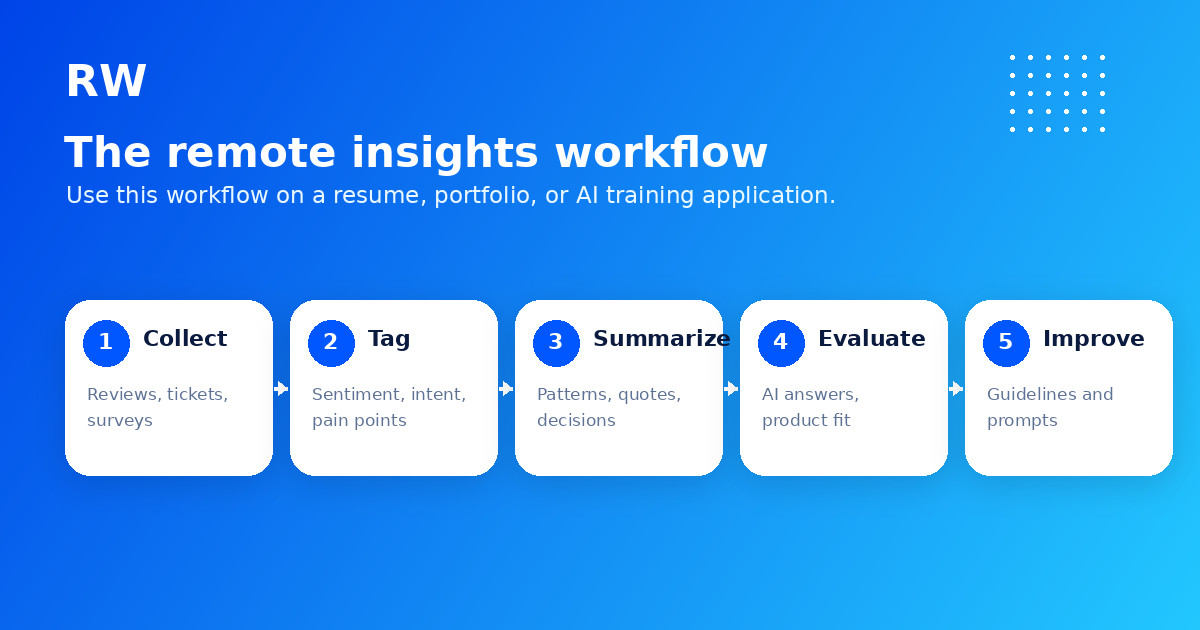
Remote customer insights work tends to follow a recognizable cycle: collect raw material, tag and categorize it, summarize patterns, evaluate quality or relevance, and recommend improvements. This workflow is the same whether you are analyzing product reviews for a software company, reviewing survey responses for a brand, or evaluating AI-generated customer service answers for a training platform.
Understanding this cycle helps you communicate your value. You are not just a person who reads feedback. You are someone who can take unstructured input, apply a consistent framework, make judgment calls, and produce structured output. That is exactly what remote AI evaluation and training work requires.
The strongest remote insights workers are comfortable working asynchronously, setting their own pace on tasks, organizing their own files, and meeting written output standards without constant supervision. Those habits are important across every category of remote work.
Skill-to-job fit: who is right for which roles
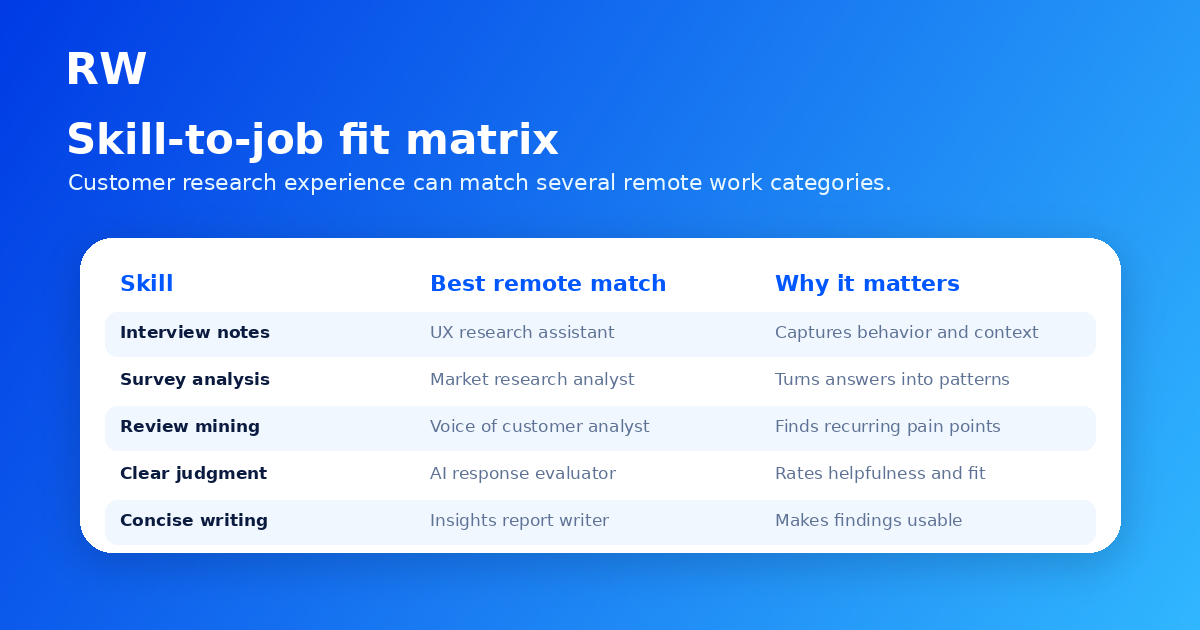
Not every customer research background leads to the same remote opportunity. Here is how different skill strengths align with remote roles:
If your strength is qualitative analysis and synthesizing customer language, voice of customer analyst and insights report writer roles are your best starting point. If you are strong at survey design and interpreting quantitative results, survey research specialist and market research analyst roles fit naturally. If you are comfortable reviewing content, following rubrics, and explaining quality differences, AI response evaluator and product feedback reviewer roles are worth prioritizing.
If you have subject matter expertise in a specific domain — healthcare, finance, legal, education, technology, or business — AI expert review roles can pay significantly more than generalist annotation work. Your domain knowledge is what makes your feedback valuable to AI companies building specialized models.
If you come from customer success or support, customer journey analyst and AI training specialist roles for support and consumer behavior are well-aligned. Your experience understanding frustration, escalation patterns, and common complaints is exactly what AI companies need when building or evaluating customer-facing AI tools.
Resume keywords to include
A strong remote customer insights resume should include both traditional research keywords and AI-adjacent keywords. Traditional keywords include customer research, customer insights, voice of customer, market research, survey analysis, qualitative research, user interviews, customer experience, product feedback, churn analysis, customer journey, and research reporting.
AI-adjacent keywords include AI evaluation, AI training, data annotation, response rating, rubric-based evaluation, prompt evaluation, user intent, sentiment analysis, content quality review, fact-checking, model evaluation, and human feedback. Do not stuff keywords randomly. Use the terms that honestly match your experience and examples.
For customer research and insights roles, your resume should show that you can work independently. Remote employers care about clear communication, reliable output, organized files, meeting deadlines, written summaries, and comfort working without constant supervision.
Portfolio ideas that can help you stand out
A simple portfolio can help because many applicants claim they are analytical, but few show evidence. You do not need a complicated website. A clean PDF, Google Doc, Notion page, or short case study can work.
Useful portfolio samples include a voice of customer report, survey analysis summary, app review theme analysis, customer journey map, AI chatbot response evaluation, usability test notes summary, or market research brief. Use public information or fictionalized data. Do not expose private customer information from a previous employer.
Keep each sample short. Hiring teams and AI platforms often review quickly. The goal is to show how you think: what you noticed, how you grouped the evidence, what you concluded, and what you recommended.
To prove your insights report writing skill, create a sample one-page insights brief. Use a simple structure: research question, method, top three findings, evidence, recommendation, and next step. That sample can support applications for remote research jobs, AI evaluation jobs, and content-heavy customer experience roles.
Application checklist and 30-day action plan
Before applying, run through this checklist. Your resume should include both research and AI-adjacent keywords that honestly match your background. You should be able to point to at least one concrete example that shows pattern recognition and written judgment. Your cover letter or application text should describe your work in terms of organizing information, evaluating quality, and turning observations into recommendations — not just "reviewing feedback."
Search beyond exact title matches. Look for customer insights, voice of customer, UX research assistant, market research, product feedback, customer experience analyst, AI evaluator, AI trainer, data annotation, and response reviewer. Use combinations of keywords rather than one exact phrase.
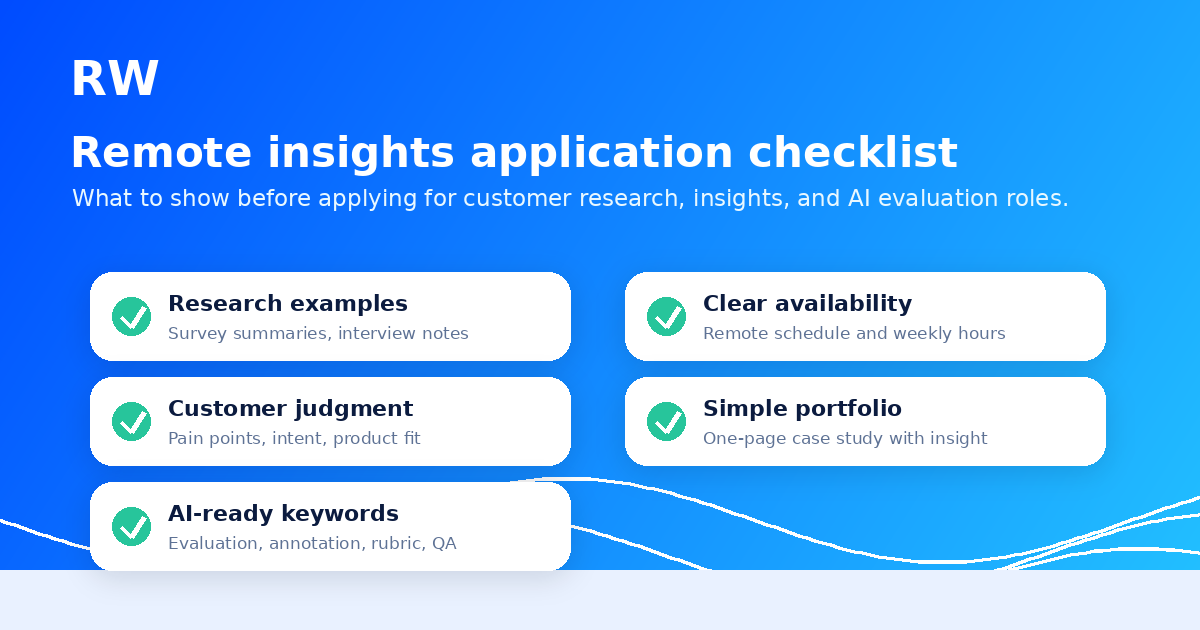
For a 30-day plan: in week one, rewrite your resume around research, feedback, analysis, and remote judgment — add the right keywords but keep every claim honest. In week two, create one small portfolio sample that shows how you turn customer feedback into insights. In week three, apply to a mix of customer insights roles, UX research assistant roles, voice of customer roles, and remote AI evaluation jobs. In week four, follow up, refine your applications, and expand to adjacent roles.
The goal is not to wait for the perfect job title. The goal is to match your customer understanding to any remote role that needs judgment about users, feedback, intent, product quality, and helpful responses.
Common mistakes to avoid
Do not apply only for jobs with the exact phrase "customer research" in the title. Search broader terms. Do not make your resume sound like a generic customer service resume if you want insights work. Customer service experience can be valuable, but you need to highlight pattern recognition, documentation, escalation themes, knowledge base improvements, customer sentiment, and feedback loops.
Do not overclaim technical ability. If you do not know SQL, Python, or advanced statistics, do not pretend. Instead, focus on the remote roles that reward qualitative analysis, writing, human judgment, survey review, customer feedback tagging, and AI response evaluation.
Also remember that remote AI work is broader than any one platform. People looking for work-from-home AI jobs often build profiles across Mercor, Handshake AI, micro1, and Outlier AI simultaneously. The long-term strategy is to build a profile that can work across multiple platforms, not to depend on one application.
Best background matches for this work
Customer research and insights roles are not limited to people with formal research titles. Strong candidates can come from customer support, customer success, account management, sales, marketing, product operations, community management, consulting, ecommerce, product management, journalism, UX, data analysis, or small business operations.
A customer support rep may understand pain points better than anyone. A marketer may understand messaging and buyer intent. A sales rep may understand objections. A product operations person may understand workflows. A journalist may be good at asking questions and summarizing evidence. A consultant may be strong at turning messy inputs into recommendations. The key is to translate the background into remote work language: research, analysis, feedback, categorization, evaluation, writing, and decision support.
Conclusion
The best work from home jobs for customer research and insights roles include customer insights analyst, voice of customer analyst, UX research assistant, market research analyst, survey research specialist, product feedback reviewer, customer journey analyst, AI response evaluator, AI training specialist, and insights report writer.
These roles fit people who are curious, organized, observant, and strong at written judgment. They also connect naturally to remote AI jobs because AI evaluation depends on understanding user intent, customer context, response quality, and practical usefulness. Customer research and insights skills are increasingly useful because companies and AI systems both need better human feedback. If you can understand customers, explain what they need, and judge whether a response or product experience actually helps, you have a real remote work angle.
Frequently Asked Questions
What are the best work from home jobs for customer research professionals?
The best remote roles include customer insights analyst, voice of customer analyst, UX research assistant, market research analyst, survey research specialist, product feedback reviewer, customer journey analyst, AI response evaluator, AI training specialist, and insights report writer. All of these can be done fully remote and reward the pattern recognition and judgment skills customer researchers already have.
Can customer research experience qualify me for remote AI evaluation jobs?
Yes. AI evaluation work often involves judging whether a response addresses user intent, whether the tone matches the situation, and whether the answer is helpful or misleading. Those are customer insights skills. Platforms like Mercor, Handshake AI, micro1, and Outlier AI hire for these roles and value candidates who can explain user behavior and evaluate response quality.
What keywords should a customer research resume include for remote AI jobs?
Traditional keywords: customer insights, voice of customer, survey analysis, qualitative research, user interviews, product feedback, customer journey, NPS, CSAT, and research reporting. AI-adjacent keywords: AI evaluation, data annotation, response rating, rubric-based review, user intent, prompt evaluation, human feedback, content quality review, and model evaluation. Use the terms that honestly match your experience.
Do I need technical skills to get remote customer insights work?
Not always. Many remote customer research roles reward qualitative analysis, clear writing, pattern recognition, and judgment rather than coding or statistics. Survey design, usability testing, and voice of customer work are all accessible to non-technical applicants. AI evaluation jobs similarly value human judgment over technical background.
How can someone with a customer support background position themselves for remote insights roles?
Highlight pattern recognition, documentation, escalation themes, knowledge base improvements, customer sentiment, and feedback loops from your support experience. Avoid framing yourself as a generic customer service candidate. Emphasize the analytical and evaluative parts of the work — how you identified recurring issues, organized customer feedback, and turned observations into actionable recommendations.