Data annotation jobs from home are one of the most common entry points into remote AI work. They are also one of the most misunderstood. Many job seekers see phrases like data annotation, AI data labeling, AI model training, AI rater, prompt evaluator, response reviewer, RLHF, and human feedback jobs and assume they all mean the same thing. They overlap, but they are not identical.
A traditional data annotation job usually asks a remote worker to label information so a machine learning system can learn from clean examples. AI training jobs are broader — some still involve labeling data, but many focus on evaluating what an AI model produces. Instead of only tagging an image or categorizing a sentence, a remote AI evaluator may compare two chatbot responses, judge whether an answer follows instructions, check factual accuracy, or explain why one response is better than another.
For remote job seekers, the practical takeaway is simple: data annotation jobs from home can be a solid starting point, but AI training jobs may offer a wider range of projects for people who can write, fact-check, reason, compare, and review model outputs.
What Data Annotation Jobs From Home Actually Are
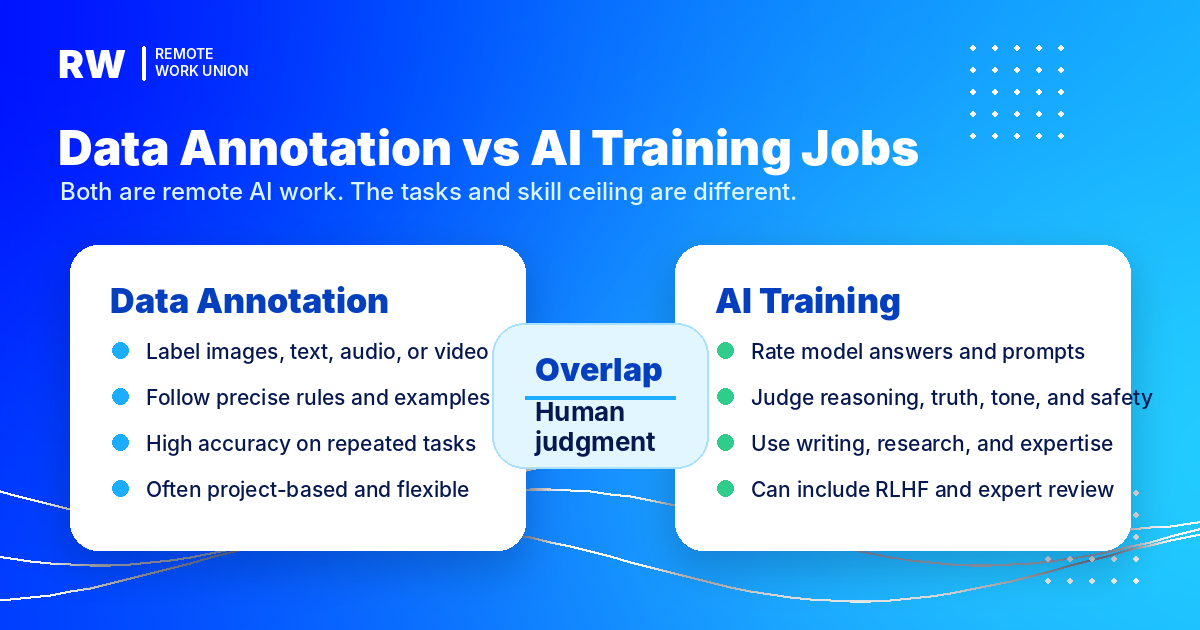
Data annotation is the process of adding human labels to raw information. Those labels help AI systems detect patterns. Remote data annotation jobs often involve tasks such as tagging images with categories, drawing boxes around objects, labeling text sentiment or intent, checking whether a search result matches a query, identifying names, dates, locations, or entities in a document, reviewing audio transcripts, categorizing product listings, or flagging unsafe, low-quality, duplicate, or irrelevant content.
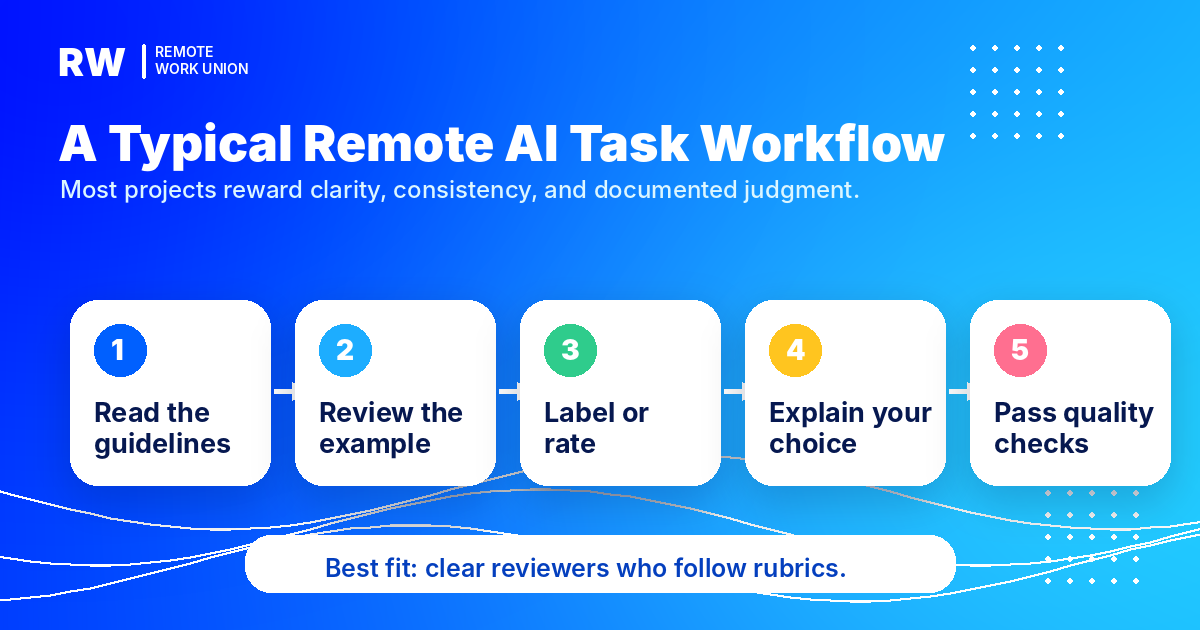
The work can be repetitive, but repetition is part of the value. AI systems need many clean examples, and the quality of those examples depends on workers applying the same rules consistently. Data annotation platforms usually provide detailed guidelines — a good annotator reads the instructions, studies edge cases, and avoids overthinking when the rubric is clear.
How AI Training Jobs Are Different
AI training jobs include data annotation, but they also include higher-judgment tasks designed to improve models like chatbots, search assistants, coding assistants, and writing tools. A remote AI training task might ask you to evaluate responses from systems in the category of ChatGPT, Claude, Gemini, Grok, Copilot, or Meta AI — does this answer help the user, follow the instructions, avoid hallucinations, handle nuance, and explain the topic correctly?
Common AI training job titles include: AI model trainer, AI evaluator, AI rater, prompt evaluator, AI response reviewer, chatbot response evaluator, RLHF reviewer, human feedback reviewer, search quality evaluator, language model evaluator, domain expert reviewer, AI writing evaluator, and coding evaluator. These titles are not always standardized — one platform might call the work AI training, another might call it data annotation. Always read the task description carefully.
Data Annotation vs AI Training: The Core Difference
The easiest way to understand the difference is to look at the output you are responsible for.
In data annotation, your output is usually a label. You classify, tag, select, outline, transcribe, or mark something according to instructions. A data annotation task might ask: "Which category does this image belong to?"
In AI training, your output may be a judgment. You rate, compare, explain, rewrite, fact-check, or improve something the model generated. An AI training task might ask: "Which answer is more accurate, helpful, and complete for this user's prompt? Explain your reasoning."
Both require attention to detail. Both can be done from home. But AI training often moves closer to editing, research, evaluation, and expert review.
Which One Is Better for Beginners?
For beginners, data annotation jobs from home can be easier to understand because the tasks are more concrete. However, beginner-friendly does not mean careless — many annotation projects remove workers who rush, guess, or ignore instructions. AI training can also be beginner-friendly, especially generalist evaluation projects that ask for clear English, basic research skills, and good judgment.
A practical beginner path:
- Start with data annotation, search relevance, or basic AI rater tasks.
- Learn how guidelines, rubrics, and quality checks work.
- Build examples of clear explanations and side-by-side comparisons.
- Apply for AI evaluation, prompt review, and response reviewer roles.
- Move toward higher-skill projects where your background matters.
Remote Work Union connects you to legitimate data annotation and AI training roles. Apply for free.
Find Roles Hiring Now →Skills That Matter in Data Annotation Jobs
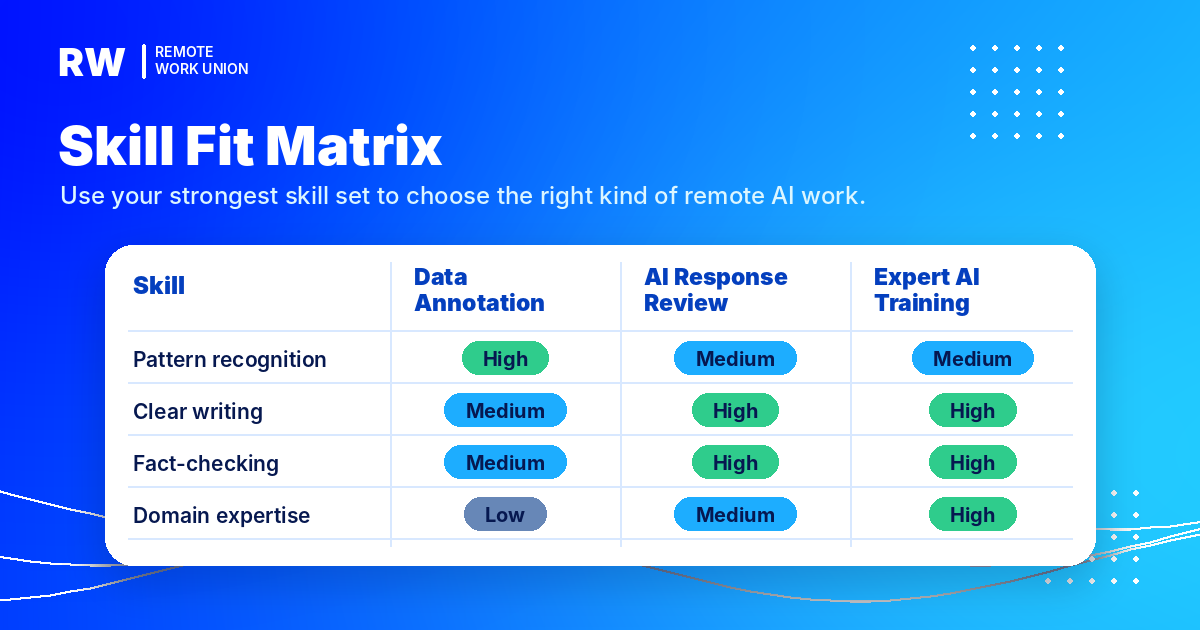
The best data annotators are not necessarily the fastest workers — they are the workers who stay consistent. Important skills include reading guidelines carefully, spotting small differences between examples, applying the same rule the same way every time, handling repetitive work without drifting, recognizing when a task is ambiguous, avoiding unsupported assumptions, and maintaining accuracy over long sessions.
The resume language should match the work: data annotation, quality review, guideline-based labeling, content classification, search relevance evaluation, text annotation, image labeling, transcript review, and accuracy-focused task completion.
Skills That Matter in AI Training Jobs
AI training work adds another layer: evaluation quality. You are often reviewing answers that sound fluent but may be incomplete, misleading, outdated, unsupported, or misaligned with the user's request. Important skills include comparing two answers objectively, identifying hallucinations and unsupported claims, checking whether an answer follows instructions, writing concise justifications, understanding tone and user intent, spotting safety issues without overreacting, and using subject knowledge when relevant.
For specialized AI training jobs, domain knowledge matters more. A legal reviewer may evaluate contract explanations. A finance reviewer may check accounting logic. A healthcare reviewer may review medical writing quality. A coding reviewer may test whether a solution works. A bilingual reviewer may compare translations and cultural nuance.
Why Job Titles Are So Confusing
Remote AI job titles are messy because the industry is still evolving. A listing for "data annotation" might include chatbot evaluation. A listing for "AI training" might include classic image labeling. That is why job seekers should not rely on the title alone. Read the work description and look for task verbs.
If the listing says label, tag, classify, transcribe, outline, categorize, or identify — it is probably closer to data annotation. If the listing says rate, compare, evaluate, critique, rewrite, fact-check, rank, review, or explain — it is probably closer to AI training. If the listing says RLHF, human feedback, preference ranking, model response evaluation, or side-by-side comparison — it is usually a form of AI training work built around human judgment.
How Pay and Project Quality Usually Differ
Pay varies by platform, project, country, skill level, language, availability, and review quality. A timeless rule is that the more the task depends on scarce judgment, the more selective it tends to become. Basic labeling tasks are often easier to enter but may be more repetitive and competitive. Higher-judgment AI training tasks may require stronger writing samples, qualification tests, domain credentials, or prior performance history.
The best opportunity is not always the one with the most impressive title. It is the one where you can pass the test, maintain quality, and keep getting assigned work.
Which Type of Remote AI Work Fits You?
Choose data annotation jobs from home if you like clear rules, repeated task patterns, structured workflows, and quiet independent work without phone calls, meetings, or constantly writing long explanations.
Choose AI training jobs if you like comparing answers, writing short justifications, checking facts, improving clarity, and using judgment. This path is often better for strong writers, researchers, teachers, editors, analysts, students, recent graduates, and professionals with specialized knowledge.
Choose expert AI review jobs if you have a valuable background in law, medicine, finance, accounting, coding, science, education, engineering, or another domain where accuracy matters.
Choose bilingual AI work if you can evaluate language quality beyond literal translation — AI systems need reviewers who understand fluency, tone, regional phrasing, cultural context, and whether an answer sounds natural in the target language.
How to Search for These Jobs
Use several search terms because companies do not use one standard title. Search for: data annotation jobs from home, AI data annotation jobs, remote data annotation jobs, data labeling jobs remote, AI training jobs remote, AI model trainer jobs, AI evaluator jobs, AI rater jobs, prompt evaluation jobs, AI response reviewer jobs, chatbot evaluator jobs, RLHF jobs, human feedback AI jobs, search quality evaluator jobs, work from home AI jobs, and remote jobs with no phone calls.
Also search around the major AI ecosystems. Many job seekers look for phrases involving OpenAI, ChatGPT, Anthropic, Claude, Google, Gemini, Microsoft, Copilot, Meta AI, xAI, Grok, and other AI companies. Not every project will be directly with a major AI company, but those keywords can help you understand what kind of model or evaluation work the market is discussing.
How to Make Your Application Stronger
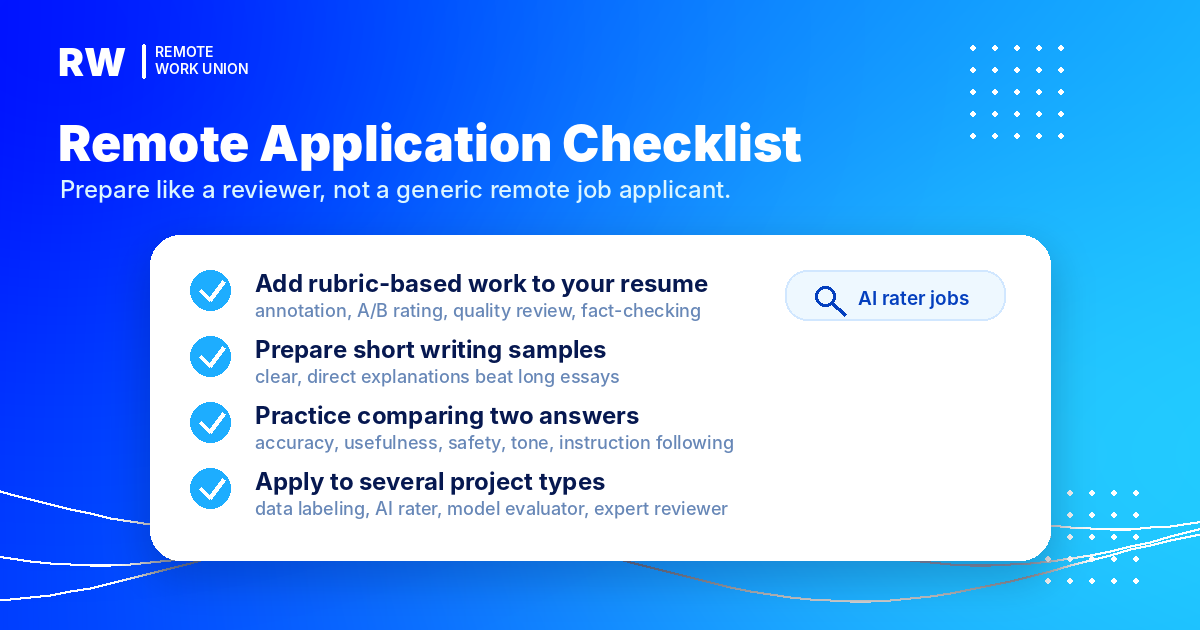
Do not apply like a generic remote job seeker. Apply like someone who understands review work. Your resume should show evidence of accuracy, judgment, writing, research, and consistency. Useful resume phrases include: evaluated written responses against detailed rubrics, performed A/B comparisons and selected higher-quality outputs, reviewed content for accuracy, clarity, relevance, and instruction following, completed guideline-based annotation and classification tasks, identified factual issues and missing context, wrote concise explanations for review decisions.
For application tests, slow down. Most AI training tests are designed to find people who can read carefully, follow instructions, and avoid unsupported assumptions. When asked to explain a choice, be direct — identify the deciding factor rather than writing a long essay.
Red Flags to Avoid
Remote AI work is real, but the category also attracts vague listings and low-quality opportunities. Warning signs include asking you to pay to access jobs, refusing to explain the task type, promising unrealistic income for beginner work, using stolen logos or fake company names, requesting sensitive personal information too early, moving the conversation to suspicious channels, offering payment only after unclear unpaid work, or copying a major AI company's name without proof. Legitimate platforms may still require tests, identity checks, tax forms, contracts, and quality review — the presence of a test is not automatically a red flag.
The Best Long-Term Strategy
Build a ladder. Start with the type of AI work you can qualify for now, then move toward the projects where your strongest skills matter more. If you are detail-oriented but not a specialist, start with data annotation, search relevance, or basic AI rater roles. If you write clearly, move toward prompt evaluation, AI response review, and human feedback jobs. If you have a college degree or professional background, look for expert AI training projects in your field. If you are bilingual, look for language evaluation and multilingual AI training work. If you code, look for coding evaluator projects.
Frequently Asked Questions
What is the difference between data annotation and AI training jobs?
In data annotation, your output is usually a label — you classify, tag, select, or mark something according to instructions. In AI training, your output may be a judgment — you rate, compare, explain, rewrite, fact-check, or improve something the model generated. Both can be done from home, but AI training often moves closer to editing, research, evaluation, and expert review.
Which is better for beginners — data annotation or AI training jobs?
Data annotation jobs from home can be easier to understand for beginners because the tasks are more concrete. AI training can also be beginner-friendly for generalist evaluation projects that ask for clear English, basic research skills, and good judgment. A practical beginner path is to start with data annotation or basic AI rater tasks, learn how guidelines and rubrics work, then apply for higher-skill AI evaluation roles.
How do I know if a remote AI job is data annotation or AI training?
Read the task description and look for task verbs. Label, tag, classify, transcribe, outline, categorize, or identify usually points toward data annotation. Rate, compare, evaluate, critique, rewrite, fact-check, rank, review, or explain usually points toward AI training or model evaluation.
What search terms should I use to find these jobs?
Use several search terms: data annotation jobs from home, AI data annotation jobs, remote data annotation jobs, data labeling jobs remote, AI training jobs remote, AI model trainer jobs, AI evaluator jobs, AI rater jobs, prompt evaluation jobs, AI response reviewer jobs, chatbot evaluator jobs, RLHF jobs, and human feedback AI jobs.