Stay-at-home parents usually do not need another generic list of remote jobs. They need work that fits the reality of parenting: interrupted schedules, school pickups, sick days, nap windows, and evenings where focus time may be available in short blocks. The best work from home jobs for stay-at-home parents are not just remote. They are flexible, asynchronous, skill-based, and realistic to maintain around caregiving.
That is why some remote jobs are much better for parents than others. A role that requires constant phone coverage can technically be work from home, but it may be a bad fit if a baby wakes up, a child needs help, or a school schedule changes. A role that rewards writing, reviewing, organizing, researching, editing, or evaluating information can be a stronger fit because the work is often easier to pause and resume.
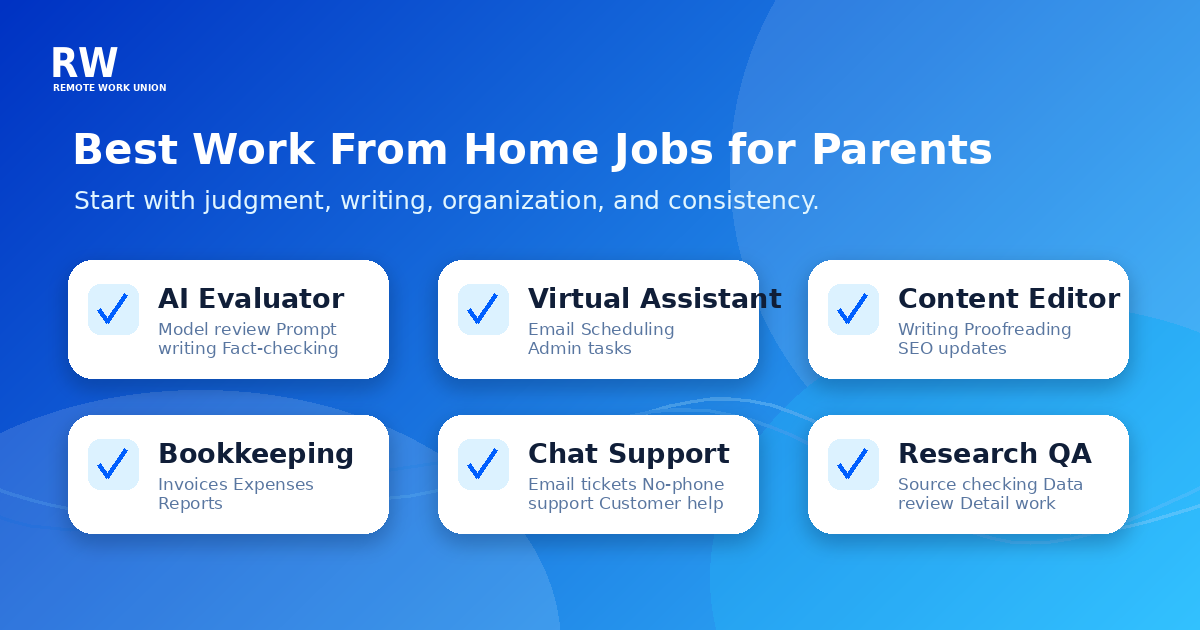
This guide breaks down the best work from home jobs for stay-at-home parents, including remote AI training, virtual assistant work, chat and email support, writing, bookkeeping, research, quality assurance, social media, and other flexible roles. The goal is not to chase every remote job. The goal is to apply for the ones that match the way parents actually have to work.
What stay-at-home parents should look for in a work from home job
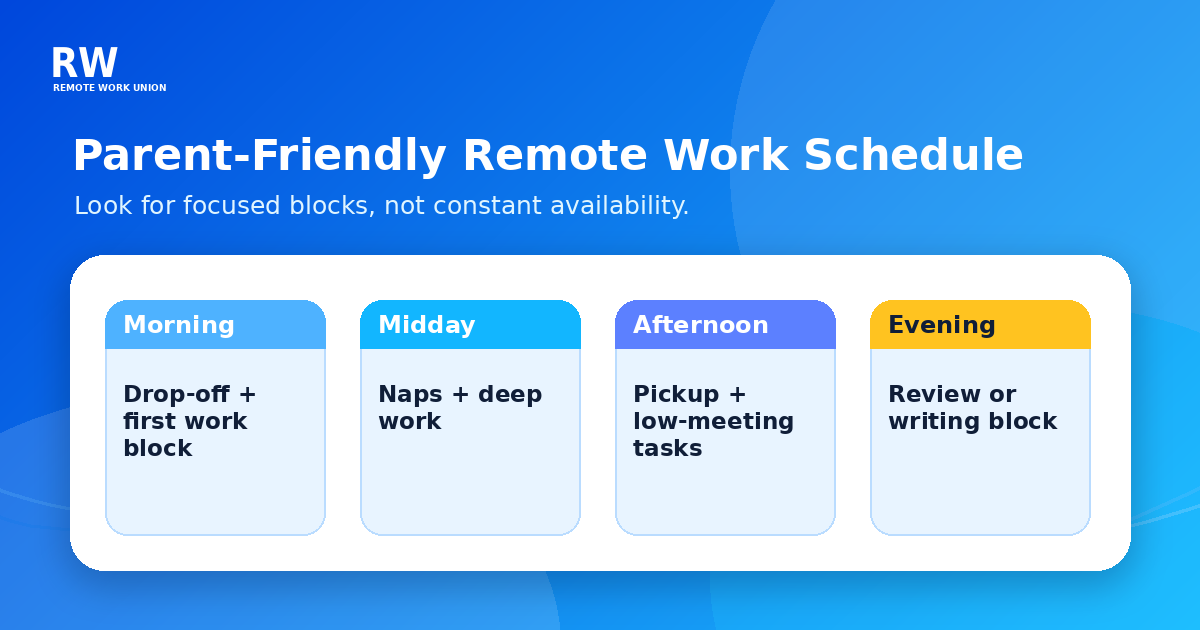
The best remote jobs for stay-at-home parents usually have five traits. First, the work can be done asynchronously. That means you are judged by the quality of completed work, not whether you are sitting in front of a webcam all day. Second, the job can be done in blocks. A parent may have 45 minutes in the morning, 90 minutes during a nap, and another hour after bedtime. Work that can be divided into blocks is far more sustainable.
Third, the role has a low meeting load. Meetings are not always bad, but frequent required calls can make a remote job much harder to manage from home. Fourth, the work uses existing skills. Parents with backgrounds in teaching, customer service, writing, health care administration, finance, sales, marketing, law, design, operations, or research may be able to convert those skills into remote tasks without starting over.
Fifth, the opportunity should be legitimate. Real remote work platforms and employers do not require you to pay to begin. They should explain the work, the requirements, the pay structure, and the application process. This matters especially for parents because time is limited. A bad lead can waste hours you do not have.
1. Remote AI evaluator and AI training jobs
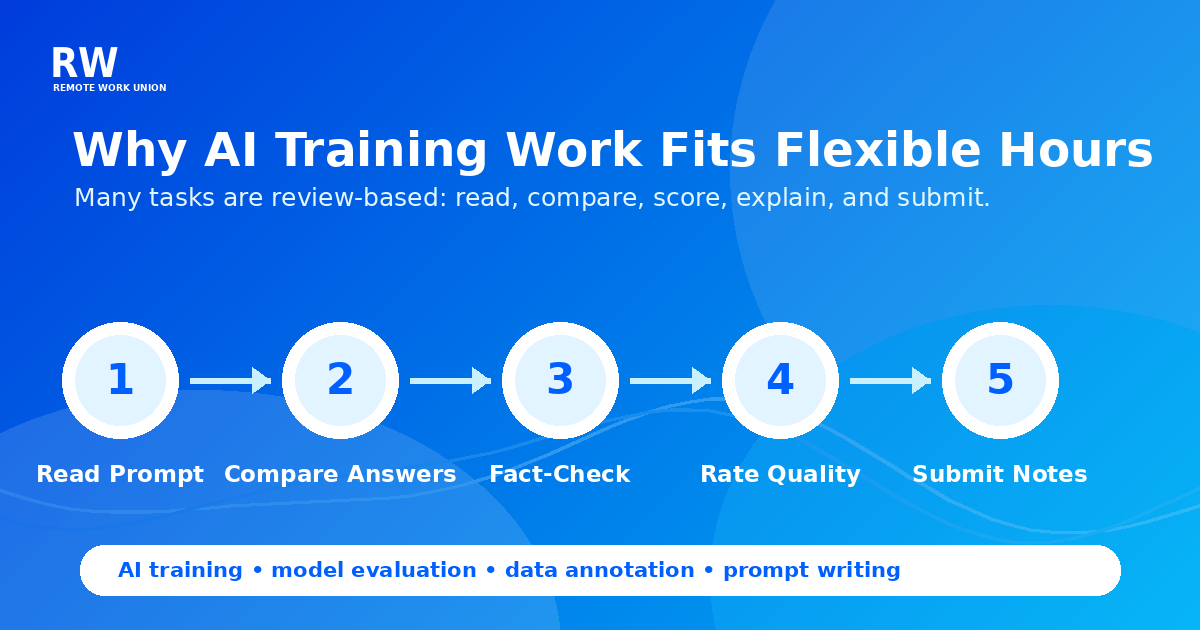
Remote AI training is one of the most relevant work from home categories for stay-at-home parents because many tasks are based on judgment, reading, writing, and careful review. These roles may use job titles such as AI evaluator, AI trainer, data annotator, model evaluator, prompt evaluator, response reviewer, AI content reviewer, or AI research assistant.
The work can include comparing two AI answers, rating whether a response followed instructions, checking factual accuracy, writing example prompts, labeling data, reviewing unsafe outputs, or explaining why one answer is better than another. This is the type of work connected to the growth of AI systems such as ChatGPT, OpenAI models, Anthropic models, Google AI products, Meta AI tools, and Grok. The exact platform, client, and task type can vary, but the underlying need is consistent: AI systems need human judgment.
For parents, the advantage is that many AI training tasks are task-based rather than call-based. You may be able to work in focused blocks, submit completed evaluations, and build a profile over time. This can be a better fit than customer phone support or rigid online meetings. The strongest applicants usually communicate clearly, follow instructions closely, and show that they can explain their reasoning without overcomplicating it.
Platforms and marketplaces such as micro1, Mercor, Handshake AI, Outlier, and similar remote AI work platforms may list roles for generalists, writers, researchers, coders, finance professionals, legal professionals, healthcare experts, teachers, and other subject matter experts. Parents do not have to be coders to qualify for every AI training job. Many projects need people who can read carefully, notice mistakes, evaluate tone, verify claims, and write useful feedback.
This is one of the best categories to consider first if you want remote work that pays for judgment instead of constant availability.
2. Virtual assistant and remote administrative work
Virtual assistant work is a strong option for stay-at-home parents who are organized, reliable, and comfortable handling digital tasks. A virtual assistant may manage email inboxes, schedule appointments, format documents, update spreadsheets, prepare simple reports, organize files, handle customer follow-up, or support a small business owner.
The parent-friendly version of this role is not the chaotic assistant job where you are expected to answer every message instantly. The better version is structured administrative support with clear tasks and deadlines. For example, a business might need five hours per week of calendar cleanup, invoice reminders, inbox sorting, and basic operations support. That can fit well around parenting if the expectations are clear.
This job works especially well for parents who previously worked in office management, executive assistant roles, customer success, recruiting, operations, education administration, real estate, healthcare offices, or nonprofit administration. Those backgrounds translate directly into remote admin work.
The best way to stand out is to present yourself as someone who reduces chaos. Mention tools you know, such as Google Workspace, Microsoft Office, Slack, Notion, Trello, Airtable, Canva, ChatGPT, QuickBooks, Calendly, or basic CRM systems. You do not need to know every tool. You need to show that you can learn systems quickly and keep work moving.
3. Email and chat customer support jobs
Customer support can be a good work from home job for parents, but the format matters. Phone-heavy support can be difficult with children at home because background noise and interruptions are hard to avoid. Email support, chat support, help desk ticketing, and community support are usually more realistic.
These roles involve answering customer questions, solving account issues, escalating technical problems, explaining policies, and documenting interactions. The best listings will say email support, live chat, ticket support, customer care specialist, customer experience associate, or support operations. A listing that requires constant phone coverage may still be remote, but it may not be the best parent-friendly option.
Parents with backgrounds in retail, hospitality, education, healthcare, sales, call centers, or office administration often have transferable skills for support work. The key is to frame the experience correctly. Instead of saying you only have in-person customer service experience, describe your ability to de-escalate problems, write clear responses, follow policies, and solve customer issues.
For stay-at-home parents, the best support jobs have written workflows, clear escalation rules, and predictable shifts. They may not be as flexible as AI training or freelance writing, but they can be more stable if you need regular income.
4. Freelance writing, editing, and proofreading
Writing and editing are among the most flexible remote jobs because they can often be done outside standard business hours. Stay-at-home parents who can write clearly, organize information, edit mistakes, or improve structure can look for roles such as content writer, blog writer, SEO writer, copywriter, editor, proofreader, newsletter writer, curriculum writer, or AI content editor.
The strongest opportunities are not always creative writing jobs. Many businesses need practical writing: product descriptions, help center articles, blog posts, email newsletters, social captions, website copy, internal documentation, and editing for clarity. AI has increased the amount of draft content in the world, but humans are still needed to check accuracy, improve tone, remove fluff, and make writing useful.
This is also connected to remote AI work. Many AI training platforms need writers and editors to test prompts, grade outputs, rewrite weak responses, and compare answer quality. A parent who has strong writing skills can use those skills in both traditional content work and AI evaluation work.
To start, create a simple portfolio with three to five samples. They do not have to be published by major websites. A clear blog post, a rewritten product description, a sample email sequence, or a before-and-after editing sample can show ability. The goal is to make it easy for a remote employer or platform reviewer to see that you can produce clean work.
5. Bookkeeping, invoicing, and finance support
Bookkeeping and finance support can be excellent work from home options for stay-at-home parents who are detail-oriented and comfortable with numbers. This category can include invoice tracking, expense categorization, basic bookkeeping, accounts receivable follow-up, accounts payable support, payroll coordination, spreadsheet cleanup, and monthly reporting.
This is not the same as being a certified accountant. Some roles require accounting credentials, but many small businesses need basic finance operations help. If you have experience with QuickBooks, Xero, Excel, Google Sheets, payroll systems, invoicing software, or business administration, you may already have useful skills.
Bookkeeping can work well around parenting because many tasks are deadline-based rather than meeting-based. A business may need weekly transaction categorization, monthly invoice follow-up, or recurring spreadsheet updates. Those tasks can often be done during focused work windows.
To apply, emphasize accuracy, confidentiality, consistency, and comfort with tools. Remote finance support requires trust. A profile that looks organized and professional can matter as much as the resume itself.
Stay-at-home parents can find flexible, asynchronous remote work that fits around caregiving responsibilities. Find opportunities hiring now.
Find Roles Hiring Now →6. Social media and content coordination
Social media work can be a good fit for stay-at-home parents who understand online communication, trends, basic design, and scheduling tools. This does not mean you have to become a full-time influencer or film yourself all day. Many businesses need behind-the-scenes help: planning posts, writing captions, scheduling content, creating simple graphics, responding to comments, organizing content calendars, or repurposing long content into short posts.
The parent-friendly version of this work is content coordination, not constant live posting. Look for job titles such as social media coordinator, content assistant, community assistant, marketing assistant, Canva designer, newsletter assistant, or short-form content editor.
This role can also pair well with AI tools. A parent who knows how to use ChatGPT, Canva, CapCut, Google Drive, and scheduling platforms can help small businesses produce content faster. The skill is not just using the tools. The skill is knowing what looks clean, what sounds professional, and what the audience needs to understand.
A simple portfolio can help here too. Create sample posts for a local business, mock content calendars, or before-and-after caption examples. Show that you can make content clear and organized.
7. Online tutoring and education support
Online tutoring can be a natural fit for parents with teaching, coaching, homeschooling, childcare, language, test prep, or subject matter experience. The work may include one-on-one tutoring, homework help, English conversation practice, curriculum support, test prep, or educational content review.
The main tradeoff is scheduling. Tutoring can pay well for the right subject, but it usually requires live sessions. That can be harder for parents with unpredictable daytime responsibilities. It may work best if your children are in school, if you have evening availability, or if you can schedule sessions during consistent blocks.
Education support can also extend beyond live tutoring. Some parents may be a better fit for curriculum writing, worksheet creation, educational editing, test question review, or AI training tasks that need subject expertise. These options can use teaching skills without requiring constant live calls.
Parents with education backgrounds should not overlook remote AI evaluator roles. AI companies and training platforms often need people who can judge explanations, spot confusing answers, and evaluate whether content is age-appropriate or instructionally useful.
8. Research assistant, fact-checking, and quality assurance
Research and quality assurance jobs are strong options for parents who are careful readers and good at noticing errors. These roles may involve verifying sources, checking data, reviewing search results, testing websites, comparing information, labeling records, or making sure content follows guidelines.
This category overlaps with remote AI jobs, search evaluation, data annotation, and content review. A task might ask you to decide whether an answer is accurate, whether a webpage satisfies a search query, whether a product listing is categorized correctly, or whether a generated response includes unsupported claims.
For stay-at-home parents, the advantage is that this work is often detail-based. You can develop a rhythm: read the instructions, complete a batch, submit, and move to the next task. The challenge is that quality standards can be strict. You need to slow down enough to avoid careless errors.
People with backgrounds in research, journalism, law, finance, healthcare administration, education, compliance, operations, or data entry may have a strong foundation for this work. The resume should emphasize accuracy, independent work, source checking, documentation, and written explanations.
9. Data entry, spreadsheet cleanup, and operations support
Data entry is one of the most searched work from home job categories, but it should be approached carefully. Some real roles exist, but the category attracts scams and low-quality listings. The better version is not generic data entry. It is operations support, spreadsheet cleanup, database maintenance, CRM updates, product catalog cleanup, or quality control.
For stay-at-home parents, this work can be useful because it is often asynchronous. You may be given a spreadsheet, a set of records, or a task queue and asked to complete a defined amount of work. It can fit around fragmented schedules.
However, pure data entry is often competitive and may not pay as well as roles that use judgment or specialized knowledge. If possible, combine data skills with another strength. For example, customer data cleanup plus CRM experience, spreadsheet work plus bookkeeping, product listing QA plus ecommerce experience, or data annotation plus AI evaluation.
When applying, avoid vague listings that promise easy money for simple typing. Look for clear task descriptions, named companies, normal hiring processes, and no upfront fees.
10. Recruiting sourcing and resume screening support
Recruiting support can be a strong remote option for parents with people skills, organization skills, or prior HR experience. Entry points include candidate sourcing, resume screening, interview scheduling, applicant tracking system updates, LinkedIn research, outreach coordination, and recruiting operations.
This role can be parent-friendly when it is structured around research and coordination. It becomes harder when it requires constant live calls or rapid-response messaging. The best listings will clarify whether the role is sourcing-heavy, admin-heavy, or phone-heavy.
Parents who have worked in sales, customer service, HR, recruiting, admissions, office management, or operations may be able to transition into this category. The core skills are reading profiles, matching experience to requirements, communicating clearly, and staying organized.
This is also useful knowledge for applying to remote work yourself. The more you understand how recruiters scan resumes and profiles, the better you can present your own skills.
How to choose the best role for your situation
The best work from home job for one parent may be a poor fit for another. Start by choosing based on schedule, not just pay. If your day is unpredictable, prioritize AI training, writing, editing, research, bookkeeping, or task-based admin work. If you have consistent quiet hours, consider tutoring, customer support, or recurring client work. If you need stable income, look for part-time employee roles or long-term contractor roles. If you need maximum flexibility, start with platforms and project-based work.
Next, match the role to your existing proof. If you have strong writing samples, apply for writing, editing, AI evaluation, and content review. If you have administrative experience, apply for virtual assistant, operations assistant, recruiting coordinator, and customer support roles. If you have a professional background in law, finance, healthcare, engineering, education, or marketing, look for expert-tier AI training and subject matter expert projects.
Finally, treat your profile as a remote work asset. A strong profile should explain what you do, what tools you know, what industries you understand, and what kind of remote work you are best suited for. Generic applications usually perform worse than focused applications. A stay-at-home parent does not need to apologize for needing flexibility. The better approach is to show that you can produce high-quality work independently.
A simple application strategy for stay-at-home parents
A practical strategy is to apply in three lanes. The first lane is flexible AI training and evaluation work. Apply to platforms and projects that match your writing, research, professional knowledge, or general reasoning skills. The second lane is skill-based remote work, such as virtual assistant work, bookkeeping, editing, social media coordination, or support operations. The third lane is stable part-time work, such as email support, tutoring, recruiting coordination, or administrative roles.
Do not spend all your time on one platform or one job board. Remote work is uneven. Some weeks one platform may have work and another may be quiet. A multi-platform approach gives you more chances to find consistent work.
Your first goal is not perfection. Your first goal is to build proof. Complete applications, improve your profile, save strong work samples, track where you applied, and follow up when appropriate. Once you find the type of remote work that fits your parenting schedule, double down on that category.
Scam filters parents should use before applying
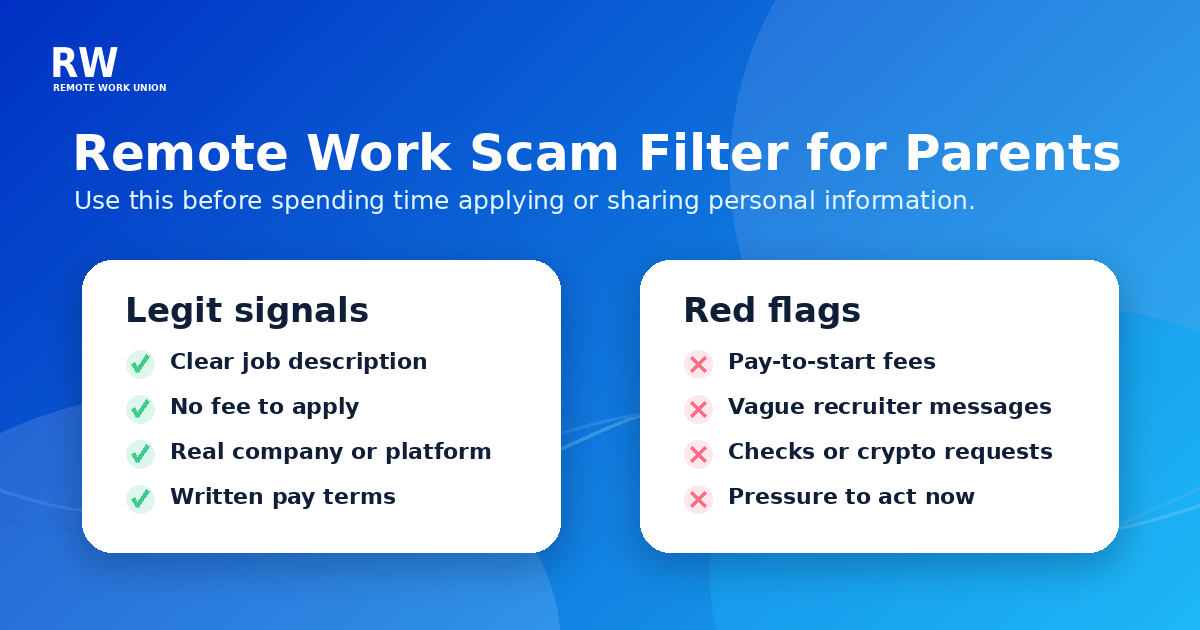
Stay-at-home parents are often targeted by remote work scams because scammers know many parents want flexible income from home. The biggest warning signs are simple: the company asks you to pay to start, sends a check before real work begins, asks for crypto, avoids explaining the job, uses a personal email address, pressures you to act immediately, or promises unusually high pay for very easy work.
A legitimate remote job or platform should have a clear application process, a real website, written terms, normal payment methods, and specific work requirements. It should not require you to buy equipment from a random vendor or deposit a check to send money elsewhere.
When in doubt, slow down. Search the company name, read the job description carefully, check whether the application is hosted on a legitimate domain, and avoid sharing sensitive information until you trust the process. Real remote work does not require panic.
Conclusion
The best work from home jobs for stay-at-home parents are the jobs that respect how parents actually live. Remote AI evaluation, virtual assistant work, email and chat support, writing, editing, bookkeeping, social media coordination, tutoring, research, quality assurance, operations support, and recruiting support can all work if the schedule and expectations are realistic.
The strongest path is to avoid generic work-from-home promises and focus on roles that use your actual skills. If you can write, research, organize, review details, explain decisions, support customers, manage records, or evaluate information, you may already have the foundation for remote work.
Start with flexible, task-based opportunities. Build proof. Apply across multiple platforms. Keep your profile clear. Protect your time. The right remote job should help you earn from home without forcing you to choose between income and caregiving.
Frequently Asked Questions
What work from home jobs are best for stay-at-home parents?
Remote AI evaluation, virtual assistant work, email and chat customer support, freelance writing and editing, bookkeeping, social media coordination, online tutoring, and research assistant work are all strong options because they tend to be asynchronous, task-based, and manageable around caregiving schedules.
Can I do AI training work with an unpredictable parenting schedule?
Many AI training tasks are designed to be completed in blocks rather than during fixed hours. If the work is task-based and asynchronous, it can fit around parenting. Check whether specific platforms require fixed availability windows before applying.
What remote jobs for stay-at-home parents have no phone calls?
Remote AI evaluation, data annotation, writing, editing, research, bookkeeping, email support, social media coordination, and many virtual assistant roles are email and task-based with no required phone calls. Search for listings that say "email support," "async," "ticket-based," or "no phone."
How do I know if a work from home job is legitimate?
Legitimate remote employers have a verifiable company, a clear job description, normal hiring steps, and no upfront payment demand. Avoid any opportunity that charges you to start, sends a check before work begins, or promises unusually high pay for minimal effort. Real platforms and employers do not need you to pay them first.