Changing careers after 40 is not the same as starting from zero. It usually means you already have years of judgment, communication, reliability, customer awareness, process knowledge, and professional context. Those are exactly the traits that many remote work jobs need.
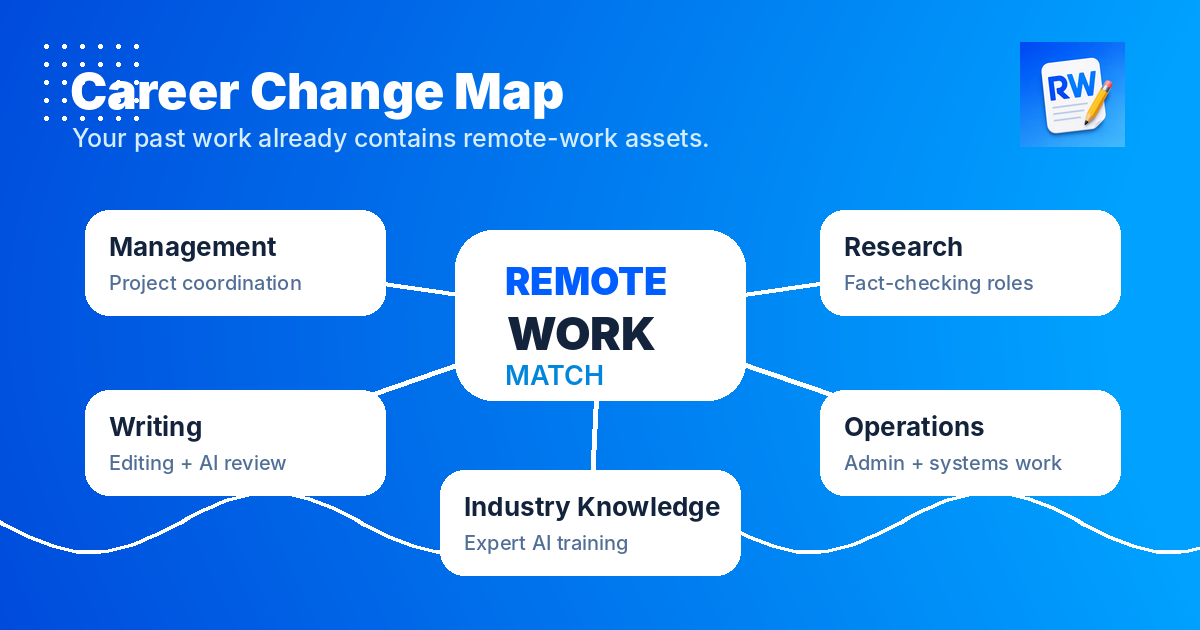
The mistake many career changers make is looking only for jobs that match their old title. A former teacher searches only for remote teaching jobs. A former office manager searches only for office manager jobs. A former sales rep searches only for sales jobs. That can work, but it is too narrow. Remote work rewards transferable skills, not just exact job titles.
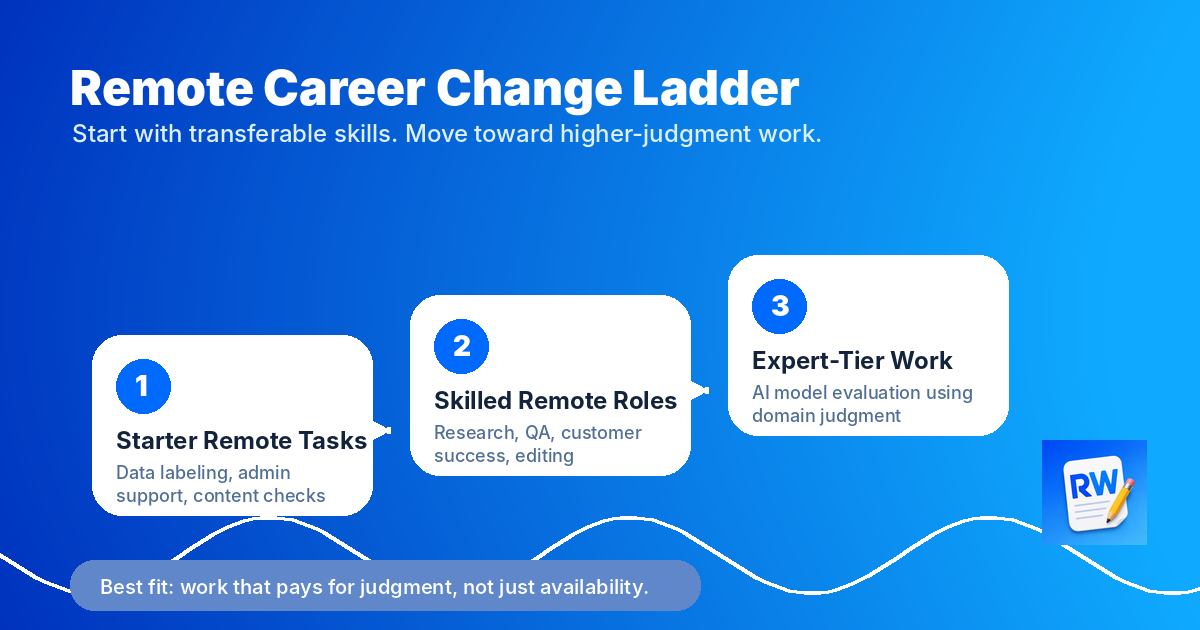
The best remote work jobs for career changers over 40 usually fall into one of three categories: roles that use professional judgment, roles that use communication and organization, and roles that use subject-matter knowledge. This includes AI training jobs, AI evaluator jobs, remote research roles, customer success, operations support, editing, proofreading, project coordination, data annotation, and expert review work.
A career change after 40 is easiest when you stop presenting yourself as a beginner and start presenting yourself as someone bringing useful experience into a new format.
In This Article
- What career changers over 40 should look for in remote work
- 1. AI model evaluator and AI response reviewer
- 2. Subject matter expert AI training
- 3. Remote research analyst or research assistant
- 4. Content editor, proofreader, and quality reviewer
- 5. Customer success and client support roles
- 6. Remote operations coordinator or virtual assistant
- 7. Project coordinator and program support
- 8. Data annotation, data quality, and QA review
- 9. Online training, course support, and curriculum work
- 10. Remote sales support and account management
- How to match your background to the right remote role
- Resume and profile tips for career changers over 40
- Where to apply for remote work as a career changer
- What to avoid
- A simple 30-day plan for career changers over 40
What Career Changers Over 40 Should Look For in Remote Work
The best remote work job is not always the highest-paying listing. It is the role where your existing skills convert cleanly into remote output.
Look for remote jobs that value written communication, independent decision-making, quality control, research, client service, documentation, and judgment. These roles are easier to do from home because the work can be measured through completed tasks, written feedback, response quality, ticket resolution, reviewed content, organized systems, or project progress.
Career changers over 40 should be cautious with roles that are really just availability-based work. If the entire job is sitting online waiting for chats, taking nonstop phone calls, or doing repetitive clicks for very low pay, it may be remote, but it may not be a strong career move.
A better target is remote work that lets you use what you already know. If you have managed people, handled customers, written reports, trained employees, reviewed documents, solved business problems, worked with data, edited content, or made judgment calls, you already have skills that can translate into work from home jobs.
1. AI Model Evaluator and AI Response Reviewer
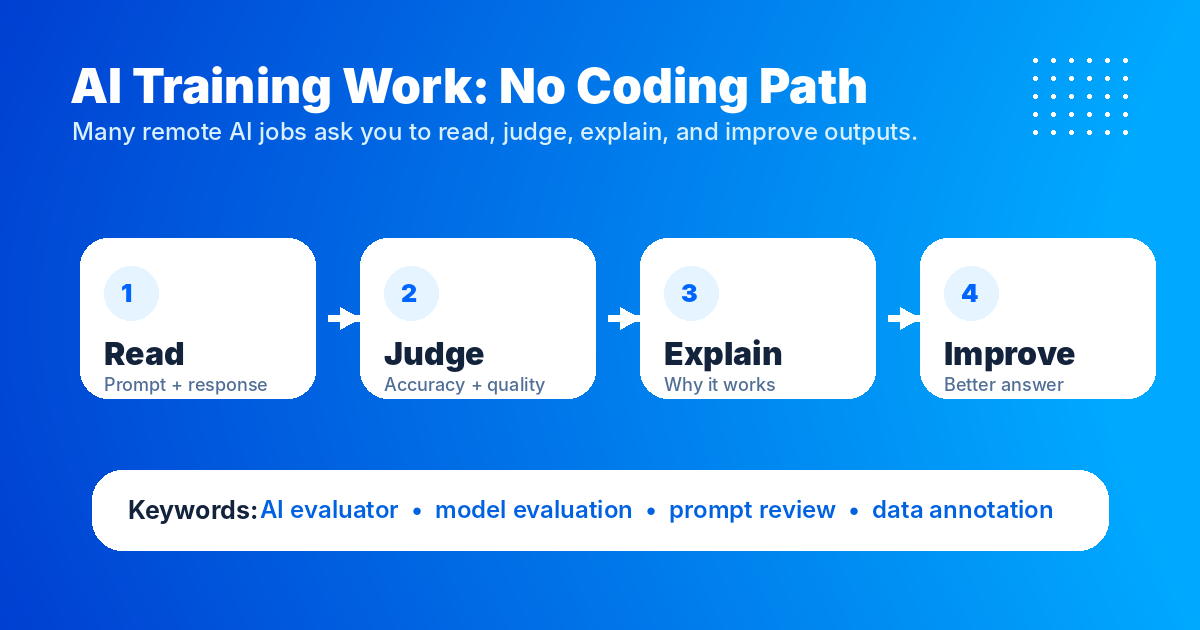
AI model evaluation is one of the strongest remote work categories for career changers because many roles do not require coding. Instead, the work often involves reading an AI-generated answer, judging whether it is accurate or useful, comparing two responses, checking instructions, identifying mistakes, and explaining your reasoning clearly.
This is where life and work experience can matter. Someone who has spent years writing emails, reviewing documents, managing customers, analyzing problems, teaching, selling, or operating a business may be better at spotting unclear logic than someone who only knows how to click through tasks quickly.
AI evaluator jobs may appear under different titles, including AI trainer, AI data annotator, AI response reviewer, search quality rater, prompt evaluator, LLM evaluator, model evaluation specialist, content quality reviewer, or AI research tasker. Platforms and contractors connected to the AI ecosystem may support work that helps improve systems built by or around companies such as OpenAI, Anthropic, Google, Meta, Grok, and other major AI labs.
For career changers over 40, this category is appealing because it can reward clear thinking, careful reading, and concise written explanations. It is also a good fit for people who want flexible remote work without becoming software engineers.
2. Subject Matter Expert AI Training
Subject matter expert AI training is a more specialized version of remote AI work. Instead of rating general answers, you review outputs in a field you already understand. That could include business, finance, law, healthcare administration, education, marketing, accounting, engineering, science, real estate, insurance, human resources, procurement, or another professional area.
The value comes from expertise. AI systems need feedback from people who can recognize when an answer sounds plausible but is incomplete, poorly reasoned, or missing practical context. A person with 15 or 20 years in an industry may be able to catch errors that a generic reviewer would miss.
These jobs may use titles such as subject matter expert, AI domain expert, expert reviewer, AI trainer, prompt evaluator, legal AI reviewer, finance AI evaluator, medical content reviewer, business analyst AI trainer, or technical writing reviewer.
This path is especially strong for career changers over 40 who do not want to abandon their old experience but also do not want to keep doing the same traditional office job.
3. Remote Research Analyst or Research Assistant
Remote research jobs are a natural fit for people who are curious, careful, and good at separating useful information from noise. These roles can involve collecting information, summarizing findings, checking sources, comparing companies, building lists, reviewing documents, or preparing short written briefs.
Research work often suits career changers because it does not always require a perfectly linear resume. A strong researcher needs patience, accuracy, judgment, and writing ability. Those skills can come from many backgrounds: teaching, journalism, law, sales, operations, consulting, customer service, recruiting, real estate, finance, nonprofit work, or management.
Search for titles such as remote researcher, research analyst, market research assistant, business research specialist, content researcher, AI research evaluator, fact-checker, online research assistant, and data research associate.
This is also a useful bridge category. A career changer can use remote research work to build proof of remote performance while moving toward higher-paying strategy, AI evaluation, writing, or analysis roles.
4. Content Editor, Proofreader, and Quality Reviewer
Editing and proofreading are not only for people with journalism backgrounds. Many professionals have spent years reviewing emails, proposals, reports, presentations, training documents, policies, customer messages, or marketing materials. That experience can translate into remote editing and quality review roles.
Remote content quality jobs can include proofreading, grammar review, fact-checking, tone improvement, AI content review, style guide enforcement, compliance checks, and user-facing content edits. In AI training, editing skills are especially useful because many tasks require identifying whether an AI answer is clear, accurate, complete, and well structured.
Useful job titles include remote editor, proofreader, AI content editor, content quality analyst, QA reviewer, writing evaluator, copy editor, content moderator, search evaluator, and response quality reviewer.
For career changers over 40, the key is to frame editing as business judgment, not just grammar. Employers and platforms want people who can improve clarity, catch problems, and explain what needs to change.
Career changers over 40 are strong candidates for remote AI training, research, and operations roles. Find opportunities that value your experience today.
Find Roles Hiring Now →5. Customer Success and Client Support Roles
Customer success is one of the most practical remote job categories for career changers. It fits people who understand how to communicate with clients, solve problems, explain products, retain accounts, and keep customers calm.
This category is different from basic phone support. Some customer service jobs are nonstop call-center roles. Customer success can be more strategic: onboarding customers, answering questions through email or chat, helping users understand software, tracking account health, collecting feedback, and coordinating with internal teams.
Search for titles such as customer success specialist, customer support specialist, client success associate, onboarding specialist, account coordinator, customer experience specialist, support operations associate, and implementation coordinator.
People over 40 often have an advantage here because they may have more experience dealing with difficult situations, managing expectations, writing professional messages, and understanding business relationships. The best versions of these jobs reward maturity and problem solving.
6. Remote Operations Coordinator or Virtual Assistant
Remote operations work is a strong option for people who are organized, dependable, and good at keeping systems moving. These jobs can involve scheduling, inbox management, data entry, document organization, vendor coordination, reporting, CRM updates, workflow tracking, and internal process support.
Virtual assistant jobs can be a good entry point, but career changers should not undersell themselves. If you have managed offices, teams, projects, events, budgets, vendors, or administrative systems, you may be better positioned as an operations coordinator, executive assistant, project assistant, or business support specialist.
Search for titles such as remote operations assistant, operations coordinator, virtual assistant, executive assistant, administrative coordinator, business operations associate, project assistant, recruiting coordinator, and office operations specialist.
This path works well for career changers who want remote work that is steady, practical, and not overly technical.
7. Project Coordinator and Program Support
Project coordination is a good remote role for people who have managed deadlines, worked across teams, handled details, or kept other people organized. You do not always need to be a certified project manager to qualify for entry-level or mid-level project coordinator work.
Remote project coordinators help track tasks, update project boards, communicate status, schedule meetings, document next steps, and make sure work does not fall through the cracks. People with backgrounds in operations, education, events, marketing, construction administration, healthcare administration, nonprofit programs, customer success, or office management may already have relevant experience.
Search for titles such as project coordinator, program coordinator, implementation coordinator, operations project coordinator, project assistant, delivery coordinator, and remote PM assistant.
For career changers over 40, this role is often about translating past responsibility into modern remote tools. Knowing how to use tools like spreadsheets, shared documents, task boards, video calls, and AI writing assistants can make the transition easier.
8. Data Annotation, Data Quality, and QA Review
Data annotation and data quality jobs can be a useful way to break into remote AI work. These roles may involve labeling information, reviewing examples, categorizing content, checking whether data is accurate, or making quality decisions based on written guidelines.
The entry-level versions can be repetitive, but they are still better than many survey apps or low-quality gig sites when they are offered by legitimate platforms. More advanced data quality roles can lead toward AI evaluation, content QA, research QA, or subject-matter review work.
Search for titles such as data annotator, AI data annotation specialist, data quality analyst, QA reviewer, content labeler, search quality rater, AI task reviewer, and evaluation specialist.
Career changers should focus on accuracy and guideline-following. These jobs are often less about speed and more about consistency, attention to detail, and the ability to explain decisions when required.
9. Online Training, Course Support, and Curriculum Work
People who have trained employees, taught classes, coached teams, written manuals, onboarded new hires, or explained complex topics may fit remote training and course-support roles.
These jobs can include helping students or customers through online programs, reviewing course materials, writing learning content, supporting webinars, creating training documentation, or answering questions in a learning platform.
Search for titles such as online trainer, learning support specialist, curriculum writer, instructional assistant, training coordinator, course support specialist, education content reviewer, and remote tutor.
This is a strong path for teachers leaving the classroom, managers who have trained teams, HR professionals, coaches, consultants, and anyone who is good at explaining ideas clearly.
10. Remote Sales Support and Account Management
Not every sales-related remote job is cold calling. Career changers with people skills may do well in account management, sales operations, renewals, lead qualification, proposal coordination, or customer relationship support.
These roles can involve preparing outreach, keeping records updated, helping account executives, responding to inbound prospects, supporting renewals, tracking pipeline activity, or managing existing customer relationships.
Search for titles such as account coordinator, sales support specialist, sales operations assistant, account manager, renewals specialist, business development coordinator, and client relationship associate.
For career changers over 40, sales support can be appealing because it values communication, persistence, follow-up, and business judgment. It is usually a better target than entry-level cold calling if you want a more stable remote path.
How to Match Your Background to the Right Remote Role
The fastest way to choose a remote work direction is to identify the skill you have used the longest.
If your strongest skill is explaining things, consider AI response review, tutoring, training support, curriculum work, customer success, or documentation.
If your strongest skill is organizing chaos, consider operations coordination, project coordination, executive assistance, recruiting coordination, or business support.
If your strongest skill is reading carefully and catching errors, consider proofreading, quality assurance, AI evaluation, data annotation, search quality rating, or content review.
If your strongest skill is industry knowledge, consider subject-matter expert AI training, consulting support, expert review, research analysis, or specialized content evaluation.
If your strongest skill is dealing with clients, consider customer success, account management, onboarding, implementation support, or client operations.
A career change over 40 becomes much easier when you stop asking, "What job title have I had before?" and start asking, "What judgment can I bring to remote work?"
Resume and Profile Tips for Career Changers Over 40
Your resume should not read like a complete career archive. It should read like a remote-work argument.
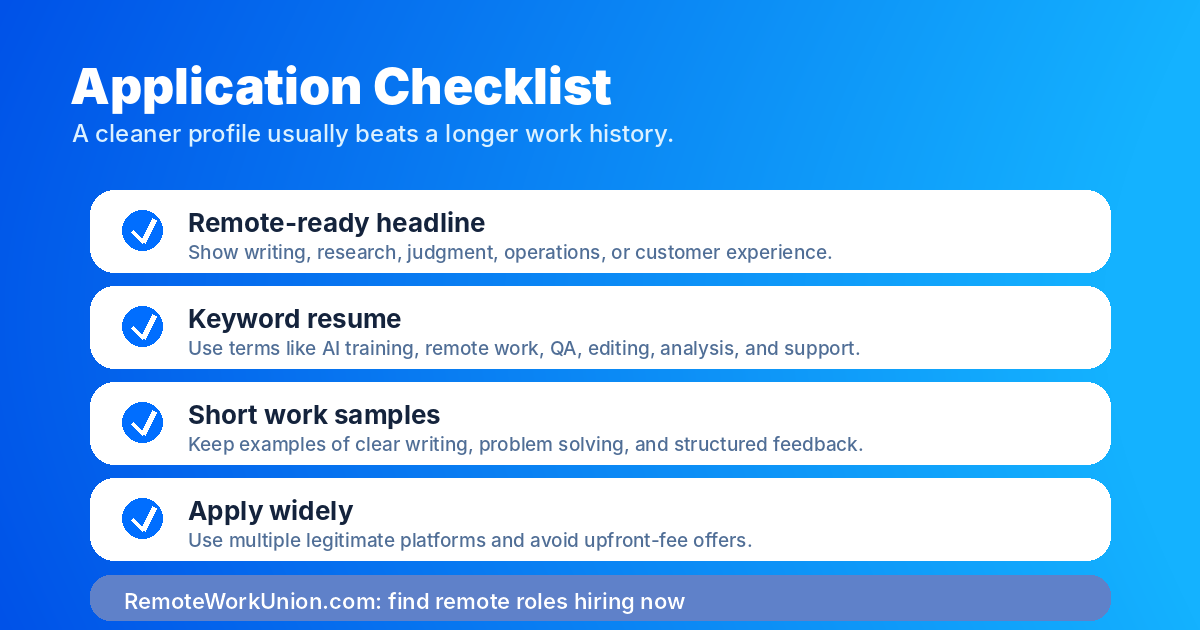
Lead with a headline that points toward your target role. For example: "Remote Operations Coordinator," "AI Response Reviewer," "Customer Success Specialist," "Research Analyst," "Content Quality Reviewer," or "Subject Matter Expert - AI Training." Then use a short summary that explains your transferable value.
Good summary example: "Experienced operations and customer-facing professional with strong writing, research, documentation, and quality review skills. Seeking remote work in AI training, customer success, research, or operations support. Comfortable working independently, following detailed guidelines, and producing clear written feedback."
Use modern keywords without pretending to be something you are not. Good keywords may include remote work, work from home, AI training, AI evaluator, model evaluation, data annotation, quality assurance, research, writing, editing, customer success, operations, documentation, project coordination, CRM, spreadsheets, prompt review, content review, and subject-matter expertise.
You do not need to list every job from 25 years ago. Keep the focus on relevant experience, recent tools, transferable wins, and proof that you can work independently.
Where to Apply for Remote Work as a Career Changer
Career changers should apply through multiple channels. Do not rely on one platform, one job board, or one application.
For AI training and AI evaluator work, look at platforms and companies that list remote evaluation, annotation, expert review, or model training projects. Examples may include micro1, Mercor, Handshake AI, Outlier, DataAnnotation-style platforms, and other AI training marketplaces. Availability changes, so treat these as places to check rather than guaranteed openings.
For broader remote work, look for customer success, operations, research, virtual assistant, project coordination, editing, and QA roles on reputable job boards and company career pages. Search with both traditional job titles and AI-specific keywords.
The smartest strategy is to build a multi-platform pipeline. Apply to several legitimate remote work platforms, create a clean remote-ready profile, keep a simple tracking sheet, and follow up where appropriate. This matters because remote project flow can be inconsistent. One platform may be quiet while another has work available.
What to Avoid
Career changers over 40 are often targeted by low-quality remote work ads because scammers know many people want flexibility. Avoid any opportunity that charges you to start, asks you to buy equipment through a strange payment process, promises unrealistic pay for no skill, uses vague company information, or pressures you to communicate only through unofficial channels.
Also be careful with survey sites, task apps, and "easy money" offers that pay very little for your time. They may be technically remote, but they usually do not build a real remote career.
A serious remote work path should help you build proof: completed projects, stronger writing samples, better platform history, customer success metrics, research examples, QA experience, or documented subject-matter expertise.
A Simple 30-Day Plan for Career Changers Over 40
Days 1 to 3: Choose two target categories. Good combinations include AI evaluator plus research, operations plus virtual assistant, customer success plus sales support, editing plus AI content review, or subject-matter expert AI training plus consulting support.
Days 4 to 7: Rewrite your resume and profile around transferable skills. Remove clutter. Add remote-work keywords. Make your headline specific.
Days 8 to 14: Apply to legitimate platforms and roles. Create profiles on relevant AI training platforms, apply to remote job listings, and track every application.
Days 15 to 21: Build proof. Create short samples: a writing sample, a research summary, a mock QA review, a customer email response, or a simple operations process document.
Days 22 to 30: Improve based on results. If you get no responses, sharpen your headline, change your target keywords, and apply to roles with a tighter fit. If you get assessments, take them seriously. Clear writing and careful instructions matter.
Conclusion
The best remote work jobs for career changers over 40 are not limited to entry-level tasks. Your experience can be useful if you package it correctly.
AI training, AI evaluation, subject-matter expert review, remote research, customer success, operations support, project coordination, editing, proofreading, data quality, and training support all reward skills that many experienced professionals already have.
The goal is not to look younger, start over, or pretend your past career did not happen. The goal is to translate your experience into remote-work language: judgment, accuracy, communication, organization, research, quality control, and independent execution.
Frequently Asked Questions
Are remote AI jobs good for career changers over 40?
Yes, they can be a strong fit when the role values judgment, writing, research, industry knowledge, or careful review. Many AI training jobs do not require coding.
Do I need a degree to get remote work after 40?
Some roles require a degree, but many remote work jobs care more about skills, samples, professional experience, and reliability. AI evaluator roles, operations support, virtual assistant work, customer success, proofreading, and research roles may have paths without a specific degree requirement.
Should I hide my age on my resume?
You do not need to hide your experience, but you should avoid making the resume feel dated. Focus on recent, relevant skills. You usually do not need to list every early-career job or graduation year unless it helps your case.
What is the best first remote job for someone changing careers?
The best first role depends on your background. If you write well, try AI response review, editing, or research. If you are organized, try operations or project coordination. If you are client-facing, try customer success or account support. If you have deep industry experience, try subject-matter expert AI training.
Can I build a long-term remote career from AI training work?
Possibly. Some people use AI training as flexible project work, while others use it to build experience in model evaluation, prompt review, content quality, research, or subject-matter review. The strongest path is to use it as part of a broader remote-work pipeline, not as your only option.