Writing skills are some of the most useful skills for work-from-home jobs because they travel well. A person who can explain ideas clearly, edit messy drafts, compare two answers, summarize research, and write for a specific audience can do valuable work without being in an office.
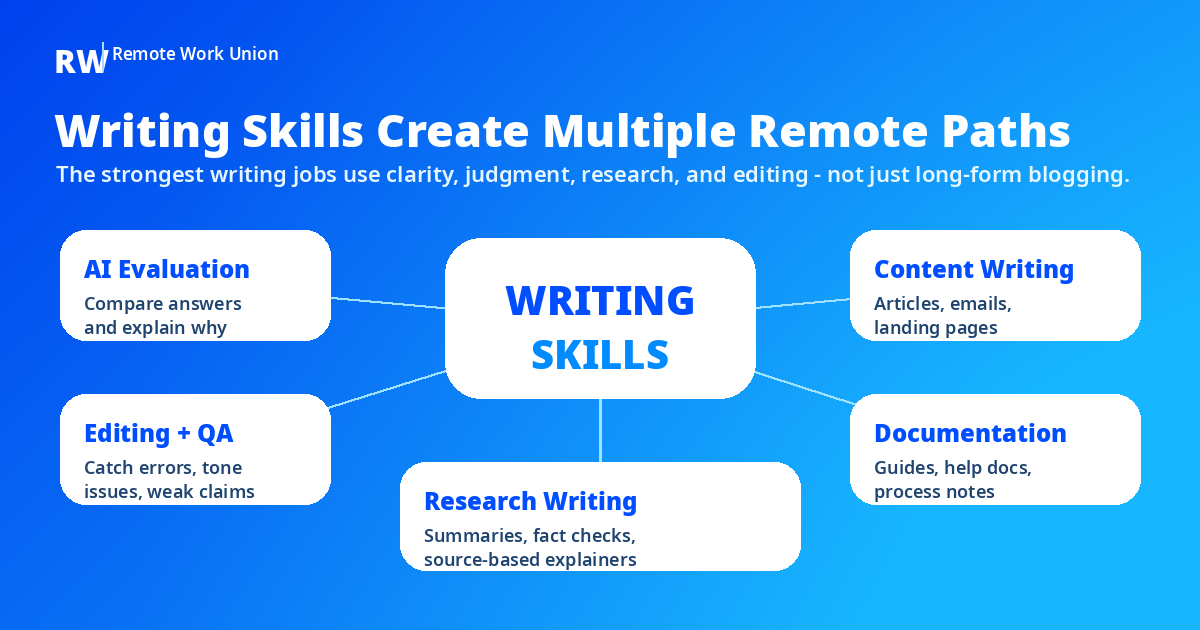
The mistake many applicants make is thinking writing jobs only mean blogging. Blogging is one path, but it is not the whole category. In 2026, writing skills show up in remote AI training work, AI response evaluation, content editing, documentation, UX writing, research jobs, email marketing, proposal writing, and quality assurance roles. Many of these jobs do not require coding. They require judgment, clarity, accuracy, and the ability to turn vague information into useful written output.
This guide breaks down the best work from home jobs that use writing skills, what each role actually does, and how to position yourself if you want remote work but do not have a traditional writing background.
Why writing skills work so well for remote jobs
Writing fits remote work because the output is easy to review asynchronously. A manager, client, or AI training platform can assign a task, review the written result, give feedback, and measure improvement without needing everyone in the same room. That makes writing-based work especially compatible with part-time, contract, freelance, and flexible remote roles.
Strong writing also signals more than grammar. It shows that you can organize thoughts, follow instructions, notice details, communicate with strangers, and explain reasoning. Those same skills matter in remote jobs across marketing, operations, customer experience, product, education, recruiting, AI evaluation, and research.
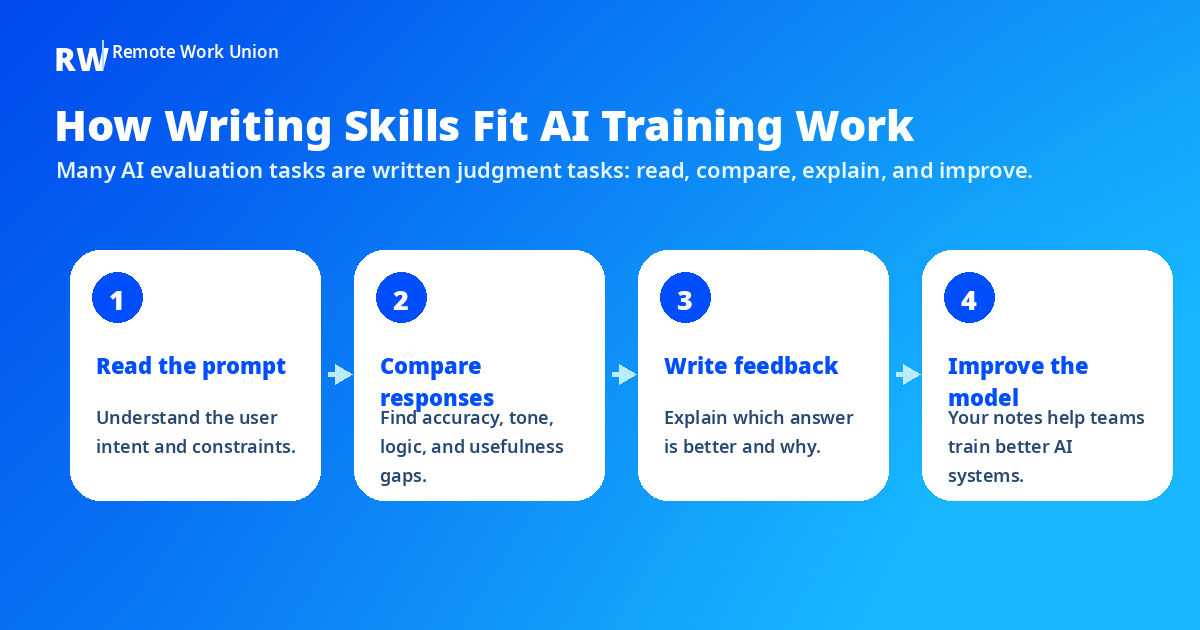
For AI companies and AI-related platforms, writing skills have become even more valuable. When people evaluate model outputs, compare chatbot responses, label data, rewrite weak answers, or explain why one response is better than another, they are doing writing-based judgment work. Companies building or evaluating models around OpenAI, Anthropic, Google, Meta, Grok, and other AI systems need human feedback that is clear enough to be useful. A vague rating does not help much. A precise written explanation does.
1. AI response evaluator
An AI response evaluator reviews AI-generated answers and decides which ones are accurate, helpful, safe, clear, and aligned with the user request. This is one of the strongest remote work paths for people with writing skills because the work depends on written judgment.
A typical task may ask you to compare two responses to the same prompt. You might check whether each response follows instructions, avoids unsupported claims, uses the right tone, answers the full question, and explains the subject well. Then you write a short justification for your rating.
This role is a good fit if you are the type of person who notices when an answer sounds confident but incomplete. It is also a good fit for editors, teachers, writers, researchers, lawyers, analysts, students, and generalists who can explain why something is good or bad. You do not need to be a software engineer to evaluate whether a written answer makes sense.
Tip: Useful keywords for this role include AI evaluator, AI response reviewer, AI writing evaluator, AI trainer, AI annotation, AI data annotation, human feedback, model evaluation, prompt evaluation, and remote AI jobs. Use these when searching platforms and building your profile.
2. Prompt writer or prompt tester
Prompt writers and prompt testers create or test the instructions given to AI systems. The job is not just typing random questions into a chatbot. Good prompt work requires clarity, structure, scenario design, and the ability to predict how a model might misunderstand an instruction.
A prompt tester may write prompts to check reasoning, creativity, factual accuracy, tone, policy handling, or domain knowledge. A prompt writer may create sample tasks that help train or evaluate an AI model. In both cases, the core skill is written communication.
This is a strong work-from-home job for people who can write precise instructions. If you have experience writing briefs, assignments, social captions, emails, lesson plans, SOPs, scripts, or client instructions, you may already have relevant experience. The best prompt writers are not necessarily the most technical people. They are often the clearest thinkers.
3. AI content editor
AI content editors review, rewrite, and improve AI-generated content. This can include articles, product descriptions, help center pages, summaries, emails, chatbot responses, and internal documentation. The editor's job is to make the output more accurate, readable, natural, and useful.
This is different from simply accepting whatever an AI tool writes. A skilled AI content editor checks facts, removes generic filler, improves structure, fixes tone, and makes sure the final answer fits the audience. That requires human taste and judgment.
This role is especially relevant for writers who are comfortable using AI tools but do not want to become programmers. Remote teams may look for people who can combine AI-assisted drafting with human editing. If you can take a rough draft and turn it into something polished, this category is worth targeting.
4. SEO content writer
SEO content writing is still one of the most common remote writing paths. SEO writers create articles, landing pages, comparison pages, product guides, and educational resources designed to help websites rank in search engines.
The job uses writing skills, but it also rewards research, structure, keyword awareness, and search intent. A good SEO writer does not just stuff keywords into a page. They answer the reader's question better than competing pages. They organize the article so it is easy to scan, include related terms naturally, and write with enough depth to be useful.
For work-from-home applicants, SEO writing is attractive because it can be freelance, part-time, contract, or full-time. It is also portfolio-friendly. You can create sample articles in niches like remote work, AI tools, finance, health, software, music, real estate, legal services, education, or local business.
5. Copywriter
Copywriters write words designed to drive action. That can include landing pages, ads, sales emails, product pages, social media campaigns, app notifications, and sign-up flows. The writing is usually shorter than blog writing, but it requires sharper thinking.
Remote copywriting roles are a good fit for people who understand persuasion, audience pain points, and clear calls to action. You do not need to write in a flashy style. In many industries, the best copy is simple, direct, and specific.
If you want this type of work, build samples that show you can write for a real business goal. A before-and-after landing page rewrite, a welcome email sequence, or a product description set can be more useful than a general writing sample.
6. Technical writer or documentation specialist
Technical writers create instructions, user guides, help center articles, onboarding documents, API explanations, internal SOPs, and process documentation. Some technical writing roles require software or engineering knowledge, but many documentation roles simply require the ability to explain steps clearly.
This is one of the best remote work categories for people who like structure. If you can take a confusing process and turn it into a clean step-by-step guide, you have a documentation skill. That skill is useful in software, healthcare, finance, operations, education, recruiting, customer support, and AI training.
A strong documentation sample might explain how to use a tool, complete a workflow, troubleshoot an issue, or follow a company process. The sample should be clean, organized, and easy to follow.
Want to find remote work that fits strong writers? Discover opportunities hiring now.
Find Roles Hiring Now →7. UX writer or product copywriter
UX writers write the small pieces of text inside products: button labels, error messages, onboarding screens, empty states, tooltips, confirmation messages, and product flows. The work is writing, but it is also product thinking.
This role is good for writers who like brevity. A UX writer may spend time deciding whether a button should say "Submit," "Continue," "Apply now," or "Save changes." That may sound small, but product copy affects whether users understand what to do.
Remote UX writing roles often overlap with product design, content design, customer experience, and software teams. You can build a sample by redesigning the copy in a common app flow, writing clearer error messages, or creating onboarding screens for a fictional product.
8. Research writer or fact-checking editor
Research writing is a strong remote category for people who like reading, verifying, and summarizing information. Tasks may include writing research briefs, summarizing sources, checking claims, comparing products, preparing background notes, or creating explainers.
This type of work is valuable because the internet is full of weak, copied, or unsupported content. Companies need people who can separate useful information from noise. AI training platforms also need workers who can identify hallucinations, unsupported claims, weak sourcing, and misleading phrasing.
If you want to apply for research-heavy remote roles, your samples should show source judgment. Do not just write an opinion. Show how you gathered information, what you included, what you left out, and why the final summary is reliable.
9. Proposal writer, grant writer, or RFP writer
Proposal writing is business writing with a clear outcome. The goal is usually to help an organization win funding, secure a client, respond to an RFP, or explain why it should be selected for a project.
This work can be remote because the deliverable is written and deadline-based. It rewards organization, attention to detail, persuasive writing, and the ability to follow strict requirements. It is often a good fit for people with experience in nonprofits, consulting, education, government contracting, sales, operations, or project management.
Proposal writing is not always beginner-friendly, but it can pay better than general content writing because the writing is tied to revenue. If you are new, start by learning proposal structure, creating sample executive summaries, and practicing how to turn messy notes into a clear case for selection.
10. Resume writer, profile writer, or LinkedIn writer
Resume and profile writing uses writing skills in a very practical way. Clients need help turning their experience into clear, keyword-rich, results-oriented language. This work can include resumes, cover letters, LinkedIn profiles, freelancer bios, creator media kits, and application summaries.
This role fits people who understand hiring language. You need to know how to translate responsibilities into achievements, remove vague wording, and make a person's background easier to scan.
It can also connect naturally with remote work. Many applicants are trying to move into work-from-home jobs, remote AI jobs, customer success roles, marketing roles, writing jobs, or operations jobs. A resume writer who understands remote hiring can help them present relevant skills more clearly.
11. Curriculum writer or training content writer
Curriculum writers create lessons, training materials, quizzes, onboarding guides, scripts, workshops, and educational content. This is a strong remote path for teachers, tutors, coaches, subject matter experts, and writers who enjoy explaining concepts.
AI training and online education have increased the need for clear learning materials. A curriculum writer may create a module that teaches employees how to use a tool, helps new hires understand a workflow, or guides students through a concept.
This role uses writing, structure, and empathy. You have to understand what the learner knows now, what they need to know next, and how to move them from one point to the other without confusion.
12. Bilingual writer, translator, or localization editor
Bilingual writing and localization are valuable remote skills because companies need content that works across languages and regions. Translation is part of the category, but localization goes further. A localization editor makes content sound natural for a specific audience, not just technically correct.
This can include app copy, website pages, support articles, marketing emails, product descriptions, subtitles, AI evaluation tasks, and multilingual data annotation. For AI training work, bilingual workers may help evaluate whether model outputs are accurate, natural, and culturally appropriate in more than one language.
If you speak and write fluently in more than one language, include that clearly in your remote work profile. Mention the language pair, your writing level, and the types of content you can handle.
How to choose the best writing-based remote job for you
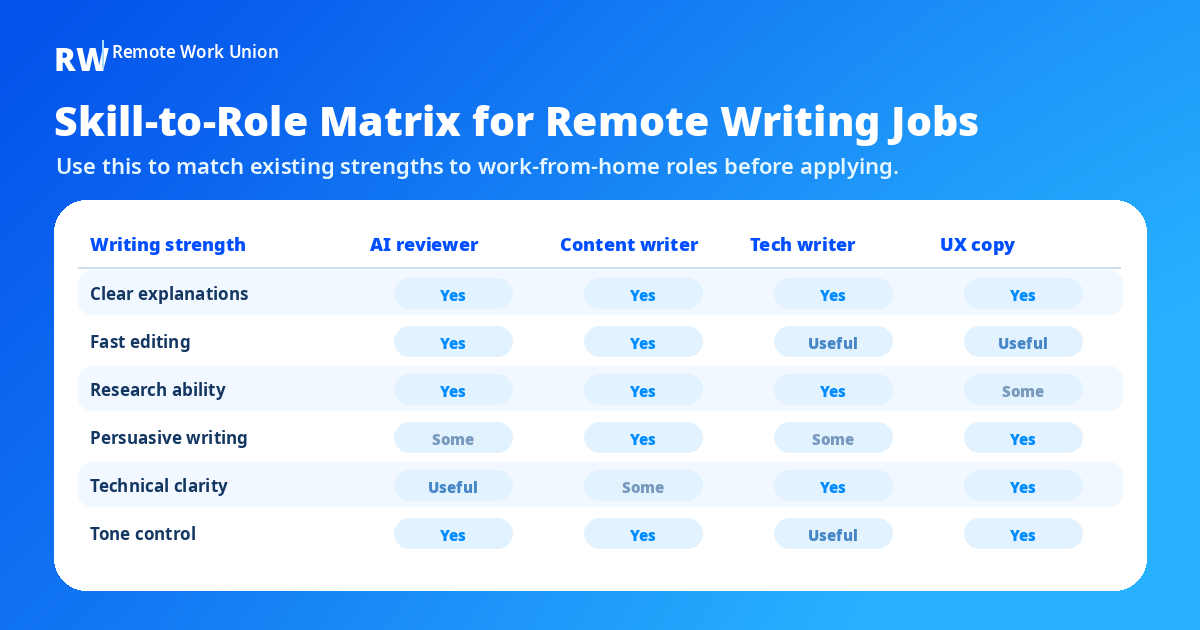
The best role depends on what part of writing you are actually good at. Someone who writes persuasive sales copy may not enjoy fact-checking. Someone who loves editing may not want to write long articles. Someone who is great at explaining processes may be better suited for documentation than social media.
Use this quick match to narrow your focus:
- If you like comparing answers and explaining decisions, look at AI response evaluation and AI training jobs.
- If you like improving messy drafts, look at editing, AI content editing, and quality assurance roles.
- If you like research, look at research writing, fact-checking, and source-based AI evaluation.
- If you like persuasion, look at copywriting, email marketing, landing pages, and proposal writing.
- If you like structure, look at technical writing, documentation, SOP writing, and curriculum writing.
- If you write in more than one language, look at localization, translation editing, and bilingual AI evaluation.
You do not need to choose only one category forever. A strong remote worker can combine several. For example, a writer might do AI evaluation work while also applying for content editing roles and building a documentation portfolio.
How to get started without a professional writing background
Many people underestimate the writing they have already done. If you have written school papers, client emails, social posts, training notes, research summaries, customer support responses, legal notes, reports, product descriptions, scripts, or internal process documents, you have writing experience to build from.
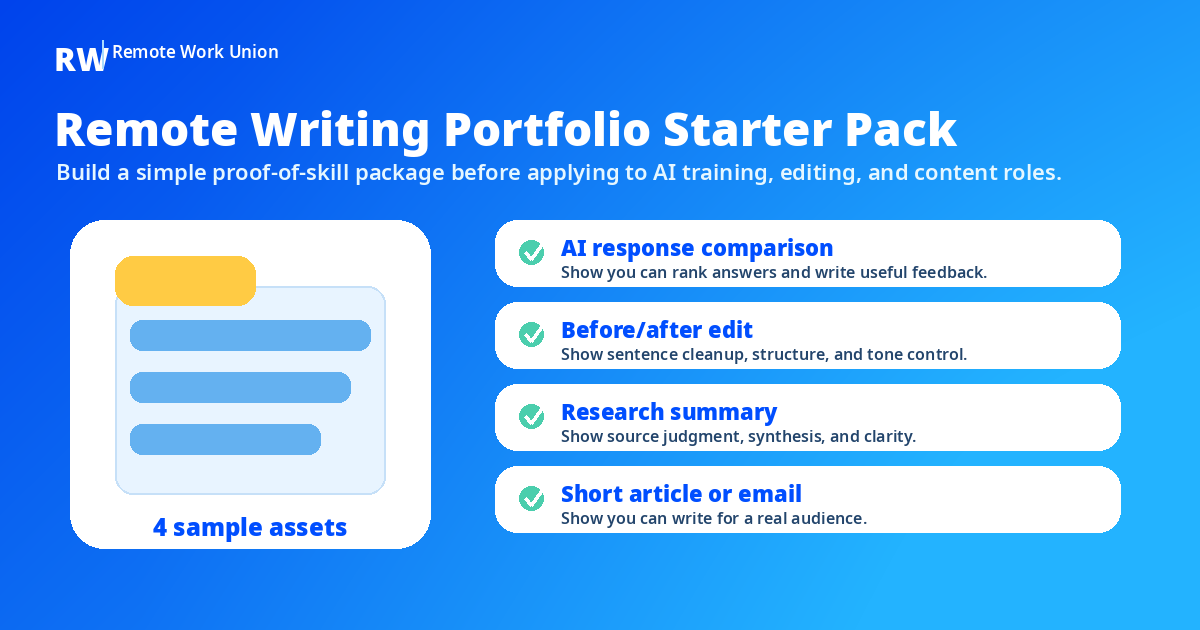
The key is to turn that experience into proof. Remote hiring is easier when you can show examples. Create a small portfolio with three to five samples:
- A short article or explainer in a niche you understand.
- A before-and-after edit showing how you improved clarity.
- A response comparison where you rank two answers and explain why one is better.
- A research summary using a few sources.
- A short business writing sample, such as an email sequence or landing page section.
These samples do not need to be long. They need to be clean, relevant, and easy to evaluate. A hiring manager or platform reviewer should be able to see your skill quickly.
How to apply for remote writing and AI training jobs
Start with a profile that makes your writing skills obvious. Use direct role keywords such as remote writer, AI evaluator, AI response reviewer, editor, content writer, technical writer, research writer, prompt writer, and AI content editor. Mention tools only when relevant, but do not make the profile about tools alone. The core selling point is your ability to produce clear written judgment.
When applying to AI training platforms such as micro1, Mercor, Handshake AI, and similar remote work platforms, keep your profile specific. Do not just say "good writer." Say what kind of writing you can do: editing, research summaries, tone matching, fact-checking, response comparison, instruction following, legal writing, finance writing, medical writing, education content, marketing copy, or technical documentation.
For traditional remote jobs, customize your samples to the role. A content job should see content samples. A documentation job should see guides. A copywriting job should see persuasive writing. An AI evaluation platform should see evidence that you can compare outputs and explain reasoning.
Red flags to avoid
Legitimate remote work should not require you to pay a fee just to start. Be cautious with any platform or recruiter that charges for access, asks for sensitive financial information too early, promises unrealistic income with no screening, or refuses to explain the work.
Also be careful with vague "writing jobs" that do not define the deliverable. A real role should eventually explain what you will write, how work is reviewed, how payment works, and what standards matter. The more specific the task, the easier it is to evaluate whether the opportunity is legitimate.
For AI training work, pauses and inconsistent task volume can happen. Contract platforms often depend on project availability. That is why many remote workers apply to multiple platforms instead of relying on only one account.
The strongest long-term strategy
The best long-term strategy is to treat writing as a flexible skill, not a single job title. Build a profile that can fit multiple remote work categories: AI evaluation, editing, content writing, documentation, research, and business writing. Then use each project to strengthen your samples.
If you complete AI evaluation tasks, save the general skill evidence without sharing confidential task content. If you write articles, turn them into portfolio samples. If you edit documents, create before-and-after examples using your own sample text. If you explain processes at work, turn one into a clean documentation sample.
Over time, the goal is to move from "I want a work-from-home writing job" to "I can evaluate AI responses, edit technical content, write clear documentation, and explain complex topics for a remote team." That is a stronger position. It gives you more keywords, more proof, and more ways to get matched.
Conclusion
The best work from home jobs that use writing skills are not limited to blogging. Writing skills can help you qualify for AI response evaluation, prompt testing, AI content editing, SEO writing, copywriting, technical writing, UX writing, research writing, proposal writing, resume writing, curriculum writing, and localization work.
The common thread is clear communication. Remote teams need people who can think carefully, write clearly, follow instructions, and improve information before it reaches the final audience. AI companies and AI training platforms need the same thing. They need human feedback that is specific, accurate, and useful.
If you are trying to start remote work, begin by building a small writing portfolio, applying to multiple platforms, and positioning your writing skills around the jobs you actually want.
Frequently Asked Questions
What work from home jobs use writing skills?
Writing skills are useful in a wide range of remote jobs including AI response evaluation, prompt writing, AI content editing, SEO content writing, copywriting, technical writing, UX writing, research writing, proposal writing, resume writing, curriculum writing, and bilingual localization. AI training platforms are one of the fastest-growing areas for writers.
Can I get remote writing jobs without a degree?
Yes. Most remote writing and AI evaluation roles care more about demonstrated skill than formal credentials. A small portfolio of three to five samples showing your writing, editing, or judgment skills is often more persuasive than a degree. AI training platforms like micro1, Mercor, and Handshake AI evaluate applicants based on skills and reasoning.
How do writers qualify for AI training jobs?
Writers qualify by demonstrating the ability to compare AI-generated responses, identify errors or unsupported claims, explain why one answer is better than another, and follow task-specific instructions. Platforms like micro1, Mercor, and Handshake AI use application processes that include skills assessments. Strong writing and clear reasoning are the most valuable qualifications.
Do remote AI evaluation jobs require coding?
No. Many remote AI evaluation and AI training jobs do not require coding. They reward judgment, writing clarity, research skill, and the ability to follow instructions. Writers, editors, researchers, teachers, lawyers, marketers, and other non-technical professionals regularly get hired for these roles.
How do I build a portfolio for remote writing jobs?
Create three to five samples that match the roles you want. Good samples include a short article or explainer, a before-and-after editing example, a research summary with sources, a response comparison where you explain which AI answer is better and why, and a business writing sample like an email or landing page. Samples should be clean, specific, and easy to evaluate quickly.