People searching for Claude AI training jobs are usually looking for one of three things: a role connected directly to Claude or Anthropic, a remote AI evaluation project that includes Claude-style assistant tasks, or a broader AI training job where humans review chatbot answers, compare outputs, write feedback, and help improve response quality.
The important point is simple: AI systems do not improve only because engineers write code. They also improve because humans judge whether answers are accurate, helpful, safe, complete, clear, and aligned with the user's request. That human judgment is the center of many remote AI jobs, including AI evaluator jobs, AI response reviewer jobs, prompt evaluation jobs, RLHF jobs, data annotation jobs from home, and expert review projects.
What Are Claude AI Training Jobs?
A Claude AI training job is not always a single official job title. In practice, the phrase can refer to any role where a person helps improve AI assistants like Claude by reviewing prompts, responses, model behavior, and feedback data. Some roles may be full-time technical jobs at an AI company. Others may be contract projects through AI training platforms, research vendors, data annotation companies, or expert networks. A remote worker might never train Claude directly, but the work can still be similar: reviewing AI answers, comparing outputs, checking for mistakes, identifying unsafe responses, and writing structured feedback.
That is why job seekers should treat Claude AI training jobs as a search category, not just one exact job posting. Useful related searches include: Claude AI jobs, AI training jobs, remote AI evaluator jobs, AI model evaluation jobs, AI response reviewer jobs, prompt evaluation jobs, human feedback jobs in AI, RLHF jobs, data annotation jobs from home, AI research jobs from home, AI quality analyst jobs, and AI content evaluation jobs.
How Claude AI Training Jobs Work
At a high level, AI training work turns human judgment into structured feedback. Reviewers read a prompt, inspect one or more AI responses, score the response against a rubric, and explain what should be better.
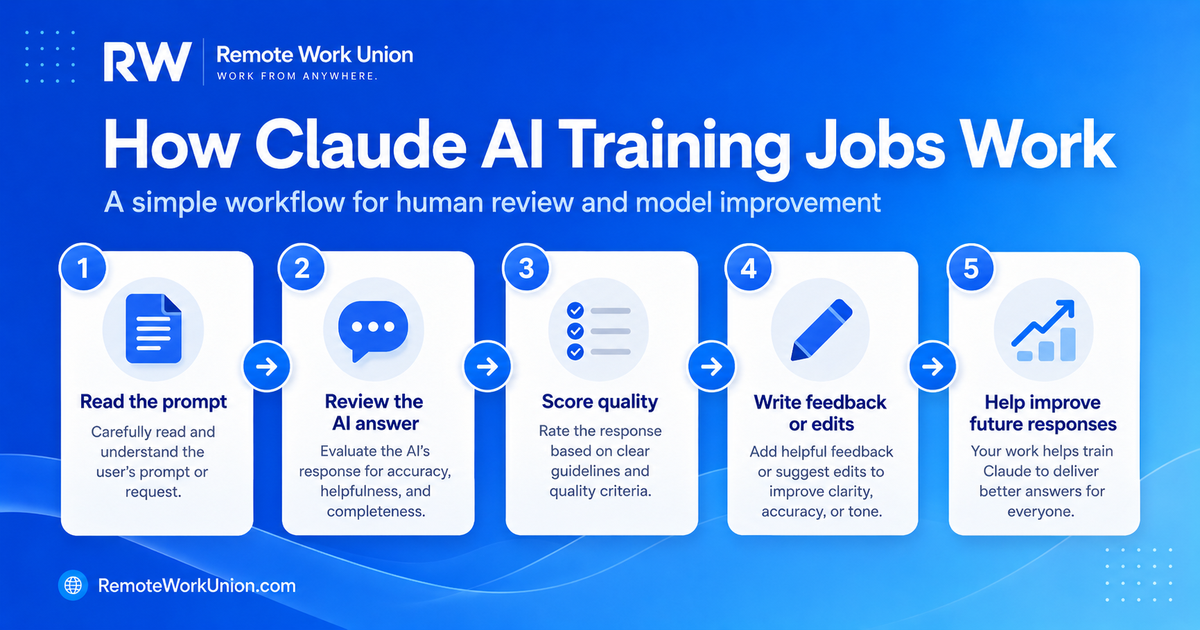
A typical workflow looks like this: (1) Read the user prompt and identify what the user asked for, what constraints matter, and what a good answer should include. (2) Review the AI answer and check whether the response actually satisfies the request. (3) Score the quality by applying a rubric for accuracy, helpfulness, safety, clarity, and instruction following. (4) Write feedback or edits explaining what was wrong, what was missing, and how the answer could improve. (5) Help improve future responses — the structured feedback becomes part of a larger process for evaluating, ranking, and improving AI systems. The job is less about "talking to a chatbot" and more about disciplined judgment.
What Human Reviewers Evaluate
Claude-style AI review work depends on consistent quality signals. Different projects use different rubrics, but the core categories are usually similar.
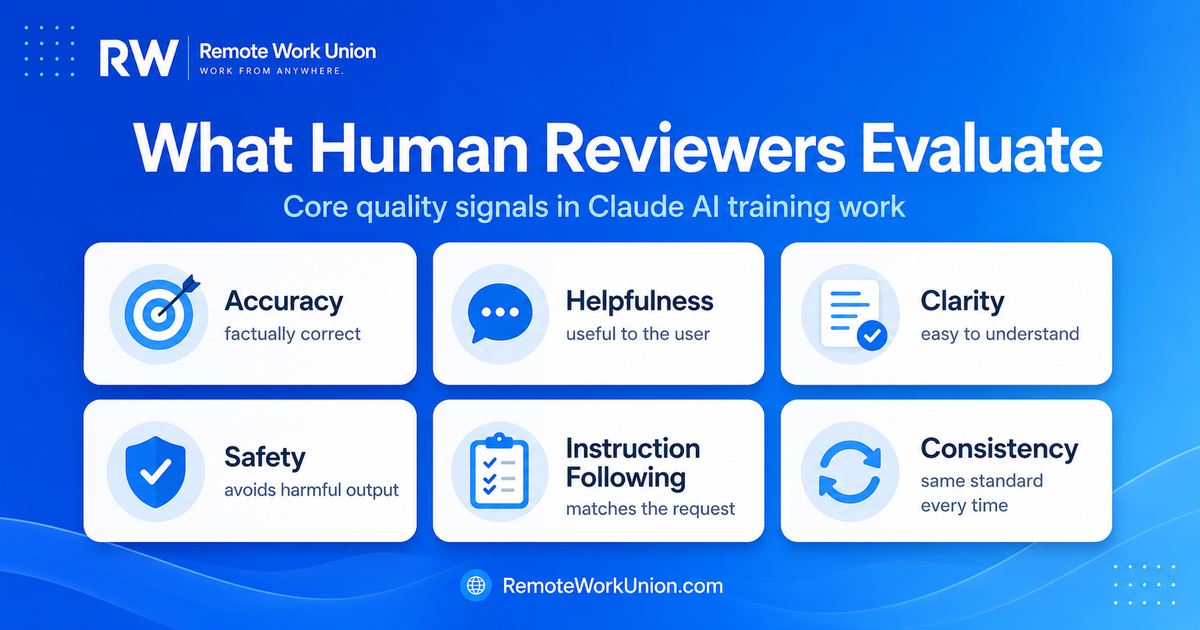
Accuracy: The answer is factually correct and does not invent details. Reviewers catch unsupported claims, bad math, weak citations, outdated information, or confident statements that are not justified by the prompt. Helpfulness: The answer solves the user's actual problem. A response can be grammatically clean but still unhelpful if it avoids the question or gives advice that is too generic. Clarity: The answer is easy to understand — organized, concise, direct, and readable. Safety: The AI avoids harmful, reckless, or inappropriate output. Instruction following: The response follows the user's request and project rules — if the user asks for a short answer, the response should be short. Consistency: The reviewer applies the same standard every time, because two similar responses should receive similar scores.
Common Task Types in Claude AI Training Work
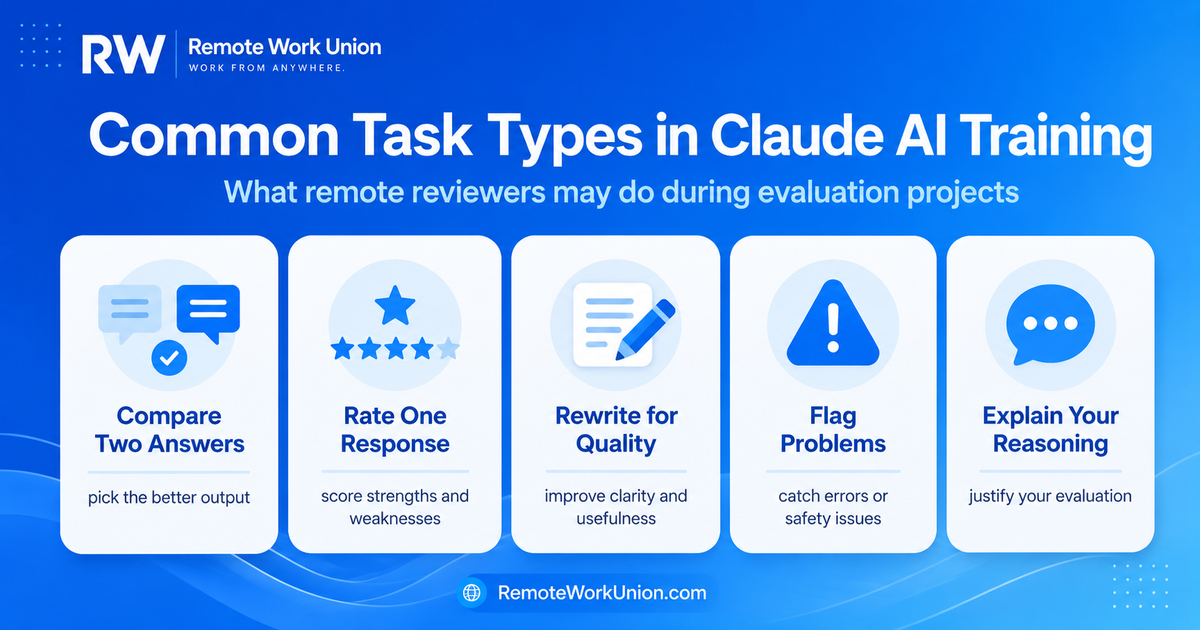
| Task Type | What You Do | Skills It Uses | Why It Matters |
|---|---|---|---|
| Compare two answers | Decide which AI response is better | Judgment, reading comprehension, rubric use | Helps rank stronger model outputs |
| Rate one response | Score an answer against quality criteria | Accuracy checking, consistency, attention to detail | Helps identify strengths and weaknesses |
| Rewrite for quality | Improve an answer by editing or rewriting | Writing, clarity, tone control | Shows what a better answer should look like |
| Flag problems | Identify safety, factual, or instruction issues | Policy awareness, critical thinking | Helps reduce harmful or low-quality output |
| Explain your reasoning | Write why one answer is better or worse | Clear feedback, structured analysis | Makes the judgment useful for model improvement |
| Research and verify | Check claims against reliable sources when allowed | Research, fact-checking, source evaluation | Improves factual reliability |
| Expert review | Evaluate answers in a specific field | Domain expertise, professional judgment | Supports higher-quality specialized AI responses |
Remote Work Union connects you to legitimate Claude and AI training evaluation roles. Apply for free.
Find Roles Hiring Now →Claude AI Training Jobs vs General AI Evaluator Jobs
| Search Term | What It Usually Finds | Best For |
|---|---|---|
| Claude AI training jobs | Claude-specific or Claude-adjacent searches | People interested in AI assistant evaluation |
| Anthropic AI jobs | Company career pages, technical roles, research roles | Applicants seeking official company employment |
| AI evaluator jobs | Broad remote evaluation and ranking work | Generalists, writers, researchers |
| AI model evaluation jobs | More technical or structured evaluation projects | People comfortable with rubrics and analysis |
| Prompt evaluation jobs | Work focused on prompt-response quality | Writers, editors, AI power users |
| RLHF jobs | Human feedback work for model training | Reviewers who understand ranking and feedback |
| Data annotation jobs from home | Labeling, classification, and review projects | Entry-level remote workers and flexible contractors |
| AI response reviewer jobs | Reviewing chatbot answers for quality | Strong readers, writers, and domain experts |
Skills That Make Applicants Stronger
You do not always need to be a programmer to apply for AI training work. The most useful skills include: clear writing (reviewers often need to explain why an answer is good or bad), strong reading comprehension (the work depends on understanding the user's request precisely), attention to detail (small instruction misses can change the quality score), fact-checking (some projects require verifying claims or spotting unsupported statements), rubric discipline (good reviewers apply the project standard instead of grading by instinct), research ability (some tasks require careful search, source comparison, or evidence checking), subject matter expertise (professional knowledge can qualify applicants for higher-skill projects), AI tool familiarity (experience with ChatGPT, Claude, Gemini, Perplexity, Copilot, Grok, or other AI assistants), and consistency (platforms need reviewers who can maintain quality over many tasks).
Resume Keywords for Claude AI Training Jobs
Useful resume and profile phrases include: AI response evaluation, AI model evaluation, human feedback, prompt-response review, rubric-based scoring, answer quality assessment, factual accuracy review, instruction-following evaluation, side-by-side response comparison, content quality analysis, research and fact-checking, written feedback, data annotation, RLHF, LLM evaluation, safety policy review, technical writing, editing and rewriting, and domain expert review.
A writer could say: "Reviewed AI-generated responses for clarity, accuracy, helpfulness, and instruction following; wrote structured feedback to improve answer quality." A teacher could say: "Evaluated AI explanations for grade-level clarity, completeness, and educational usefulness." A finance professional could say: "Reviewed AI answers involving business, accounting, and financial concepts for accuracy and practical relevance."
Who These Jobs Fit Best
Writers and editors may be strong at rewriting, tone evaluation, clarity checks, and feedback. Researchers may be strong at fact-checking, evidence comparison, and source evaluation. Teachers and tutors may be strong at judging explanations, lesson content, and learning support. Coders may evaluate programming answers, debug model outputs, or review code explanations. Lawyers, paralegals, medical writers, finance professionals, and subject matter experts may qualify for specialized projects where general knowledge is not enough.
The work also appeals to people who want remote jobs with fewer meetings and no phone calls. Many projects are asynchronous. However, remote does not mean effortless — the work can be mentally demanding because it requires precision, consistency, and long periods of focused reading.
How to Search for Legitimate Claude AI Training Jobs
Start with broad searches, then narrow by skill. Use combinations such as "Claude AI training jobs remote," "AI evaluator jobs remote," "AI response reviewer jobs," "AI model evaluation jobs," "prompt evaluation jobs remote," "human feedback AI jobs," "RLHF jobs remote," "data annotation AI jobs from home," "AI training jobs for writers," "AI training jobs for teachers," "AI training jobs for lawyers," "AI training jobs for finance experts," "remote AI research jobs," and "LLM evaluator jobs." Search in multiple places — company career pages, remote job boards, AI training platforms, LinkedIn, and professional networks. The most efficient approach is to build a search cluster and not rely on one keyword.
Application Tips for AI Training Work
Many applicants treat these roles like generic remote jobs — that is a mistake. AI training applications often test the same abilities the work requires. Before applying, prepare a profile that shows: you understand the task (mention response evaluation, rubrics, feedback, and quality review), you can write clearly (keep your application direct and polished), you can follow instructions (read every application prompt carefully), you can support claims (show examples if you say you are detail-oriented), and you have relevant expertise (highlight writing, research, coding, teaching, law, finance, healthcare, language, or other domain skills). If there is a qualification test, slow down — many people fail because they rush.
Red Flags and Scams to Watch For
The popularity of remote AI jobs attracts low-quality listings and scams. Watch for these red flags: the company asks you to pay for access to jobs; the listing promises guaranteed income or unrealistic earnings; the role has no clear company name, website, or hiring process; the application asks for sensitive personal information too early; the job description is copied, vague, or full of hype; the recruiter pushes you to move to encrypted messaging immediately; the platform refuses to explain payment terms; the task requires unpaid work that looks like real production work; or the listing claims official affiliation with a major AI company but provides no proof. A legitimate AI training role should be able to explain the work, the pay structure, the qualification process, and the basic expectations.
Frequently Asked Questions
What are Claude AI training jobs?
A Claude AI training job is not always a single official job title. In practice, the phrase can refer to any role where a person helps improve AI assistants like Claude by reviewing prompts, responses, model behavior, and feedback data. This includes reviewing AI answers, comparing outputs, checking for mistakes, identifying unsafe responses, and writing structured feedback. Job seekers should treat Claude AI training jobs as a search category — useful related searches include AI training jobs, remote AI evaluator jobs, AI model evaluation jobs, AI response reviewer jobs, prompt evaluation jobs, and human feedback jobs in AI.
What do human reviewers evaluate in Claude AI training work?
Human reviewers evaluate accuracy (whether the answer is factually correct), helpfulness (whether the answer solves the user's actual problem), clarity (whether the response is easy to understand), safety (whether the AI avoids harmful or inappropriate output), instruction following (whether the response follows the user's request and project rules), and consistency (whether the reviewer applies the same standard every time).
What skills make someone good at Claude AI training work?
Clear writing, strong reading comprehension, attention to detail, fact-checking, rubric discipline, research ability, subject matter expertise, AI tool familiarity, and consistency. Applicants should describe these skills in practical language: instead of saying "I use AI," say "I evaluate AI responses for accuracy, instruction following, clarity, and helpfulness using structured rubrics."
How should I search for Claude AI training jobs?
Combine Claude-specific keywords with broader AI training terms. Search for Claude AI training jobs remote, AI evaluator jobs remote, AI response reviewer jobs, AI model evaluation jobs, prompt evaluation jobs remote, human feedback AI jobs, RLHF jobs remote, and data annotation AI jobs from home. The best search strategy is to combine specific and broad terms — Claude is useful, but AI model evaluator, LLM response reviewer, and human feedback specialist may find roles that never use the word Claude.