Searches for Google AI training jobs usually come from a reasonable place: people see Google, Gemini, AI Overviews, Search, YouTube, Android, Cloud, and Workspace becoming more AI-driven, and they want to know whether regular remote workers can get paid to help train or evaluate those systems. The answer is not as simple as typing one phrase into a job board and applying to the first result.
Some jobs are direct corporate roles. Some are vendor or contractor projects. Some are remote AI evaluation jobs related to the broader AI ecosystem but not Google employment. Some search results are training courses, content farms, or vague listings that use the words Google and AI without offering real paid work. If you are looking for Google AI training jobs from home, Gemini AI training jobs, remote AI evaluator jobs, or human feedback jobs, the most important skill is search clarity.
What "Google AI Training Jobs" Can Mean
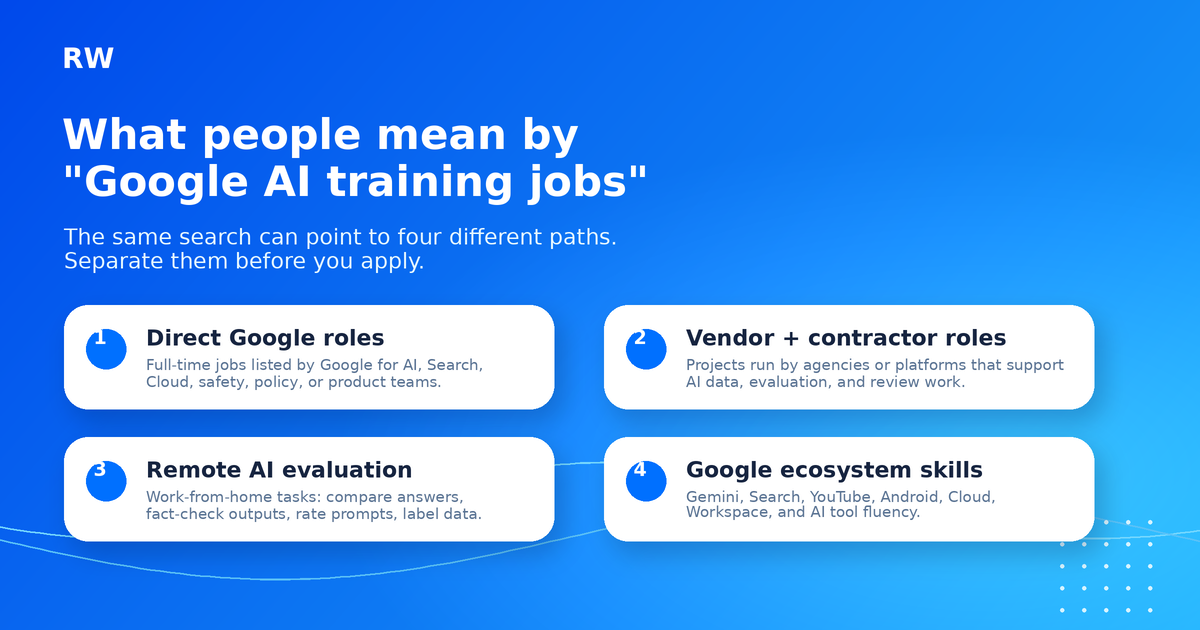
The phrase can mean several different things, and mixing them up wastes time.
First, it can mean direct employment at Google — roles in product, engineering, research, safety, policy, operations, trust and safety, search quality, cloud AI, data, or user experience teams. Direct roles usually require a stronger resume, a formal interview process, and more specialized experience.
Second, it can mean contractor or vendor work connected to AI data, search quality, rating, or model evaluation. These roles may not be posted by Google itself — they may be run by staffing companies, data vendors, research vendors, or AI training platforms that support large technology clients.
Third, it can mean jobs that involve Google's AI ecosystem without being a Google job. A listing might ask for experience with Gemini, Google Search, Google Workspace, YouTube, Google Ads, Google Cloud, or AI-powered search tools without being a direct Google hire.
Fourth, it can mean general AI training work that job seekers associate with Google because Google is one of the major AI companies — in which case, related searches like Microsoft AI training jobs, Claude AI training jobs, ChatGPT evaluator jobs, or remote AI training jobs may lead to similar role types.
Direct Google Jobs vs Remote AI Training Projects
The biggest mistake is assuming every AI training role with Google-related language is a direct Google job. A direct role at Google should be listed through an official hiring channel, use a clear employer identity, and describe a team, function, location, and employment structure. These jobs may be competitive.
Remote AI training projects are different — they are often contract-based, part-time, task-based, or project-based. The work may involve reviewing model outputs, labeling data, testing prompts, rating search results, fact-checking AI responses, comparing two answers, rewriting flawed responses, or applying a rubric to decide which output is more useful. These projects may be more accessible to strong writers, researchers, teachers, lawyers, finance professionals, healthcare experts, bilingual workers, coders, and generalists with sharp judgment.
Common Tasks in Remote AI Training Work
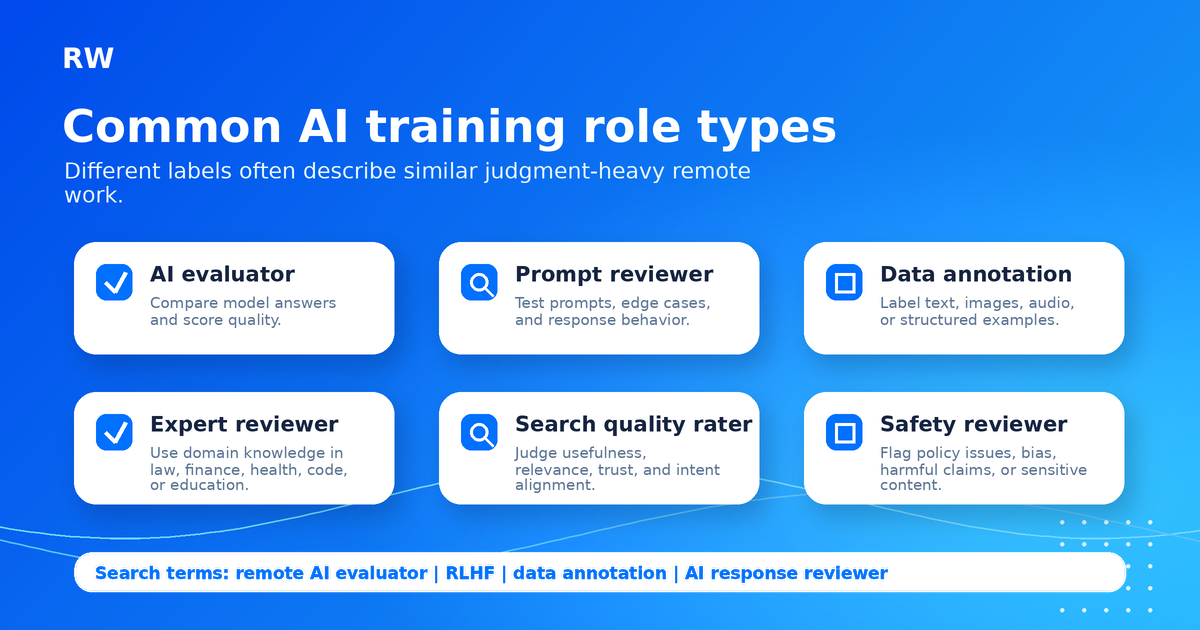
AI response evaluation: You judge whether a chatbot answer is accurate, complete, helpful, safe, and well-written. You may compare two responses and choose the better one, or explain why one answer is stronger. Prompt evaluation jobs focus on testing how models respond to different instructions. Data annotation jobs involve labeling examples so a model can learn from structured human input. Expert review jobs use domain knowledge — a lawyer reviews legal reasoning, a teacher assesses educational explanations, a nurse or medical writer flags misleading health claims.
Skills That Matter More Than Hype
Many people assume AI training work is only for software engineers. For non-technical remote workers, the strongest skills are clear writing, careful reading, research discipline, fact-checking, grammar, tone control, instruction following, and consistent rubric application. The best applicants can explain why an answer is good or bad without rambling, separate personal preference from task criteria, know when a claim needs verification, and work inside a style guide.
Useful resume keywords include AI evaluation, AI model training, data annotation, response review, prompt evaluation, human feedback, RLHF, rubric-based evaluation, search quality, fact-checking, research, content quality, editing, domain review, A/B comparison, option selection, and error analysis.
Remote Work Union connects you to legitimate Google, Gemini, and AI training evaluation roles. Apply for free.
Find Roles Hiring Now →How to Search Smarter for Google AI Training Jobs
Do not rely on one search phrase. Use clusters of related terms. Good search phrases include remote AI evaluator jobs, AI model trainer jobs, AI response reviewer jobs, prompt evaluation jobs, data annotation jobs from home, human feedback AI jobs, RLHF jobs, search quality rater jobs, Gemini AI training jobs, Google AI evaluator jobs, AI data annotation remote, AI chatbot evaluation jobs, and work from home AI jobs no phone calls. It also helps to search platform names directly, including Handshake AI, Mercor, micro1, and Outlier AI.
Also search by skill and domain: a lawyer might search "legal AI evaluator jobs," a teacher might search "education AI evaluator," a bilingual worker might search "Spanish AI evaluator" or "language model evaluator," a coder might search "code evaluator" or "AI coding reviewer." When using job boards, combine search terms with filters like remote, contract, part-time, freelance, writing, research, quality, evaluator, reviewer, annotation, and AI.
How to Read a Job Description Before Applying
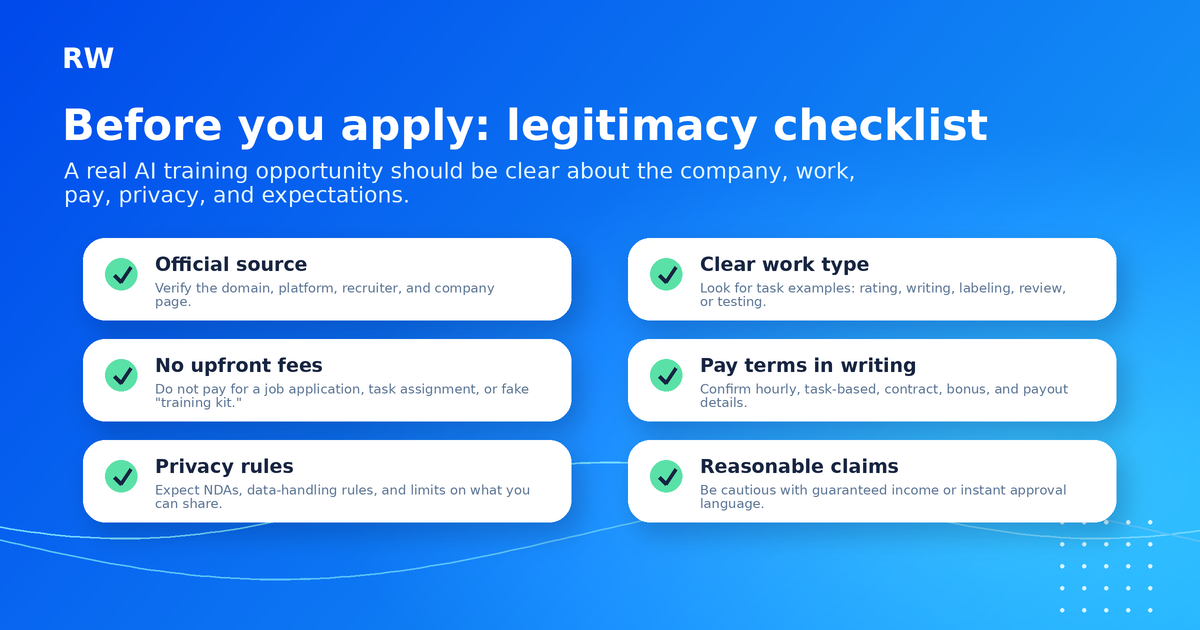
A legitimate role should make the basic work structure clear. Answer five questions before applying: who is hiring, what work will you do, how will you be evaluated, how will you be paid, and what information will you need to provide? Look for concrete task language — rating AI-generated answers, comparing outputs, labeling data, evaluating search results, checking factual accuracy, writing explanations, following detailed guidelines, or reviewing content against policies. Check employment type — some roles are full-time employee positions, some are independent contractor projects, some are freelance assignments. Pay language matters: a serious listing should eventually explain whether compensation is hourly, per task, per project, or salary-based.
Red Flags and Scams to Avoid
The phrase "Google AI training jobs" can attract low-quality search results because it combines a trusted company name with a fast-growing job category. Be skeptical of any listing that promises guaranteed high income, instant approval, no screening, no skills required, or direct access to secret Google projects. Do not pay for a job — you should not have to buy a starter kit, pay for certification, or purchase training access. Be careful with unofficial messaging and watch for brand confusion — a job may use words like Google, Gemini, search, AI, or training without being a Google job.
How to Position Yourself as a Stronger Applicant
Your application should make your judgment visible. Rewrite your resume bullets around the work itself: "reviewed written content for accuracy, clarity, tone, and guideline compliance" instead of "strong communication skills"; "verified claims using source comparison and documented reasoning for quality decisions" instead of "research experience"; "applied rubric-based criteria to compare options and identify errors in content, formatting, and logic" instead of "detail-oriented."
A short portfolio can help. Create sample evaluations using public, non-sensitive examples — show how you compare two answers, identify an unsupported claim, rewrite a vague response, or apply a rubric. For profiles on AI training platforms, be specific about domains. If you are bilingual, list languages and fluency honestly. If you code, list languages and your comfort level.
What to Expect From Assessments
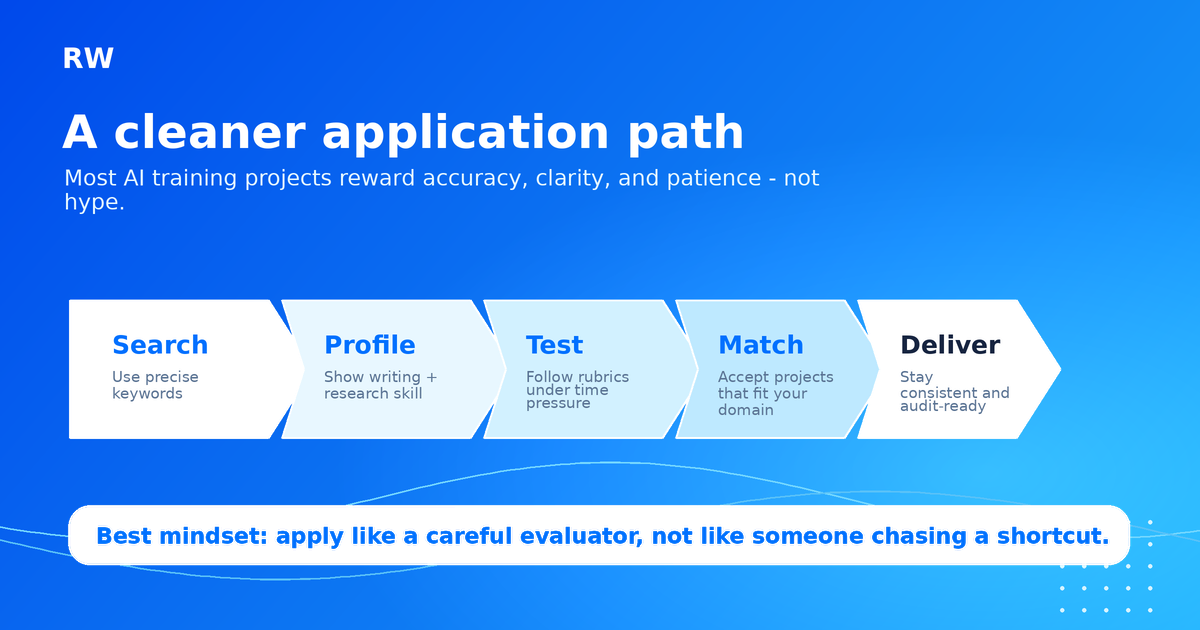
Many remote AI training jobs use assessments before they give you project access. These tests are usually about whether you can follow instructions, apply examples, and make stable decisions — not just whether you are the smartest person in the room. Read the rubric before answering. Expect ambiguous examples — AI evaluation work often involves close calls. A good note might say: "Response A is better because it answers the user's exact question, includes fewer unsupported claims, and follows the requested format. Response B adds irrelevant advice and misses the location constraint." Keep your writing plain — feedback should be specific enough to be useful, but not overloaded.
Should You Focus Only on Google-Related Searches?
No. Use Google as one keyword cluster, not the whole strategy. Also search for remote AI training jobs, AI evaluator jobs, data annotation jobs, prompt reviewer jobs, AI model evaluation jobs, chatbot evaluation jobs, search quality rater jobs, and human feedback jobs. Compare listings across platforms. Also compare adjacent company keywords: Microsoft AI training jobs, Claude AI training jobs, OpenAI evaluator jobs, Gemini AI jobs, Meta AI jobs, xAI jobs, and LinkedIn AI jobs. Those searches can help you understand the market language, even when the actual role titles differ. The goal is not to chase a brand name — the goal is to find legitimate paid work where your skills match the task.
A Practical Search Plan
Start with one hour of research. Make a spreadsheet with columns for company, role title, link, employment type, location eligibility, pay information, required skills, assessment required, and notes. Separate direct employer roles from contractor platforms and vendor roles. Then build three versions of your application materials: one for general AI evaluator and AI response reviewer jobs, one for data annotation and search quality roles, and one for your strongest domain (legal, finance, healthcare, education, coding, marketing, or language work). Apply in batches — ten thoughtful applications are better than fifty generic submissions. Track outcomes and note which search terms produced legitimate listings, which platforms responded, and where you stalled.
Frequently Asked Questions
What does "Google AI training jobs" usually mean?
The phrase can mean several different things: direct employment at Google, contractor or vendor work connected to AI data, search quality rating, or model evaluation; jobs involving Google's AI ecosystem without being a Google job; or general AI training work that job seekers associate with Google as a major AI company. Many remote AI training projects are not posted by Google itself but come through staffing companies, data vendors, or AI training platforms.
How do I search smarter for Google AI training jobs?
Use clusters of related terms. Good search phrases include remote AI evaluator jobs, AI model trainer jobs, AI response reviewer jobs, prompt evaluation jobs, data annotation jobs from home, human feedback AI jobs, RLHF jobs, search quality rater jobs, Gemini AI training jobs, and work from home AI jobs no phone calls. Also search by skill and domain.
How can I tell if a Google AI training job listing is legitimate?
A legitimate role should make the basic work structure clear. You should be able to answer five questions before applying: who is hiring, what work will you do, how will you be evaluated, how will you be paid, and what information will you need to provide? Avoid listings that promise guaranteed income, require upfront payment, or promise direct access to secret Google projects.
Should I focus only on Google-related searches for AI training work?
No. Use Google as one keyword cluster, not the whole strategy. Also search for remote AI training jobs, AI evaluator jobs, data annotation jobs, prompt reviewer jobs, AI model evaluation jobs, chatbot evaluation jobs, search quality rater jobs, and human feedback jobs. Compare listings across platforms and look at adjacent company keywords like Microsoft AI training jobs, Claude AI training jobs, OpenAI evaluator jobs, Gemini AI jobs, and Meta AI jobs.