The Handshake AI Fellowship is the kind of opportunity many remote job seekers search for when they want AI work that is more serious than generic data entry and more accessible than a full-time machine learning role. It sits in the broader category of remote AI training, AI model evaluation, human feedback, prompt evaluation, and AI response review work. For the right applicant, that can mean flexible online work built around judgment, writing, research, and subject knowledge rather than sales calls or traditional office hours.
This guide explains who the Handshake AI Fellowship is likely to fit, how to think about the application, what skills to emphasize, and how to prepare without sounding generic. Because specific fellowship requirements can change, applicants should always read the current role page carefully before applying. The strategy below is built to stay useful across fellowship-style AI opportunities, including projects connected to AI evaluation, chatbot quality review, AI research support, and model training work.
What Is the Handshake AI Fellowship?
The phrase "AI Fellowship" usually signals a structured opportunity rather than a random one-off task. In remote AI work, that structure may include onboarding, project guidelines, quality standards, evaluation rubrics, writing samples, trial tasks, or a limited cohort of selected applicants. The important point for job seekers is that fellowship-style opportunities often reward preparation.
A strong application should not simply say, "I am interested in AI." It should show that you can think clearly, follow instructions, review information carefully, and communicate your reasoning. AI companies and AI work platforms need humans who can judge whether model responses are accurate, helpful, safe, well-written, and aligned with the task. That is why the best applicants often come from many backgrounds: writing, editing, education, law, medicine, finance, consulting, research, coding, customer operations, language work, and academic study.
The Handshake AI Fellowship should be understood as part of the wider remote AI jobs market. People also search for AI trainer jobs, AI evaluator jobs, AI rater jobs, prompt evaluator jobs, RLHF jobs, data annotation jobs, expert review jobs, and paid AI research jobs from home. The names vary, but the underlying value is similar: modern AI systems still need human judgment.
Who the Handshake AI Fellowship Fits Best
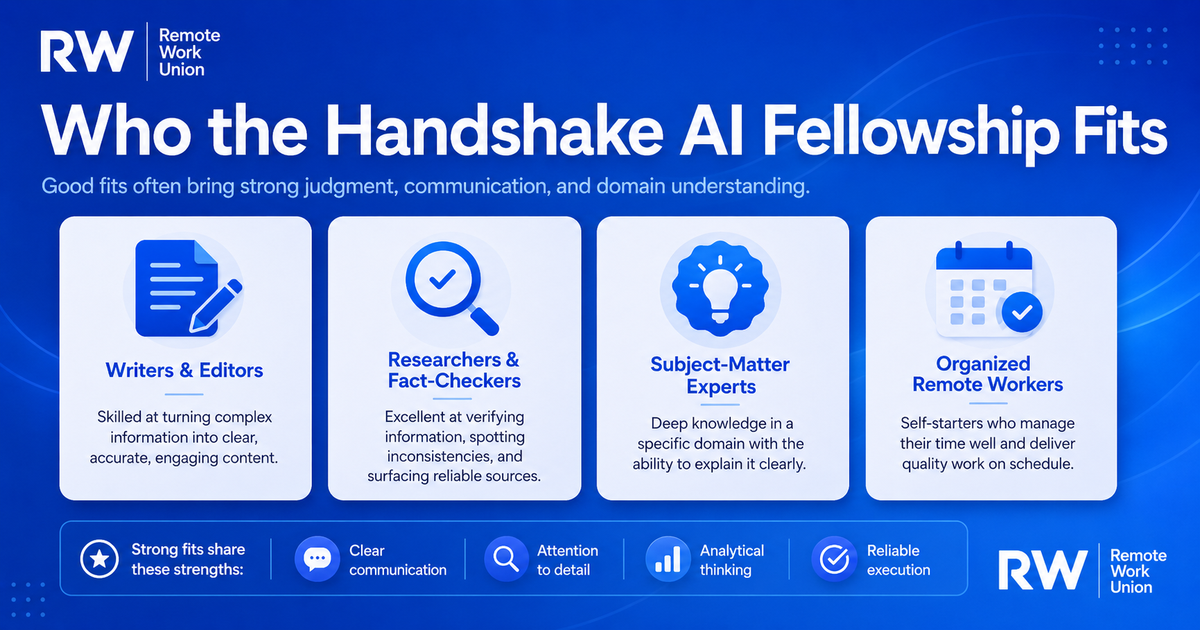
The best fit is not always the person with the most technical background. Many AI fellowship applicants assume that they need to be software engineers, machine learning researchers, or computer science graduates. For some projects, technical skill matters. For many evaluation and feedback projects, the core skill is judgment.
The fellowship may be a strong fit for writers and editors who can make complicated information clear. A person who can compare two answers, explain why one is better, identify vague wording, and improve clarity already has a useful foundation for AI response review. This matters for systems built by or used alongside major AI companies such as OpenAI, Anthropic, Google, Meta, Microsoft, and xAI, where output quality depends on detailed human evaluation.
It can also fit researchers and fact-checkers. Many AI tasks require workers to verify claims, notice contradictions, compare sources, and separate confident-sounding language from accurate information. If you are good at asking, "Is this actually true?" and "What evidence supports this?" you may be well suited for model evaluation work.
Subject-matter experts can also stand out. A marketer, salesperson, finance analyst, accountant, business operator, customer service lead, teacher, nurse, lawyer, engineer, coder, or bilingual professional may be useful because domain knowledge helps evaluate specialized answers. AI systems need broad general feedback, but they also need expert review in areas where mistakes are costly or subtle.
Finally, organized remote workers tend to do well. AI training projects can involve detailed instructions, changing guidelines, task queues, deadlines, quality audits, and feedback loops. Applicants who can manage their own time, track requirements, and submit consistent work are often better prepared than applicants who only want a quick remote side hustle.
Who May Not Be a Good Fit
The fellowship may not be the right match for someone looking for passive income, instant approval, or fast-money work. Real remote AI work usually requires careful reading, repeated feedback, and attention to small details. It can be flexible, but flexible does not mean careless.
It may also be a poor fit for applicants who dislike ambiguity. AI evaluation often involves comparing imperfect answers, choosing the better response, and explaining tradeoffs. There may not always be one obvious answer. Strong evaluators can defend their decisions in plain language.
Another weak fit is the applicant who relies too heavily on AI tools during the application. It is reasonable to use ChatGPT, Claude, Gemini, Grok, or other tools to organize ideas, but the final application should sound specific and human. Fellowship reviewers can often detect generic language. The application should prove judgment, not just produce polished filler.
The Skills That Matter Most
The most important skills for fellowship-style AI work are usually practical rather than flashy.
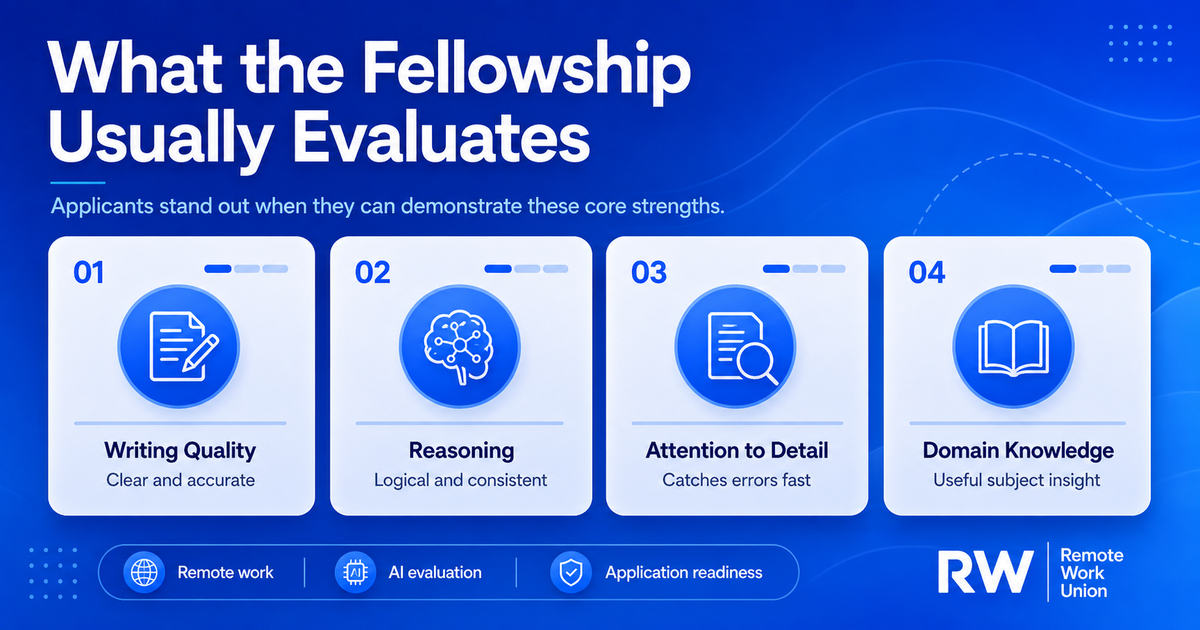
Clear writing matters because many AI tasks ask workers to explain decisions. It is not enough to choose option A over option B. You may need to explain why one answer is more accurate, more complete, better structured, or more aligned with the prompt.
Reasoning matters because AI evaluation is not simple preference voting. A good reviewer can identify the goal of a task, compare evidence, notice missing context, and make a consistent decision. This is especially important in RLHF and human feedback work, where models improve from patterns in human judgment.
Attention to detail matters because small errors can change the quality of an answer. A model might cite the wrong company, confuse two similar terms, miss a constraint, use outdated information, or answer only part of the prompt. Strong evaluators catch those issues quickly.
Domain knowledge matters when the task requires expertise. A generalist can evaluate clarity and structure, but a specialist can evaluate whether the answer is actually useful in a specific field. This is why remote AI jobs increasingly include expert review, coding review, legal review, medical writing, finance analysis, education content, and language-specific evaluation.
Communication matters because remote work depends on trust. If a fellowship includes written explanations, quality feedback, or asynchronous collaboration, your ability to be concise and professional becomes part of the job.
Remote Work Union connects you to legitimate remote AI training and evaluation roles, including fellowship-style AI opportunities. Apply for free.
Find Roles Hiring Now →How to Prepare Before Applying
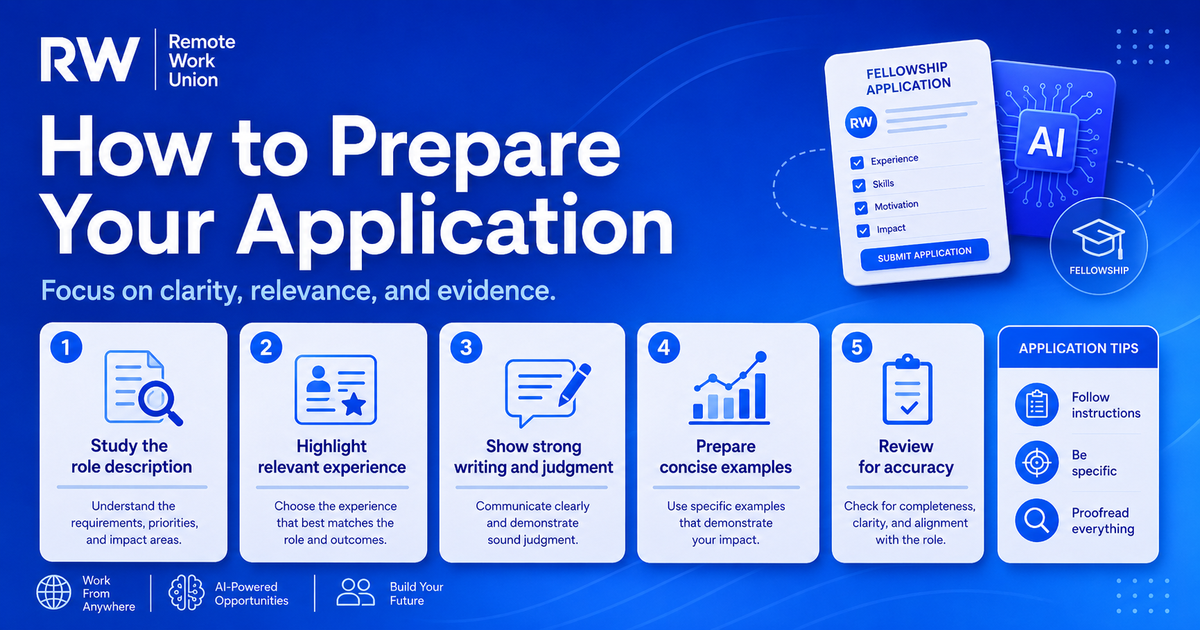
Start by reading the fellowship page like a set of instructions, not like a normal job ad. Highlight the requirements, preferred skills, time expectations, application steps, and any sample-task language. Many applicants lose opportunities because they miss basic instructions.
Next, build a short inventory of your strongest evidence. This can include writing samples, research projects, school work, client work, professional reports, editing experience, coding projects, tutoring experience, published articles, spreadsheets, analysis work, or examples of detailed review. The goal is not to include everything. The goal is to select evidence that matches the fellowship.
Then prepare a concise explanation of why you fit. A strong answer might connect your background to specific AI work tasks: evaluating responses, checking accuracy, reviewing sources, improving prompts, comparing outputs, explaining decisions, or applying domain expertise. Avoid vague phrases like "I am passionate about AI" unless you back them up with proof.
You should also prepare for a writing or evaluation sample. Many remote AI jobs use screening tasks because resumes alone do not prove judgment. Practice comparing two AI answers to the same prompt. Ask which answer is more accurate, which follows the instructions better, which is clearer, and what each answer misses. Then write a short explanation in plain English.
Finally, clean up your resume and profile. Use keywords that match the role without stuffing them unnaturally. Good terms may include AI training, AI evaluation, model evaluation, prompt evaluation, data annotation, research, fact-checking, writing, editing, analysis, domain expertise, communication, remote work, and quality review.
What to Include in Your Application
A good Handshake AI Fellowship application should be specific, concise, and evidence-based.
First, explain your relevant background in normal language. If you are a writer, mention the types of content you have written or edited. If you are a researcher, mention the kind of sources you evaluate. If you are a student or recent graduate, mention coursework, projects, research, tutoring, or analytical writing. If you are a professional, translate your existing experience into AI evaluation language.
Second, show how you think. Fellowship reviewers are often looking for judgment. Instead of only listing tools, include a sentence about how you approach quality. For example, you might say that you check whether an answer follows the prompt, supports its claims, avoids unnecessary assumptions, and communicates clearly.
Third, highlight any domain expertise. AI platforms often need people who understand law, healthcare, finance, education, coding, language, science, business, marketing, and technical documentation. Even if the fellowship is general, domain knowledge can make your application more memorable.
Fourth, make your availability clear if the application asks for it. Remote AI work can be flexible, but platforms still need reliable contributors. If you can consistently work certain blocks of time, say so.
Fifth, proofread everything. This sounds basic, but an application for AI writing, evaluation, or review work is itself a sample of your attention to detail.
How to Position Non-Technical Experience
Many applicants overlook how useful non-technical experience can be. AI training work is not only about building models. It is also about improving the quality of model behavior. That requires people who understand language, intent, logic, user needs, and real-world context.
A teacher can position experience around explaining complex ideas, grading work, identifying gaps in reasoning, and giving constructive feedback. A legal researcher can position experience around precision, evidence, ambiguity, and source review. A nurse or medical writer can position experience around clarity, patient-facing communication, accuracy, and risk awareness. A finance or accounting professional can position experience around numerical reasoning, spreadsheet analysis, and careful review. A customer support professional can position experience around understanding user intent, identifying missing information, and communicating clearly.
The key is translation. Do not just list your old job title. Translate your experience into the tasks that remote AI roles care about: evaluate, compare, verify, explain, summarize, classify, annotate, research, edit, review, and improve.
Common Mistakes to Avoid
The biggest mistake is sending a generic application. If your answer could be copied into any remote job application, it is probably too broad. The fellowship application should connect directly to AI evaluation, remote work, writing quality, research ability, or domain expertise.
Another mistake is overclaiming technical expertise. If you do not code, do not pretend to be a machine learning engineer. Many fellowship-style AI roles are open to non-coders, and honesty is better than inflated language. Emphasize the skills you actually have.
A third mistake is ignoring instructions. If the application asks for a short answer, keep it short. If it asks for examples, include examples. If it asks for a specific format, follow the format. In AI evaluation work, following the task prompt is part of the skill.
A fourth mistake is using AI-generated application language without editing it. AI tools can help you draft, but they often produce vague, inflated phrases. Replace generic language with real details from your background.
A fifth mistake is focusing only on pay or flexibility. Those are valid reasons to search for remote AI jobs, but the application should focus on fit, quality, and reliability.
How This Fits Into the Broader Remote AI Jobs Market
The Handshake AI Fellowship is one search path within a much larger market. Remote job seekers should also search for AI evaluator jobs, AI model trainer jobs, AI rater jobs, AI response reviewer jobs, prompt evaluation jobs, data annotation jobs, RLHF jobs, human feedback jobs, paid AI research jobs, and expert review jobs from home.
Applicants often compare fellowship opportunities with platforms and job boards that list AI training or evaluation projects. Search results may include companies, marketplaces, staffing platforms, university career tools, LinkedIn posts, and remote work boards. The challenge is that the same phrase can mean different things. "Handshake jobs" may refer to the student career platform. "Handshake AI" may refer to AI-specific work or fellowship-style opportunities. A smart applicant reads the posting carefully and confirms what the role actually is before applying.
This is where Remote Work Union can help. Instead of treating every search result as equal, remote job seekers need a system for finding real roles, comparing platforms, and avoiding vague fast-money claims. The best remote AI opportunities usually look more like skilled online contract work than effortless passive income.
A Simple Preparation Checklist
Before submitting your application, run through this checklist:
- Confirm the current requirements on the fellowship page.
- Identify the skills the fellowship appears to value most.
- Pick two or three examples from your background that prove those skills.
- Update your resume with relevant AI, writing, research, analysis, or domain keywords.
- Prepare a short explanation of how you evaluate quality.
- Write in a clear, direct style.
- Avoid generic AI-generated filler.
- Proofread your application before submitting.
- Save a copy of your answers so you can reuse strong material for related AI jobs.
Tip: This checklist works not only for the Handshake AI Fellowship, but also for many remote AI training jobs, AI model evaluation roles, prompt review jobs, and expert review projects. Build the habit once and reuse it across platforms.
Frequently Asked Questions
Do you need a technical background for the Handshake AI Fellowship?
Not necessarily. Many fellowship-style AI roles value judgment, writing, research, and domain expertise more than a technical or coding background. Writers, editors, researchers, teachers, lawyers, medical professionals, and finance analysts can all be strong candidates. For some projects technical skill matters, but for many evaluation and human feedback tasks, the core skill is clear thinking.
What skills matter most for the Handshake AI Fellowship?
The most important skills are clear writing, careful reasoning, attention to detail, and domain knowledge relevant to the tasks. Remote AI fellowship work often asks workers to compare answers, identify errors, explain decisions, and follow detailed rubrics. Communication and reliability matter too, since remote work depends on trust and consistent output.
How do I prepare my application for the Handshake AI Fellowship?
Start by reading the fellowship page carefully and noting every requirement. Build a short inventory of your relevant experience — writing samples, research projects, analysis work, domain expertise. Prepare a concise explanation of how you evaluate quality. Practice comparing two AI answers to the same prompt and writing a short explanation of which is better and why. Then update your resume with AI training keywords and proofread your full application before submitting.
What are the most common mistakes in a Handshake AI Fellowship application?
The biggest mistake is sending a generic application that could apply to any remote job. Other common mistakes include overclaiming technical expertise, ignoring specific instructions in the application form, using heavily AI-generated language without editing it, and focusing only on pay or flexibility rather than fit, quality, and reliability.
How does the Handshake AI Fellowship fit into the broader remote AI jobs market?
The Handshake AI Fellowship is one path within a larger market that includes AI evaluator jobs, AI model trainer jobs, AI rater jobs, RLHF jobs, data annotation jobs, prompt evaluation jobs, and expert review projects. Applicants who prepare for one fellowship-style opportunity often build skills and materials that are useful across many similar remote AI roles.
How should I position non-technical experience in my application?
Translate your experience into the tasks that remote AI roles care about. Instead of listing your old job title, describe what you can do in AI evaluation terms: evaluate, compare, verify, explain, summarize, classify, annotate, research, edit, review, and improve. A teacher might emphasize grading, feedback, and identifying reasoning gaps. A finance professional might emphasize numerical reasoning, careful review, and spreadsheet analysis.
Final Take
The Handshake AI Fellowship may be a strong fit for remote workers who can combine clear communication with careful judgment. You do not necessarily need to be a software engineer. You do need to show that you can read closely, reason carefully, explain decisions, and apply your background to AI quality work.
The best application is not the longest one. It is the clearest one. Show your relevant experience, explain how you think, follow instructions, and make it easy for the reviewer to understand why you fit the work.