Outlier AI jobs sit at the intersection of remote work, freelance writing, expert review, prompt evaluation, and artificial intelligence. For people searching for work from home jobs that do not require a traditional software engineering background, Outlier has become one of the most searched AI training platforms because it offers a clear pitch: use your existing knowledge to help improve AI systems, work remotely, and get paid for completed work.
That pitch needs context. Outlier AI work is not the same as a salaried remote job. It is not guaranteed full-time employment. It is best understood as a flexible remote AI training platform where qualified contributors may be matched to projects that need human judgment — comparing AI responses, ranking outputs, writing prompts, checking accuracy, applying domain knowledge, or evaluating whether an AI system followed instructions.
For the right person, this can be one of the better online job categories to understand because AI companies still need humans to judge quality, nuance, safety, accuracy, reasoning, and usefulness. This guide explains how Outlier AI jobs actually work, who they are best for, and how to position yourself for better projects.
What Is Outlier AI?
Outlier is a remote AI training and expert feedback platform operated by Scale AI. Its core function is to connect qualified contributors with projects that help improve large language models and other AI systems. Instead of building the model yourself, you provide the human feedback that helps the model become more useful, accurate, safe, and aligned with real-world expectations.
In plain English, Outlier uses remote workers to help AI systems learn what good answers look like. That work may include checking whether an AI answer is factually correct, deciding which of two responses is better, writing prompts that test reasoning, reviewing model outputs in a specialized field, or following a detailed rubric to score a chatbot's performance.
The platform is especially relevant for people who have strong writing ability, careful reading skills, research judgment, or subject-matter expertise in law, finance, medicine, science, mathematics, education, languages, or technical fields. The important distinction: Outlier is a platform for project-based remote work, not a traditional job board.
How Outlier AI Jobs Usually Work
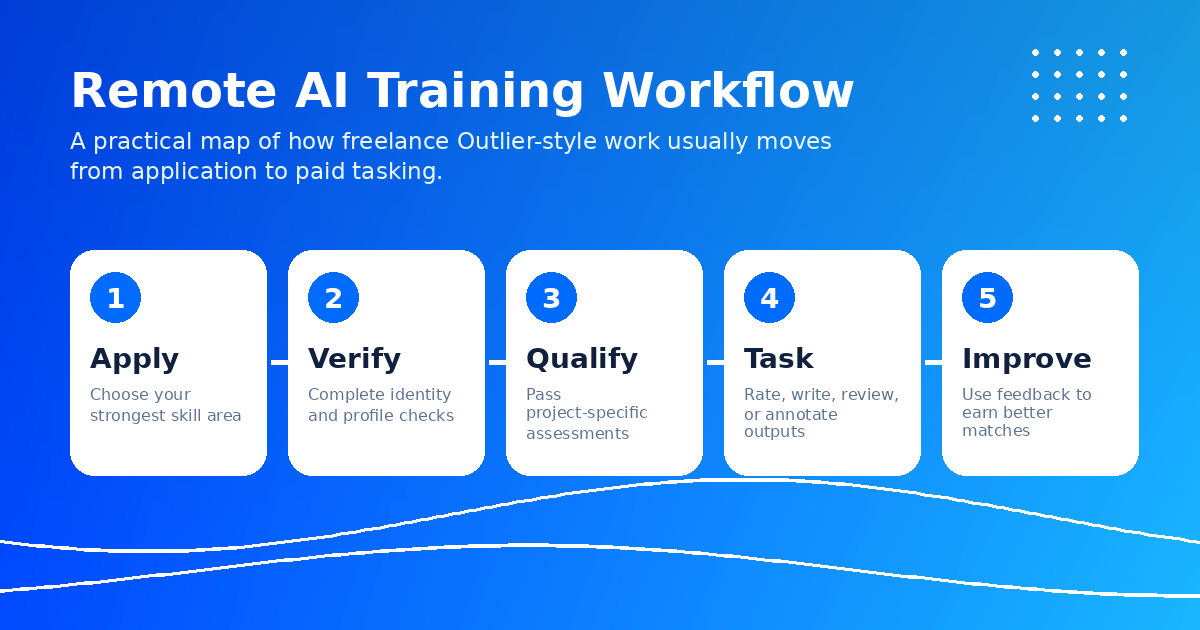
The basic workflow looks like this:
- You apply or create a contributor profile.
- You choose or declare your areas of expertise.
- You complete identity verification and general onboarding.
- You take one or more assessments or skill screenings.
- You may be matched to a project based on your profile, location, skills, and current demand.
- You complete project-specific training or qualification tasks.
- You work on paid tasks when available.
- Your task quality affects future access, feedback, and project matching.
This means the first goal is not just to "sign up." The first goal is to look matchable. A weak profile that says "I can do anything" is less useful than a profile that clearly says "I have finance experience, strong writing skills, and can evaluate complex reasoning," or "I am a Python developer who can review code and explain bugs."
Common Outlier AI Task Types
Outlier projects can vary widely, but most remote AI training jobs fall into a few practical categories.
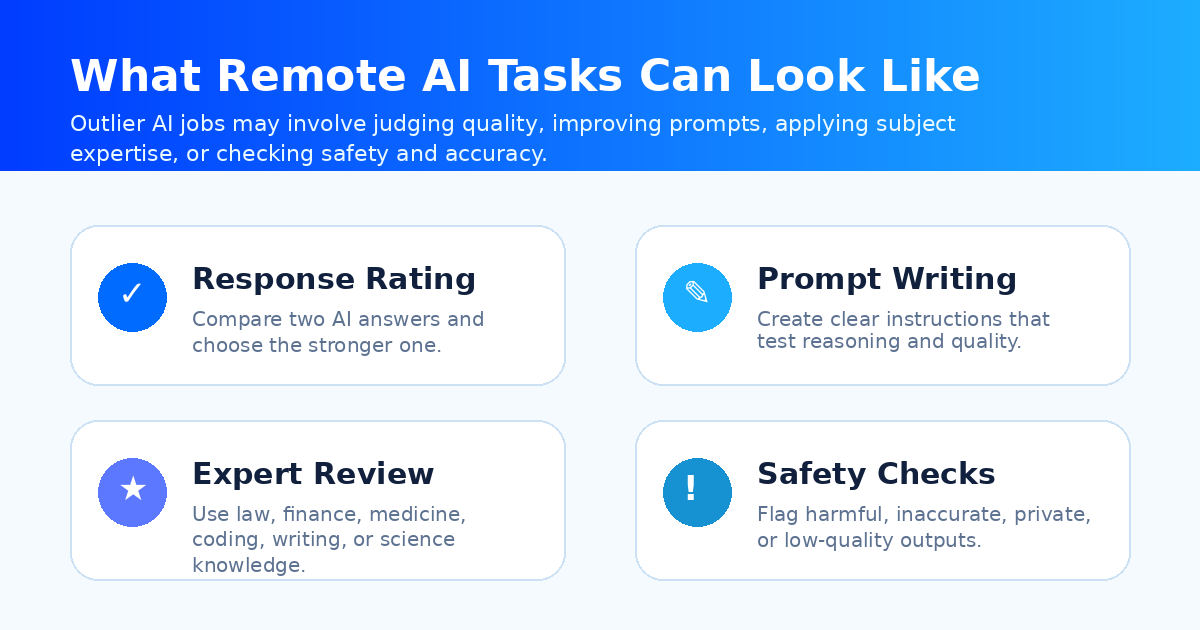
Response Rating
You may be shown a user prompt and two or more AI responses. Your job is to decide which response is better according to a rubric — judging accuracy, completeness, clarity, tone, safety, instruction following, formatting, or reasoning quality. The best remote AI evaluators learn to separate surface-level polish from actual quality.
Prompt Writing
Prompt writing tasks ask you to create inputs that test an AI model. A good prompt might require reasoning, domain knowledge, careful formatting, or multi-step analysis. In some projects, you may create prompts that expose model weaknesses, such as hallucination, shallow reasoning, weak legal analysis, or failure to follow constraints.
Expert Review
Expert review is where Outlier-style work can become more valuable. A medical expert may review whether an AI answer gives safe and accurate health information. A finance person may check calculations or reasoning. A lawyer may evaluate legal reasoning. A coder may test whether code works. This is why people searching for high-paying remote AI jobs look beyond generic data labeling.
Editing and Rewriting
Some tasks involve improving a model response — rewriting an answer to make it clearer, more accurate, more concise, more complete, or safer. Writers, editors, teachers, tutors, researchers, and content professionals can often adapt well to this kind of AI training work.
Safety and Policy Evaluation
Some AI training jobs involve checking whether a model response violates a policy — harmful advice, privacy concerns, copyrighted content, medical risk, legal risk, or other sensitive areas. These tasks can be important but may also be mentally tiring. Pay attention to the task description and decide whether it is work you are willing to do.
Coding and Technical Evaluation
Coding projects may ask contributors to write prompts, review code, debug model outputs, compare solutions, or judge whether an AI-generated answer solves a programming problem. Skills in Python, JavaScript, SQL, data analysis, or web development can be useful and often command higher pay.
Who Outlier AI Jobs Are Best For
Outlier AI jobs are a better fit for people who are comfortable with independent, detail-heavy, self-managed work. The best contributors can read instructions carefully, follow a rubric even when it conflicts with personal opinion, explain why one answer is better than another, spot confident but false claims, and work without constant supervision.
This work may be a strong fit for writers and editors, lawyers and legal researchers, finance professionals and accountants, medical professionals and healthcare experts, coders and data analysts, teachers and tutors, multilingual speakers, and research-heavy professionals. It may be a poor fit if you need guaranteed hours, fast approval, instant income, simple repetitive work, or a normal employment relationship.
Pay, Schedule, and Workload Reality
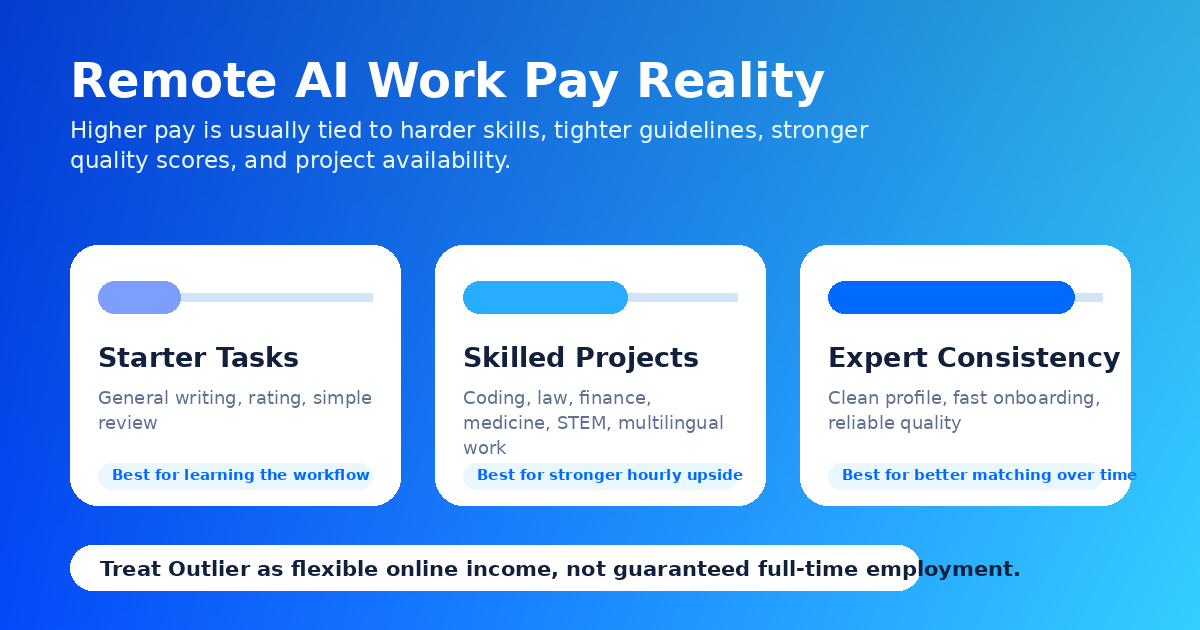
Remote AI training can pay better than many low-skill online jobs, especially when the project requires specialized knowledge. However, pay varies by project, skill level, location, task type, quality, and current demand. Some projects may be hourly, others task-based. Some may include training stages. Some may disappear after a short period.
The schedule can be flexible, but flexible does not always mean available. You may be able to work from home on your own schedule when tasks are available, but that does not guarantee tasks will always be there when you want them. Project supply changes. Quality rules change. Location restrictions can apply.
If your goal is stable full-time remote work, use Outlier as one part of your strategy. Also apply to Mercor remote jobs, Handshake AI projects, AI evaluator roles, data annotation platforms, expert networks, and freelance writing or technical review opportunities.
Is Outlier AI Legit?
Outlier is a real platform connected to Scale AI, and real contributors have been paid for remote AI training work. The better question is not simply "Is Outlier legit?" — the better question is: "Is Outlier a good fit for my skills, risk tolerance, location, and income needs?"
A platform can be legitimate and still have inconsistent work. It can pay contributors and still have confusing onboarding. It can offer strong hourly rates for some projects and low task volume for others. It can be a useful side hustle without being a reliable full-time job. Apply if you have relevant skills. Complete onboarding carefully. Do not pay anyone for access. Do not assume a high advertised rate means you will earn that amount every week. Use the opportunity, but manage it like freelance work.
Remote Work Union connects you to legitimate remote AI training and evaluation roles. Apply for free and find roles matching your expertise.
Find Roles Hiring Now →How to Apply for Outlier AI Jobs Smarter
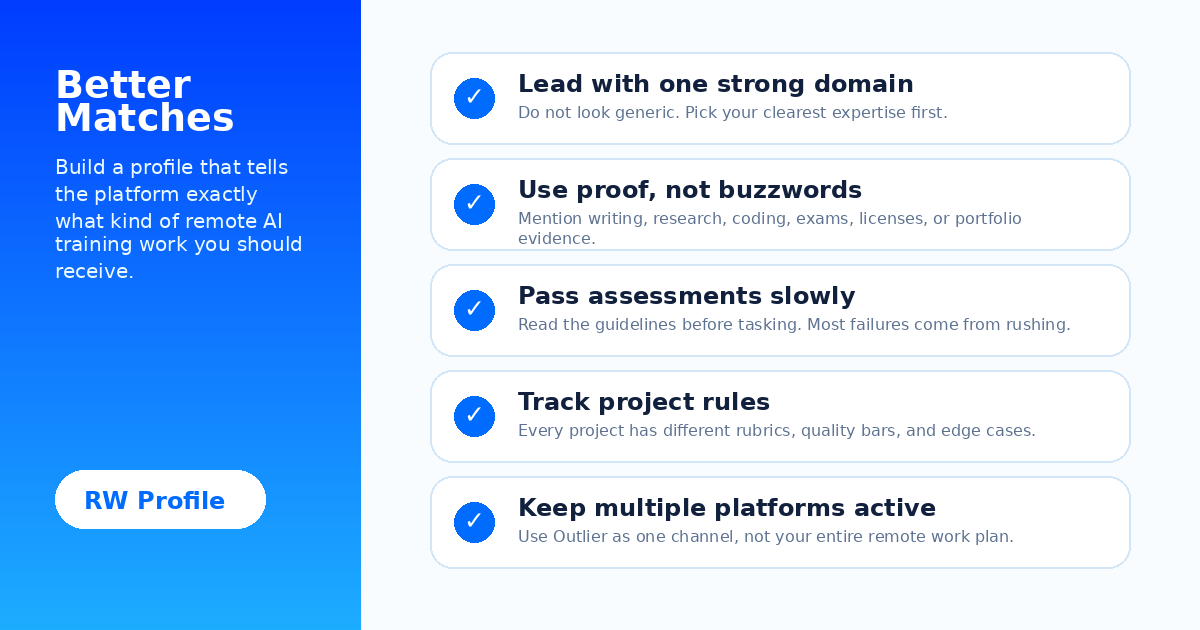
Most people apply too casually, treating AI training platforms like simple survey sites. Start by identifying your strongest category — pick the area where you have the most credible proof: writing, editing, law, finance, medicine, coding, math, science, tutoring, translation, research, or another specialized field.
Then make your profile specific. Instead of saying "good writer," say you can evaluate clarity, factual accuracy, tone, structure, and instruction-following. Instead of saying "finance," say you can review financial reasoning, business analysis, market explanations, accounting logic, and valuation concepts. The goal is to help the platform understand where you belong.
Strong profile signals include:
- Degrees, certifications, licenses, or coursework.
- Professional roles and industries.
- Writing samples, publications, portfolios, or research experience.
- Coding languages, GitHub projects, technical interviews, or shipped work.
- Domain-specific examples of analysis you can perform.
How to Pass Outlier Assessments
The biggest mistake is rushing. Many AI training assessments are not testing whether you are smart in general — they are testing whether you can follow the project's rules. Read the instructions. Then read them again. Look for edge cases. Notice how the rubric defines quality. If the assessment includes examples, study them. If it asks for written explanations, be concise, specific, and tied to the rubric.
A good explanation sounds like this: "Response A is better because it directly answers the user's question, gives the correct calculation, and explains the assumption. Response B is more fluent, but it invents a statistic and ignores the user's constraint." Specificity matters. Rubric alignment matters. Accuracy matters.
What to Do After You Get Accepted
Getting accepted is the start of quality management, not the finish line. When you enter a new project, create a simple note file with the project rules. Track examples of good and bad answers. Write down edge cases. Note what the project cares about most: factuality, format, safety, reasoning, citation quality, brevity, or tone.
Also watch your time. Track your actual earnings per hour after unpaid reading, qualification time, revisions, and waiting. This will tell you which project types are worth prioritizing. A task that pays well on paper may not be worth it if it takes too long to understand.
A Practical Outlier AI Job Strategy
First: Pick your strongest lane — writing, coding, finance, legal, medical, STEM, language, research, or another credible specialty.
Second: Clean up your profile — make it evidence-based and specific.
Third: Apply carefully — treat the onboarding process like a job assessment, not a formality.
Fourth: Study every project rubric — assume the details matter.
Fifth: Track your time and results — know which project types are actually profitable for you.
Sixth: Build a wider remote work pipeline — apply to multiple AI training platforms, remote evaluator roles, expert review jobs, and work from home opportunities.
Seventh: Turn the experience into resume language — describe it in terms employers understand: AI model evaluation, response ranking, prompt testing, rubric-based quality review, factual accuracy review, domain-specific analysis, and quality assurance.
Frequently Asked Questions
Do you need coding experience for Outlier AI jobs?
Not always. Some projects focus on writing, rating, language, research, or expert review. Coding experience can help you qualify for technical projects, but it is not the only path into AI training work.
Can Outlier AI work be done from home?
Yes, many Outlier-style AI training projects are remote. However, availability can depend on your location, the project's requirements, and the platform's current needs.
Is Outlier AI a full-time job?
It is better to treat it as freelance remote work or flexible online income. Some contributors may work many hours when projects are available, but task volume is not guaranteed.
What skills help most for Outlier AI jobs?
Writing, research, coding, law, finance, medicine, math, science, education, languages, editing, and analytical judgment can all help. The most important skill is being able to follow a rubric and explain quality decisions accurately.
Should you only use Outlier AI?
No. Use Outlier as one part of a broader remote work strategy. Also search for remote AI jobs, work from home jobs, AI evaluator roles, data annotation jobs, expert review jobs, and flexible online jobs from other platforms.
Can beginners apply to Outlier AI jobs?
Yes, beginners can apply, especially if they have strong writing, education, research, language, or professional knowledge. But beginners should not treat assessments casually — read every instruction carefully and treat screenings like paid work.