Applying to Handshake AI and hearing nothing back can feel confusing. You may have submitted your resume, completed a form, answered screening questions, or joined a waitlist, then watched your inbox stay quiet. That silence does not automatically mean you were rejected. In remote AI training work, no response can mean several different things: the platform is still reviewing applicants, the current project is full, your profile is waiting for a skills match, or your application needs stronger signals before it stands out.
The important thing is not to treat one quiet application as the end of your search. Handshake AI, Outlier, Mercor, micro1, LinkedIn listings, and direct AI company hiring pages can all move at different speeds. A smart applicant keeps improving their profile and keeps applying while one platform is slow. This guide explains what a no response usually means after you apply, what to check before assuming the worst, and what to do next.
Does No Response Mean Handshake AI Rejected You?
No response does not always mean rejection. In many remote contractor systems, silence can simply mean that your application has not been matched to an active project yet. AI training platforms often review applicants based on a mix of skill area, writing quality, location, availability, resume strength, subject matter expertise, and current client demand. Even a qualified applicant can sit in a queue if there is not an immediate project that fits their background.
That said, you should still treat silence as useful feedback. If a platform does not respond, your application may not be communicating your strengths clearly enough. The goal is not to panic. The goal is to make your next application sharper.
Why Handshake AI May Not Respond After You Apply
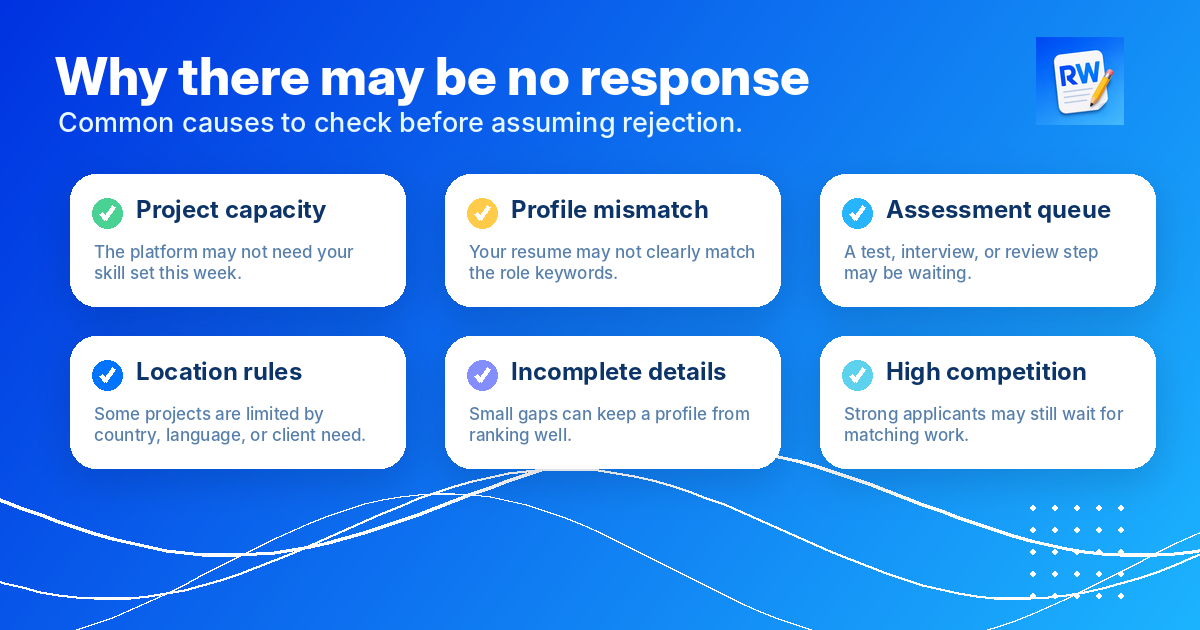
A no-response situation usually falls into one of several categories. First, the platform may have more applicants than available projects. Remote AI work has become more competitive because many educated professionals now understand that AI evaluation can pay for writing, research, coding, finance, legal, healthcare, teaching, or other expert judgment. When a project receives enough qualified applicants, later applicants may not hear back quickly.
Second, your profile may not be specific enough. A resume that says "strong communicator" is weaker than a resume that says "evaluated AI-generated answers for accuracy, clarity, and reasoning quality." A profile that says "good with technology" is weaker than one that lists AI model evaluation, prompt writing, fact-checking, spreadsheet analysis, research, editing, legal reasoning, finance analysis, coding review, or technical writing.
Third, the role may require a location, language, or expertise match. Some AI training jobs are open globally, while others are limited by country, language fluency, client requirements, or domain expertise. If the project is looking for US English legal reviewers, for example, a strong general writing profile may still not match.
Fourth, the system may be waiting for another step. Some platforms use interviews, assessments, skills tests, onboarding tasks, identity checks, or project matching queues. A delay can happen between any two of those steps. The applicant sees "no response," but the platform may simply have no new assignment ready.
What to Check Before You Assume the Application Is Dead
Start with the basics. Check your inbox, spam folder, promotions tab, and any email address you used during signup. Many applicants miss automated messages because they used a secondary email or because the message landed outside the primary inbox. Also check whether you completed every required step. A profile that is 80 percent complete can look submitted from your side while still being weak in the system.
Then review your resume and profile from the platform's point of view. Does it clearly explain why you can evaluate AI answers? Does it include the exact skills that matter for model evaluation work? Does it mention writing quality, research, fact-checking, prompt response writing, ranking answers, editing, domain expertise, or reviewing outputs? Does it show a real professional or academic background instead of generic remote-work language?
For AI training work, the best profiles are specific. If you are a writer, show that you can compare tone, structure, instruction following, and clarity. If you are a finance person, show that you can review business logic, financial reasoning, spreadsheets, and quantitative explanations. If you are a legal applicant, show that you can identify legal nuance, jurisdiction issues, and unsupported claims. If you are a coder, show languages, frameworks, debugging, and code review experience. The closer your profile is to the actual task, the easier it is to match.
What to Do After Three Days, One Week, Two Weeks, and Thirty Days
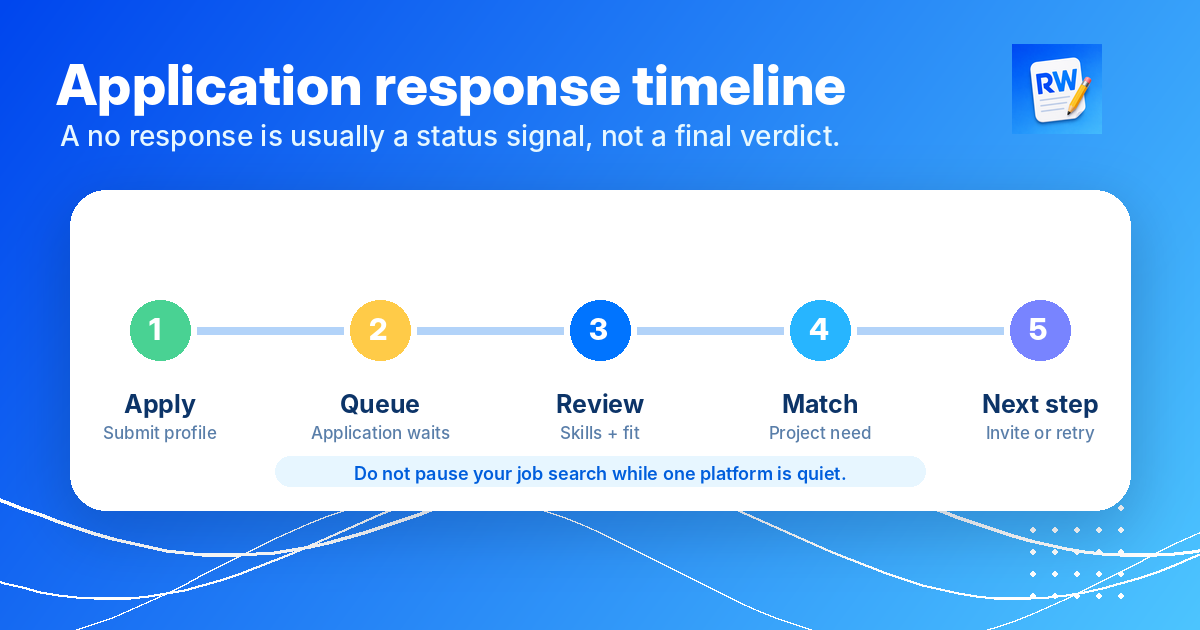
After three days, do very little. Make sure you completed the application correctly and check your inbox folders. A short delay is normal in many remote hiring funnels. Do not send multiple messages or rewrite your entire profile immediately.
After one week, review your profile and resume. Improve weak wording. Add clearer AI training keywords. Replace vague claims with concrete examples. If the platform allows updates, make the profile easier to scan. Your goal is to make the next reviewer understand your fit in ten seconds.
After two weeks, keep applying elsewhere. Do not wait for one platform to decide your entire remote work plan. Apply to other AI evaluation jobs, data annotation roles, AI writing evaluator positions, search quality roles, coding review projects, and subject matter expert projects. You can still keep Handshake AI in your pipeline, but it should not be your only option.
After thirty days, treat the application as cold unless you receive new instructions. That does not mean you can never work there. It means you should focus your energy on new applications, stronger profiles, better samples, and platforms with active roles.
Remote Work Union connects you to legitimate remote AI training and evaluation roles across multiple platforms. Apply for free.
Find Roles Hiring Now →Should You Follow Up With Handshake AI?
A follow-up can make sense if the platform provides a clear support email or applicant contact channel. Keep it short and professional. Do not sound frustrated, do not demand a timeline, and do not send the same message repeatedly. A good follow-up simply confirms that you applied, restates your strongest skill area, and asks whether any additional information is needed.
A simple follow-up can be as direct as: "Hi, I applied for AI evaluation work and wanted to confirm my application was received. My background is in writing, research, and reviewing AI-generated responses for accuracy and clarity. Please let me know if there is any additional information I should provide."
If there is no obvious place to follow up, do not spend hours searching for a hidden contact. Put that time into better applications. In remote AI work, output matters. More strong applications usually beat one perfect follow-up email.
How to Improve Your Profile Before Applying Again
The most common mistake is applying with a general remote-work resume. AI training jobs are not exactly the same as customer support, admin work, data entry, or ordinary freelance writing. They are usually about judging answer quality. That means your profile should show that you can read instructions carefully, compare two answers, identify errors, explain your reasoning, and write clear feedback.
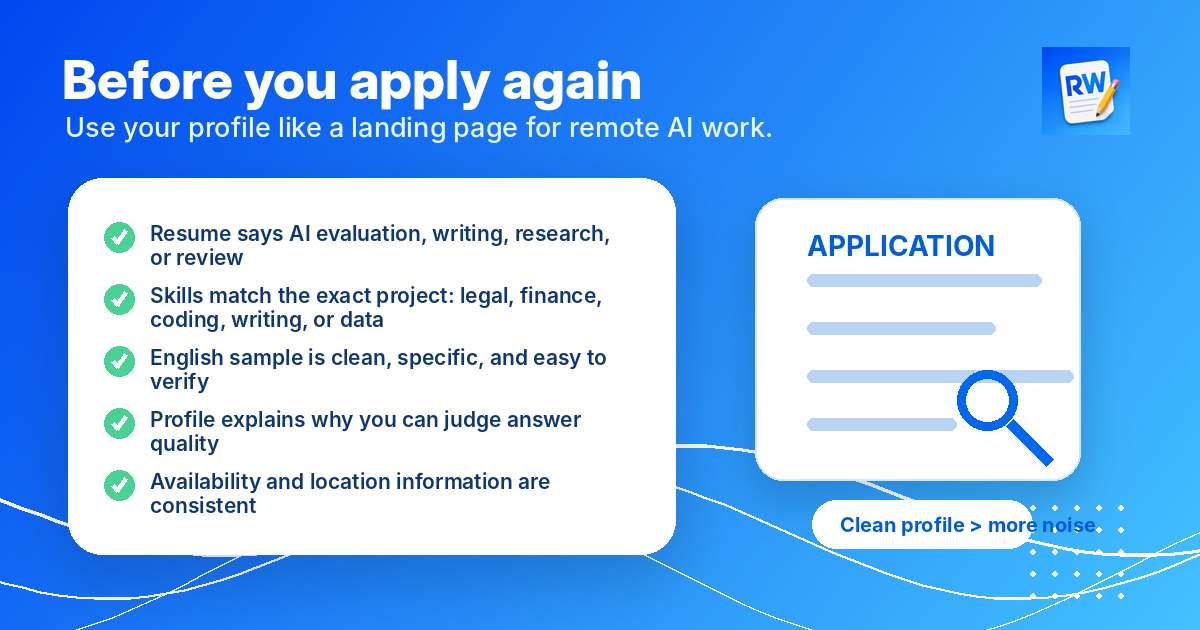
Add relevant keywords naturally. Useful terms include AI evaluator, AI training, model evaluation, prompt writing, response ranking, RLHF, data annotation, fact-checking, research, editing, accuracy review, helpfulness, safety, instruction following, and domain expertise. Do not stuff keywords into random sentences. Use them where they describe real skills.
A stronger profile might say: "Experienced writer and researcher with strong attention to detail. Comfortable evaluating AI-generated answers for accuracy, clarity, instruction following, and usefulness. Able to explain why one response is better than another using concise written feedback." That is more useful than saying: "Looking for remote work and willing to learn."
How Long Should You Wait Before Applying to Other AI Platforms?
You should apply to other platforms immediately. Waiting is the wrong strategy if your goal is to earn income from remote AI work. These platforms are project-based. A company can be active one month and quiet the next. A role can be open for one skill set and closed for another. Your best chance comes from building a pipeline.
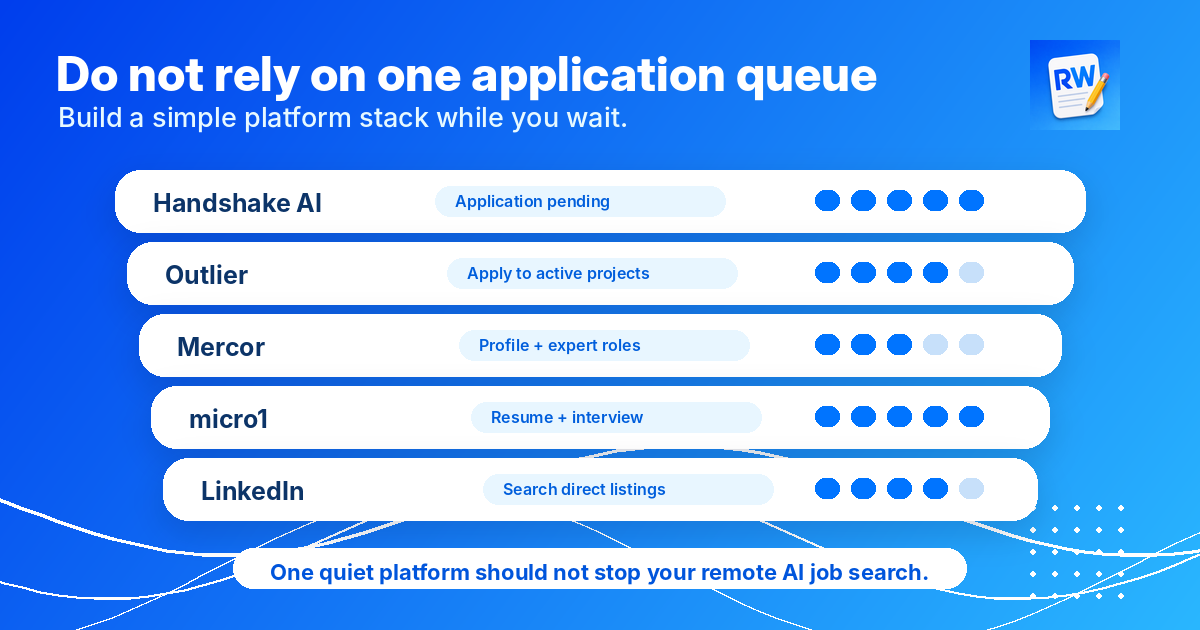
Apply to multiple legitimate sources: AI training platforms, AI data annotation companies, LinkedIn job posts, company career pages, and remote work boards. Search for terms like AI evaluator, AI trainer, AI data annotator, AI writing reviewer, model evaluation, search quality rater, prompt evaluator, and subject matter expert AI projects. Major AI companies like OpenAI, Anthropic, Google, Meta, and Grok also create search demand around AI work, but many evaluator roles appear through contractor platforms, vendors, and specialized AI training companies rather than only through the biggest brand names.
That includes platforms like Mercor, Outlier AI, micro1, and newer AI training companies. Keep your profile specific, keep your applications moving, and do not let one quiet inbox slow down your whole search.
The Best Mindset After a No Response
A no response should not make you quit. It should make you more systematic. Track where you applied, what email you used, what role you applied for, what version of your resume you submitted, and whether you completed an assessment. Then use that information to improve each next application.
The applicants who do best in remote AI work usually think like professionals, not lottery players. They do not apply once and wait. They build a profile, improve their resume, apply across several platforms, learn the task types, and keep their availability realistic. They understand that AI training income can be inconsistent, so they do not depend on one application queue.
Tip: Handshake AI not responding after you apply is frustrating, but it is not a reason to stop. It may be a timing issue, a project-fit issue, a profile issue, or simply a normal delay in a crowded application funnel. Check your email folders, confirm your application is complete, improve your profile, and keep applying to other legitimate AI training and model evaluation roles.
Frequently Asked Questions
Does Handshake AI no response mean I failed?
Not necessarily. It may mean your application is still waiting, there is no active project match, or your profile was not specific enough to move forward quickly.
Should I reapply to Handshake AI right away if I got no response?
Only reapply if the platform allows it and you can make a stronger application. Sending the same weak profile again typically does not help.
What should I improve first after no Handshake AI response?
Improve the first ten seconds of your profile. Make your role, skills, and fit for AI evaluation obvious. Add specific keywords around AI training, model evaluation, writing, research, or your expert domain.
Can I apply to other AI training jobs while waiting for Handshake AI?
Yes, and you should. Remote AI work is project-based. Mercor, Outlier AI, micro1, and other platforms may have active projects that match your background right now.
What types of people fit AI evaluation work?
Strong writers, editors, teachers, researchers, software engineers, analysts, finance professionals, legal researchers, medical writers, and other subject matter experts can all qualify for different AI training tasks depending on the project.