A Handshake AI rejection can feel final, especially if you were applying for remote AI training work, model evaluation, writing evaluation, data annotation, or research projects. But before you assume you are permanently blocked from the entire category, separate the situation into two questions: what exactly was rejected, and what can you improve before your next application?
In remote AI work, rejection often means one of several different things. You may not match the current project demand. Your resume may not make your expertise obvious. You may have missed an assessment threshold. The platform may have enough applicants in your field for now. Or the rejection may be tied to a specific project rather than every future opportunity.
The right response is not to spam the same application again. The right response is to diagnose the reason, improve your profile, and build a wider pipeline across Handshake AI, Outlier, Mercor, micro1, LinkedIn AI jobs, and other legitimate remote AI platforms.
What a Handshake AI Rejection May Mean
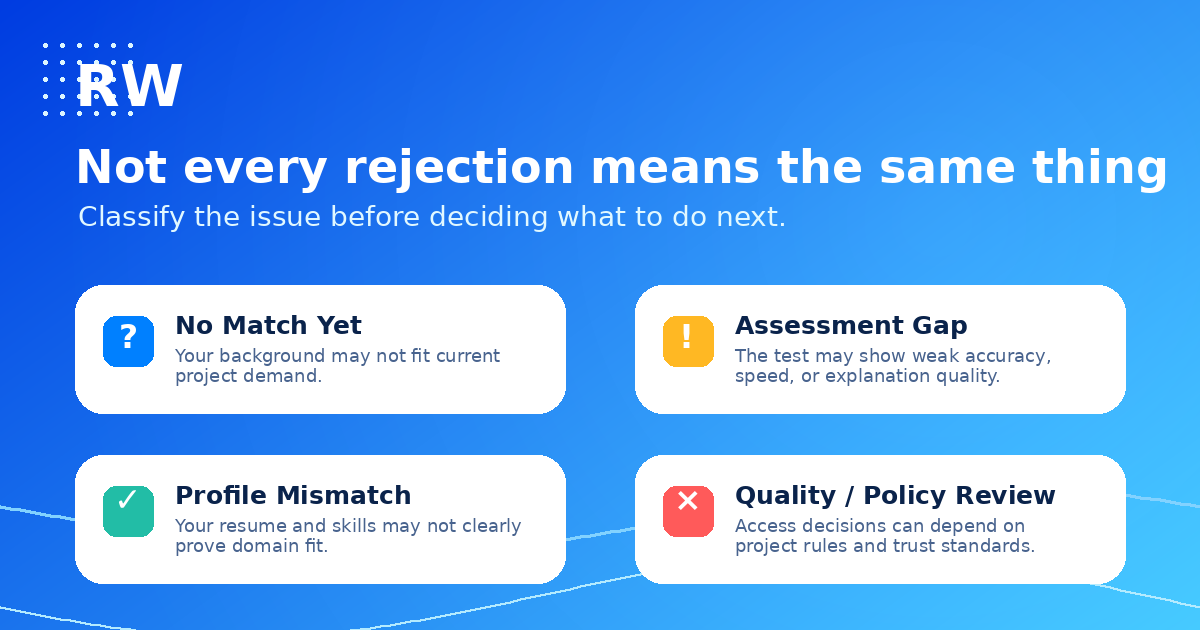
The word rejection is too broad. For remote AI applicants, it can describe several different outcomes.
You may be rejected from a specific project. For example, a legal AI training role, finance evaluator role, healthcare AI project, coding evaluation role, or writing evaluator project may require a very specific background. If your profile does not match that project, you may still be a reasonable fit for a future AI training project.
You may be placed in a waiting pool rather than rejected. Some applicants submit a profile and do not hear back quickly because project invitations depend on current demand, capacity, qualifications, and timing. In that case, the practical move is to strengthen your profile and keep applying elsewhere rather than refreshing one dashboard every day.
You may fail an assessment. Assessments are common in AI model evaluation work because companies need people who can follow instructions, compare model outputs, identify hallucinations, explain ratings, and produce consistent feedback. A failed assessment is a signal that you should practice before trying another similar test.
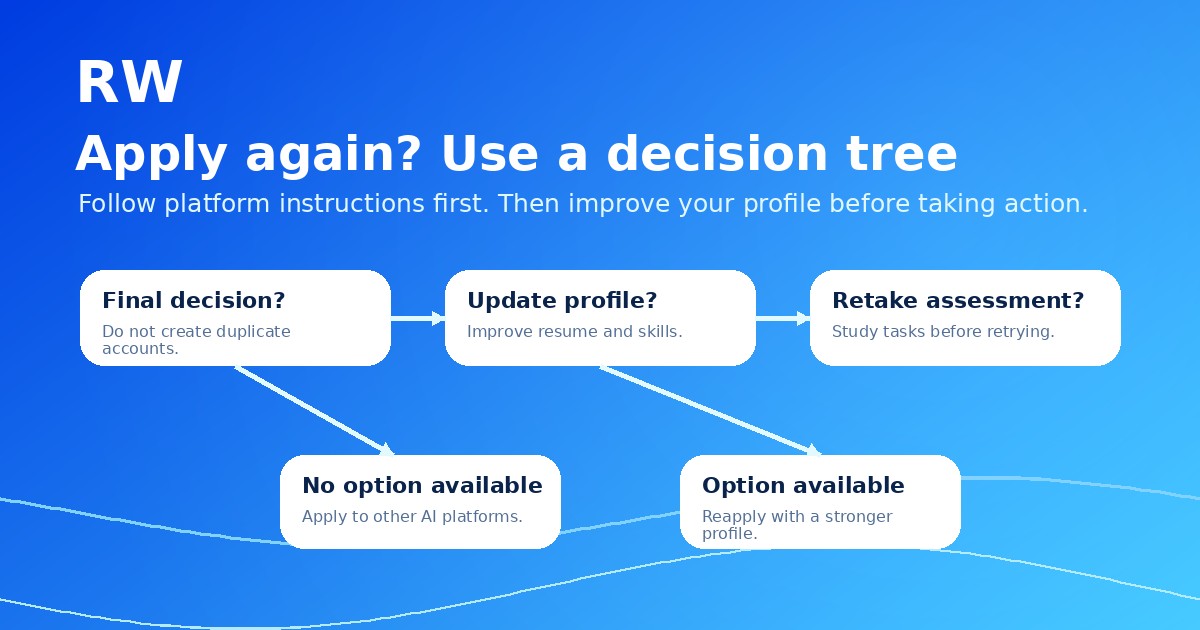
You may be rejected for quality, policy, identity, or trust reasons. That is more serious. If the platform says a decision is final, follow the instruction. Do not create duplicate accounts, misrepresent your identity, reuse another person's work, or try to bypass platform rules.
Can You Apply Again After a Handshake AI Rejection?
The safest answer is: follow the instructions in the rejection email, dashboard, or application portal. If the platform gives you a reapply option, update option, new assessment, or future project invitation, use that official path. If the platform says the decision is final, treat it as final unless the platform later gives you a new official option.
If you are allowed to apply again, do not send the same weak profile twice. A second application should be meaningfully better than the first. That means your resume, profile headline, skills, work samples, and project preferences should make your fit clearer.
If there is no reapply option, you can still improve your broader remote AI job search. Handshake AI is one platform, not the whole market. AI training jobs also appear through specialized platforms, job boards, contractor networks, university channels, LinkedIn posts, and company-adjacent hiring funnels. A rejection from one platform is not proof that you cannot do AI evaluator work.
Do Not Confuse No Response With Rejection
Many applicants search for Handshake AI rejection when the real issue is no response. Those are different. No response usually means you do not yet have enough information to diagnose the problem.
A remote AI platform may review applications on a rolling basis. Project needs can change. Some projects may need legal reviewers one month, finance experts the next month, healthcare writers after that, and generalist AI evaluators in between. You may be qualified and still not receive an invitation immediately.
If you have no response, take three practical steps. First, check your email, spam folder, and dashboard for any missing assessment or profile requirement. Second, improve the keywords and evidence in your profile. Third, keep applying to other legitimate remote AI jobs so one slow platform does not control your income.
Remote Work Union connects you to legitimate remote AI training and evaluation roles across multiple platforms. Apply for free.
Find Roles Hiring Now →How to Improve Your Profile Before Applying Again
A strong Handshake AI profile should answer one question quickly: why should this applicant be trusted with AI training work?
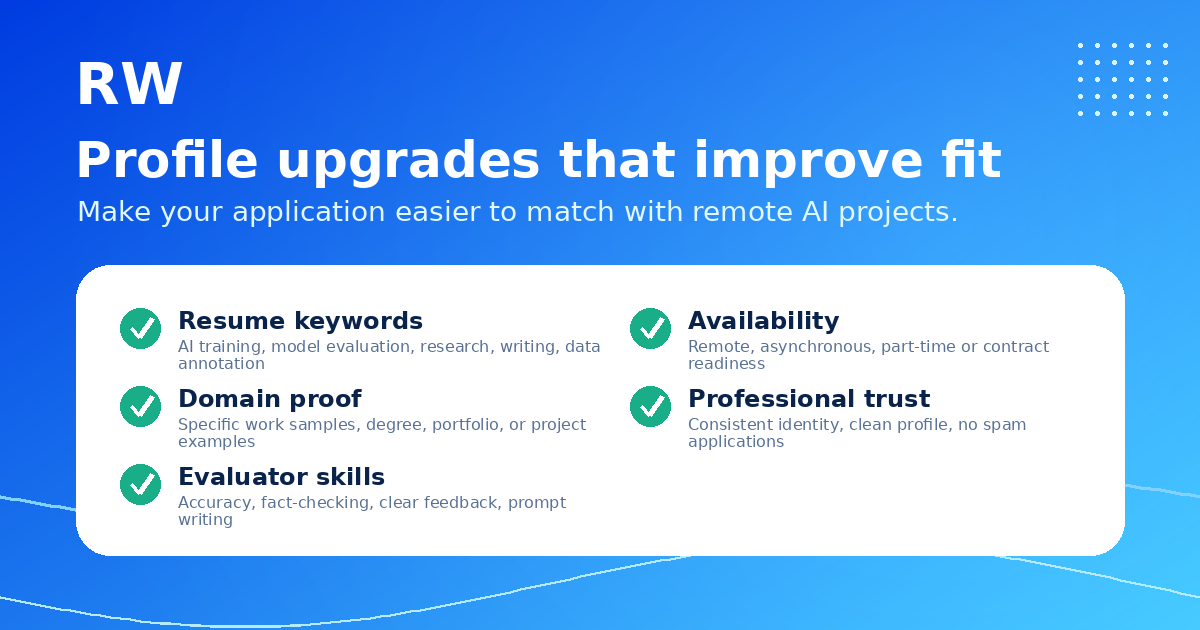
Start with the resume. Use plain language that matches the work. Include terms such as AI training, AI model evaluation, response ranking, prompt writing, research, editing, fact-checking, data annotation, LLM evaluation, content review, and subject-matter expertise when they are true. Do not stuff keywords randomly. Put them where they describe real skills.
Next, make your expertise specific. A vague profile that says strong communicator is less useful than a profile that says finance graduate with Excel modeling experience, legal researcher with contract review experience, biology graduate with literature review experience, teacher with rubric-based grading experience, or writer/editor with experience evaluating factual accuracy and clarity.
Then add proof. Proof can be a degree, work history, writing samples, portfolio clips, research projects, tutoring experience, analysis work, coding projects, spreadsheets, publications, certifications, or examples of professional judgment. Remote AI training platforms are often trying to match applicants to partner needs. Specific proof helps them understand where you fit.
Finally, clean up the basics. Use a professional email address. Make your name consistent. Remove confusing or outdated resume sections. Avoid exaggeration. Make your availability clear. If you are applying for remote contract AI work, the profile should show that you can work independently, follow instructions, meet quality standards, and communicate clearly.
Resume Keywords That Matter for AI Training Jobs
The best keywords are the ones that match real experience. For Handshake AI and similar platforms, useful keywords may include:
- AI training
- AI model evaluation
- LLM evaluation
- AI response ranking
- Prompt writing
- Data annotation
- Research and analysis
- Fact-checking
- Editing and proofreading
- Rubric-based grading
- Technical writing
- Subject-matter expertise
- Legal research, finance analysis, healthcare writing, coding review, or another specific domain
Major AI companies such as OpenAI, Anthropic, Google, Meta, and Grok rely on human feedback, expert review, safety testing, data quality, and evaluation workflows in different ways. You do not need to claim you worked for those companies. The point is to show that you understand the type of human judgment that improves AI systems: clear reasoning, accuracy, instruction following, domain knowledge, and careful comparison of answers.
Tip: Keywords work best when they describe real tasks you have done. If you have graded student writing, that is rubric-based evaluation. If you have fact-checked articles, that is AI evaluation-adjacent experience. Translate what you have done into the language of the work.
What to Do if You Failed an Assessment
If your rejection came after an assessment, treat it like test feedback. Most AI evaluator assessments test a small group of skills: reading instructions closely, comparing two responses, identifying factual errors, noticing missing details, rating helpfulness, writing concise explanations, and avoiding unsupported claims.
Before taking another assessment, practice the actual work pattern. Take two AI-generated answers to the same question and ask yourself which is more helpful, more accurate, safer, and better organized. Then write a three-sentence explanation. Do not over-explain. Do not invent reasons. Do not reward confident answers that are factually wrong.
Strong AI evaluators are not just good writers. They are consistent reviewers. They can explain why one answer is better without turning every task into an essay. That skill matters for Handshake AI, Outlier AI, Mercor-style expert projects, micro1 AI interviews, AI writing evaluator jobs, and broader model evaluation work.
What Not to Do After a Rejection
Do not create multiple accounts to get around a rejection. Do not change your identity details. Do not copy someone else's resume or assessment answers. Do not use AI to fabricate experience you do not have. Do not apply to every project with the same generic resume. Do not argue with support in a way that makes you look harder to trust.
A calm, improved, accurate profile gives you a better chance when legitimate opportunities are available. The strongest reapplications look nothing like the original submission — they show a clearer lane, stronger proof, and a more specific fit for the kind of work the platform needs.
Apply to More Than One AI Training Platform
A single-platform strategy is fragile. Even strong applicants can face rejection, no response, project pauses, assessment failures, or slow task availability. That is normal in remote contract work.
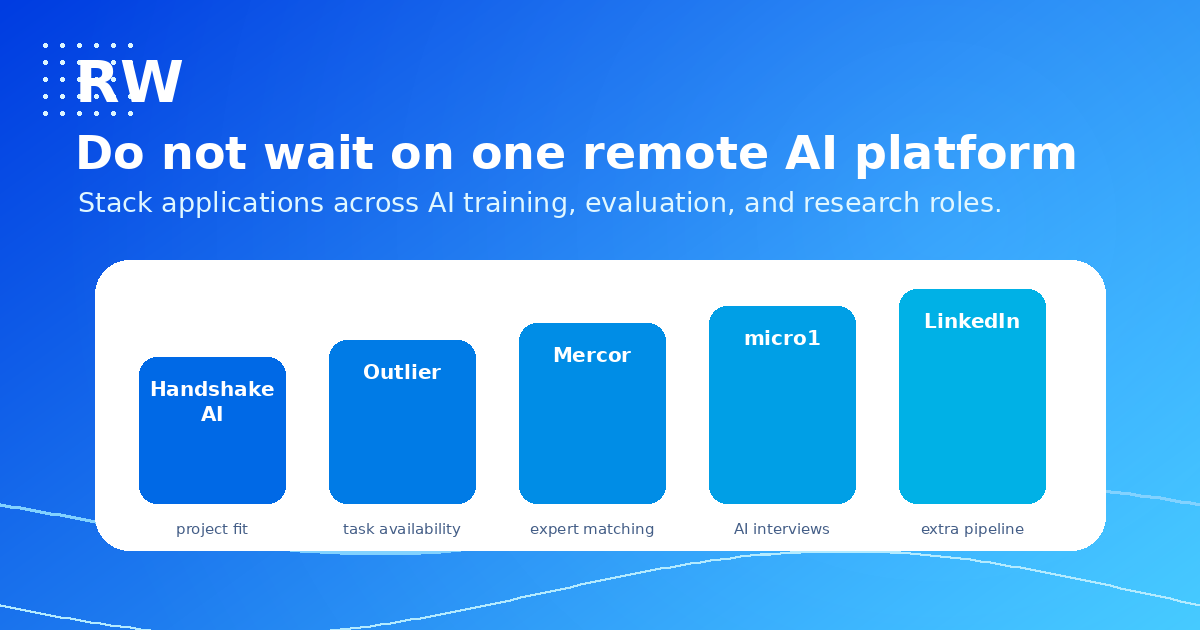
Instead of asking whether Handshake AI is the only path, build a platform stack. Apply to Handshake AI if you are a fit. Also look at Outlier AI projects, Mercor-style expert matching, micro1 AI roles, LinkedIn AI evaluator posts, AI data annotation opportunities, writing evaluator roles, research contractor listings, and legitimate remote job boards.
The goal is not to apply everywhere carelessly. The goal is to increase the number of qualified shots. A good applicant might have one resume for general AI evaluation, one for writing and editing evaluation, one for finance or business analysis, one for legal or healthcare expertise, and one for technical review if they have coding skills.
A Simple Recovery Plan After Handshake AI Rejection
Use this sequence instead of reacting emotionally.
Day 1: Save the rejection email or dashboard message. Identify whether it refers to a specific project, assessment, application, quality review, or general account status.
Day 2: Review your profile from the perspective of a project matcher. Can someone understand your expertise in ten seconds? Are your strongest skills near the top? Does your resume include remote AI work keywords that are true?
Days 3 to 5: Rewrite your resume and profile. Add specific examples of evaluation, writing, research, analysis, teaching, editing, coding, finance, law, healthcare, or other relevant experience. Remove weak filler.
Days 6 to 10: Practice model evaluation tasks. Compare AI answers, write short justifications, fact-check claims, and learn to explain quality differences clearly.
After that: If Handshake AI allows you to reapply, submit a stronger application. If not, keep your improved materials and use them across other AI training platforms.
The Bigger Lesson: Rejection Is Data
A rejection is not always a verdict on your ability. Sometimes it is a signal about timing, fit, profile clarity, project demand, or assessment readiness. Treat it like data.
If your profile is too generic, make it specific. If your resume hides your expertise, move the strongest proof to the top. If you failed an assessment, practice rating and explanation. If one platform is slow, apply elsewhere. If you are not sure what went wrong, improve the parts you can control.
Remote AI jobs reward people who can communicate clearly, learn quickly, follow instructions, and apply judgment. Those same traits should show up in your application.
Frequently Asked Questions
Can I apply again after a Handshake AI rejection?
Sometimes, but only through the official path the platform provides. If a reapplication, profile update, reassessment, or future project invitation is available in the dashboard, use that path after improving your profile. If the decision is stated as final, treat it as final.
Does a Handshake AI rejection mean I am rejected from all future projects?
Not necessarily. A rejection on one listing or project does not automatically mean you are unqualified for every future Handshake AI opportunity. A project mismatch, assessment gap, or profile clarity issue may be fixable.
What should I improve before reapplying to Handshake AI?
Improve your resume keywords, make your domain expertise specific, add proof of AI evaluation skills, and align your profile with the type of project you are applying for. A stronger profile makes the next application easier to evaluate.
How do I know if my Handshake AI rejection was a project mismatch?
A project mismatch typically happens when your background does not clearly match the role's requirements. If the rejection came without an assessment, profile mismatch or capacity may be the cause. Improve profile specificity and apply to roles that better match your expertise.
Final Answer
Can you apply again after a Handshake AI rejection? Sometimes, but only through the official path the platform gives you. If a reapplication, profile update, reassessment, or future project invitation is available, use it after improving your profile. If the decision is final, do not try to bypass it.
The better move is to turn the rejection into a stronger remote AI job search. Improve your resume, clarify your expertise, practice evaluator skills, and apply to multiple legitimate AI training platforms. A rejection from one platform is one data point — not a ceiling on what you can earn from remote AI work.