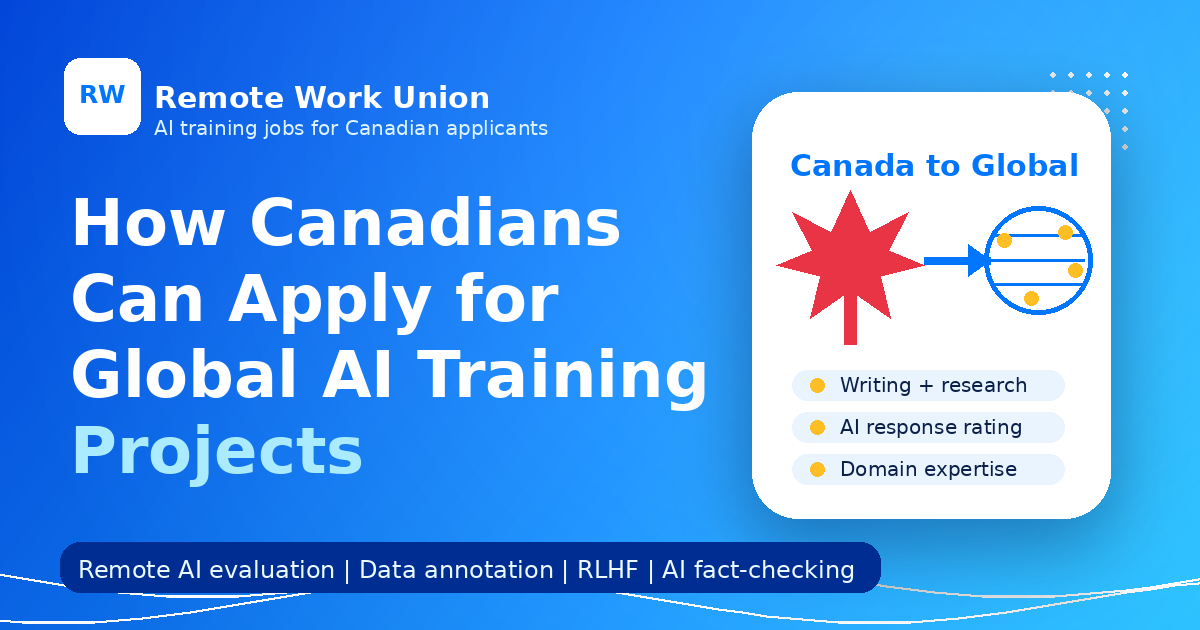
Canadian applicants are in a useful position for remote AI training work. Many global AI projects need people who can read carefully, write clearly, research accurately, compare model responses, evaluate chatbot answers, and apply detailed guidelines without rushing. That creates opportunities for Canadians with strong English skills, bilingual English/French ability, professional expertise, technical knowledge, or general research judgment.
The key is knowing how to apply for global AI training projects instead of only searching for traditional Canadian remote jobs. AI training work may appear under many labels: AI evaluator, AI data annotator, AI model reviewer, AI response rater, RLHF contractor, search quality analyst, prompt evaluator, content quality analyst, AI fact-checker, AI writing reviewer, coding evaluator, or subject matter expert. The names change, but the core idea is similar: humans review AI outputs so models can become more accurate, useful, safe, and aligned with real user expectations.
Why Global AI Training Projects Can Fit Canadian Applicants
Global AI systems need feedback from people who understand language, culture, reasoning, and professional standards. A model that helps users write emails, answer legal questions, compare financial explanations, debug code, summarize research, or evaluate medical content needs more than raw data. It needs human reviewers who can judge whether an answer is clear, truthful, complete, safe, and appropriate for the user's intent.
Canadian applicants may be especially competitive when projects need high-quality English writing, North American context, bilingual English/French review, careful research, or professional expertise. Some projects are broad and beginner-friendly, while others are built for specialists such as lawyers, finance analysts, accountants, software engineers, healthcare professionals, teachers, editors, consultants, researchers, and graduate students.
What Canadians Should Search For
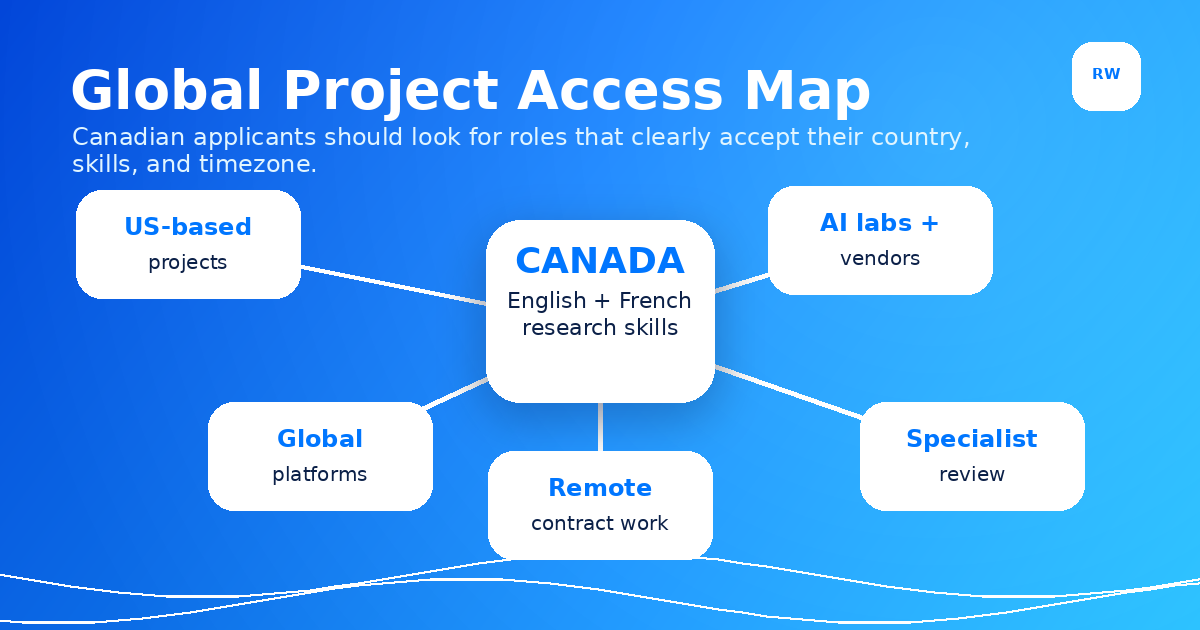
Do not rely on one job title. AI training work is fragmented across platforms, vendors, job boards, contractor marketplaces, and company career pages. A good search strategy uses several keyword groups.
Start with broad terms such as remote AI training jobs, AI evaluator jobs, AI model evaluation jobs, AI data annotation jobs, AI response rating jobs, AI content reviewer jobs, AI fact-checking jobs, and remote RLHF jobs. Then add Canada-specific terms: Canada, Canadian applicants, North America, work from anywhere, global contractors, remote contract, English-speaking applicants, bilingual French, and Canadian writers.
For specialist roles, search your profession plus AI evaluation. Examples include legal AI evaluator, finance AI training jobs, healthcare AI reviewer, coding AI evaluator, math AI trainer, biology AI evaluator, accounting AI model review, and education AI training.
How to Check if a Global Role Accepts Canadians
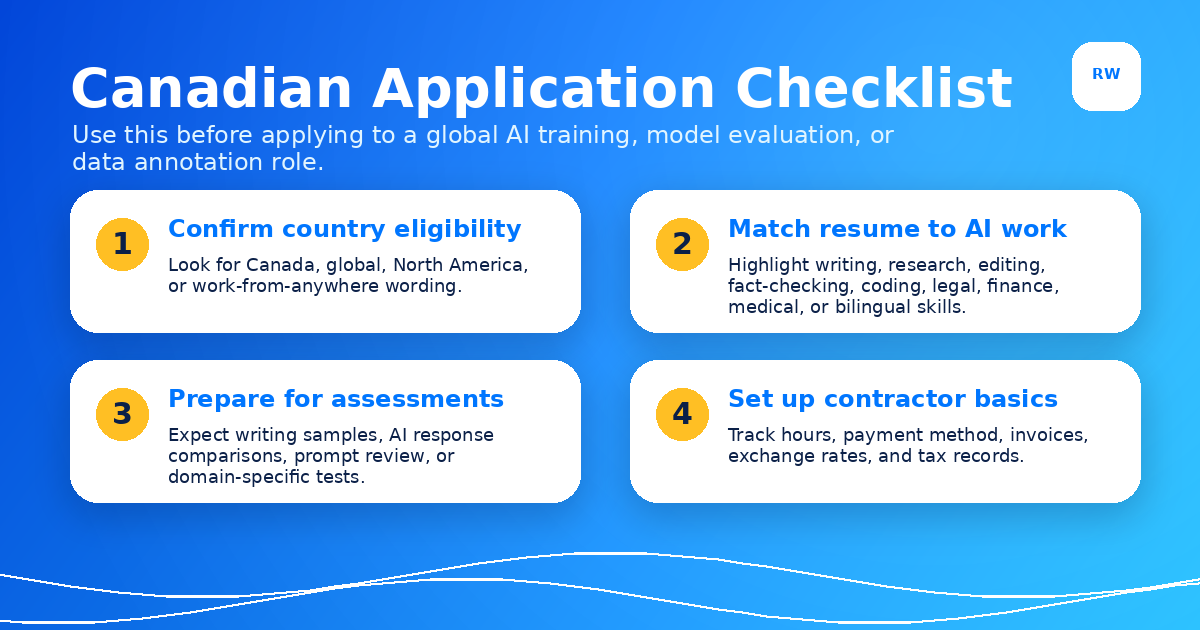
Before spending time on a long application, confirm the location language in the posting. Look for phrases such as Canada, open to Canadian applicants, North America, remote in Canada, global contractors, work from anywhere, English-speaking countries, or country-specific onboarding. If the posting says US only, UK only, or requires employment authorization in another country, do not assume Canada is accepted.
Practical rule: If the country requirement is unclear, treat it as a signal to keep searching. You can still apply when the role looks plausible, but do not build your entire plan around one vague posting. Apply across multiple platforms and prioritize roles that clearly mention Canada or global eligibility.
The Profile Canadian Applicants Should Build
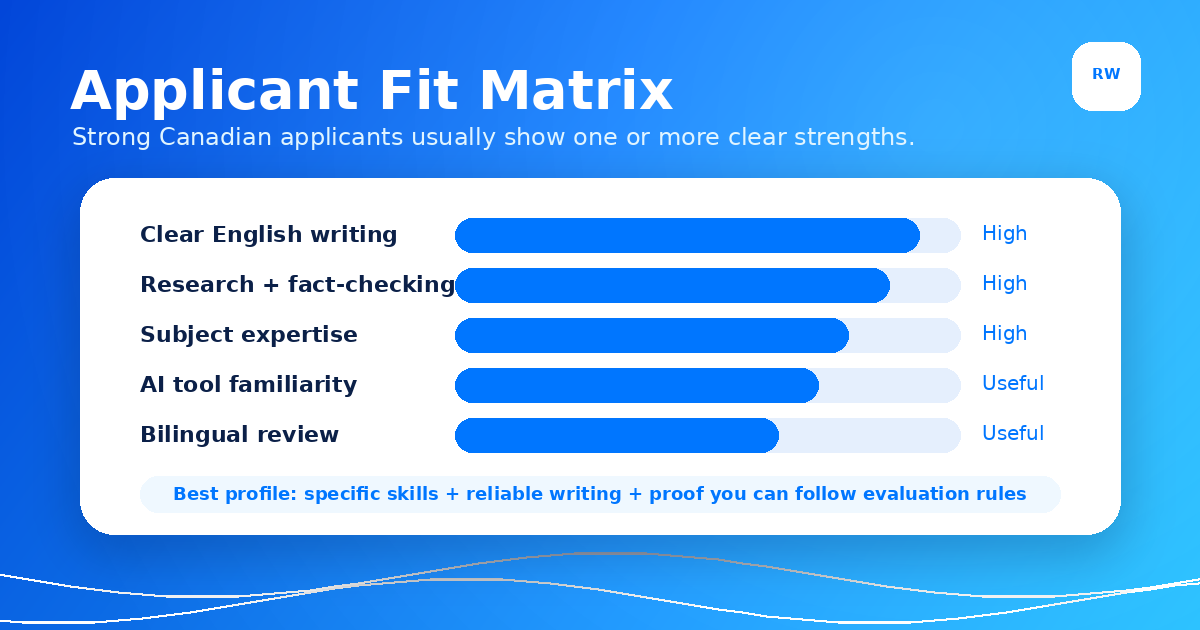
Most AI training applications are not won by sounding generic. A stronger profile makes it obvious what kind of AI work you can review. Instead of saying "hard worker seeking remote work," show evidence that you can evaluate information.
Writers and editors should emphasize clear writing, grammar, tone judgment, editing, summarization, content review, and the ability to explain why one answer is better than another. Researchers should emphasize source checking, fact verification, synthesis, note-taking, academic writing, and careful comparison. Specialists should make their domain obvious: legal, finance, accounting, medical, science, engineering, coding, education, business, marketing, or operations.
Bilingual applicants should mention language pairs directly, especially English and French, because some global AI projects need reviewers who can evaluate translation quality, multilingual prompts, Canadian French wording, or culturally specific language use.
Resume Keywords That Help for AI Training and Evaluation
A resume for AI training work should be clear, short, and keyword-friendly. Useful keywords include AI model evaluation, data annotation, response rating, prompt evaluation, RLHF, research, fact-checking, editing, writing, quality assurance, content review, subject matter expertise, instruction following, analytical reasoning, error detection, classification, rubric-based scoring, search evaluation, technical review, and feedback writing.
You can also include tools and AI systems you know how to use, such as ChatGPT, Claude, Gemini, Grok, Perplexity, Microsoft Copilot, Google Workspace, Excel, Google Sheets, Notion, Airtable, and Slack. Do not claim expertise you do not have. The goal is to help the platform understand your actual fit.
Remote Work Union connects you to legitimate remote AI training and evaluation roles. Apply for free and find roles hiring now.
Find Roles Hiring Now →How to Answer Application Questions
Many global AI training platforms ask short application questions before showing assessments. These questions often look simple, but they are screening for clarity, professionalism, and whether you understand the work.
When asked why you are a fit, be specific. A weak answer says, "I want remote work and I am good with AI." A stronger answer says, "I have experience writing and researching complex topics, I can compare two responses against a rubric, and I can explain quality differences clearly." If you have domain experience, name it directly. If you are bilingual, name the languages and the type of work you can review.
How to Prepare for AI Training Assessments
Assessments are common in AI model evaluation work. A platform may ask you to compare two chatbot answers, rate a response for helpfulness and accuracy, identify hallucinations, rewrite an answer, check sources, explain a ranking decision, or complete a domain-specific test.
The biggest mistake is treating the assessment like casual ChatGPT use. AI evaluation work is rule-based. Read the instructions, follow the rubric, and explain your judgment in plain language. If the task asks for evidence, provide evidence. If the task asks you to choose the better response, do not only choose — explain why.
What Kinds of AI Training Projects Canadians May See
General AI evaluation projects usually involve comparing model responses, rating answers, labeling content, checking whether a chatbot followed instructions, or writing feedback. These can fit strong writers, editors, researchers, and detail-oriented remote workers.
Specialist projects are narrower. A legal project may ask reviewers to evaluate legal reasoning or identify whether a response overstates a claim. A finance project may ask for review of calculations, accounting explanations, or business analysis. A coding project may ask reviewers to test code, compare solutions, or write prompts that expose bugs. A healthcare or science project may require careful review of technical accuracy and safety boundaries.
Some projects are connected to large AI ecosystems such as OpenAI, Anthropic, Google, Meta, Microsoft, Claude-style assistants, Gemini-style systems, ChatGPT-style workflows, and Grok-style chat products. Many roles are not posted directly by those companies — they come through vendors, platforms, contractors, staffing partners, or specialized AI training marketplaces.
How to Avoid Scams and Low-Quality Listings
Legitimate remote AI work should be clear about the type of task, the application process, basic eligibility, and payment structure. Be careful with listings that promise guaranteed income, ask for upfront fees, require you to buy a course before applying, or avoid explaining what the work actually involves.
How to Stack Multiple Platforms Without Losing Focus
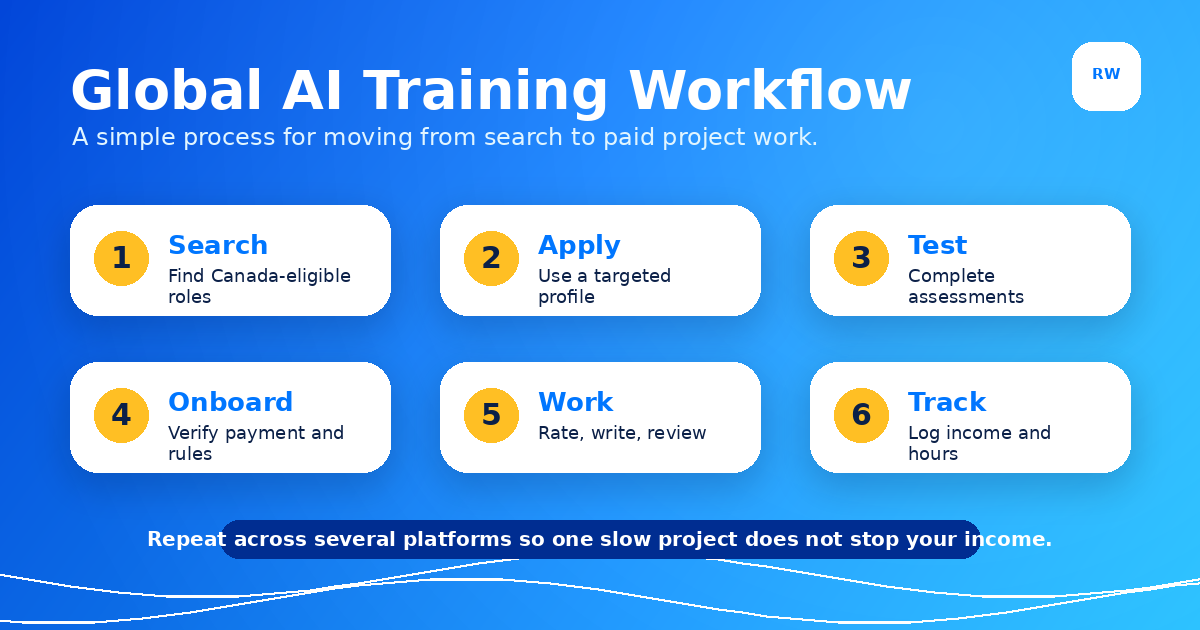
AI training work can be inconsistent. One week may have plenty of tasks and another week may have none. That is why Canadians applying globally should avoid depending on a single platform too early. A better approach is to build a small pipeline: apply to several relevant AI training platforms such as Handshake AI, Mercor, micro1, and Outlier AI, keep a simple spreadsheet of applications, note which countries each platform accepts, track assessment dates, save login links, and record which skills each profile emphasizes.
Frequently Asked Questions
Why can Canadians apply for global AI training projects?
Canadian applicants are often competitive for global AI training projects because many projects need strong English writing, North American cultural context, bilingual English/French ability, and professional expertise. Canada also has time-zone overlap with the US, which can help with project coordination.
What should I search for as a Canadian looking for global AI training work?
Search using both global AI keywords and Canada-specific eligibility terms. Try combinations like "remote AI evaluator Canada," "Canadian AI evaluator jobs," "AI data annotation Canada English," "global AI training contractor," and "bilingual AI evaluator remote." Add your specialty for better matches.
How do I check if a global AI training role accepts Canadians?
Look for phrases like Canada, open to Canadian applicants, North America, remote in Canada, global contractors, work from anywhere, or English-speaking countries. If the posting says US only or UK only, do not assume Canada is accepted. Always read the eligibility language before investing time in a long application.
How should I prepare for global AI training assessments?
Read the instructions carefully before starting. Identify the exact task type — comparison, annotation, rubric-based review, answer writing, or fact-checking. Apply the rubric, not just your gut reaction. Explain your judgment clearly and specifically. Many applicants fail by rushing or ignoring a hidden constraint in the instructions.