Quick Answer
Handshake AI does not have one fixed response timeline for every applicant. The most practical answer is this: some applicants may hear back quickly when their background matches an active project, while others may wait weeks or receive no project invitation at all if there is no current match. A delayed response does not always mean you failed. It often means the platform is matching applicants to specific project demand.
Handshake says applications are reviewed on a rolling basis and that project invitations depend on project needs, qualifications, experience, area of expertise, partner demand, and project availability. That means the timeline is less like a normal full-time job application and more like a talent marketplace for remote AI training work.
For most applicants, the right approach is to apply, improve your profile, track your application date, and keep applying to other remote AI jobs instead of waiting on one inbox.
Why Handshake AI Response Times Vary
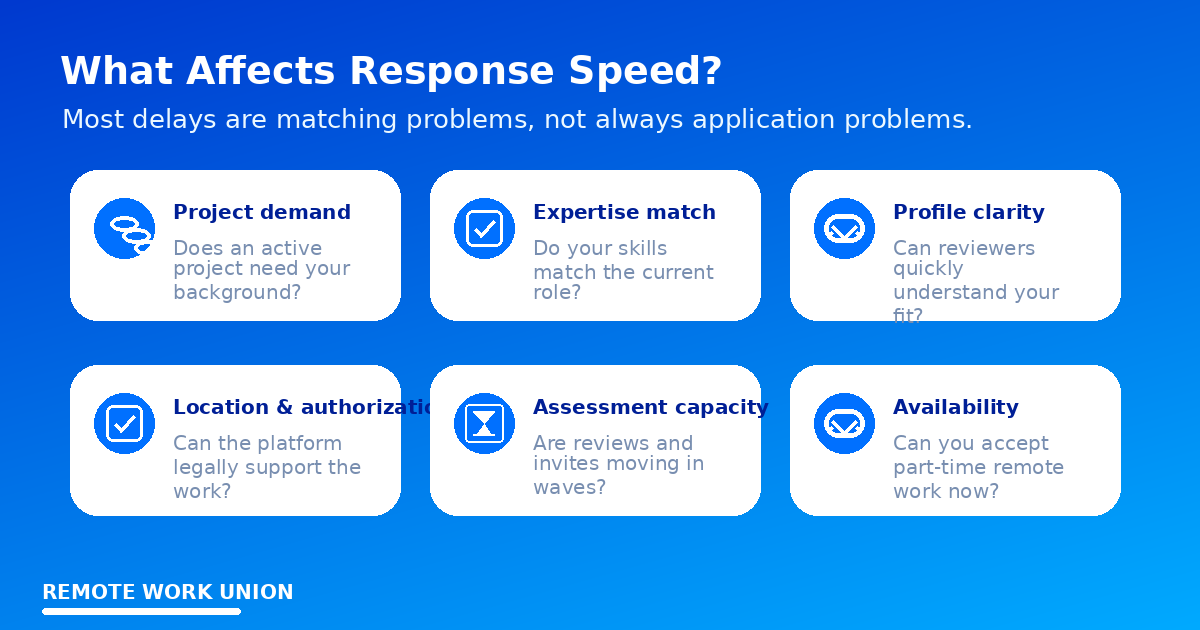
The biggest reason response times vary is that Handshake AI work is project-based. A candidate might be qualified for AI model evaluation, prompt response review, data annotation, or subject matter expert work, but still not receive a fast invitation if there is no active project that needs that exact background.
This is different from applying to a single open job with a fixed hiring manager. In AI training and model evaluation work, platforms often need waves of reviewers for specific categories. One week they may need software engineers, medical writers, finance experts, creative writers, teachers, lawyers, or multilingual evaluators. Another week they may need a completely different group.
That is why two people can apply on the same day and get different results. One applicant may fit an active project immediately. Another may be placed in a general pool for future opportunities. A third may need to improve profile clarity before the platform can understand where they fit.
What "Under Review" Usually Means
If your Handshake AI application is under review, it usually means your information has been submitted and is being considered for current or future project opportunities. It does not necessarily mean a human reviewer is reading your profile every day. It also does not guarantee that a project invitation is coming.
The useful way to read "under review" is: you are not done, but you are not hired yet. Your profile may be eligible for matching, but your next step depends on demand, fit, assessment availability, and whether your background is clear enough for the project team to route you.
Do not treat the status as a reason to stop applying elsewhere. Remote AI work can be inconsistent across platforms. Handshake AI, Mercor, Outlier AI, micro1, and other AI evaluator opportunities can all move at different speeds. Serious applicants usually build a pipeline instead of relying on one response.
A Practical Response-Time Framework
There is no universal deadline, but applicants can use a practical framework.
After 24 to 72 hours: Make sure your application is complete and that you can still access your account. Do not panic if nothing happens yet. Many AI training applications do not move instantly.
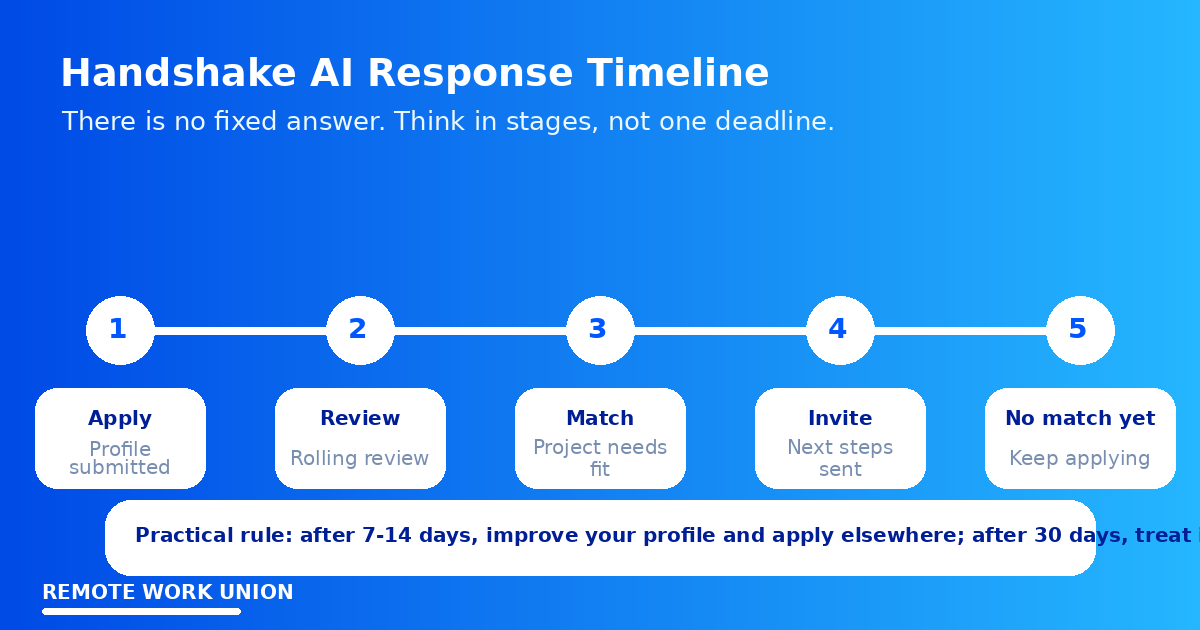
After 7 to 14 days: Assume you should improve the parts of your profile you control. Tighten your resume keywords, clarify your domain expertise, and prepare stronger writing or reasoning samples. Search terms like AI model evaluation, remote AI training, LLM evaluation, prompt writing, RLHF, data annotation, AI writing evaluator, and subject matter expert AI jobs should be reflected where accurate.
After 14 to 30 days: It is reasonable to send one polite follow-up if there is a clear support or recruiter contact path. Keep it short. Mention the role, the date you applied, your strongest relevant qualifications, and your continued availability. Do not send repeated messages.
After 30 days: Treat silence as "no current match" rather than a personal rejection. Keep the account updated, but move your energy toward additional applications and stronger platforms for your background.
What Makes an Applicant More Likely to Hear Back
The strongest applicants make it easy to understand what they can evaluate. Handshake AI and similar platforms do not only need generic remote workers. They need people who can judge whether an AI answer is helpful, accurate, safe, complete, and well-explained.
A strong profile usually shows clear writing ability, subject matter expertise, careful reasoning, and comfort reviewing AI-generated content. For example, a finance applicant should not only say "finance." They should mention financial analysis, Excel modeling, accounting, investing knowledge, valuation, business writing, risk analysis, or other relevant areas. A teacher should mention grading, rubric-based evaluation, curriculum, tutoring, student feedback, and written explanations. A writer should show editing, research, fact-checking, tone control, and clear comparative feedback.
The goal is not to stuff keywords randomly. The goal is to make your fit obvious. If a platform needs reviewers for business prompts, legal reasoning, healthcare writing, coding answers, math tasks, or general AI chat quality, your profile should help the reviewer route you quickly.
Remote Work Union connects you to legitimate remote AI training and evaluation roles across multiple platforms. Apply for free.
Find Roles Hiring Now →What to Do While Waiting for Handshake AI
The worst strategy is refreshing your inbox for weeks. The better strategy is to use the waiting period to strengthen your application pipeline.
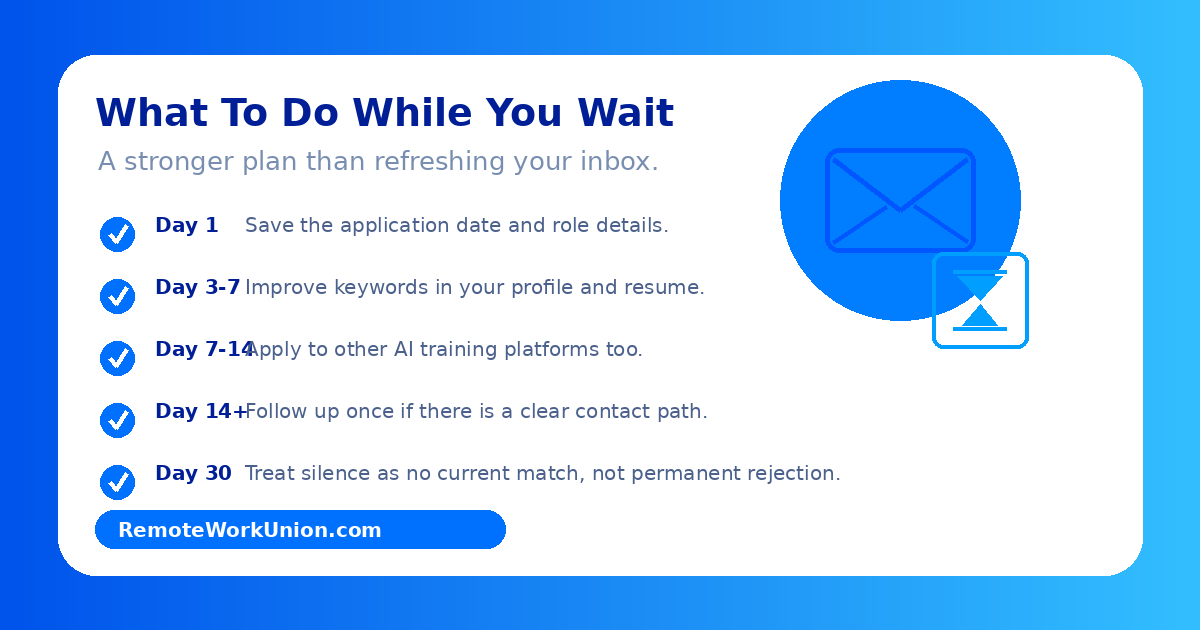
First, update your resume for AI training work. Add accurate keywords such as AI evaluator, model evaluation, prompt response review, content evaluation, data annotation, AI writing feedback, research, fact-checking, and remote contract work. Keep it simple and readable.
Second, prepare examples. Many AI evaluator platforms care about whether you can explain why one answer is better than another. Practice comparing two responses for accuracy, completeness, clarity, instruction-following, tone, and safety. The more specific your feedback is, the better.
Third, apply to multiple platforms. Handshake AI may be a strong option for some applicants, but remote AI work is not guaranteed on any single platform. Mercor, Outlier, micro1, AI training job boards, LinkedIn, and specialty evaluator roles can all be part of a broader search.
Fourth, track everything. Keep a simple spreadsheet with the platform, role, date applied, profile status, assessment status, follow-up date, pay range, and notes. Remote AI job applications get confusing when you are applying to several projects at once.
Should You Follow Up?
Yes, but only once and only when it is useful. A good follow-up is short, factual, and easy to process. The purpose is not to pressure the platform. The purpose is to clarify your continued interest and remind them why you are a fit.
A simple version could say: "I applied to the Handshake AI Fellowship on [date] and wanted to confirm my application is complete. My background is in [field], with experience in [specific skills]. I am interested in remote AI evaluation, prompt response review, and model feedback projects. Please let me know if there are any additional steps I should complete."
Tip: Do not send a follow-up every few days. If the platform says applications are reviewed on a rolling basis, repeated messages usually do not speed up matching. Your time is better spent improving your profile and applying to more roles.
Common Mistakes That Slow Applicants Down
One common mistake is being too vague. "I want remote work" is not enough. Platforms need to know what kind of AI work you can do. Can you evaluate writing? Check facts? Review code? Grade math? Judge business reasoning? Edit medical explanations? Compare chatbot answers?
Another mistake is applying with a normal resume that does not mention AI evaluator skills. Even if you have never had an AI training job before, you may have transferable skills. Editing, tutoring, research, customer support QA, legal writing, coding, spreadsheet analysis, journalism, academic work, and technical documentation can all matter if framed correctly.
How This Compares With Other AI Training Platforms
Handshake AI is part of a larger remote AI work market. Applicants often search for jobs connected to OpenAI, Anthropic, Google, Meta, Grok, Gemini, Claude, and other major AI systems. In practice, many roles are not direct employment with those companies. They are contractor, fellowship, evaluator, annotation, or expert review opportunities connected to the broader AI model training ecosystem.
That matters because response times can be uneven everywhere. Mercor may move quickly for one expert category and slowly for another. Outlier may have assessments available but no active tasks. micro1 may be relevant for some expert profiles and not others. LinkedIn postings may lead to staffing firms, marketplaces, or direct employers.
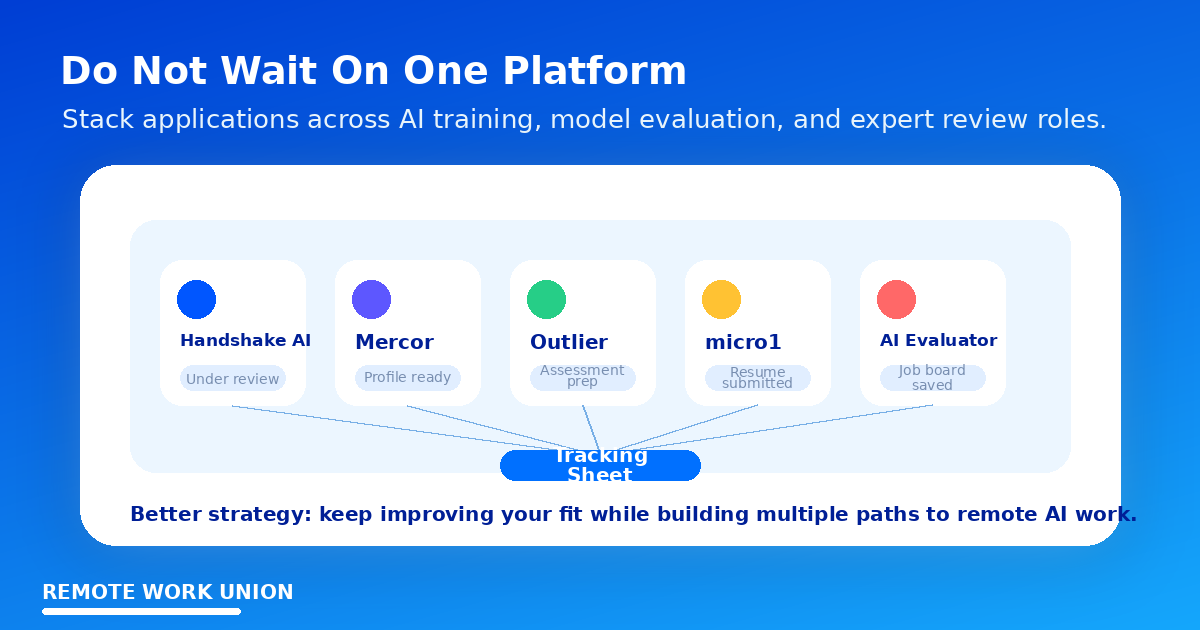
The applicant who wins is not always the applicant who waits the longest. It is the applicant who keeps improving their profile, applies broadly, understands the task type, and learns how to explain their expertise in language AI hiring teams recognize.
Frequently Asked Questions
How long does Handshake AI take to respond?
There is no fixed response timeline. Handshake AI reviews applications on a rolling basis. Some applicants hear back quickly when their profile matches an active project. Others may wait weeks or receive no response if there is no current project match.
What does under review mean for a Handshake AI application?
Under review means your application has been submitted and is being considered for current or future project opportunities. It does not guarantee placement, but it does mean the application has not been rejected outright.
Should I follow up if Handshake AI has not responded?
Yes, but only once and only through an available support or contact channel. Keep the follow-up short, mention your strongest qualification, and ask if any additional information is needed. Do not send repeated messages.
What should I do if Handshake AI never responds?
Treat silence as no current match rather than permanent rejection. Keep your profile active, apply to other AI training platforms like Mercor, Outlier AI, and micro1, and revisit the dashboard periodically for new opportunities.
Bottom Line
Handshake AI can respond quickly when your profile matches an active project, but there is no single guaranteed response time. "Under review" means you are in consideration, not that placement is guaranteed. A smart applicant gives the process time, then moves forward instead of standing still.
Use the first week to confirm your application and sharpen your profile. Use the second week to apply more broadly. After a month, assume there may not be a current project match and continue building your remote AI work pipeline.
Remote AI jobs are real, but they reward applicants who treat the process like a pipeline: clear profile, strong keywords, good assessment preparation, multiple platforms, and consistent follow-up discipline.