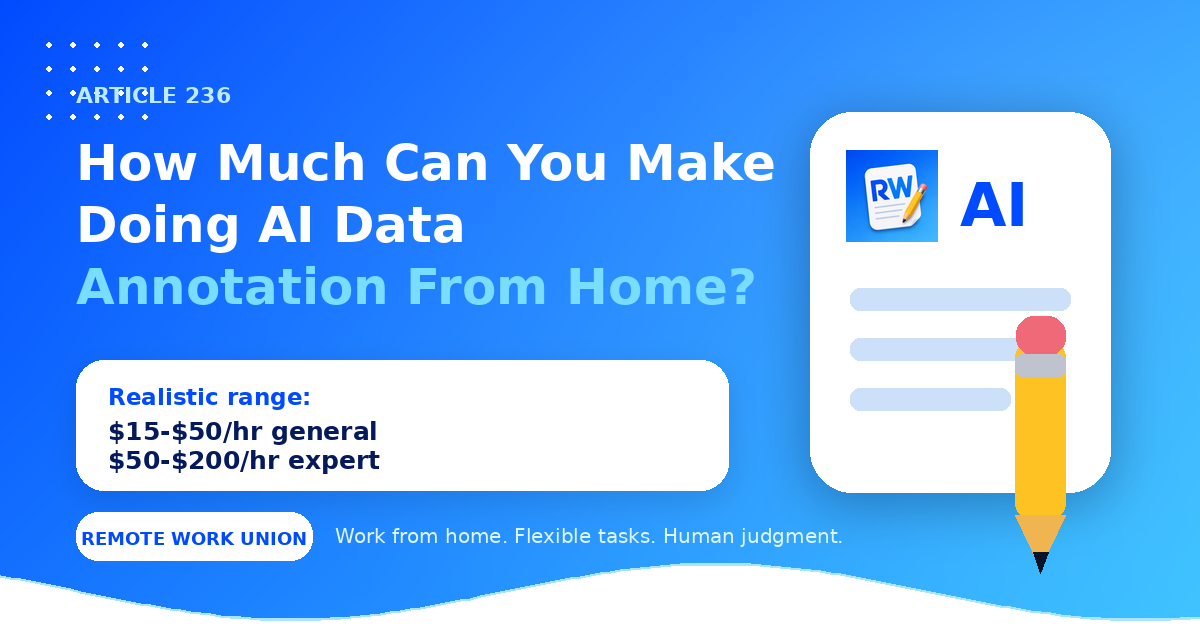
You can make anywhere from a few hundred dollars per month to several thousand dollars per month doing AI data annotation from home. The realistic range depends on your hourly rate, the number of projects available, your location, your accuracy, and whether you qualify for expert work.
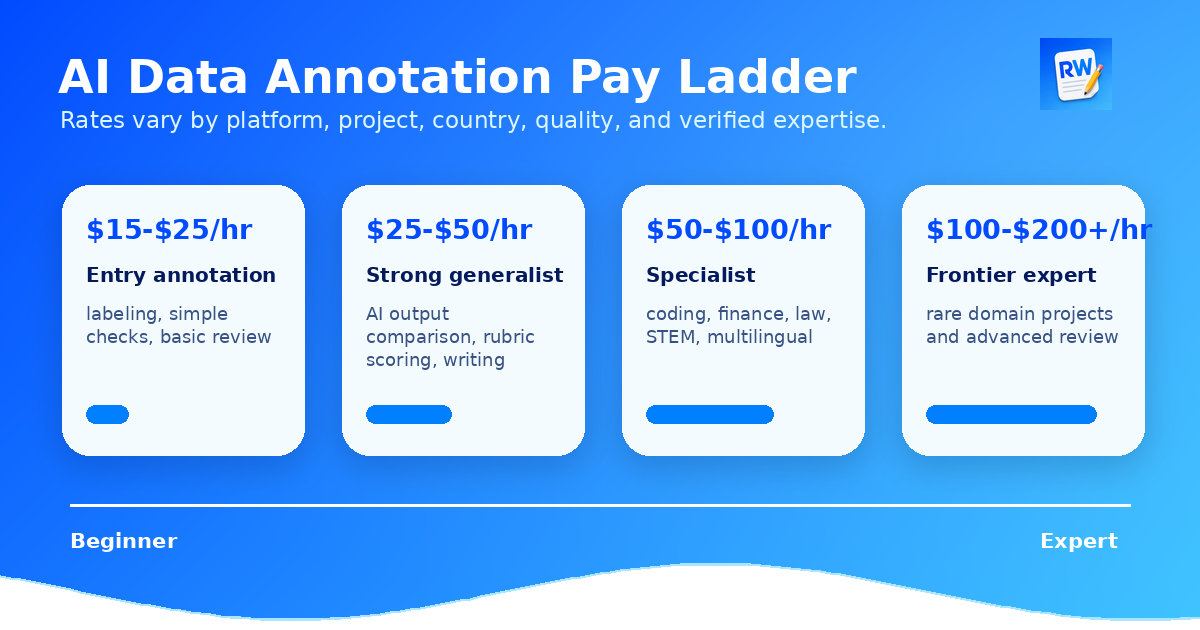
For many beginners, a realistic starting range is $15 to $25 per hour. Strong generalists who can write clearly, follow detailed rubrics, compare AI responses, and catch subtle mistakes may see work in the $25 to $50 per hour range. Specialized contributors — including software engineers, legal professionals, finance professionals, medical professionals, scientists, researchers, bilingual experts, and other subject matter experts — may qualify for projects that pay $50 to $100+ per hour. Some frontier expert projects can reach $100 to $200+ per hour, but those roles are competitive, selective, and not guaranteed.
What AI Data Annotation From Home Actually Means
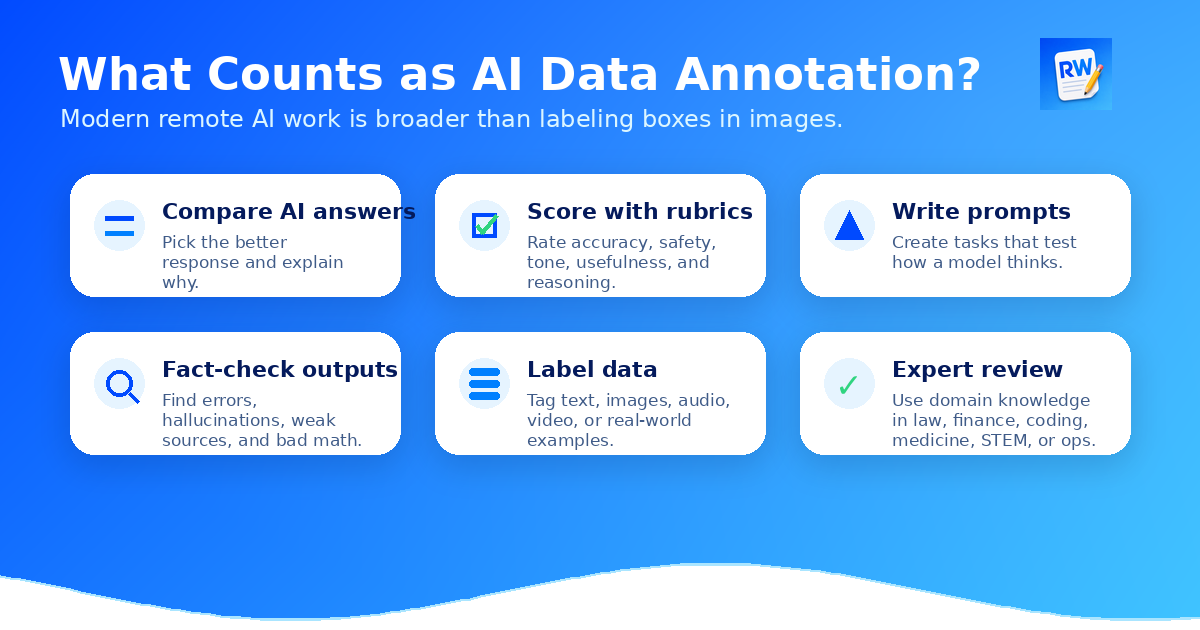
Older data annotation jobs were often simple: label an image, tag a sentence, transcribe audio, classify a search result, or decide whether an object appeared in a photo. Those tasks still exist, especially in image annotation, audio labeling, video annotation, and content classification.
But in 2026, the higher-value side of data annotation has shifted toward AI training and AI model evaluation. Large language models need human feedback to improve. AI companies and model teams need people to compare answers, test reasoning, identify hallucinations, write better prompts, evaluate safety, score tone, check facts, and apply judgment in ambiguous cases. That is why many remote AI jobs now use terms like AI data annotation, AI training, AI model evaluation, AI response rating, RLHF, prompt evaluation, chatbot response comparison, human feedback, data labeling, expert review, and AI quality analyst.
The Realistic Pay Range
A useful way to think about AI data annotation pay is to divide it into tiers.
Entry-Level Annotation: $15 to $25 per Hour
This is the beginner-friendly range. Tasks may include labeling data, classifying content, checking short AI responses, reviewing simple outputs, or following a straightforward rubric. The people who do well are usually not the fastest clickers — they are the people who read instructions carefully, avoid sloppy mistakes, and keep their answers consistent across many tasks.
Strong Generalist AI Evaluation: $25 to $50 per Hour
This is where AI data annotation becomes more interesting. A strong generalist might compare two chatbot answers, decide which response is more helpful, explain the difference, flag false claims, identify weak reasoning, or rewrite a response to meet a higher standard. Former teachers, writers, editors, researchers, customer success professionals, operations managers, paralegals, analysts, marketers, and project managers can all have useful transferable skills.
Specialist and Technical Projects: $50 to $100+ per Hour
Specialist projects pay more because the model needs feedback that a random person cannot provide. Examples include coding, legal analysis, finance, healthcare, mathematics, science, engineering, cybersecurity, accounting, procurement, product management, UX research, translation, localization, and industry-specific judgment. In these roles, the platform is not paying only for your time — it is paying for your expertise.
Frontier Expert Work: $100 to $200+ per Hour
The highest-paying AI training projects are usually narrow, selective, and expertise-heavy. They may involve advanced coding, frontier model evaluation, expert writing, high-stakes domain review, or complex multi-step problem solving. These roles exist, but treat them as upside, not as a guaranteed starting point.
Monthly Income Examples
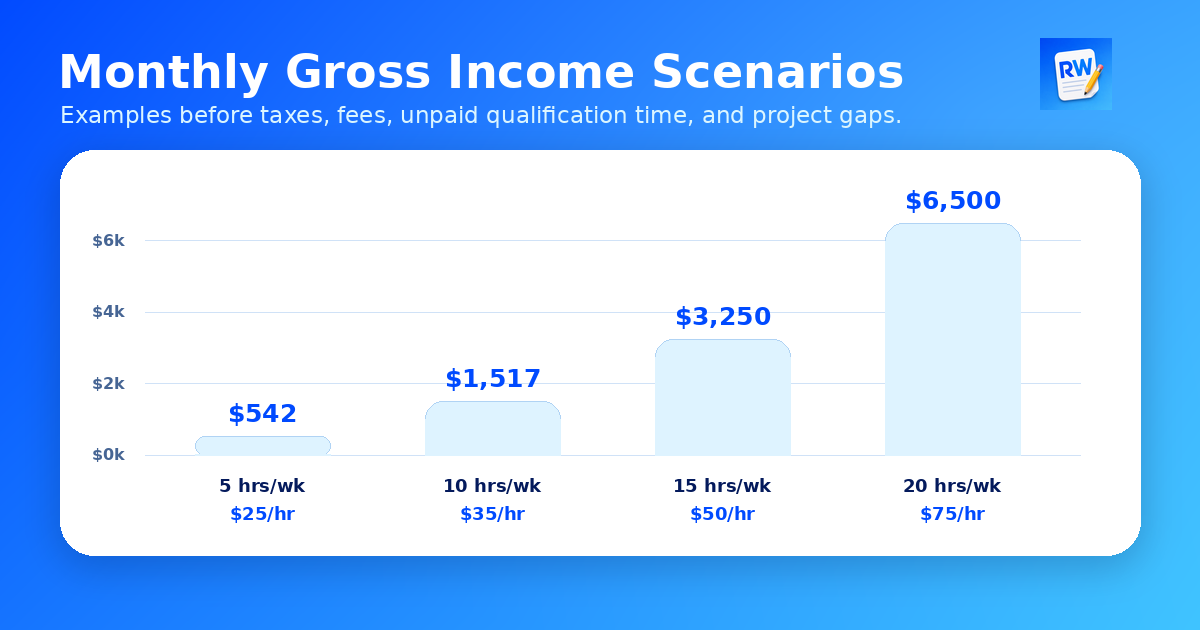
Hourly rates only tell part of the story. Your monthly income depends on how many paid hours you actually receive. Remote AI platforms can be inconsistent — you may have a full dashboard one week and fewer tasks the next.
Here are simple gross income examples before taxes: 5 hours/week at $25/hr equals roughly $542/month. 10 hours/week at $35/hr equals roughly $1,517/month. 15 hours/week at $50/hr equals roughly $3,250/month. 20 hours/week at $75/hr equals roughly $6,500/month. These numbers are possible mathematically, but they are not promises. The difficult part is getting accepted, maintaining quality, keeping access to projects, and joining enough platforms that one pause does not erase your income.
What Determines How Much You Can Make?
Your task type: Basic labeling usually pays less than complex judgment work. Expert review usually pays more than general annotation. Coding, legal, finance, medical, scientific, and other specialized projects can pay more because fewer qualified people can do the work well.
Your country and payment eligibility: Some roles are worldwide. Others are US-only, Canada-only, UK-only, or limited to specific countries. Pay can also vary by location. Before applying, check whether the role accepts workers in your country and whether the platform supports payment methods available to you.
Your accuracy and consistency: Quality is the real currency in remote AI work. If your work is accurate, consistent, and aligned with the rubric, you are more likely to keep access to projects and qualify for better ones.
Your expertise: A generalist may be able to evaluate whether an answer is clear and helpful. A lawyer can evaluate legal reasoning. A programmer can evaluate code quality. A bilingual speaker can judge translation and cultural accuracy. Expertise increases earning potential.
Ready to apply for AI data annotation and model evaluation roles that match your skills?
See Roles Hiring Now →What Kinds of Tasks Pay the Most?
The higher-paying tasks usually require one or more of the following: complex reasoning where you decide where the model's logic breaks, domain expertise in law, finance, medicine, science, engineering, coding, or operations, high-quality writing to explain evaluations precisely, fact-checking to verify claims and identify unsupported statements, rubric judgment applied consistently across many examples, prompt creation that tests model behavior and reasoning, or multilingual and localization skill to evaluate whether language sounds natural and culturally correct.
If you want to earn more, do not present yourself as only someone who wants data entry. Present yourself as someone who can evaluate AI outputs with judgment.
Can Beginners Make Money With AI Data Annotation?
Yes, but beginners need realistic expectations. You can start without a coding background, but you still need to pass assessments. Most platforms are screening for reading ability, writing ability, attention to detail, and reliability.
A beginner should focus on five things: create a clean profile that highlights writing, research, editing, QA, operations, customer support, teaching, analytics, or industry experience; apply to more than one platform so you are not dependent on one approval decision; take assessments slowly and follow the instructions exactly; start with generalist tasks, then update your profile as you identify stronger niches; and track your real hourly earnings after unpaid onboarding and qualification time.
How to Increase Your AI Annotation Earnings
Build a profile around judgment, not just availability. Do not only say, "I am available for remote work." Say what you can evaluate: "I can compare AI responses for accuracy, clarity, and helpfulness. I can review customer support answers for tone, completeness, and policy compliance. I can evaluate finance explanations or business strategy outputs."
Apply to several platforms. Remote AI work is distributed across platforms such as micro1, Mercor, Outlier, and other AI training and data labeling companies. A multi-platform approach gives you more chances to get accepted and more protection when one project slows down. Keep your skills list specific — generic profiles get generic tasks, while specific profiles are easier to match to higher-paying work.
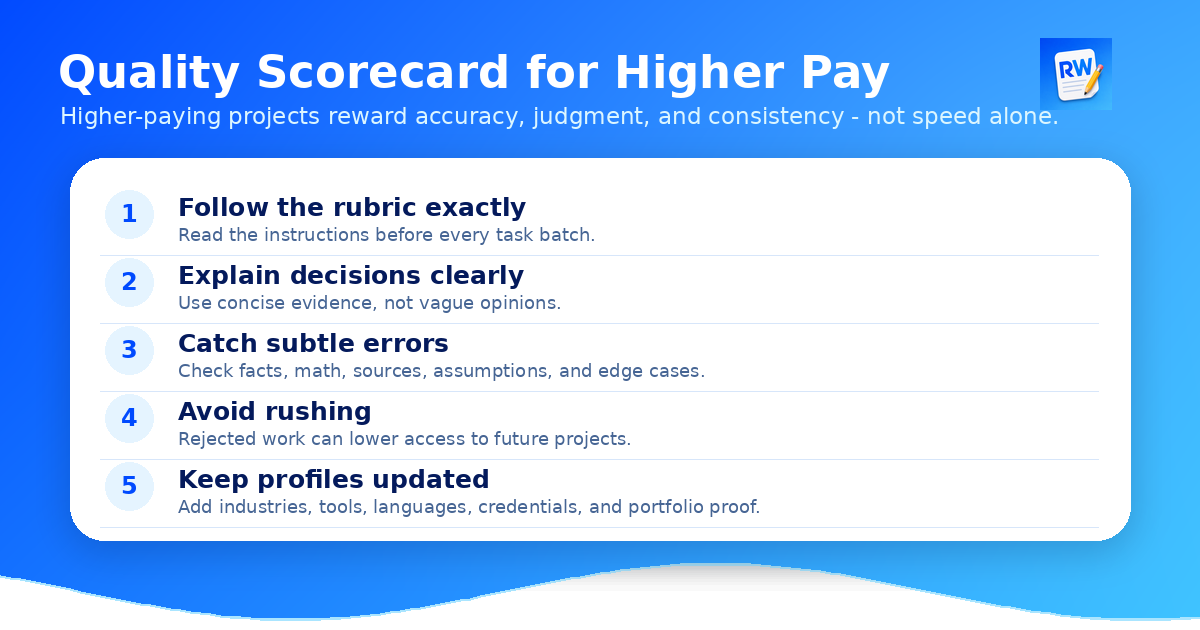
Key insight: Treat instructions like the job. In AI data annotation, the instructions are not background reading. Many workers fail because they rely on instinct instead of the rubric. Higher-paying projects often include detailed guidelines because the client needs consistent feedback from many reviewers.
Red Flags to Avoid
Legitimate remote AI work should not require you to pay to apply. Be careful with any site that charges a startup fee, asks you to buy equipment from a specific vendor, promises guaranteed income, or pressures you to send sensitive personal information before you understand the role. Also be careful with fake recruiter messages using the names of major AI companies. OpenAI, Anthropic, Google, Meta, xAI, and other major AI organizations may work through vendors or platforms, but scammers also use recognizable names to look credible.
Frequently Asked Questions
Is AI data annotation the same as AI training?
They overlap. Data annotation usually means labeling or structuring data. AI training is broader and may include rating AI responses, writing prompts, comparing outputs, fact-checking, and giving feedback that helps models improve. Many platforms use the terms interchangeably.
Do you need coding experience for AI data annotation?
No, not for many generalist roles. Coding experience helps for technical AI evaluation and can unlock higher rates, but many tasks rely on writing, reading, research, language, domain knowledge, and attention to detail.
Is AI data annotation work flexible?
Often, yes. Many projects are remote and self-directed. But flexibility does not always mean unlimited work. You may choose your hours only when tasks are available. Project availability is the biggest variable most applicants underestimate.
How fast can you start earning from AI data annotation?
Some people start quickly after passing assessments. Others apply and never hear back. Some pass but wait for projects. The best approach is to apply broadly and keep improving your profile instead of waiting on one platform.
What is the best way to make more than beginner pay?
Move from basic annotation into judgment-heavy work. Highlight your professional background, pass assessments carefully, write clear explanations, and apply for specialist roles that match your real skills. Expert-tier work in law, finance, medicine, coding, or research can pay $50–$200/hr.