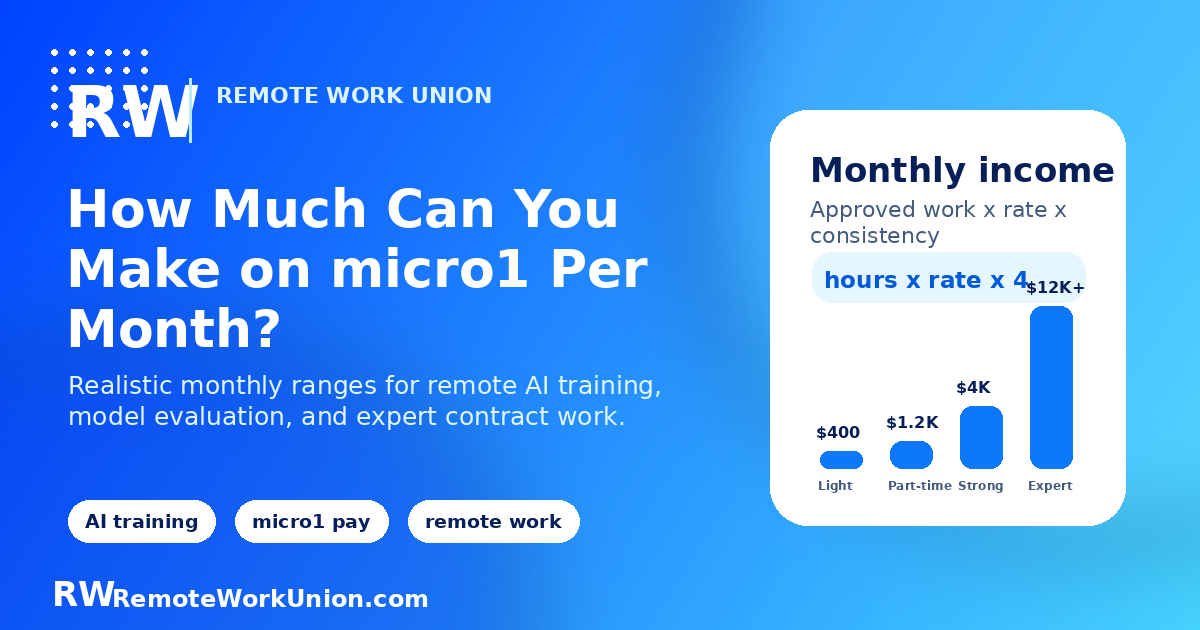
The honest answer is that micro1 monthly income depends less on whether you get accepted and more on whether you are matched to paid projects with enough approved work. A person who applies but has no active project may earn $0 that month. A beginner with occasional tasks might make a few hundred dollars. A solid part-time contributor with steady approved work might make $1,000 to $4,000 per month before taxes. A high-skill expert on a strong project can potentially make more, but that requires the rare combination of higher rates, project volume, fast turnaround, and consistent quality.
That is why the best way to think about micro1 is not as a fixed salary. It is contract-based remote AI work. Your monthly number is a formula: approved hours, effective pay rate, project availability, and quality acceptance. If one variable disappears, your income drops — even if your profile is strong.
The Basic Income Formula
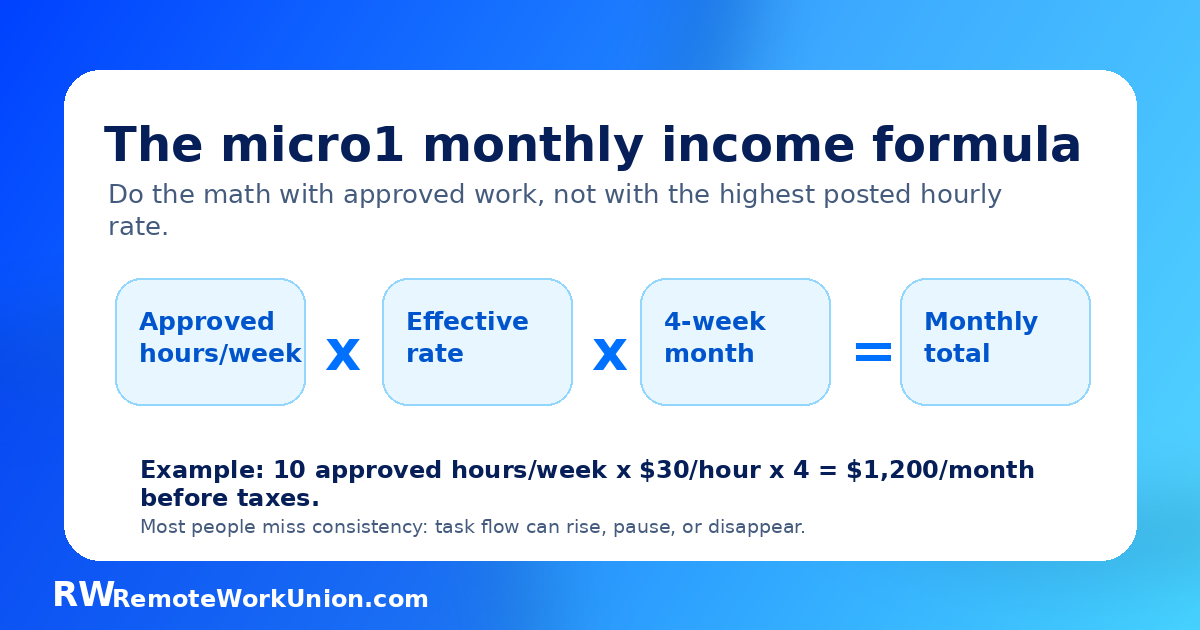
The simple formula is approved hours per week multiplied by your hourly or effective rate multiplied by roughly four weeks. Ten approved hours per week at $30 per hour is about $1,200 per month before taxes. Twenty approved hours per week at $50 per hour is about $4,000 per month before taxes. Thirty approved hours per week at $100 per hour is about $12,000 per month before taxes.
The important phrase is approved hours. Many remote AI jobs are paid only after work is submitted, reviewed, and accepted. Some projects pay by task, by minute of approved data, or by deliverable instead of a clean hourly clock. In those cases, your effective hourly rate is what you earn after accounting for instructions, setup, revisions, rejected submissions, and waiting time.
What micro1 Roles Tend to Pay
micro1 postings vary widely by role. Many domain expert and AI trainer listings show ranges around $20 to $50 per hour. Some specialized roles in fields such as medicine, engineering, software, creative tools, legal, finance, or technical evaluation can show higher ranges. Some video, robotics, and data collection roles are output-based, meaning the pay depends on approved submissions rather than a traditional hourly schedule.
That creates a wide monthly spread. Someone doing general AI model evaluation, annotation, or task review may have a very different month from someone contributing as a specialist in law, healthcare, finance, audio engineering, design software, coding, or another expert niche. Your background can matter. Your country, state, language, tools, and availability can also matter because some roles are location-specific or project-specific.
Realistic Monthly Ranges
A realistic way to group micro1 monthly outcomes:
| Scenario | Monthly Range (before taxes) |
|---|---|
| No active project match | $0 |
| Light work / new applicant with occasional tasks | $100 – $800 |
| Regular matched work at moderate rate | $800 – $2,500 |
| Strong consistent approved work at good rate | $2,500 – $5,000 |
| Expert-tier high demand with strong volume | $5,000 – $10,000+ |
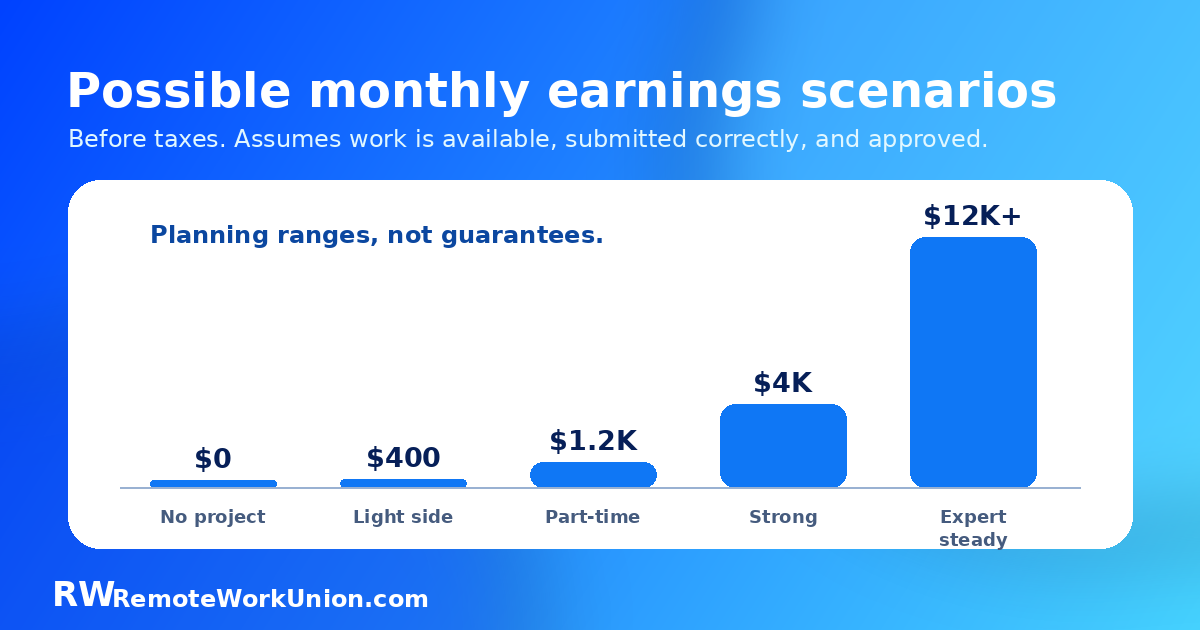
These are not guarantees. They are planning ranges. The difference between the low and high end is usually not effort alone. It is project match, task supply, approvals, and whether your skills line up with roles that are currently open.
Why Monthly Income Is Not Always Steady
Remote AI training platforms are not like traditional jobs where you receive a fixed paycheck every two weeks regardless of project volume. The work is usually tied to client demand. AI labs and enterprises may need evaluators for a specific model, language, tool, profession, or workflow. When that project is active, there may be plenty of work. When it pauses, fills, or changes requirements, the available task volume can drop.
This is normal across the AI training market. People doing AI data annotation, model evaluation, RLHF, agent evaluation, rubric scoring, prompt review, or domain expert work often see waves of availability. A project can be busy one week and quiet the next. That does not always mean your account has a problem. It can mean the project has enough workers, quality review is delayed, the client paused the batch, or the platform is waiting for more tasks.
Example Monthly Earnings Scenarios
A light contributor who completes 5 approved hours per week at $20 per hour would make about $400 per month before taxes. A part-time contributor who completes 10 approved hours per week at $30 per hour would make about $1,200 per month before taxes. A stronger contributor who completes 20 approved hours per week at $50 per hour would make about $4,000 per month before taxes. An expert contributor who completes 30 approved hours per week at $100 per hour would make about $12,000 per month before taxes.
The most practical goal for a new applicant is not to chase the biggest number first. The goal is to get accepted, pass interviews, complete early tasks correctly, build a reputation for quality, and then apply to better-matched roles.
The Biggest Factors That Decide How Much You Make
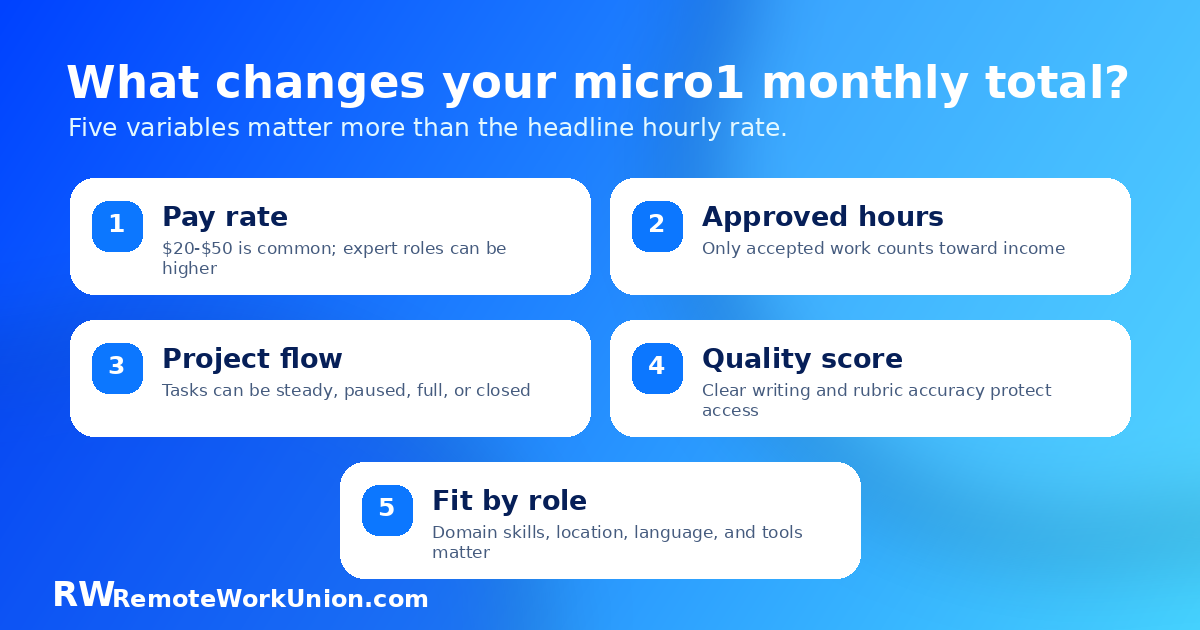
The first factor is your rate. Higher rates usually come from stronger domain expertise, rarer skills, more difficult evaluations, technical knowledge, or projects that need fast staffing. The second factor is approved hours. Many applicants overestimate income because they multiply the posted rate by 40 hours per week. That is only useful if the project actually gives you 40 hours of work and approves it.
The third factor is project flow. You can be qualified and still have a quiet month. The fourth factor is quality. AI model evaluation work rewards careful reading, consistent rubric use, factual accuracy, clean writing, and following instructions. The fifth factor is profile fit. micro1 and similar platforms match people to projects based on skills, work history, credentials, language, location, and availability.
Ready to apply to micro1? Remote Work Union connects you to micro1 and other top AI training platforms. Apply for free through our referral link.
Apply to micro1 Now →Can micro1 Replace a Full-Time Salary?
micro1 can become meaningful income for some workers, but it is safer to treat it as one part of a broader remote work strategy. The people most likely to replace full-time income are not just accepted into one platform. They usually stack multiple remote AI platforms, apply to new roles quickly, keep their profiles updated, and build a system around project flow.
For beginners, a better target is first-dollar income. Your first goal is to prove you can get accepted and complete paid work. Your second goal is to reach repeatable side income. Your third goal is to stabilize income across multiple platforms or multiple project types.
Platforms worth applying to alongside micro1: Mercor, Handshake AI, and Outlier AI all offer AI training and expert review work that can run in parallel with micro1 projects.
What Beginners Should Expect in the First Month
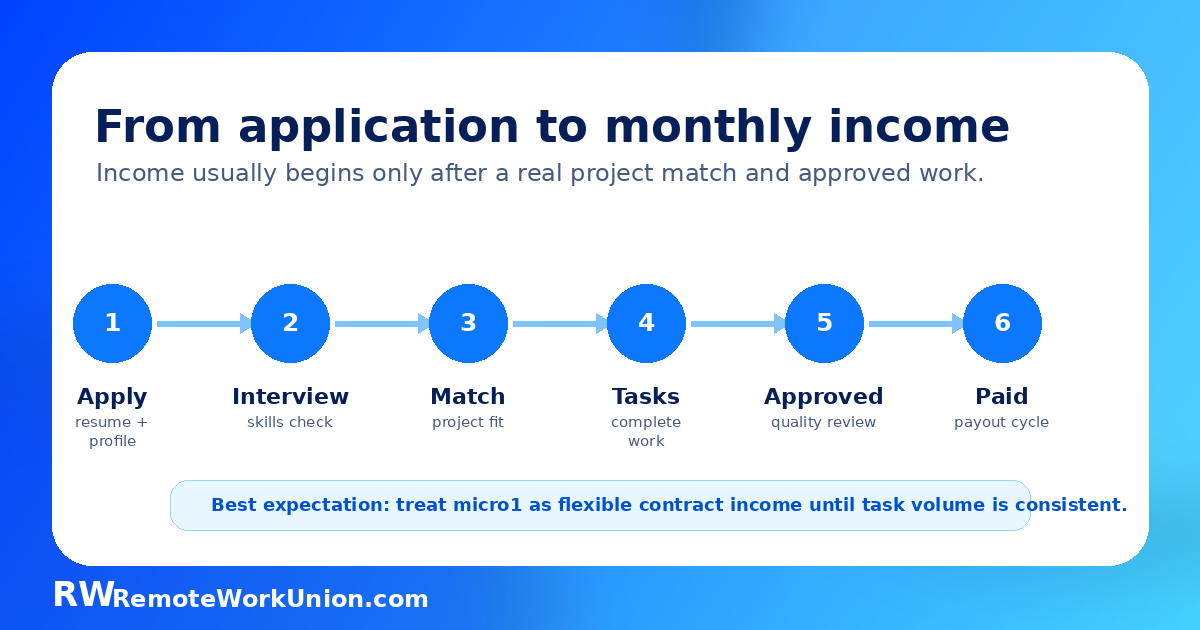
In the first month, you may earn nothing. That does not mean applying was pointless. There can be a delay between submitting a profile, completing an AI interview with Zara (micro1's AI screening tool), getting reviewed, and being matched to paid work. Some projects fill quickly. Some require a specific skill. Some applicants sit in a talent pool until a better match opens.
Do not build your budget around expected micro1 income until you have seen actual approved work and actual payouts. It is fine to be optimistic. It is not smart to count projected gig income before the project exists in your dashboard.
How to Increase Your Odds of Higher Monthly Earnings
The best way to improve your earning potential is to make your profile specific. Do not describe yourself only as hard-working or detail-oriented. Name the actual skills that matter: writing, editing, research, QA, coding, Excel, accounting, legal analysis, medical knowledge, design software, audio production, recruiting, sales operations, customer success, data analysis, prompt writing, or subject matter expertise.
Apply to roles that match your real background. A generic application to every opening is weaker than a focused application to roles where you can prove you understand the work. During interviews or screening questions, answer clearly. Platforms that use AI recruiting tools are often looking for structured communication, concrete examples, and evidence that you can follow instructions.
How micro1 Compares to Other Remote AI Work
micro1 sits in the same broad market as remote AI training, AI model evaluation, data annotation, expert review, and RLHF-style work. The market exists because major AI companies and AI labs need human judgment to improve models. Even when the end product is used by companies such as OpenAI, Anthropic, Google, Meta, Grok, or other AI teams, the work often flows through specialized evaluation and expert platforms.
This type of work is different from surveys, low-paid gig apps, or random online tasks. The better roles pay for expertise and judgment. They may ask you to compare AI responses, rate accuracy, write improved answers, evaluate reasoning, label data, record task videos, test agents, or explain how an expert would solve a problem. That is why background matters — and why people with real professional experience in business, marketing, sales, finance, healthcare, education, law, engineering, and other fields have an advantage over generic applicants.
Bottom Line
So, how much can you make on micro1 per month? A beginner might make $0 while waiting, a few hundred dollars with light task access, $1,000 to $4,000 with steady part-time approved work, and more if they land a high-rate expert project with real volume. The upside is real, but it is not automatic.
The key is to stop thinking only about hourly rate. Think in terms of approved hours, task flow, quality, role fit, and platform diversification. micro1 can be a strong remote work opportunity, but it works best when you treat it like a serious contract pipeline rather than a guaranteed paycheck.
Frequently Asked Questions
How much can you realistically make on micro1 per month?
Realistic monthly ranges depend heavily on your project match and approved hours. A beginner with light task access might earn $100 to $800 per month. Someone with regular matched work at a moderate rate might earn $800 to $2,500 per month. Strong consistent approved work can reach $2,500 to $5,000 per month. Expert-tier roles with high demand can reach $5,000 to $10,000 or more. These are planning ranges, not guarantees.
What is the basic formula for estimating micro1 monthly income?
The formula is: approved hours per week multiplied by your effective hourly rate multiplied by approximately four weeks. For example, 10 approved hours per week at $30 per hour equals about $1,200 per month before taxes. The key word is approved — only submitted and accepted work counts toward income.
Why is micro1 income inconsistent from month to month?
micro1 income is tied to client and project demand rather than a fixed schedule. When a project is active there may be plenty of tasks; when it pauses, fills, or changes requirements the available volume can drop. This is normal across the AI training market. Project-based income always has waves of availability, and a quiet week does not necessarily mean your account has a problem.
What factors most affect how much you make on micro1?
Five factors drive micro1 monthly totals: your pay rate (higher rates come from stronger domain expertise and rarer skills), approved hours (only accepted work counts), project flow (tasks can be steady, paused, full, or closed), quality score (clear writing and rubric accuracy protect your access), and profile fit (domain skills, location, language, and availability affect project matching).
Can micro1 replace a full-time salary?
It is possible but not the default outcome. The workers most likely to replace full-time income stack multiple remote AI platforms, apply to new roles quickly, keep their profiles updated, and build a system around project flow. A better first goal is first-dollar income, then repeatable side income, then income stability across multiple platforms.