Outlier AI is one of the better-known platforms people search for when they want remote AI training jobs, AI evaluator jobs, data annotation work, or flexible model evaluation tasks. The basic appeal is simple: apply online, complete the required screening steps, and get matched to projects where you review, rate, rewrite, or fact-check AI model responses.
The timeline is less simple.
Some applicants may move through the process quickly and see available tasks soon after onboarding. Others may pass an assessment and still wait because there is no matching project, no task volume, or no immediate need for their skill set. A third group may apply, test, and never receive usable work.
So the honest answer is this: you may be able to start working on Outlier AI quickly if your profile matches an active project, you complete the assessment successfully, and the platform has task volume available. But you should not treat Outlier AI as guaranteed income until you have completed real paid work and confirmed that tasks are continuing.
This guide explains what affects the Outlier AI start timeline, why applicants sometimes get stuck with no tasks, and how to improve your chances while searching for remote AI jobs in 2026 and beyond.
Quick Answer: How Fast Can You Start?
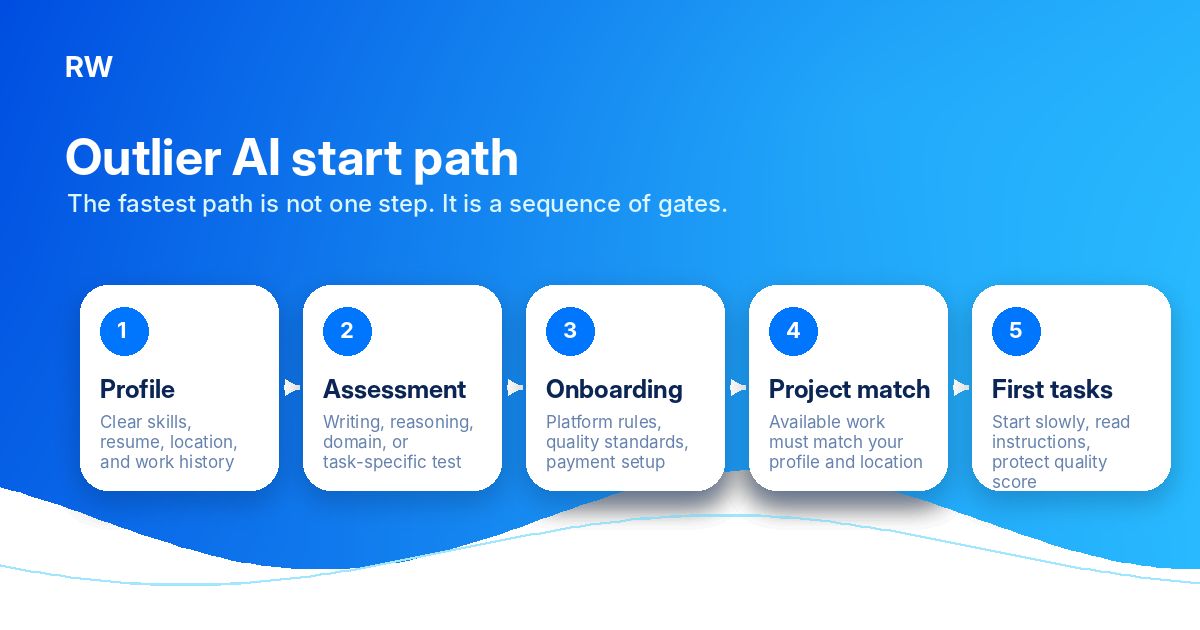
For a strong applicant, the fastest path is usually:
- Create or complete your profile.
- Apply for relevant Outlier AI projects.
- Complete an assessment or screening task.
- Finish onboarding, identity, tax, or payment steps if required.
- Wait for a project match.
- Begin tasks once a project has active work.
That sequence can feel fast when everything lines up. It can also stretch out when project demand is low or when the platform needs a different kind of reviewer.
The key point: passing an assessment and receiving paid tasks are not always the same thing. Outlier AI, like other AI training platforms, may approve a profile before there is steady work available.
Why Outlier AI Timelines Vary So Much
Remote AI training platforms are not like traditional employers with one fixed start date. They usually operate around project-based demand. That means the timeline depends on both your application and the platform's current need for reviewers.
A project may need people with strong general writing skills. Another may need software engineers who can evaluate code. Another may need legal researchers, medical writers, finance experts, math tutors, bilingual speakers, fact-checkers, or people who can compare long AI answers for helpfulness and accuracy.
This is why two applicants can have completely different experiences. One person may start quickly because the platform needs their exact skill set. Another person may be qualified but still wait because there are not enough active tasks for their category.
Common timeline factors include:
- Your location and work eligibility.
- Your resume and profile quality.
- Your assessment score.
- Whether your skills match an active project.
- Whether the platform needs generalists or subject matter experts.
- Whether there is current task volume.
- Whether you complete onboarding, payment, and verification steps.
- Whether your early task quality meets project standards.
This is also why searches like "Outlier AI no tasks," "Outlier AI application under review," and "Outlier AI not getting tasks" are common. A person can be interested, qualified, and available, but still not have work in the queue.
What Happens Before You Can Actually Work?
Most remote AI evaluator platforms follow a similar funnel. The exact details may change, but the structure is usually consistent.
1. Profile Setup
Your profile is where the platform decides what kinds of projects you may fit. Do not treat this as a casual form. Use clear keywords that match the work you can actually do.
Useful keywords may include: AI evaluator, model evaluation, AI training, RLHF, data annotation, chatbot reviewer, prompt writing, fact-checking, research, editing, coding, math, legal research, finance analysis, medical writing, and teaching or tutoring.
Do not claim skills you do not have. The goal is not to look impressive in every category. The goal is to make it easy for the platform to match you to appropriate work.
2. Application or Project Selection
Some applicants apply to a general role. Others apply to a specific project. If you see multiple relevant listings, prioritize the roles that actually match your background.
For example, a strong writer should not apply only to coding roles because the rate looks higher. A finance analyst should highlight finance, spreadsheet, research, and business analysis experience. A teacher should highlight grading, explanation, feedback, curriculum, and student support experience.
The closer the project is to your real background, the better your odds of passing screening and performing well once tasks begin.
3. Assessment
Assessments are one of the biggest bottlenecks. AI training work often requires careful reading, instruction following, comparison, and written reasoning. Many applicants fail because they rush.
Common assessment categories may include: ranking two AI responses, explaining which answer is better, editing a weak answer, fact-checking an AI response, writing a prompt or ideal response, reviewing safety, accuracy, or helpfulness, solving domain-specific problems, and evaluating code or technical explanations.
The main mistake is treating the test like a speed challenge. For most AI evaluator jobs, careful work matters more than fast work. Read the rubric, follow the instructions, and explain your reasoning clearly.
4. Onboarding and Verification
If you pass the required steps, you may still need to complete onboarding. This can include platform rules, task instructions, tax forms, identity verification, payment setup, or project-specific training.
Do not ignore these steps. An incomplete onboarding profile can delay work even if your application is otherwise strong.
5. Project Matching
This is the stage applicants often misunderstand. You may be eligible for the platform, but not yet matched to a project with active work. A project match depends on demand.
The platform may need reviewers for a specific region, language, specialty, or quality level. It may also pause, restart, or reduce projects as client needs change.
This is why you should avoid planning your monthly income around a platform before you have task history.
6. First Tasks
When tasks appear, do not rush through them. Your first work may influence whether you continue receiving tasks. Prioritize accuracy, instruction following, and clear explanations.
A good early approach: read the instructions before every task type, keep examples open while you work, do not guess when the task requires verification, use concise reasoning rather than vague opinions, avoid overcomplicating simple tasks, and submit only work you would be comfortable having reviewed.
Early quality matters because many AI training platforms use quality controls. If your work is inconsistent, you may lose access to a project even after getting accepted.
Fast Timeline vs Slow Timeline
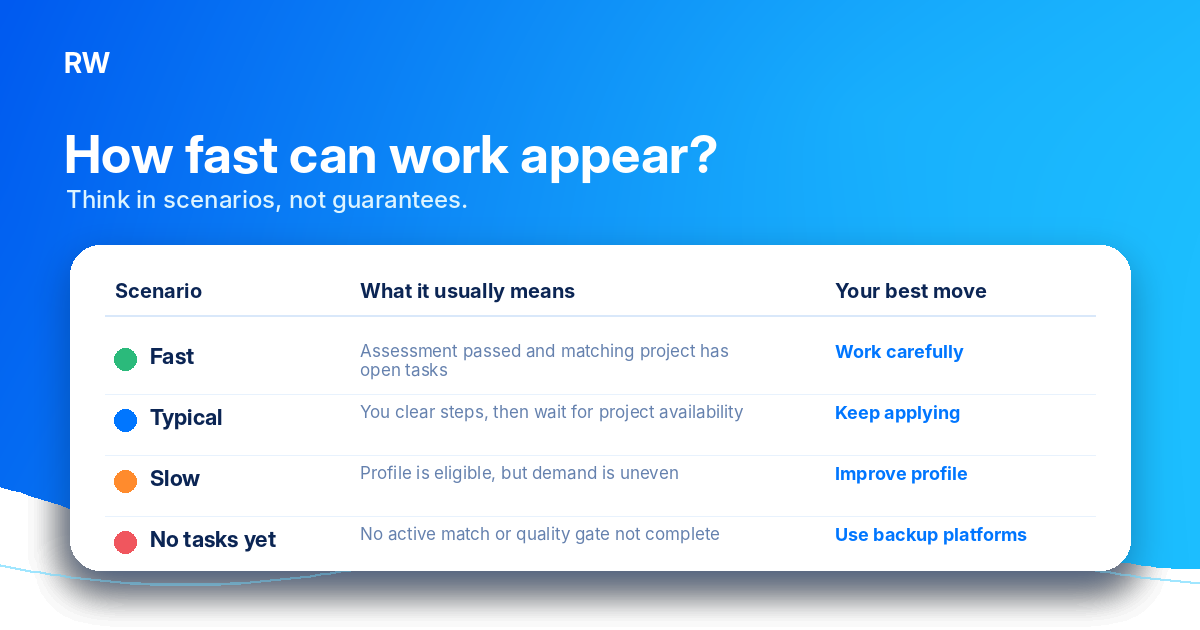
A fast Outlier AI timeline usually means all of these things happened at once:
- Your profile matched an active project.
- Your assessment was strong.
- You completed onboarding quickly.
- The platform had available tasks.
- Your first submissions met quality standards.
A slow timeline usually means one or more of these issues occurred:
- Your profile was incomplete or too vague.
- Your assessment needed review.
- Your skill set did not match current project demand.
- Tasks were temporarily unavailable.
- The project was full.
- Location or eligibility requirements limited your options.
- You were accepted generally but not assigned to a paid queue.
The most frustrating version is when an applicant feels approved but sees no available tasks. In that case, the issue may not be your ability. It may simply be that there is no work available for your current project or category.
Remote Work Union connects you to legitimate remote AI training and evaluation roles across multiple platforms. Apply for free.
Find Roles Hiring Now →How to Improve Your Chances of Starting Faster
You cannot control Outlier AI's project demand, but you can control the quality of your application and how prepared you are when an opportunity opens.
Use a Focused Resume
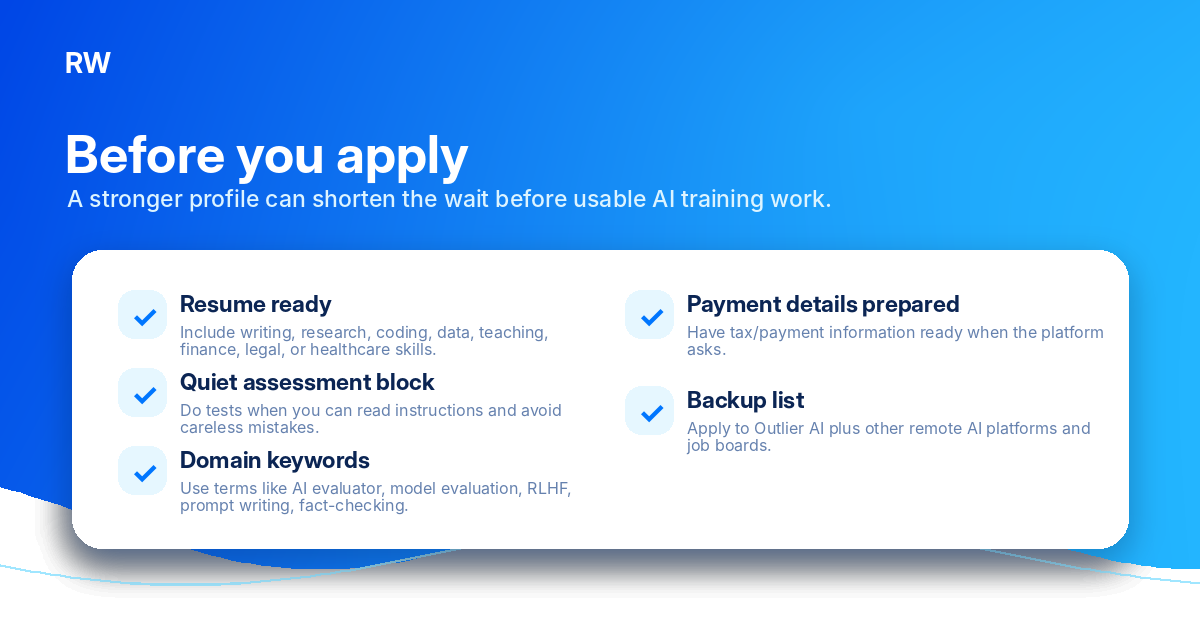
Your resume should show why you can evaluate AI outputs. You do not need a machine learning background for every AI training role. Many projects need strong readers, writers, researchers, editors, coders, analysts, teachers, and subject matter experts.
Add relevant bullets such as:
- Reviewed written material for accuracy, clarity, and tone.
- Compared multiple responses or deliverables against a rubric.
- Researched factual claims and corrected errors.
- Wrote structured feedback for students, clients, or team members.
- Used spreadsheets, documentation, or internal tools to track work.
- Created prompts, instructions, examples, or training content.
These are not just resume filler. They map directly to remote AI evaluator work.
Match Your Application to the Project
If a role is for writing evaluation, emphasize writing and editing. If a role is for AI code evaluation, emphasize programming languages, debugging, code review, and technical communication. If a role is for finance or legal review, emphasize domain knowledge and research.
Generic profiles are weaker than focused profiles. Platforms need to understand what you can do.
Take Assessments Seriously
Set aside quiet time. Do not take the test while distracted. Do not use a rushed, casual tone. If the task asks for reasoning, explain the reason one answer is better, not just which answer you prefer.
A good evaluator can say things like:
- Response A is more accurate because it directly answers the user's question and avoids unsupported claims.
- Response B is weaker because it introduces irrelevant advice and fails to follow the requested format.
- The better answer is more helpful, but it still needs a citation or clearer caveat.
This is the kind of thinking AI model evaluation work often rewards.
Keep Your Profile Current
If you gain new skills, update your profile. If you complete a new degree, certification, coding course, writing portfolio, or domain-specific project, add it. AI training platforms often route work based on profile signals.
Be Ready for Payment and Tax Setup
If the platform asks for payment details, tax forms, or verification, complete them quickly and accurately. A profile can stall when administrative steps are incomplete.
What to Do If You Are Accepted but Have No Tasks
Do not assume no tasks means permanent rejection. It may mean the project is paused, full, or not currently matched to your profile.
Your best moves are:
- Check whether onboarding is complete.
- Review whether there are other eligible projects to apply for.
- Update your profile with stronger skill keywords.
- Avoid repeatedly submitting low-quality applications.
- Apply to other remote AI training platforms while waiting.
- Keep a simple tracker of where you applied, when, and what happened.
This is especially important because remote AI work can be inconsistent. Even strong contractors can see task volume rise and fall.
Should You Wait for Outlier AI Before Applying Elsewhere?
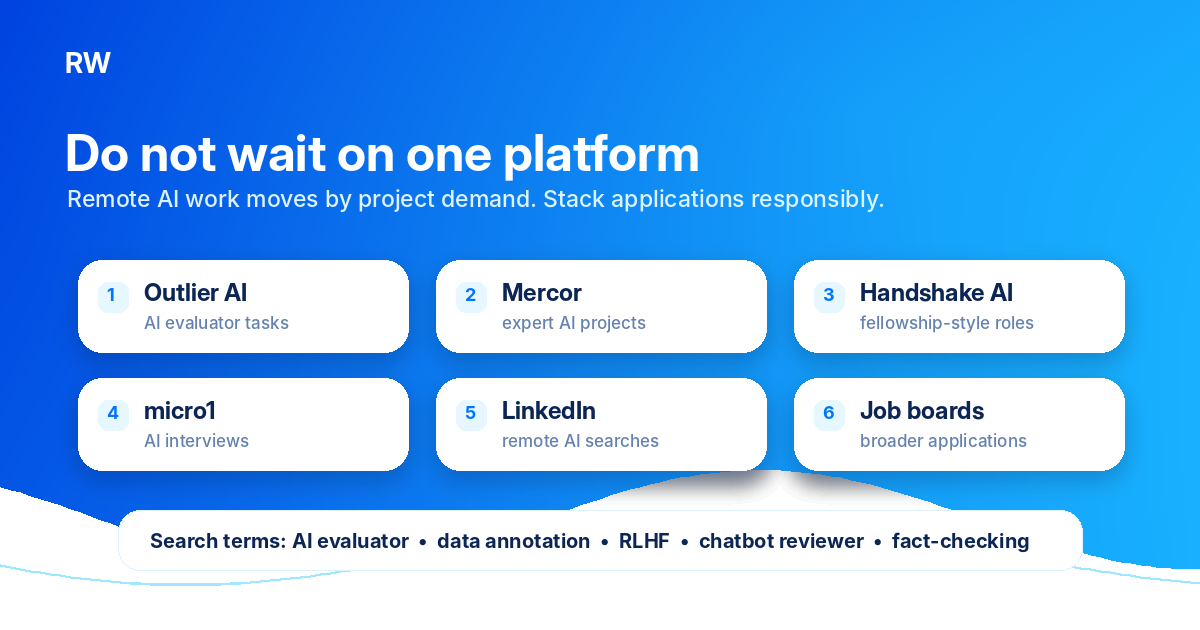
No. Do not wait on one platform.
Outlier AI may be a good place to apply, but it should be part of a broader remote AI job search. The same applicant may also look at Mercor, Handshake AI, micro1, Surge AI, Stellar AI, LinkedIn AI jobs, and other remote work platforms.
You can also search around major AI company keywords, but be precise. People often search for OpenAI jobs, Anthropic jobs, Claude AI training jobs, Google AI jobs, Gemini AI jobs, Meta AI jobs, Grok AI jobs, and Microsoft AI jobs. Not every search result will be a contractor evaluation role. Some will be full-time engineering jobs, some will be research roles, and some will be unrelated job posts using AI keywords.
Use practical search terms like: remote AI evaluator, AI model evaluator, AI response evaluator, RLHF evaluator, chatbot evaluator, data annotation remote, AI writing evaluator, AI fact-checking jobs, prompt response reviewer, search quality rater, and remote AI training jobs.
The broader your search, the less dependent you are on a single platform's task volume.
How to Avoid Scams While Searching for Outlier AI Alternatives
Remote AI jobs are popular, which means scams and low-quality listings exist. Be careful with any job that asks you to pay upfront, move communication to suspicious channels, cash a check, buy equipment from a specific vendor, or provide sensitive personal information before a legitimate onboarding process.
A real remote AI training opportunity should have a clear application process, clear task expectations, and a legitimate payment setup. It should not pressure you to act immediately or pay money to unlock work.
When in doubt, slow down and verify the company, domain, job listing, and payment process.
Best Applicant Profile for Starting Quickly
The applicants most likely to move quickly usually have three things:
- A specific skill the platform currently needs.
- A profile that clearly communicates that skill.
- Strong assessment performance.
For general AI evaluator jobs, strong writing and careful reasoning help. For expert AI training jobs, domain knowledge can matter more. Software engineers, lawyers, medical professionals, finance analysts, teachers, researchers, and experienced editors may qualify for more specialized tasks when those projects are available.
That does not mean beginners cannot apply. It means beginners should be realistic. If you do not have a specialized background, focus on general evaluator roles, writing evaluation, data annotation, search quality, and entry-level AI response review.
A Realistic Way to Think About Outlier AI Income
Do not think of Outlier AI as income until you are actually completing paid work. An application is not income. An assessment is not income. A dashboard with no tasks is not income.
A better approach is to treat each platform as one possible income channel. Your goal is to build a portfolio of options: Outlier AI, other AI training platforms, remote job boards, freelance work, and direct applications.
This mindset protects you from overcommitting to a platform that may not have steady work available that month.
Tip: Keep a simple spreadsheet tracking each platform you applied to, the date, what step you are on, and any follow-up needed. This prevents opportunities from disappearing quietly and helps you see where your applications are actually progressing.
Frequently Asked Questions
How long does it take to start working on Outlier AI?
Varies by role and project availability; some applicants see tasks within days of onboarding, others wait weeks. The timeline depends on your profile quality, assessment score, and whether the platform has active projects matching your skill set.
Why don't I have tasks after completing the Outlier AI assessment?
Passing the assessment qualifies you for the pool but tasks depend on active project demand and skill matching. You may be approved generally but not yet assigned to a paid project queue. This is common across AI training platforms — check for other available projects on your dashboard.
What should I do while waiting for Outlier AI tasks?
Improve your profile, apply to other platforms like Mercor and Handshake AI, and check your dashboard regularly. Treat each platform as one possible income channel rather than your only option. Update your skills section and verify all onboarding steps are complete.
Is Outlier AI worth applying to if tasks are slow?
Yes, but treat it as part of a broader pipeline — apply to multiple AI training platforms. Remote AI work can be inconsistent on any single platform, so diversifying across Mercor, Handshake AI, micro1, and others reduces risk and keeps income more stable.
Can I start working on Outlier AI the same day I apply?
It may be possible in a fast scenario, but you should not expect it. You still need to complete the required application, assessment, onboarding, and project matching steps before paid tasks appear.
What skills help with Outlier AI and similar platforms?
Useful skills include writing, editing, research, fact-checking, coding, math, teaching, legal analysis, finance analysis, medical writing, data analysis, and careful instruction following. Domain expertise often opens access to higher-paying specialized projects.