Finding remote work that replaces a full-time salary is different from finding a remote job that sounds good online. A real salary replacement plan has to answer practical questions: How much money do you actually need each month? How predictable does the income need to be? What skills can you sell from home? What happens if one platform pauses work, one client slows down, or one application never gets a response?
That is the difference between remote work as a side hustle and remote work as a serious income path. A side hustle can be random. Salary replacement cannot be random.
In 2026, remote work is not limited to customer service or low-paid data entry. There are remote roles in AI training, AI model evaluation, writing, editing, research, sales, recruiting, bookkeeping, project coordination, customer success, marketing, operations, design, and subject matter expert work. Some are full-time employee jobs. Some are contract roles. Some are flexible project-based opportunities. The right path depends on your skills, your income target, and how much stability you need.
In this guide
- Start With the Number You Actually Need to Replace
- Look for Remote Work That Pays for Skill, Not Just Availability
- Use a Salary Replacement Stack Instead of One Source
- Search for Roles by Skill Category
- Build a Profile That Shows You Can Work Without Supervision
- Create Proof Before You Need It
- Treat Applications Like a Weekly System
- Full-Time Remote Jobs vs Flexible Remote Income
- A 30-60-90 Day Plan
Start With the Number You Actually Need to Replace
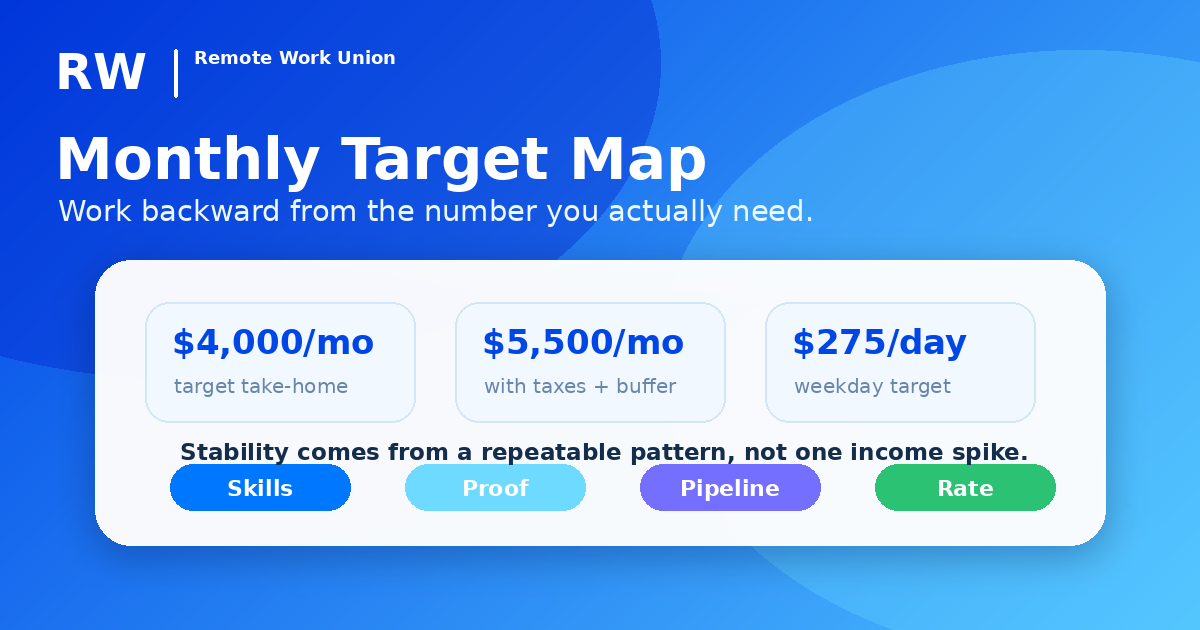
Before applying anywhere, define the salary you are trying to replace. Many people say they want to replace a full-time salary, but they have not translated that salary into a monthly remote income target. A $60,000 salary is not the same as $60,000 of freelance or contract revenue. A job may include taxes withheld, benefits, paid time off, employer payroll contributions, equipment, and some level of predictability.
Ask yourself: How much money do I need each month after taxes? How much do I need for rent, food, transportation, insurance, debt, savings, and emergencies? Do I need benefits from a job, or can I handle them separately? Would a mix of remote contracts and flexible AI work be acceptable, or do I need one full-time W2 role?
Once you know the monthly target, you can evaluate opportunities clearly. A remote task that pays a small amount may be fine as a starter, but it cannot be the foundation of a salary replacement plan. A specialized AI training role, remote sales role, writing contract, research project, or customer success job may be much closer to the kind of income you need.
Look for Remote Work That Pays for Skill, Not Just Availability
Low-paid remote work usually pays for availability. Higher-value remote work pays for judgment. That distinction matters. If a role only needs someone to be online, click through tasks, or follow a script, pay tends to be limited. If the role requires writing ability, research judgment, industry knowledge, sales skill, editing ability, legal reasoning, finance experience, technical understanding, design judgment, or strong communication, the pay ceiling is usually higher.
Remote AI jobs are a good example. Some AI data annotation jobs are simple. Others require applicants to evaluate model responses, write ideal answers, fact-check outputs, score reasoning, review code, assess legal or financial content, or judge whether an AI system followed instructions. Those tasks are more valuable because they require human judgment that AI companies cannot fully automate.
When searching, focus on roles where your experience creates leverage:
- Writers: AI writing evaluation, content editing, SEO writing, copywriting, prompt review
- Sales reps: remote account executive, SDR, customer success, partnership, revenue operations
- Teachers: curriculum review, AI education evaluation, tutoring, instructional design
- Lawyers and paralegals: legal AI review, contract analysis, compliance research, legal content
- Finance and accounting: bookkeeping, financial analysis, AI finance evaluation, operations
- Generalists: research, AI response evaluation, operations, admin, recruiting, content quality
Use a Salary Replacement Stack Instead of One Source
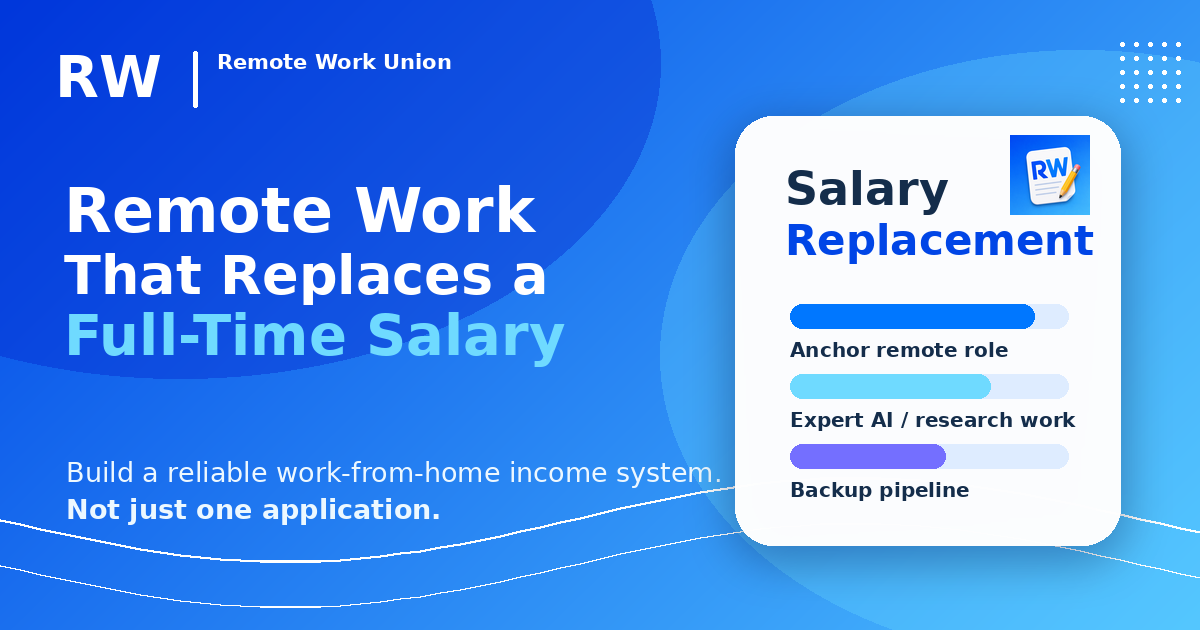
A full-time salary usually feels stable because it comes from one employer. Remote income often becomes more stable when it comes from more than one source. That does not mean you need five jobs at once. It means you should build a salary replacement stack.
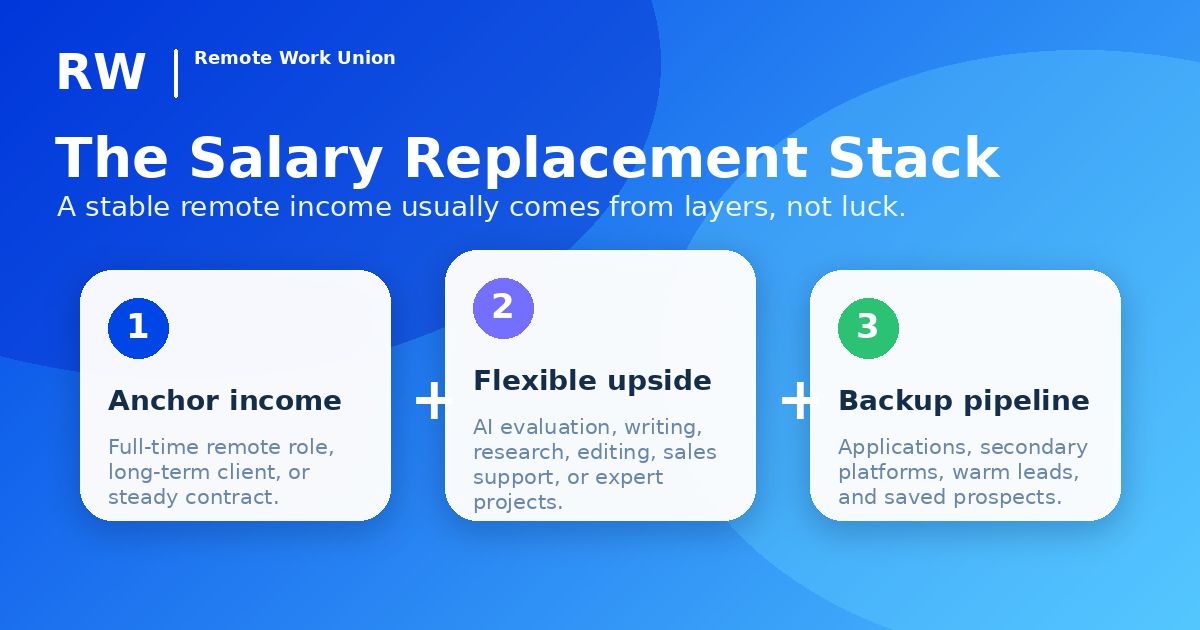
A strong stack often has three layers:
Layer 1: Anchor income. This is your main source. It could be a full-time remote job, a long-term contract, a consistent client, a remote sales role, a customer success job, a project management role, or a platform that provides steady AI training work.
Layer 2: Flexible upside. This is work that can increase your income when available. Examples include AI model evaluation, remote writing projects, editing work, research assignments, data annotation, prompt review, expert interviews, sales projects, or freelance consulting.
Layer 3: Backup pipeline. This is your safety net. It includes applications in progress, secondary platforms, warm leads, saved job searches, recruiter relationships, and a list of companies or platforms you can apply to if work slows down.
Looking for remote roles that can anchor a real salary replacement plan?
Join Remote Work Union Free →Search for Roles by Skill Category, Not Just "Remote Job"
The keyword "remote job" is too broad. Better searches are skill-specific. Use searches that combine role, skill, and remote intent:
- remote AI evaluator jobs
- AI training jobs from home
- remote content editor
- remote research analyst jobs
- remote customer success jobs
- remote account executive jobs
- remote bookkeeping jobs
- remote legal research jobs
- remote operations jobs
Use job boards, company career pages, remote work platforms, LinkedIn, specialized AI work platforms, and referral-based communities. Do not depend on one search engine or one platform.
Build a Profile That Shows You Can Work Without Supervision
Remote employers and platforms care about trust. They want to know whether you can understand instructions, write clearly, meet deadlines, communicate without being chased, and produce clean work from home.
Instead of saying "hard worker" or "detail-oriented," show evidence. A strong remote work summary might say: "Remote-ready writer and researcher with experience evaluating content quality, following detailed instructions, fact-checking online information, and producing clear written analysis. Interested in AI model evaluation, remote research, content editing, and work from home roles that require strong judgment and communication."
Create Proof Before You Need It
Many applicants wait until a platform asks for samples before creating proof. A better approach is to build a small proof folder before you apply widely. Useful examples include a short research memo, a before-and-after writing edit, a sample AI response evaluation using a simple rubric, a sample sales outreach sequence, a spreadsheet tracker, or a short analysis of a product or business problem.
For remote AI jobs, proof can be especially useful. Platforms may test your writing, reasoning, attention to detail, or ability to compare two AI responses. Practicing with sample evaluations helps you move faster when you reach the assessment stage.
Treat Applications Like a Weekly System
Remote work that replaces a salary usually comes from consistency, not one huge application day. Set a weekly operating system:
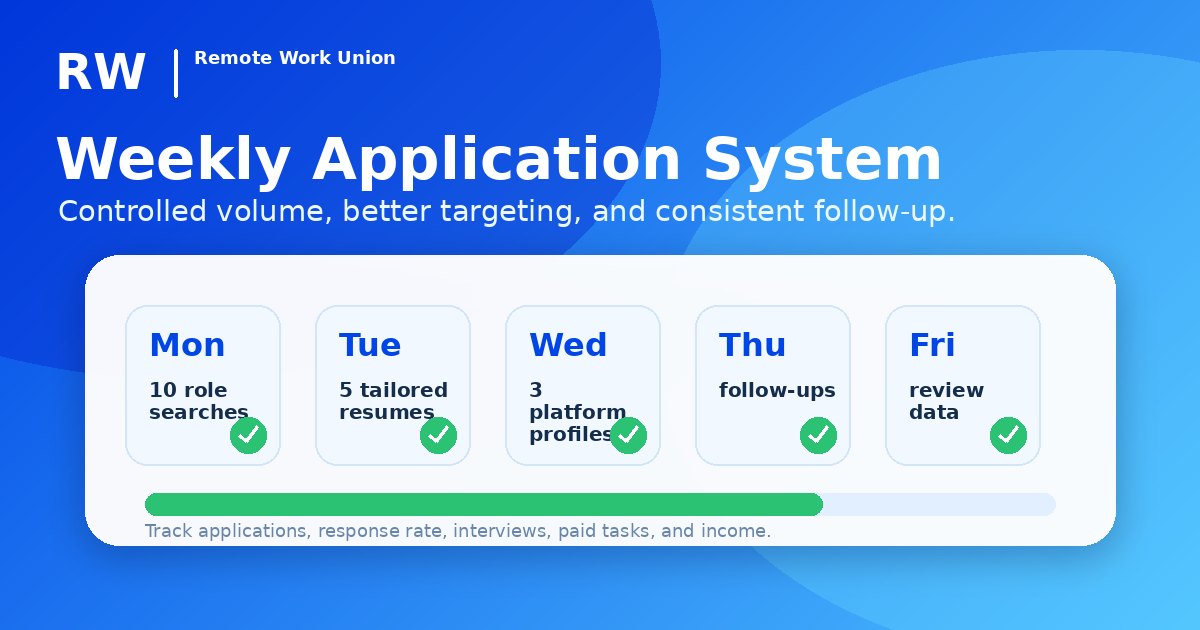
Monday: Search for new roles and platforms. Save 20 relevant opportunities.
Tuesday: Tailor resumes and profiles for the strongest matches.
Wednesday: Apply to platforms and roles that match your skills.
Thursday: Follow up, complete assessments, and improve samples.
Friday: Review results, response rates, interviews, paid tasks, and income.
Track everything in a spreadsheet. Include the company or platform, role, date applied, status, pay range if listed, required skills, assessment status, follow-up date, and notes. This turns the search into a process you can improve over time.
Know the Difference Between Full-Time Remote Jobs and Flexible Remote Income
There are two common ways to replace a full-time salary from home. The first is a traditional full-time remote job. The advantage is stability. The disadvantage is that hiring can be competitive, slow, and location-restricted.
The second is flexible remote income: AI training jobs, AI model evaluation, data annotation, freelance writing, editing, research projects, virtual assistant work, expert consulting, or contract sales support. The advantage is speed and flexibility. The disadvantage is that income may vary.
The best strategy often combines them. If you need stable benefits and predictable hours, prioritize full-time remote jobs while using flexible projects to add income. If you are transitioning from a job, flexible remote work can help prove that online income is possible before you fully switch.
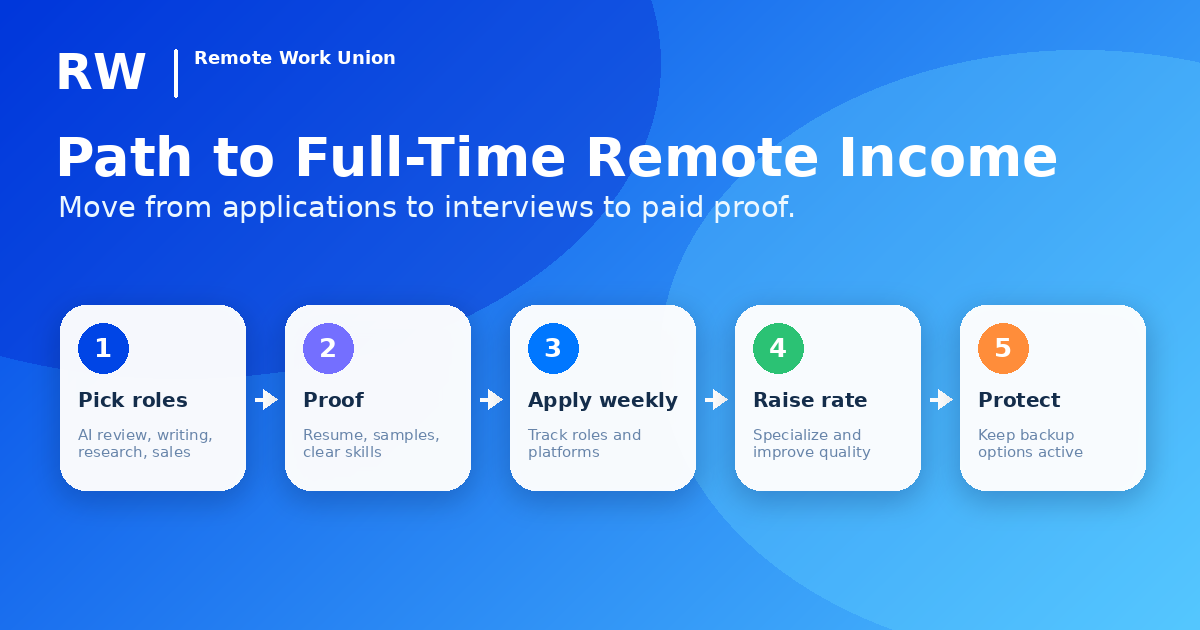
A 30-60-90 Day Plan for Replacing a Salary With Remote Work
Days 1–30: Build the foundation
Define your monthly income target. Choose three to five remote work categories that match your background. Update your resume and profiles with remote work keywords. Create a proof folder. Apply to a mix of full-time remote roles, AI training platforms, and flexible project opportunities. Start tracking everything.
Days 31–60: Double down on what gets responses
Review your application data. Which roles respond? Which platforms invite you to assessments? Improve your samples. Practice AI evaluation, writing tests, research tasks, sales interviews, or role-specific assessments. Start removing low-value categories that produce no results.
Days 61–90: Build stability
Focus on the best-performing categories. Increase application quality. Follow up consistently. Add secondary platforms. Track weekly income. Look for ways to raise your rate through specialization and more targeted roles. Build the backup pipeline before you need it.
FAQs
What is a salary replacement stack for remote work?
A salary replacement stack has three layers: anchor income (your main source like a full-time remote job or steady contract), flexible upside (AI model evaluation, writing projects, research assignments), and a backup pipeline (applications in progress, secondary platforms, warm leads).
How much can I realistically make with remote AI training work?
Pay varies significantly by role type. Expert-tier AI evaluation work (legal, finance, medical, coding) can pay $50–$200 per hour. Generalist work and simpler annotation tasks typically pay less. Most workers use AI training as one layer of a broader remote income strategy, not their only source.
How do I start replacing my salary with remote work?
Define your monthly income target first, then identify three to five remote work categories that match your skills. Build a proof folder, apply to a mix of full-time remote jobs and flexible platforms, track every application, and improve your profile weekly based on what gets responses.
Should I quit my job before my remote income is established?
In most cases, no. A conservative approach is to prove consistency first — several months of repeatable income with a functioning pipeline and backup options — before fully depending on remote work. A gradual transition reduces pressure and helps you make better decisions.