The question people do not ask out loud but think about constantly: can AI training actually replace a full-time job? The honest answer is that it depends on your skills, your income requirements, how many platforms you can qualify for, and whether the work is stable enough to replace what you already have.
Some remote workers do earn their primary income from AI model evaluation, RLHF rating, search quality review, AI writing evaluation, fact-checking, data annotation, and expert review work. But the path to full-time AI training income is not a straight line. It requires a specific kind of build: multiple platforms, demonstrated quality, and a clear-eyed view of income floor versus income ceiling.
What AI Training Is vs What a Full-Time Job Provides
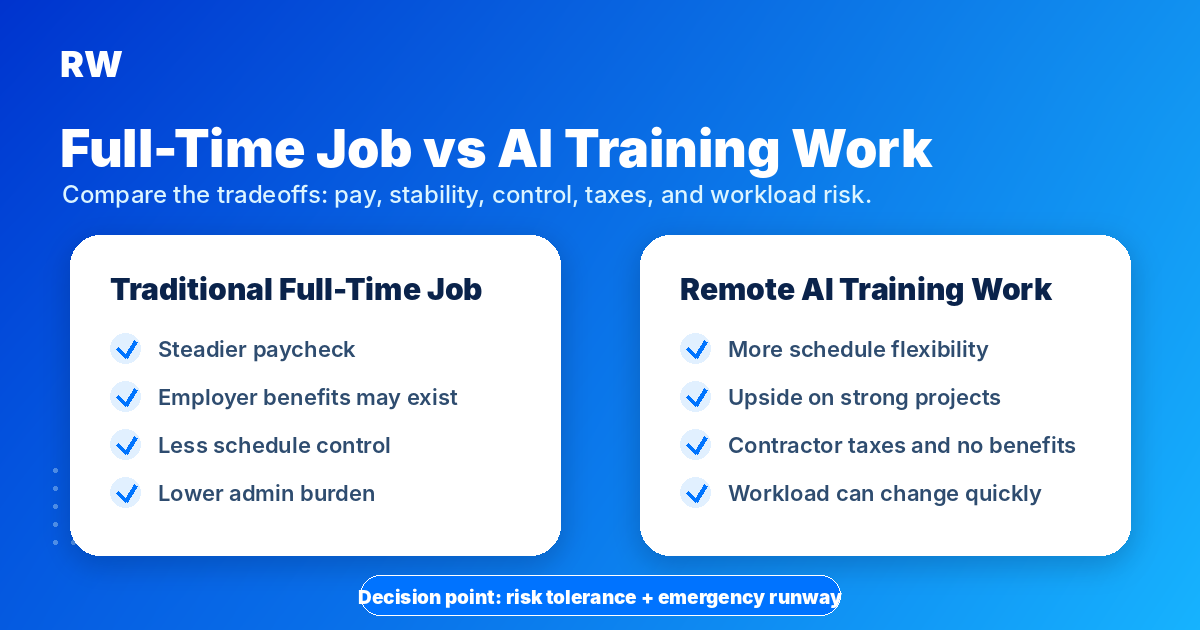
A full-time job usually provides predictable income, a fixed schedule, employer-paid benefits, legal employment protections, tax withholding, and often a career path. AI training work provides none of those automatically. It is project-based contract work. There is no guaranteed minimum, no employer-paid healthcare, and no protection against project cancellations.
That does not make it bad. It makes it different. The trade-off is flexibility and income potential. AI training work can pay $20+ per hour for general evaluation tasks and $50 to $200 per hour for expert-tier specialized review. You set your own hours, choose which projects to accept, and can work from anywhere. But you also absorb all the variability.
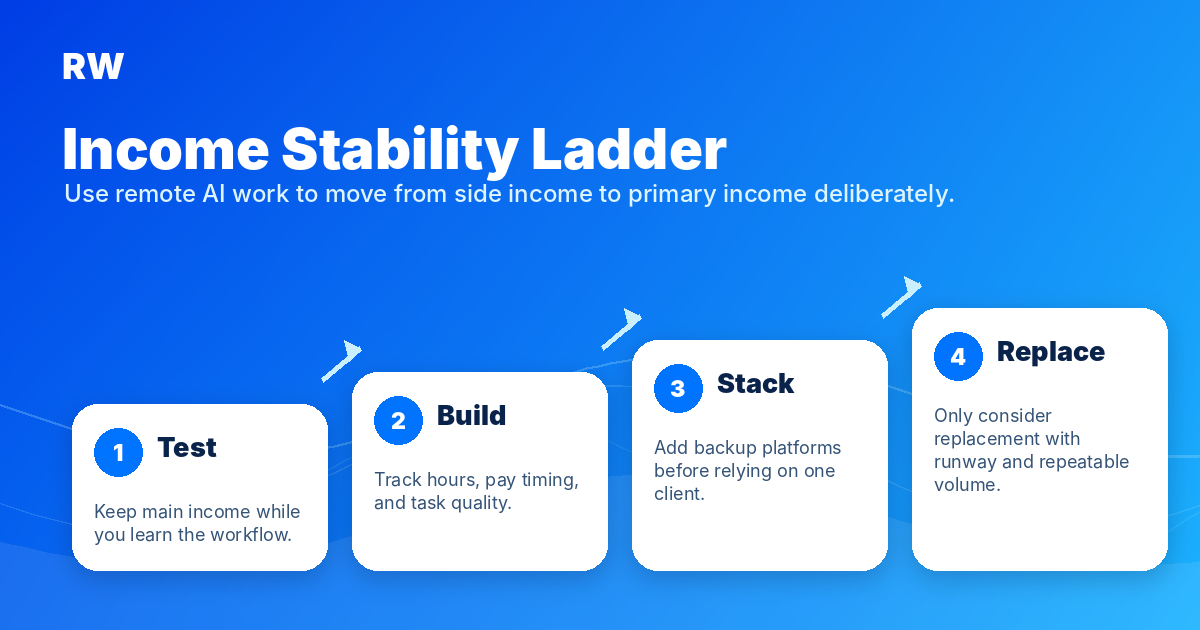
The Income Stability Ladder
AI training income follows a ladder. At the bottom are beginners with one platform and no proven track record — income is unpredictable, often low, and intermittent. In the middle are contractors who have qualified on multiple platforms, maintain strong quality scores, and have at least one reliable project — income can reach serious part-time levels. At the top are experienced evaluators with specialized expertise, strong platform relationships, and multiple active work streams — income can rival or exceed a traditional full-time salary.
Most people start at the bottom and stay there if they only apply to one platform. The contractors who build meaningful income are typically the ones who treat AI training work as a business — tracking which platforms pay, which projects are consistent, and which skills should be developed next.
The Platform Stack Model
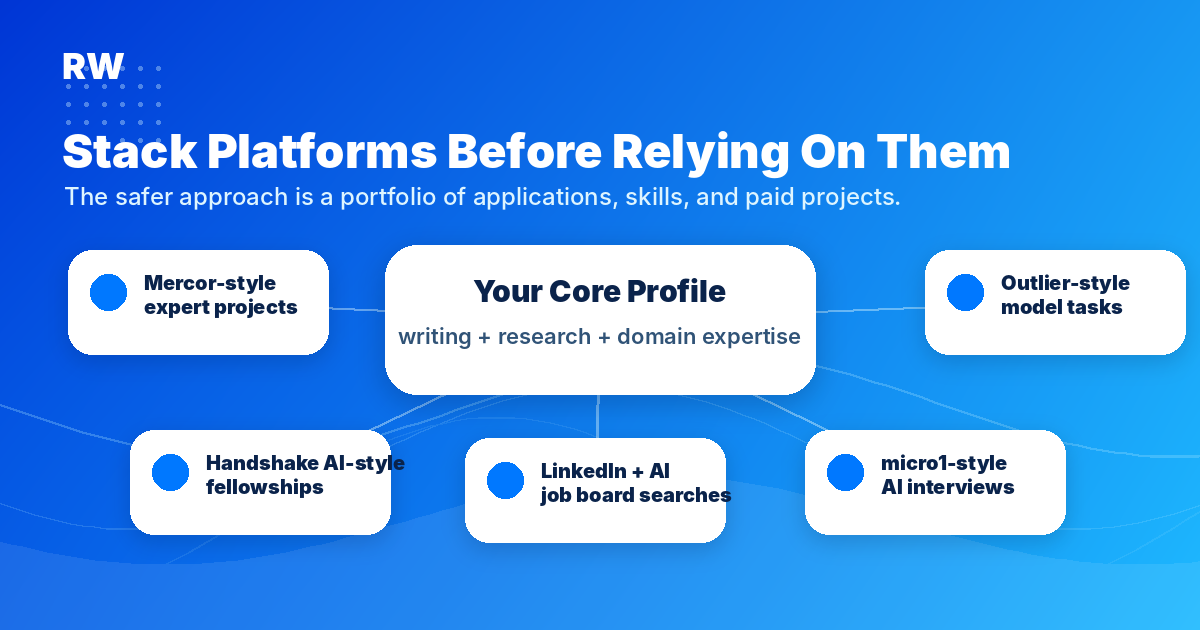
No single platform can reliably provide full-time hours. Projects end, task queues slow down, and quality review periods can pause work without warning. The platform stack model means building income across multiple legitimate sources — one anchor platform with the best pay and consistency, one backup platform for slower periods, and one experimental platform you are testing.
For example, a strong writer might anchor on a writing evaluation project through Mercor or Outlier AI, use Handshake AI as backup, and test micro1 for expert-tier opportunities. Each platform adds resilience. Losing one does not eliminate your income.
Remote Work Union connects you to legitimate remote AI training platforms to build your income stack. Apply for free to find roles hiring now.
Find Roles Hiring Now →The Replacement Test
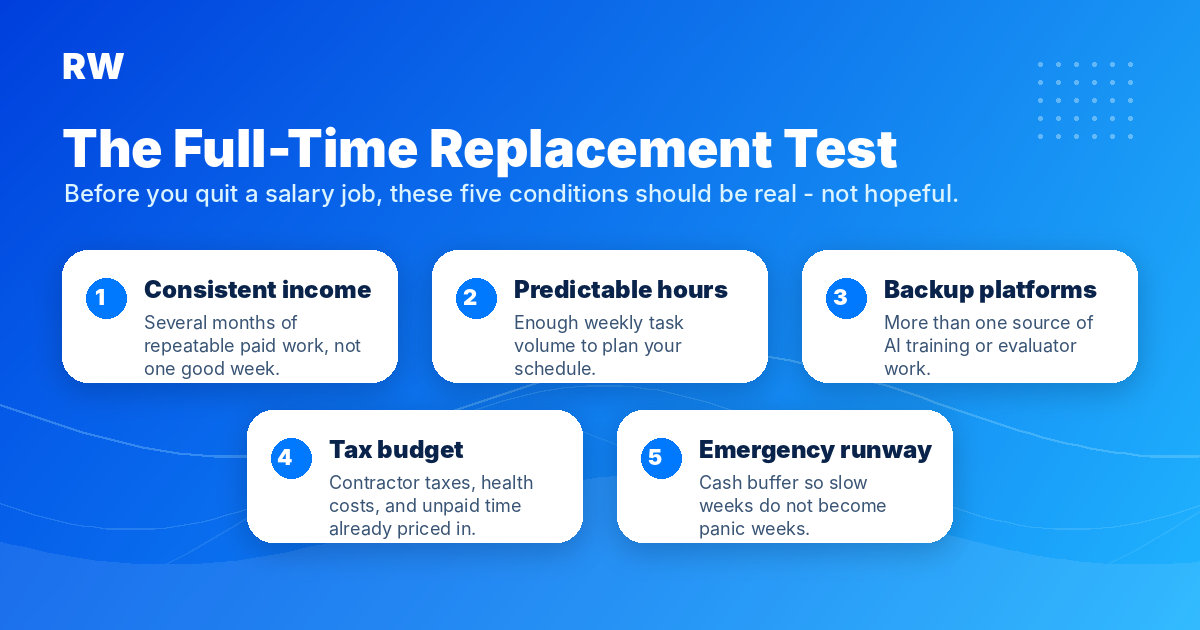
Before treating AI training as your primary income, apply the replacement test. Ask three questions:
- Has the income been consistent for at least three months? One strong month is not evidence. Three months of stable income across multiple platforms is the minimum signal.
- Can you cover essential expenses from floor income, not peak income? Budget around your lowest month, not your best. AI training income swings. If your floor does not cover your bills, you are not ready.
- Do you have backup platforms so a single slow project does not eliminate your work? At least two active income streams from different platforms is the minimum safety net.
If all three answers are yes, you may be ready to treat AI training as primary income. If any answer is no, keep your current income source while you build.
Who Can Actually Replace a Full-Time Job
The best candidates for full-time AI training income are people with in-demand expertise who can qualify for high-value specialized projects. Lawyers can review legal reasoning. Medical writers can evaluate healthcare content. Finance professionals can assess investment-related answers. Software engineers can review code outputs. Strong writers and editors can handle large volumes of AI writing evaluation. Teachers and researchers can review educational and academic content.
The pattern is consistent: people who replace a full-time job with AI training work usually have real expertise that platforms need, not just general availability. A generic applicant with no specific skill advantage is competing for the same high-volume general tasks as everyone else.
The Real Risks to Plan For
The most significant risks are project cancellation (a project ends with little warning and you lose a large portion of your income), quality score drops (a period of inconsistent work can reduce your access to better projects), and platform rule changes (platforms can change requirements, rates, or availability without much notice). Tax planning is also essential — AI training income is usually contract income, which means you are responsible for your own taxes, including self-employment tax in many countries.
Tip: Treat income swings as normal. The contractors who last are the ones with a cash buffer. Before going full-time, try to have at least two to three months of living expenses in reserve so a slow project period does not create a financial emergency.
The Right Build Order
Do not quit your job to focus on AI training applications. The right order is: (1) apply while employed, (2) pass assessments and complete initial tasks while keeping your income, (3) build your platform stack to two or three active sources, (4) track three months of stable income, (5) apply the replacement test, and (6) only then consider making AI training your primary income.
This order might feel slow, but it dramatically reduces risk. Most contractors who succeed at full-time AI training income built their stack over months, not days.
Frequently Asked Questions
Can AI training work replace a full-time job?
For some people, yes — but only after building a stable multi-platform income over several months. AI training income is project-based and can be inconsistent. Until you have repeated strong weeks across multiple platforms, it is safer to treat AI training as a serious supplement to a primary income rather than an immediate replacement.
How much can you realistically earn from AI training work?
General AI training work often pays $20+ per hour, and expert-tier roles can reach $50 to $200 per hour for specialized knowledge. Actual earnings depend on your skills, platform access, project availability, and how many hours you can maintain at quality. Most contractors start part-time before building toward full-time income.
What is the replacement test for AI training income?
The replacement test asks three questions: Has the income been consistent for at least three months? Can you cover your essential expenses from floor income, not peak income? Do you have backup platforms so a single slow project does not eliminate your work? All three should be yes before relying on AI training as primary income.
What is the biggest risk of replacing a full-time job with AI training work?
The biggest risk is income inconsistency. AI training work is project-based. Task availability can drop with little warning when a project ends, budgets change, or your skill profile does not match active openings. Building a buffer and stacking platforms are the best defenses against this risk.