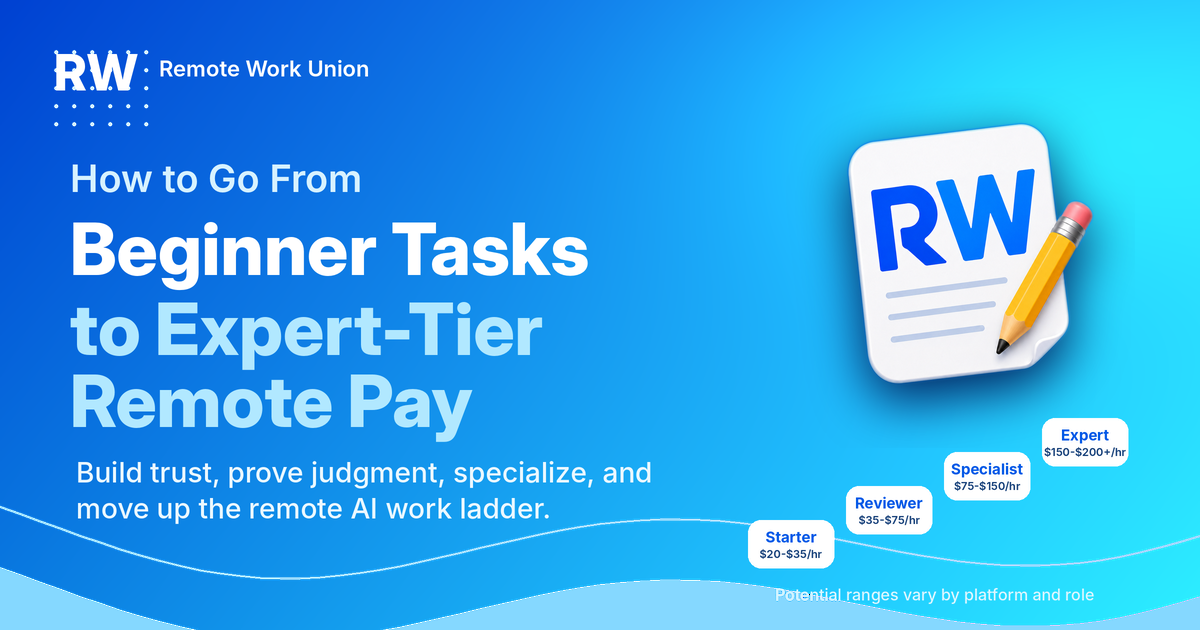
Beginner remote tasks are not where most people want to stay. They are where many people start.
That distinction matters. A basic AI rating task, data annotation project, search quality review, writing evaluation, or prompt comparison may look small on its own. But if you treat it correctly, it becomes proof. It shows that you can follow instructions, make consistent judgments, explain your reasoning, and work without someone watching you every hour.
That is the bridge from beginner remote work to expert-tier remote pay.
Higher-paying remote AI jobs usually do not appear just because someone wants more money. They appear when a platform, client, or hiring team believes your judgment is worth paying for. In the AI economy, that judgment can come from writing skill, research ability, legal knowledge, finance experience, coding ability, language fluency, scientific understanding, safety judgment, editing skill, or years of practical work experience.
The goal is not to stay forever in the easiest task queue. The goal is to use beginner tasks as a training ground, then move toward work where your expertise matters.
Ready to apply for jobs? Go to RemoteWorkUnion.com to find roles hiring now.
Beginner Tasks Are a Starting Point, Not a Career Ceiling
Many people enter remote AI work through simple projects: labeling responses, comparing two answers, checking whether an AI followed instructions, rating factual accuracy, reviewing tone, or rewriting short pieces of text. These jobs are common entry points because they test core remote work behaviors.
They answer basic questions:
- Can you read instructions carefully?
- Can you apply the same standard repeatedly?
- Can you explain why one answer is better than another?
- Can you avoid careless mistakes when no manager is sitting next to you?
- Can you work independently without turning every task into a support ticket?
Those skills are not glamorous, but they are valuable. AI companies and AI training platforms need workers who can improve model outputs at scale. Beginner tasks are often where platforms learn whether you are reliable enough for more complex work.
This is why the first phase should not be treated like disposable gig work. It should be treated like a paid audition.
What Expert-Tier Remote Pay Actually Means
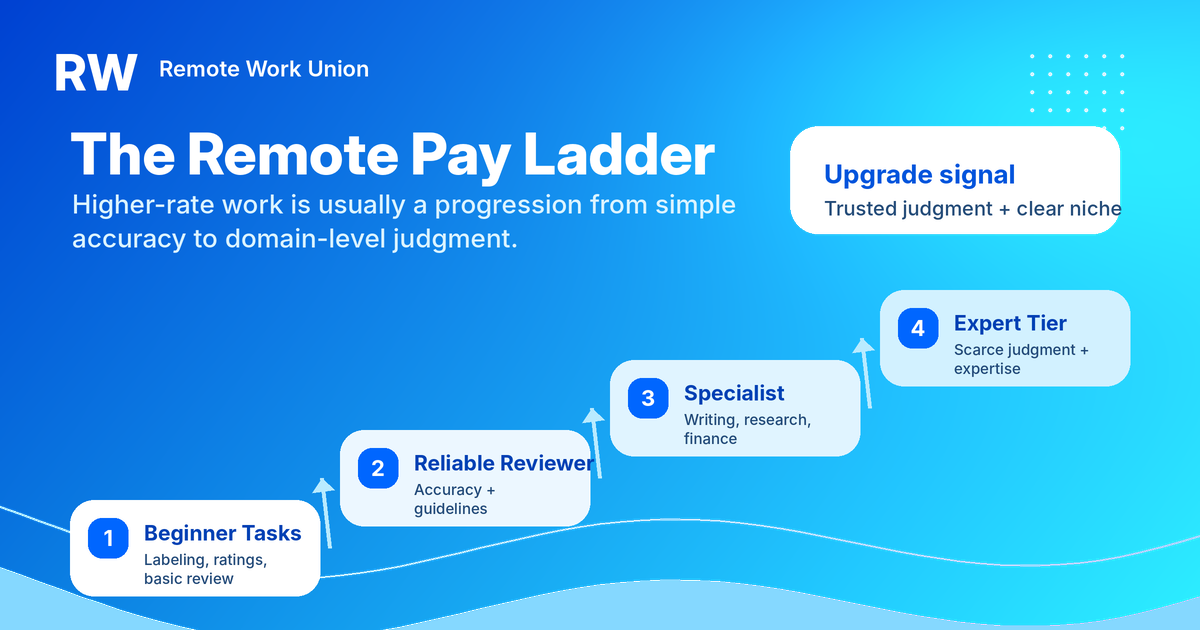
Expert-tier remote pay does not mean every task pays hundreds of dollars per hour. It also does not mean every beginner can jump directly into the highest-paying work. In most cases, expert-tier pay means the work is tied to scarce judgment rather than simple availability.
A beginner task might ask, "Which answer is better?" An expert task might ask, "Is this answer legally sound, financially accurate, medically safe, technically correct, mathematically rigorous, or aligned with a complex policy?"
That difference matters.
Remote AI work tends to become more valuable when it requires one or more of the following:
- Deep subject matter expertise
- Strong writing and editing judgment
- Research and fact-checking ability
- Coding or technical review skill
- Bilingual or multilingual fluency
- Legal, finance, medical, scientific, or academic knowledge
- Safety, policy, or trust-and-risk judgment
- Experience reviewing ambiguous information
The worker is no longer being paid only to complete tasks. The worker is being paid to reduce uncertainty.
That is the core of expert-tier remote pay.
Step 1: Become Excellent at the Basic Tasks
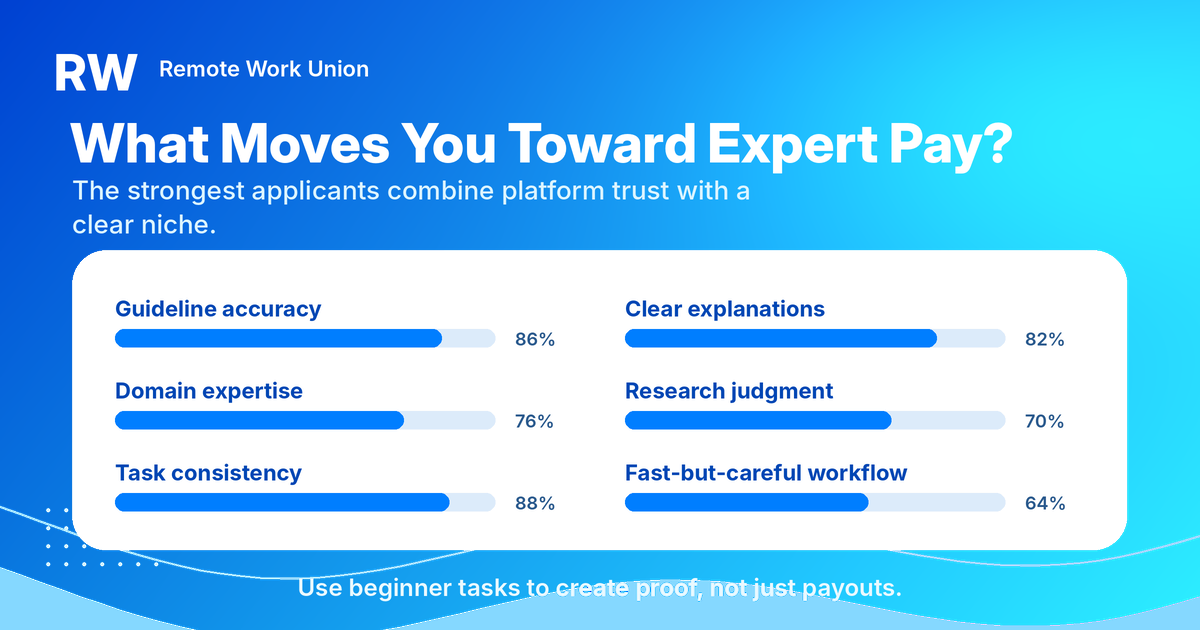
The fastest way to move beyond beginner work is not to rush through beginner work. It is to become unusually dependable at it.
Most platforms care about quality signals before they care about your ambitions. If your ratings are inconsistent, your explanations are thin, or your submissions need heavy correction, it becomes harder to justify giving you more advanced work.
Focus on the basics first:
Read the full instructions before starting. Many beginner workers lose opportunities because they skim. Remote AI tasks often include detailed rubrics. The difference between a passable worker and a trusted worker can be as simple as reading the edge cases carefully.
Explain your reasoning clearly. When a task asks for a short explanation, do not write filler. Explain the exact reason for the rating. Mention accuracy, completeness, instruction following, clarity, safety, formatting, or relevance when appropriate. Good explanations show that you are not guessing.
Stay consistent. Platforms need workers who apply standards the same way across many tasks. A worker who gives random ratings is difficult to trust, even if some individual answers look correct.
Track your mistakes. Keep a simple document with recurring issues: misunderstood instruction, missed detail, formatting error, weak explanation, factual oversight, or slow task completion. The point is not to punish yourself. The point is to stop making the same mistake twice.
Avoid shortcuts that damage trust. Do not paste tasks into AI tools in a way that violates platform rules. Do not submit work you do not understand. Do not chase speed so aggressively that quality drops. A few low-quality batches can close off higher-paying opportunities.
Step 2: Turn Your Task History Into a Skill Narrative
Beginner tasks alone may not make you look like an expert. But they can reveal what kind of expert path fits you.
After a week or two of remote AI work, ask yourself what parts of the job felt natural.
Were you best at catching factual errors? You may be strong in research and verification roles.
Were you good at improving awkward language? You may fit writing, editing, or AI content review roles.
Were you good at spotting policy violations or unsafe outputs? You may fit trust and safety evaluation work.
Were you strong at math, spreadsheets, finance, coding, or technical explanations? You may qualify for higher-value specialist work.
Were you evaluating tone, persuasion, customer communication, or user intent? You may fit customer research, UX research, or communications-focused AI evaluation.
This is where many beginners make a mistake. They describe themselves as "open to anything." That sounds flexible, but it does not help a platform match you.
A stronger profile says something specific:
"Remote AI evaluator with experience reviewing model responses for accuracy, clarity, instruction following, and research quality. Strong background in writing, business topics, and internet research."
Or:
"AI training contributor focused on finance, accounting, spreadsheet logic, and business analysis tasks. Comfortable reviewing numerical reasoning and explaining errors clearly."
The goal is to make your remote work profile easier to match.
Step 3: Pick a Higher-Value Niche
General AI training work can be useful, but specialist work is where pay often improves. That does not mean you need a PhD. It means you need a recognizable area where your judgment is stronger than average.
Writing and editing. AI companies need people who can judge clarity, tone, structure, originality, helpfulness, and style. Writers, editors, copywriters, content marketers, teachers, journalists, and communications professionals can often transfer their skills into AI response evaluation and prompt writing jobs.
Research and fact-checking. Research-heavy remote AI jobs reward people who can verify claims, compare sources, identify unsupported statements, and explain uncertainty. This can fit analysts, students, researchers, assistants, journalists, and detail-oriented generalists.
Business, finance, and accounting. AI models need help with spreadsheets, financial reasoning, business writing, accounting logic, and market analysis. Workers with finance, bookkeeping, operations, consulting, or business backgrounds should not hide that experience.
Legal and policy review. Paralegals, legal assistants, law students, compliance professionals, and policy specialists may qualify for tasks involving legal reasoning, contract language, regulatory interpretation, or safety policy.
Coding and technical review. Software engineers, technical writers, data analysts, and strong self-taught coders can pursue code review, debugging, technical explanation, and AI programming evaluation work.
Science, math, and education. AI systems need evaluation in math, biology, chemistry, physics, tutoring, curriculum, and academic reasoning. Teachers, tutors, graduate students, lab workers, and technical professionals should present those skills clearly.
Language and localization. Bilingual professionals can evaluate translations, cultural tone, multilingual prompts, and regional language quality. Strong English plus another language can be a real advantage in remote AI work.
Looking for AI training roles that match specialist skills? Find opportunities hiring now on RemoteWorkUnion.com.
Find Roles Hiring Now →Step 4: Apply for Specialist Roles Before You Feel Fully Ready
Many workers wait too long to apply for better roles. They think they need months of experience before trying specialist tasks. That can be a mistake.
You do not need to claim expertise you do not have. But if you have real knowledge in a field, you should apply for roles that use it.
- A bookkeeper should apply for accounting, spreadsheet, and financial reasoning tasks.
- A former teacher should apply for tutoring, curriculum, writing, and education evaluation tasks.
- A paralegal should apply for legal review and policy-related AI evaluation tasks.
- A marketer should apply for copywriting, ad review, brand voice, and content quality tasks.
- A bilingual worker should apply for translation, localization, and multilingual evaluation roles.
- A software developer should apply for code review and technical AI training jobs.
The right question is not "Am I the world's top expert?" The better question is "Can I make better judgments in this category than a random generalist?" If the answer is yes, apply.
Step 5: Build a Multi-Platform Ladder
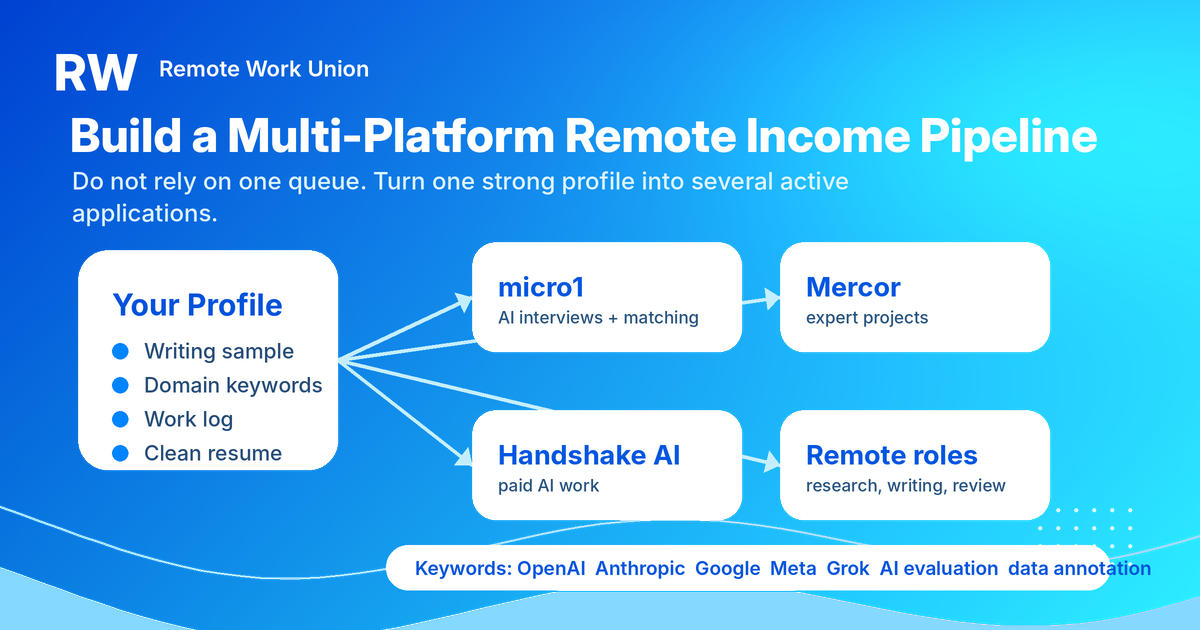
One platform is not a remote career. One platform is one opportunity source.
Remote AI work can be inconsistent. Task volume changes. Accounts can pause. Hiring needs shift. A role that is active one week may slow down the next. That is why serious remote workers build a multi-platform pipeline.
A practical ladder might include:
- One platform where you do beginner AI tasks and build consistency
- One platform where you apply for specialist AI evaluation work
- One platform where you maintain an expert profile
- One broader remote job board where you apply for writing, research, operations, or analyst roles
- One personal work log that helps you update your resume and applications
Platforms such as micro1, Mercor, Handshake AI, and other AI training marketplaces may screen workers differently. Some emphasize resumes. Some use interviews. Some use tests. Some match workers to projects based on domain keywords.
The strategy is not to depend on one application. The strategy is to keep improving your profile until several platforms understand what you are good at.
Step 6: Keep a Work Log That Proves Growth
Most beginners do not track their work. That makes it harder to move up.
A simple work log can help you identify your strongest categories and write better applications. It does not need to include confidential task content. In fact, you should avoid saving private platform materials. Track general categories instead:
- Date / Task Type / Skill Used / What Went Well / What to Improve
This log helps you see patterns. Maybe you are not just "doing tasks." Maybe you are developing AI evaluation experience, research judgment, editorial review skill, and domain-specific quality control. That language matters when applying for higher-paying work.
Step 7: Upgrade Your Profile Every Time You Learn Something
Your first remote AI application is usually not your best application. It is just the first version.
As you gain experience, update your profile with better keywords and clearer positioning.
Weak profile language: "I am hard-working and looking for remote work. I am open to any opportunity."
Stronger profile language: "Remote AI evaluator with experience reviewing model responses for accuracy, relevance, instruction following, and writing quality. Strong background in online research, business writing, and detailed feedback."
Even stronger, if true: "Remote AI evaluator specializing in business, finance, and written response quality. Experienced in comparing AI outputs, identifying unsupported claims, and writing concise explanations for ratings."
The stronger version gives a platform more reasons to match you with better work.
Step 8: Learn How Higher-Paying Tests Are Different
Beginner tests often check whether you can follow instructions. Expert tests often check whether your judgment is actually good.
Expect more complex prompts. Expect ambiguity. Expect tasks where both answers are partly right. Expect instructions that require tradeoffs between accuracy, usefulness, completeness, tone, safety, and user intent.
To perform well, slow down and use a repeatable method:
- Identify the user's actual request.
- Check whether the AI answer followed the instructions.
- Check factual accuracy and unsupported claims.
- Check completeness.
- Check clarity and organization.
- Check safety, policy, or domain-specific risks.
- Write a concise explanation of the final judgment.
Common Mistakes That Keep Workers Stuck at Beginner Level
- Chasing speed too early — speed helps only after quality is stable
- Applying to every role with the same generic profile
- Hiding real experience (teaching, accounting, legal, writing all count)
- Treating no response as final rejection — remote platforms can be slow
- Using AI tools carelessly in ways that violate platform rules
- Waiting for perfect confidence before applying for higher-value work
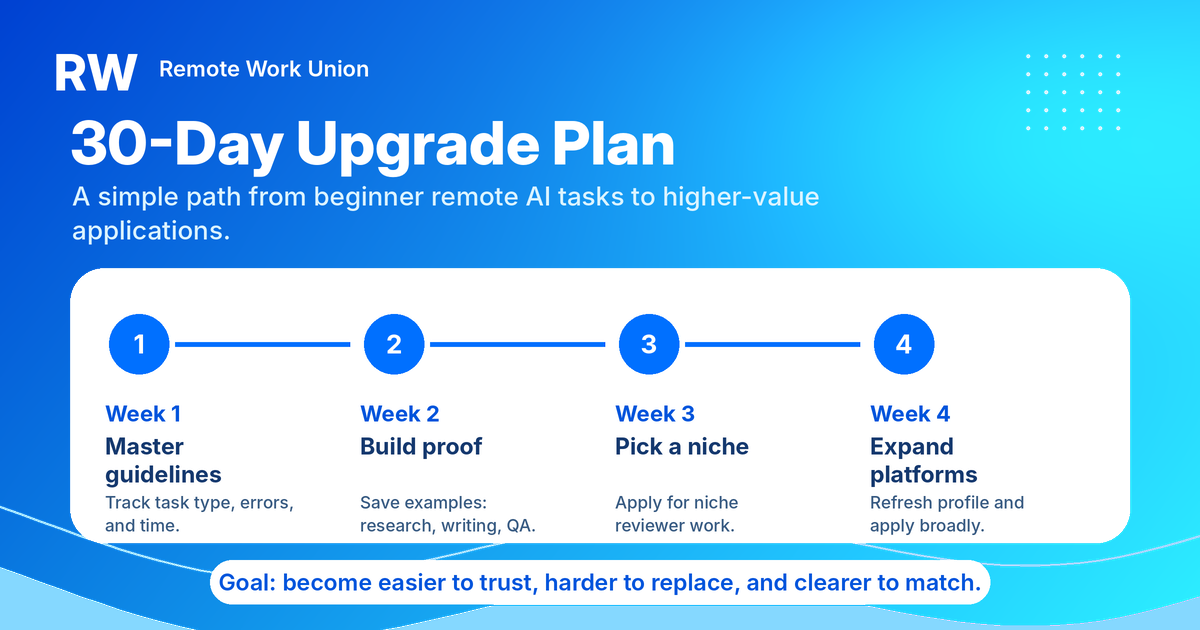
A 30-Day Plan to Move Up
Days 1–7: Master the basics. Complete beginner tasks carefully. Read instructions fully. Track your task types, mistakes, and strongest categories. Do not worry about being fast yet.
Days 8–14: Build your proof. Update your resume and remote work profile. Add phrases like AI evaluation, response rating, instruction following, content review, research, fact-checking, writing quality, and data annotation where accurate.
Days 15–21: Choose a niche. Pick one or two categories where your judgment is strongest: writing, research, legal, finance, coding, math, science, language, education, marketing, operations, or policy.
Days 22–30: Apply upward. Apply to specialist roles on multiple platforms. Tailor each application to the task type. Keep a list of where you applied, what test you took, what you learned, and what to improve.
The Real Difference Between Beginner and Expert Remote Work
Beginner remote work asks, "Can this person complete the task?"
Expert-tier remote work asks, "Can this person make judgments we can trust?"
That is the shift.
The remote AI job market rewards people who can combine reliability with expertise. You do not need to know how to code for every role. You do not need a perfect resume for every platform. But you do need to show what kind of judgment you bring.
If you are starting with beginner AI training tasks, use them strategically. Learn the rubrics. Improve your explanations. Track your strengths. Pick a niche. Apply across platforms. Rewrite your profile as your skills become clearer.
The path from beginner tasks to expert-tier remote pay is not automatic. But it is real for workers who treat each small task as evidence of a bigger skill set.
Ready to apply for jobs? Go to RemoteWorkUnion.com to find roles hiring now.
Frequently Asked Questions
How long does it take to go from beginner remote AI tasks to expert-tier pay?
There is no fixed timeline, but many workers begin positioning for specialist work within four to eight weeks of consistent beginner tasks. The key is building a track record of quality work, identifying your strongest skill category, and updating your profile and applications to reflect specialist expertise rather than general availability.
What niches pay most in remote AI work?
Expert-tier remote AI pay tends to be highest for roles requiring scarce judgment: legal reasoning, financial analysis, medical or scientific review, software code evaluation, and advanced writing or research. Workers with domain expertise in these areas can earn $50–$200 per hour on platforms like micro1, Mercor, and Handshake AI, compared to lower rates for general annotation tasks.
Do I need a degree to move into higher-paying remote AI work?
Not always. Platforms care more about demonstrated judgment than credentials. A strong writer, experienced paralegal, seasoned marketer, or detail-oriented analyst can qualify for specialist AI training roles without a formal degree if they can clearly explain their expertise and perform well on skills assessments.
How should I describe my experience when applying for specialist AI roles?
Be specific rather than broad. Instead of saying you are "open to anything," describe the type of judgment you bring: AI evaluation focused on writing quality, research accuracy, and instruction following; or financial reasoning review for AI model training. Clear positioning makes it easier for platforms to match you with higher-value work.
Can I work on multiple AI training platforms at once?
Yes, and it is often the right strategy. Remote AI work can be inconsistent on any single platform. Building a presence across micro1, Mercor, Handshake AI, and other remote AI training marketplaces creates a more stable pipeline and opens more paths to higher-paying specialist roles.
What is the difference between a beginner AI task and an expert-tier AI task?
Beginner tasks typically ask whether a candidate can complete the task consistently — rating responses, comparing outputs, labeling data, or following rubrics. Expert-tier tasks ask whether the worker's judgment is trustworthy in a specific domain — verifying legal reasoning, checking financial accuracy, evaluating code correctness, or reviewing medical information. Expert work is less about availability and more about scarce domain knowledge.