Remote AI training work sounds more technical than it usually is. Many people hear phrases like AI model evaluation, data annotation, prompt writing, and AI response review and assume they need to be software engineers. Some roles do require coding, math, or advanced technical knowledge. But many remote AI jobs are built around human judgment: reading carefully, comparing answers, checking facts, rewriting unclear responses, rating quality, and explaining why one answer is better than another.
That means you may qualify even if you do not have an AI background. You may qualify because you write clearly. You may qualify because you notice mistakes fast. You may qualify because you have experience in law, finance, healthcare, customer support, education, operations, marketing, research, sales, design, or another real-world field. You may qualify because you are bilingual, analytical, detail-oriented, or good at following instructions.
The important question is not, Do I know everything about artificial intelligence? The better question is, Can I help an AI company improve the quality, safety, accuracy, usefulness, or style of its model outputs? If the answer is yes, you may have a path into remote AI training work.
In This Article
- What remote AI training work actually includes
- The simple qualification test
- Signs you may already qualify
- Do you need a degree?
- Do you need coding experience?
- Backgrounds that commonly translate
- What platforms usually look for
- What can disqualify you
- How to position yourself as qualified
- A practical application plan
- Beginner, generalist, and expert paths
- The qualification scorecard
What remote AI training work actually includes
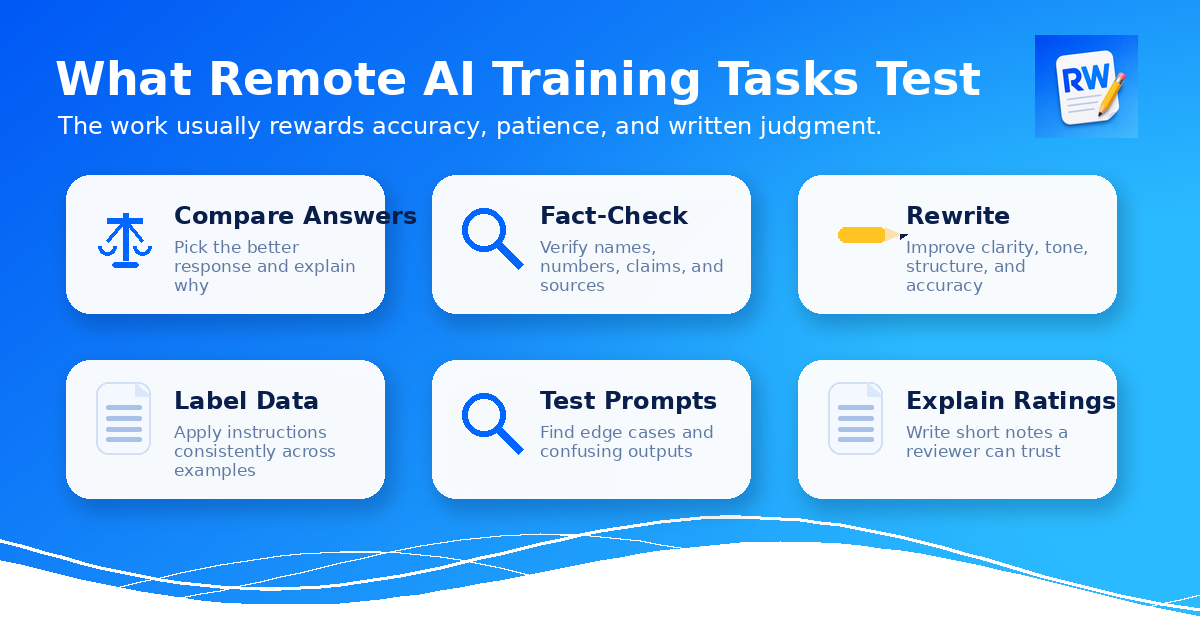
Remote AI training work is a broad category. It can include AI data annotation, AI response evaluation, prompt writing, content rewriting, search quality evaluation, factuality checking, safety review, code review, domain-specific analysis, and model behavior testing. The common thread is simple: a human reviews or creates examples that help AI systems become more useful.
For example, a task may show you two answers from an AI model and ask which one is better. Another task may ask you to verify whether an answer made a false claim. Another may ask you to rewrite a weak response so it is clearer, more complete, and more accurate. A platform may ask you to label examples, classify content, review instructions, or test whether a model follows a user request.
Major AI companies and AI labs, including ecosystems around OpenAI, Anthropic, Google, Meta, and Grok, all depend on high-quality human feedback in some form. Many workers access these projects through remote work platforms, contractors, vendors, or specialized AI training marketplaces. Platforms such as micro1, Mercor, Handshake AI, and similar companies are often part of the wider remote AI work landscape.
The exact project changes over time, but the core skill stays the same: can you make reliable judgments about language, information, reasoning, instructions, and quality?
The simple qualification test
A practical way to test whether you qualify is to ask three questions: Can you judge an answer? Can you explain your judgment? Can you improve the answer if needed?
If you can compare two responses and say which one is more accurate, useful, complete, and better written, you already have one of the core skills. If you can explain that decision in a short, clear note, you have another. If you can rewrite the weaker answer so it becomes better, you may be a fit for prompt writing, AI content editing, or response improvement work.
This is why remote AI training work can be accessible to people from many backgrounds. A teacher may be good at grading explanations. A writer may be good at tone and clarity. A paralegal may be good at precision. A researcher may be good at checking claims. A customer support worker may be good at identifying whether an answer actually solves the user's problem. A finance professional may be good at reviewing business or spreadsheet-related tasks. A bilingual worker may be good at translation quality and cultural nuance.
Key insight: You do not need to be perfect. You do need to be consistent. AI training platforms usually care less about confidence and more about whether your decisions match the instructions, the rubric, and the facts.
Signs you may already qualify
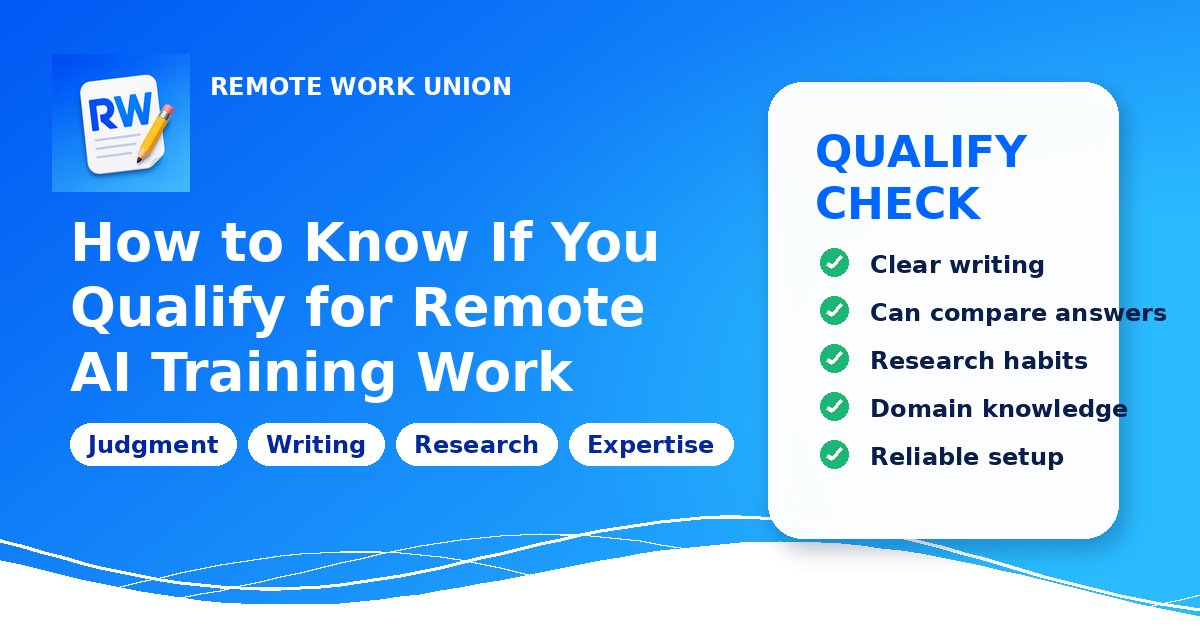
You may already qualify for remote AI training work if several of these describe you:
- You can write in clear, direct sentences without confusing the reader.
- You notice when an answer sounds confident but is actually wrong.
- You can compare two pieces of writing and explain which one is stronger.
- You are comfortable researching a claim before accepting it.
- You can follow detailed instructions without improvising your own rules.
- You have experience in a specific field, even if it is not technical.
- You can work independently from home without constant supervision.
- You can stay patient when tasks are repetitive or detailed.
- You can explain your reasoning in a few sentences.
- You understand that quality matters more than speed at the beginning.
These skills are common in work from home jobs, office jobs, creative jobs, academic work, and customer-facing roles. The challenge is not always having the skills. Often, the challenge is presenting them in a way that AI training platforms can understand.
Do you need a degree?
A degree can help for specialized roles, but it is not always required for beginner-friendly remote AI jobs. Many generalist AI evaluator jobs, AI data annotation jobs, AI content reviewer jobs, and prompt writing jobs care about task performance more than credentials. If the platform gives you an assessment, your score on that assessment may matter more than the exact name of your school or degree.
That said, degrees and certifications can be useful signals. A law degree can help with legal evaluation work. A finance degree can help with business, accounting, or investing tasks. A computer science degree can help with coding projects. A teaching background can help with education tasks. A nursing, medical, or healthcare background can help with health-related review tasks, depending on the project rules.
The key is to separate generalist qualification from expert qualification. You may not qualify for every expert project. That does not mean you cannot qualify for remote AI training work at all. Start with roles that match your actual skill level, then move into more specialized work when your profile and track record are stronger.
Do you need coding experience?
No, not for every role. Coding experience is required for coding evaluation, software engineering tasks, technical debugging, and some STEM-heavy projects. But many remote AI training jobs are non-coding roles. These can include writing evaluation, factuality review, instruction-following review, content editing, search quality tasks, safety classification, translation review, and general AI response rating.
If you do not code, avoid positioning yourself as a technical expert. Instead, highlight the skills that matter for non-technical AI work: writing, editing, research, quality assurance, analysis, judgment, communication, industry knowledge, and careful instruction-following.
The phrase "no coding required" should not be understood as "no skill required." Strong non-technical workers still need precision. They need to read the task rules, understand the rating system, and produce consistent feedback. The best beginner applicants do not oversell. They show they can do the work carefully.
Backgrounds that commonly translate into AI training work
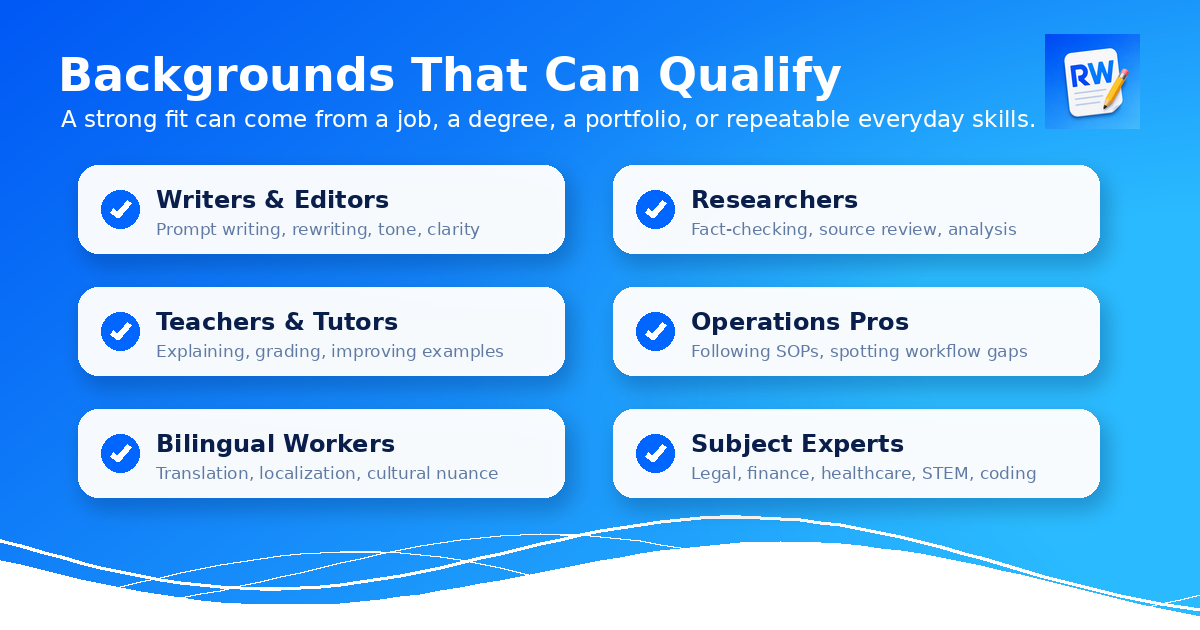
Many people qualify because their existing work has already trained them to evaluate information. Writers and editors often fit prompt writing, rewriting, response improvement, and content quality tasks. Researchers often fit fact-checking, source review, summarization, and accuracy evaluation. Teachers and tutors often fit grading, explanation review, and educational content tasks. Customer support professionals often fit helpfulness evaluation because they understand whether an answer actually solves a user problem.
Legal assistants, paralegals, accountants, analysts, healthcare professionals, engineers, marketers, designers, translators, and operations managers may qualify for more specialized task categories. The more specific the task, the more your domain knowledge matters. A generalist can judge whether a response is clear. A subject matter expert can judge whether it is technically correct inside a field.
Remote AI work also rewards people who are strong generalists. If you read widely, learn new topics quickly, and enjoy checking whether information makes sense, you may fit general knowledge evaluation work. AI models produce answers across every topic, so platforms need people who can move between subjects without losing accuracy.
What platforms usually look for
Different platforms screen applicants differently, but most are trying to answer the same basic questions. Can you understand instructions? Can you write clearly? Can you pass a sample task? Can you remain consistent? Can you work legally and receive payment in your location? Can you be trusted with quality standards?
Your profile should make those answers easy. Do not write a vague profile that says you are hardworking and passionate about AI. Instead, give concrete signals: the types of writing you do, the subjects you understand, the tools you use, the languages you speak, the industries you know, and the kind of review work you can handle.
A strong profile for remote AI training work might mention skills like AI response evaluation, data annotation, prompt writing, research, editing, fact-checking, quality assurance, rubric-based review, content moderation, translation, subject matter expertise, or technical review. Only include skills that are true. Overclaiming can hurt you later if the assessment tests skills you do not have.
Ready to check your fit and apply? Find remote AI training roles hiring now.
Find Roles Hiring Now →What can disqualify you
Many applicants are not rejected because they are unqualified for all remote AI jobs. They are rejected because their application does not show fit, or because they make mistakes during assessments. Common problems include rushing through instructions, giving vague explanations, relying on AI-generated answers without reviewing them, failing to verify factual claims, choosing speed over accuracy, and applying to expert projects without matching expertise.
Another issue is inconsistency. If your resume says you are an expert in finance, but your assessment answers show weak numerical reasoning, the platform may not trust the signal. If your profile lists ten specialties but none are backed by experience, the application may look inflated. If your writing sample contains grammar errors, unclear wording, or generic filler, it may weaken your fit for AI writing jobs.
Remote work scams are another risk. Legitimate remote AI platforms should not require you to pay a fee to start. Be careful with any job that guarantees income, asks for upfront payment, avoids clear terms, or pressures you to move the conversation to a strange channel. A real application process can be selective and slow. That does not make every delay a scam, but upfront fees are a major warning sign.
How to position yourself as qualified
The best way to position yourself is to translate your existing experience into the language of remote AI work. If you were a customer service rep, you have experience judging whether answers are useful and complete. If you were an editor, you have experience improving clarity and catching mistakes. If you were a teacher, you have experience evaluating explanations. If you were an analyst, you have experience checking assumptions and reasoning. If you were a recruiter, operations manager, or office manager, you may have experience following processes, reviewing details, and communicating clearly.
Use specific phrases where they are accurate: evaluated written responses, reviewed content for accuracy, edited unclear language, followed detailed rubrics, researched claims, summarized complex information, compared options, documented reasoning, checked outputs for quality, or handled sensitive information carefully.
For remote AI jobs, a focused profile usually beats a broad profile. Instead of saying you can do everything, show a few strong lanes. For example: general AI evaluator, writing and editing reviewer, business and finance evaluator, bilingual English-Spanish reviewer, legal research reviewer, or customer support response evaluator. A clear lane helps platforms match you to relevant projects.
A practical application plan
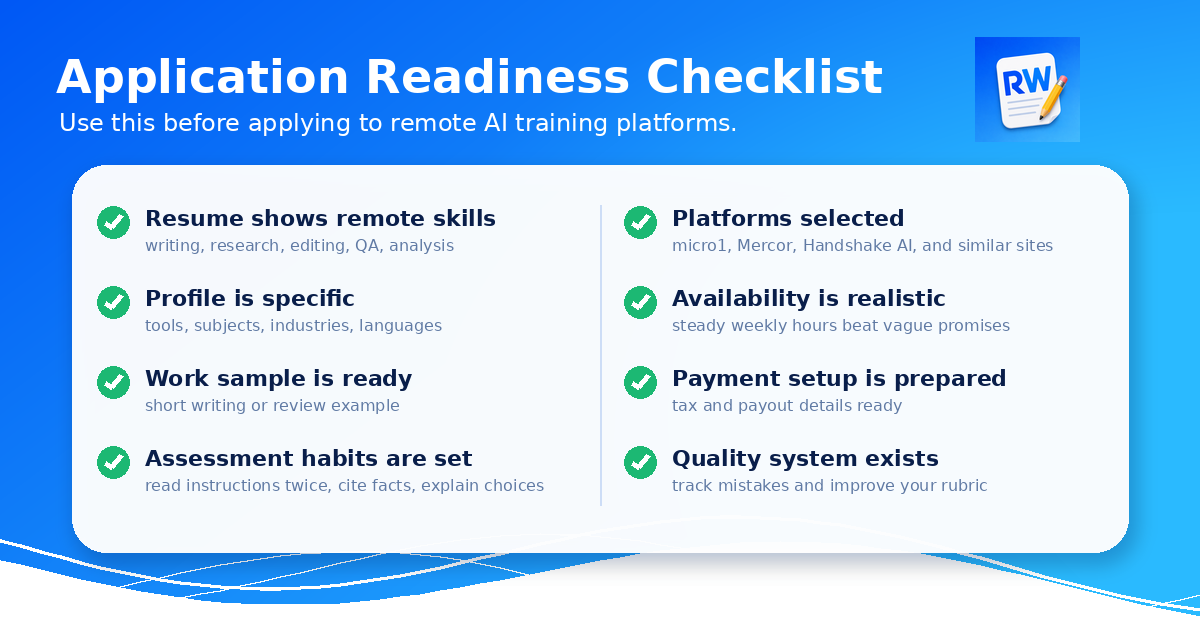
Start by choosing a few platforms instead of applying randomly to dozens. For many beginners, that may mean applying to micro1, Mercor, Handshake AI, and similar remote AI work platforms while also watching for AI evaluator, data annotation, content reviewer, and prompt writer roles on remote job boards. Keep a simple tracker with the platform name, date applied, role, test status, pay range if listed, and follow-up notes.
Before applying, prepare a short work sample. It does not need to be complicated. You can create a one-page sample where you compare two answers, identify factual problems, rewrite the weaker answer, and explain your decision. This shows the exact kind of judgment that remote AI training work often requires.
Update your resume for AI training keywords without stuffing it. Add a short summary that connects your background to remote AI evaluation. Include skills such as writing, editing, research, QA, analysis, fact-checking, rubric-based review, communication, domain expertise, and remote work discipline. If you have used tools like spreadsheets, document editors, project management software, research databases, ChatGPT, Claude, Gemini, or other AI tools, mention them only where relevant.
When you take an assessment, slow down. Read the instructions twice. If the task asks for a rating, understand the rating scale before answering. If the task asks for an explanation, write the shortest explanation that fully supports your decision. Do not fill space with generic language. Quality reviewers usually want evidence, not fluff.
Beginner, generalist, and expert paths
There are three common entry paths. The beginner path is for people who need simple, structured tasks and are still learning the standards. These may include labeling, simple comparison, content review, or basic response rating. The generalist path is for people who can evaluate many topics and write clear explanations. These roles may include AI evaluator jobs, prompt review, factuality checks, and response ranking. The expert path is for people with a strong professional domain, such as coding, law, medicine, finance, mathematics, science, or advanced writing.
You can move between paths over time. A beginner who builds a strong quality record may qualify for more complex work. A generalist who identifies a niche may become a subject matter expert. An expert who learns platform rules may gain access to higher-value projects paying $50–$200/hr. The mistake is trying to jump straight to the highest-paying role without proving the underlying skill.
The qualification scorecard
Use this quick scorecard before applying:
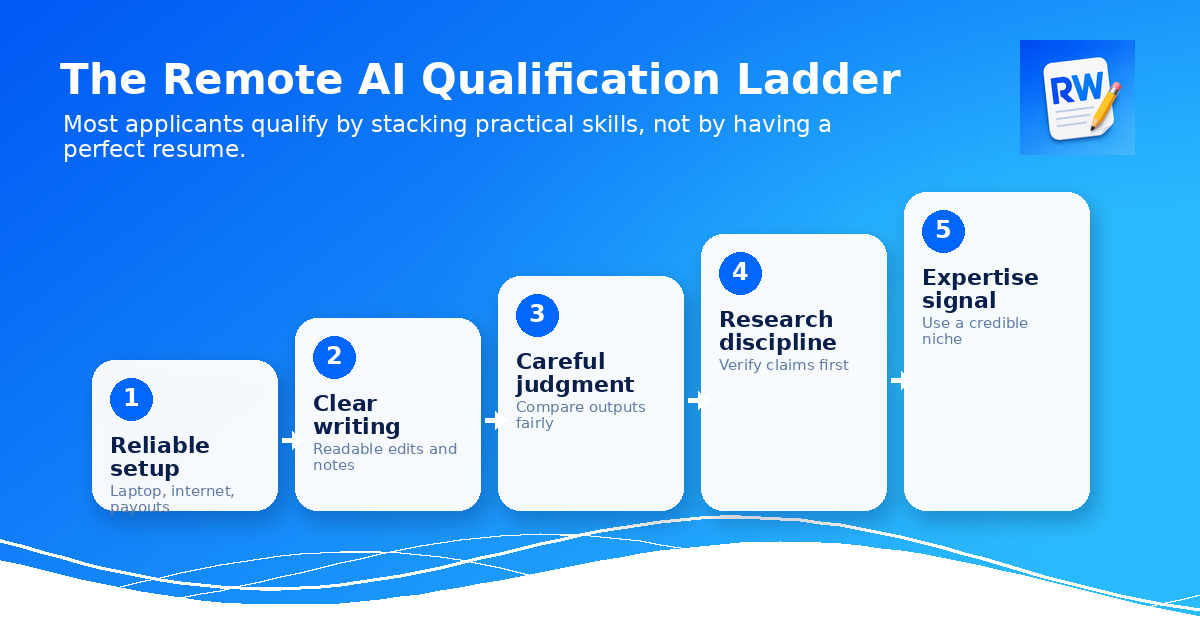
- Writing: Can you explain a decision clearly in three to five sentences?
- Accuracy: Do you check claims before accepting them?
- Judgment: Can you compare two answers without being distracted by style alone?
- Patience: Can you follow detailed instructions for repetitive tasks?
- Expertise: Do you have at least one field where your knowledge is stronger than average?
- Remote readiness: Do you have a reliable computer, internet connection, quiet work setup, and realistic availability?
- Application quality: Does your profile clearly show what kind of AI training work you fit?
If you answer yes to most of these, you may qualify for at least some form of remote AI training work. If you answer no to several, you may still qualify later. Improve the missing areas before applying to your best opportunities.
Frequently Asked Questions
Can I qualify with no experience?
Yes, sometimes. Beginner-friendly projects may test your ability directly. Your writing, attention to detail, and assessment performance may matter more than job history. Start with generalist evaluator or data annotation roles where judgment and clarity are the main requirements.
Can I qualify from outside the United States?
Sometimes. Availability depends on the platform, project, country, payment method, language needs, and client requirements. Some roles are US-only, while others hire worldwide. Check each platform's eligibility requirements before applying.
Can I use AI tools while applying?
Use caution. If a platform assessment tests your judgment, outsourcing the answer to an AI tool can backfire. You may use tools for drafting or checking your own work only when allowed, but your final answer should reflect your own reasoning and the platform rules.
Is remote AI training steady work?
It can be, but it is often project-based. Tasks may pause, move, or disappear. The safest strategy is to build profiles on multiple legitimate platforms such as micro1, Mercor, Handshake AI, and Outlier AI, and keep applying while maintaining quality.
What is the fastest way to know if I qualify?
Apply to a legitimate platform, take the assessment seriously, and compare your result to the type of tasks offered. The assessment is often the clearest signal. Platforms like micro1, Mercor, and Handshake AI all have structured screening that shows you where you stand.