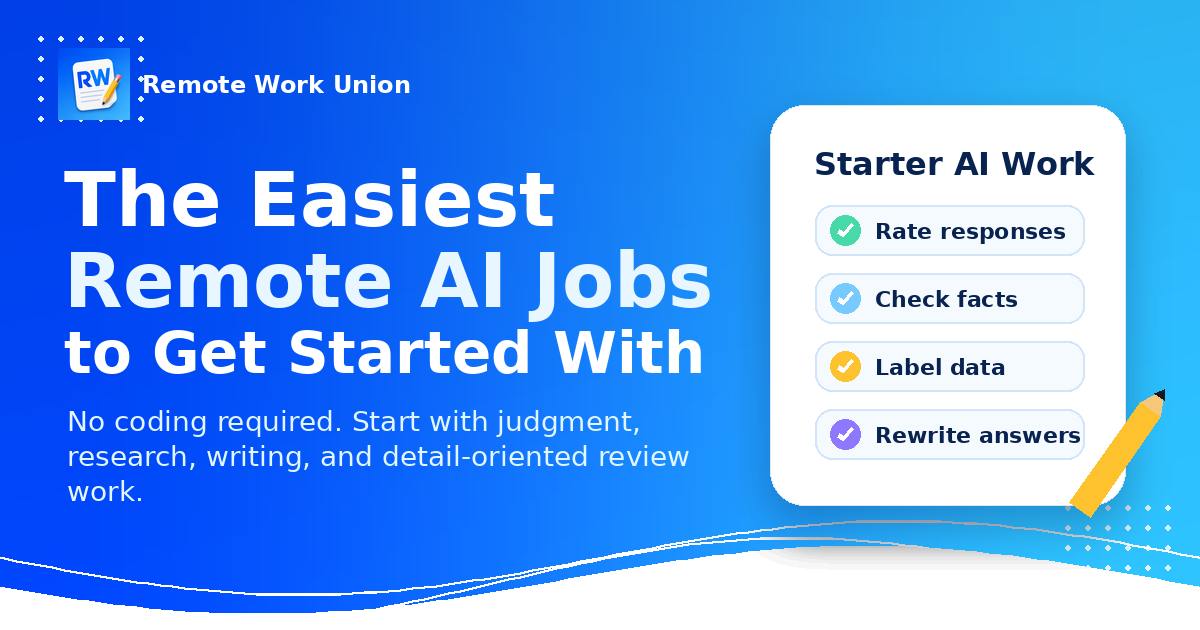
The easiest remote AI jobs are not always the highest-paying AI jobs, and they are not magic shortcuts. They are the roles with the lowest barrier to entry: work where a beginner can start by reading instructions, reviewing AI answers, labeling examples, checking facts, or writing short explanations from home.
That is why remote AI training work has become one of the most practical work from home categories for people who do not code. AI companies and AI platforms need human judgment. Models can generate answers, but humans still help decide whether those answers are useful, accurate, safe, well-written, and aligned with the instructions. That creates beginner-friendly jobs around AI data annotation, AI response evaluation, prompt testing, search quality review, AI content editing, and research-based feedback.
This guide breaks down the easiest remote AI jobs to get started with, what each role usually involves, who fits best, what skills to show on your profile, and how to apply without pretending to be an engineer. The goal is simple: understand where you can start, then build toward better remote AI work over time.
What makes a remote AI job easy to start?
Easy does not mean effortless. It means the job does not require a computer science degree, a large portfolio, a technical interview, or years of direct AI experience. The easiest remote AI jobs usually have clear guidelines, short task cycles, and work that depends on normal professional skills: reading carefully, writing clearly, judging quality, spotting mistakes, following rules, and explaining your reasoning.
A beginner-friendly AI role usually has five traits: it can be done from home, it does not require coding, it gives you examples or rubrics to follow, it rewards consistency, and it lets you use skills you already have. Those skills might come from customer service, teaching, marketing, writing, research, operations, legal support, finance, healthcare administration, sales, translation, social media, or general office work.
The easiest jobs are usually not labeled as "easy." They may be listed as AI trainer, AI evaluator, model response reviewer, data annotator, LLM evaluator, AI content reviewer, search quality rater, prompt evaluator, online research evaluator, or human feedback specialist. When you search for remote work jobs, use the role keywords rather than only searching for "easy AI job."
1. AI response evaluator
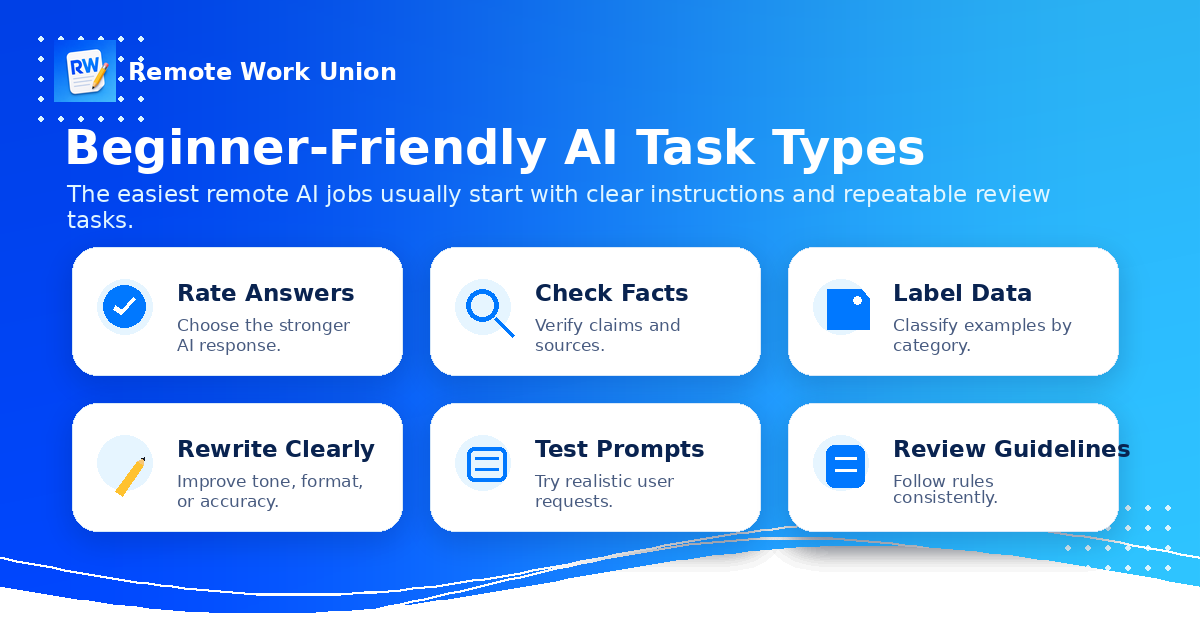
AI response evaluation is often the most approachable starting point. In this type of work, you read a prompt and one or more AI-generated answers. Your job is to decide which answer is better, whether the response followed the instructions, whether it was accurate, and how it could be improved.
Some tasks ask you to compare two answers side by side. Others ask you to score one answer across categories like helpfulness, truthfulness, clarity, completeness, tone, safety, or formatting. You may also write a short explanation explaining why one response is stronger than another.
This is beginner-friendly because it uses judgment more than technical expertise. If you can tell when an answer is vague, wrong, repetitive, off-topic, poorly organized, or missing the user's actual request, you already understand the core of the role.
Best fit: people who read carefully, write clearly, notice bad explanations, and can follow detailed instructions without rushing.
2. AI data annotation and labeling
AI data annotation is one of the most common entry points into remote AI work. Annotation means adding labels, categories, tags, corrections, or notes to data so an AI system can learn from it or be evaluated against it. The data might be text, search results, images, product listings, documents, audio clips, chatbot responses, or short conversations.
Beginner annotation tasks may ask you to label sentiment, classify user intent, mark whether a response is relevant, identify spam, categorize a question by topic, select the best tag, or highlight where an answer contains an error.
This is one of the easiest categories to start with because the work is structured. The platform often gives guidelines, examples, and quality checks. The difficult part is staying consistent. Two people might understand a label differently, so strong annotators learn to follow the rulebook instead of guessing from personal opinion.
Best fit: people who are detail-oriented, patient, consistent, and comfortable doing repeatable tasks accurately.
3. AI content reviewer or AI content editor
AI content review sits between writing, editing, and quality control. Instead of creating content from scratch all day, you review AI-generated writing and decide whether it is clear, useful, accurate, and appropriate for the request. Some jobs ask you to rewrite a weak response. Others ask you to flag problems and explain what should change.
This can include grammar cleanup, tone adjustment, formatting improvements, readability edits, instruction-following review, hallucination detection, citation review, and factual correction. For people with writing, copywriting, social media, marketing, customer support, communications, tutoring, or editing experience, this is usually easier to start than a technical AI role.
The best AI content reviewers do not just say "this sounds good." They can explain why a response works or fails. They notice when the answer is too generic, when it ignores part of the prompt, when it invents details, when it uses the wrong tone, or when it sounds polished but says very little.
Best fit: writers, editors, marketers, teachers, support reps, communications professionals, and anyone who can improve messy writing without changing the meaning.
4. Prompt testing and prompt writing
Prompt testing is beginner-friendly because it starts with a skill many people already use: asking clear questions. A prompt tester writes realistic requests, checks how an AI model responds, and reports whether the model handled the request well. A prompt writer may create examples that test specific skills, such as summarization, brainstorming, math reasoning, customer support, research, rewriting, or document analysis.
This is different from advanced prompt engineering. Beginner prompt work does not usually require building complex systems or coding. It is more about writing practical user requests and recognizing what a good answer should look like.
Prompt writing can be a strong entry point for generalists because every industry has realistic prompts. A former recruiter can test HR scenarios. A paralegal can test legal intake prompts. A sales rep can test prospecting prompts. A teacher can test lesson-plan prompts. A finance professional can test spreadsheet or budgeting prompts. Domain knowledge makes the prompt more realistic.
Best fit: people who can write clear instructions, imagine real user scenarios, and explain what a good answer should include.
5. Search quality evaluator and research rater
Search quality evaluation is another accessible remote AI job category, especially for people who like research. These roles usually ask you to judge whether search results, answers, snippets, citations, or webpages satisfy a user's intent. The work is closely related to fact-checking, online research, and relevance scoring.
A typical task might ask: does this source support the claim? Is this answer outdated? Did the AI cite a relevant page? Which search result best matches the query? Is the answer complete enough? Does the page come from a trustworthy source for the topic?
This role is beginner-friendly if you are careful and skeptical. You do not need to know everything. You need to know how to verify information, compare sources, detect weak evidence, and avoid accepting confident-sounding claims without support.
Best fit: researchers, students, editors, journalists, analysts, teachers, virtual assistants, and people who naturally double-check details.
No coding required. Beginner-friendly remote AI jobs are open now. Find roles that match your background.
Find Roles Hiring Now →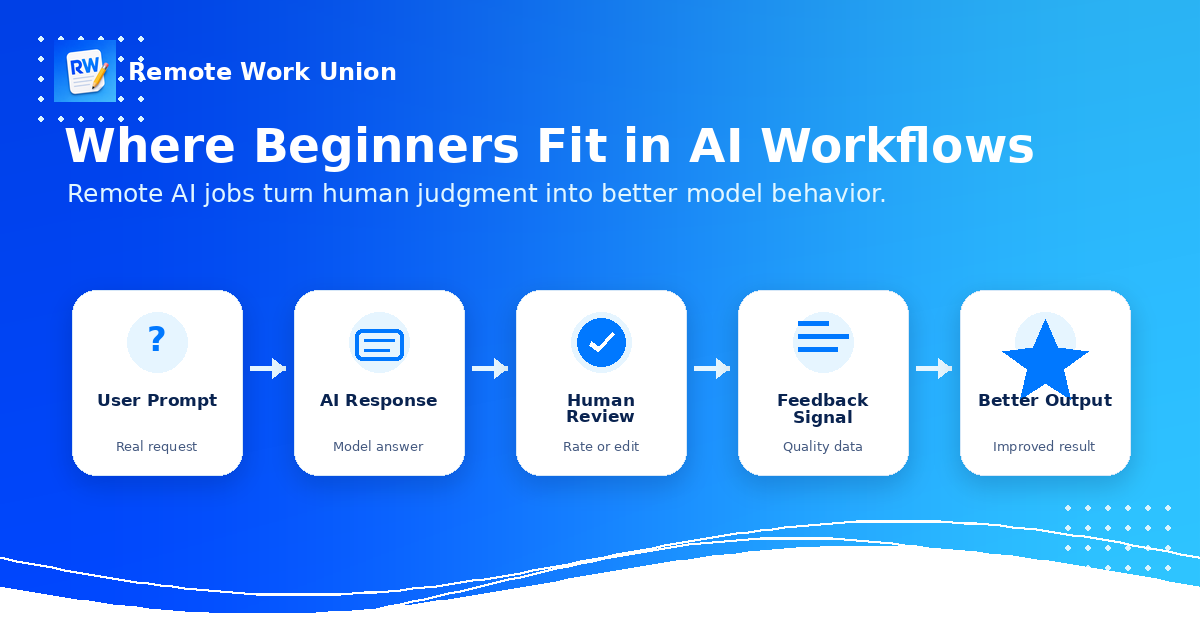
6. Voice, audio, and transcription review
Some remote AI jobs focus on voice data, audio quality, transcription accuracy, pronunciation, accents, conversational flow, and speech-to-text review. These can be beginner-friendly because the task is often concrete: listen to audio, compare it to text, mark errors, rate quality, or validate whether the transcription captures what was said.
Voice AI work may also involve checking whether a response sounds natural, whether the speaker followed instructions, whether background noise affects quality, or whether a transcript needs correction. Multilingual workers and people with strong English listening skills may see additional opportunities here.
Best fit: bilingual workers, transcription-minded workers, people with strong listening skills, and anyone who can stay precise while reviewing audio.
7. AI safety, policy, and guideline review
Some beginner AI jobs involve reviewing whether an AI response follows safety policies, platform rules, or content guidelines. This can include flagging harmful content, checking whether the model refused a prohibited request correctly, or deciding whether a response should be rewritten to be safer and more useful.
The easiest versions are rule-based: read the policy, compare the response against the policy, and select the correct label. This type of work rewards judgment, consistency, and the ability to separate personal opinion from the written guideline.
Best fit: people who can follow policy language closely, stay consistent, and make careful decisions without overreacting or under-reviewing.
Which remote AI job should a total beginner try first?
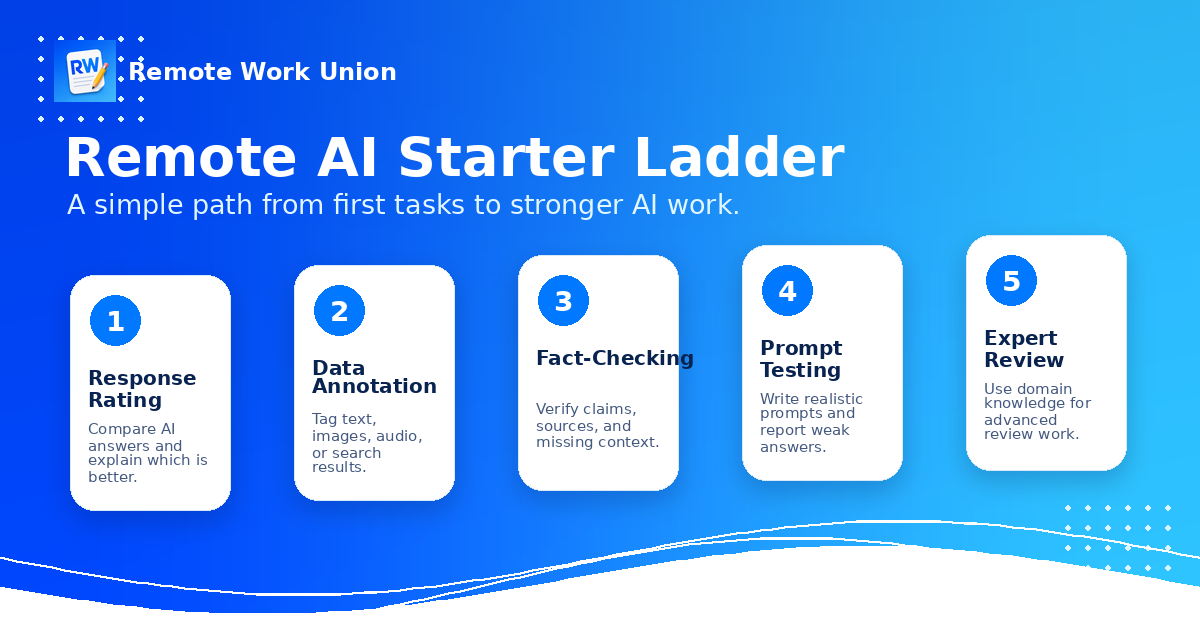
For most beginners, the easiest order is: AI response evaluator, data annotation, AI content reviewer, search quality evaluator, prompt tester, voice or transcription reviewer, then more specialized expert review. This is not a fixed career ladder, but it is a practical starting map.
If you are a strong writer, start with AI response evaluation, AI content editing, and prompt testing. If you are detail-oriented but do not want heavy writing, start with data annotation, labeling, or transcription review. If you like verifying information, start with search quality evaluation and fact-checking. If you have a professional background, use it. Subject matter expertise can move you from beginner tasks into better-paying review work faster.
Skills to put on your remote AI work profile
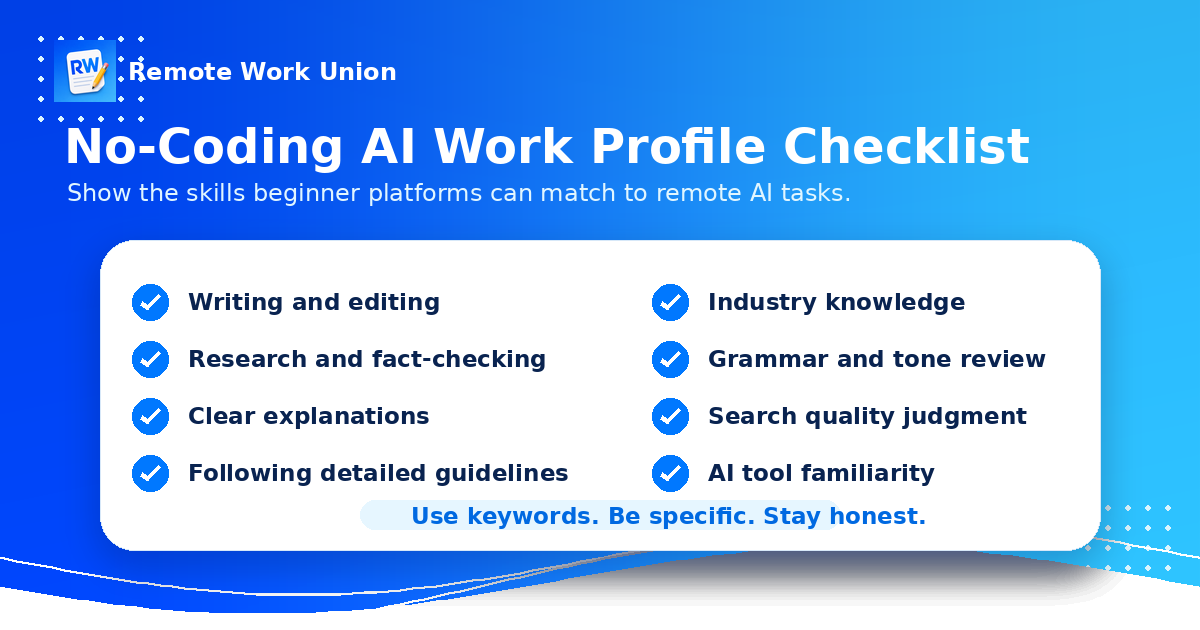
A beginner profile should be specific. Do not only say "hard worker" or "interested in AI." Use keywords that match the work: writing, editing, research, fact-checking, data annotation, AI response evaluation, prompt writing, quality assurance, grammar review, search evaluation, customer support, domain expertise, guideline adherence, and attention to detail.
A strong profile might say: "I have experience reviewing written work for clarity, accuracy, tone, and completeness. I am comfortable following detailed guidelines, comparing responses, fact-checking claims, and explaining why one answer is more useful than another. I am interested in remote AI training, model evaluation, data annotation, and AI content review tasks."
How to apply for beginner remote AI jobs
Start with a simple profile, not a perfect one. List your strongest skills, your industries, your languages, your writing ability, your research ability, and the kinds of tasks you want. Then apply across multiple legitimate platforms instead of waiting on one account.
When applying to platforms such as micro1, Mercor, Handshake AI, or similar remote AI work platforms, treat the application like a skills match. Upload a clean resume. Use relevant keywords. Take assessments seriously. Follow instructions exactly. Do not rush onboarding tasks. If a platform asks for a writing sample or reasoning explanation, make it clear, direct, and specific.
How to avoid fake "easy AI job" scams
Legitimate remote AI work should not require you to pay a startup fee to begin. Be cautious with any listing that promises guaranteed income, demands payment for access, asks for banking information before there is a real contract, uses vague company names, or pressures you to move the conversation to an unprofessional channel.
A real remote AI job or platform may ask you to complete assessments, verify your identity, sign contractor paperwork, or wait for project matching. That can be frustrating, but it is normal. Paying for a "secret list" of jobs or giving private information to a random recruiter is not normal.
A simple 7-day plan to get started
Day 1: Choose three role types from this article that fit your skills. Day 2: Update your resume and profile with relevant keywords. Day 3: Create or clean up your professional email, LinkedIn, and work samples. Day 4: Apply to multiple platforms and keep a spreadsheet with platform name, role, date applied, status, assessment, and follow-up notes. Day 5: Practice response evaluation — take any AI answer and write three bullets: what is correct, what is missing, and what should be improved. Day 6: Practice fact-checking — pick a claim, verify it against reliable sources, and write a short explanation of whether the evidence supports it. Day 7: Review your results and apply again. Remote AI work often depends on timing. If one platform has no projects, another may have active tasks.
Final takeaway
The easiest remote AI jobs to get started with are usually not engineering jobs. They are human judgment jobs. AI response evaluation, data annotation, AI content review, prompt testing, search quality rating, transcription review, and guideline-based safety review all give beginners a realistic way to enter remote AI work without coding.
The best starting point is the one that matches skills you already have. Writers should lean into editing, response review, and prompt work. Detail-oriented workers should look at annotation and quality review. Researchers should look at search evaluation and fact-checking. Professionals with subject matter expertise should use that background to qualify for higher-level review tasks over time.
Start simple, apply widely, avoid scams, and build consistency. The first remote AI job does not have to be perfect. It only has to get you into the workflow, prove you can do the work, and help you move toward better opportunities.
Frequently Asked Questions
Do I need coding experience to get started with remote AI jobs?
No. Many beginner remote AI jobs — including AI response evaluation, data annotation, content review, prompt testing, and search quality rating — do not require coding. These roles reward reading, writing, judgment, and the ability to follow detailed guidelines.
How long does it take to get accepted to a remote AI job?
Timelines vary by platform. Some platforms offer quick assessments and accept applicants within days. Others involve multiple steps including profile review, skill tests, and project matching that can take weeks. Applying to multiple platforms improves your chances of getting started faster.
What is the pay range for beginner remote AI jobs?
Beginner tasks often pay in the range of $15–$40 per hour depending on the platform, project, country, and task complexity. Higher-skill roles involving domain expertise can pay $50–$200 per hour. Entry-level annotation work may be lower.
Is it safe to apply to remote AI platforms online?
Legitimate platforms do not charge application fees, ask for bank details upfront, or guarantee income before you start. Be cautious with any listing that pressures payment, uses only messaging apps, or has vague company information.