Ready to apply for AI training and remote work roles? Apply through Remote Work Union.
Find Roles Hiring Now →Mercor interviews can feel different from a normal hiring call because the first screening step is often an AI interviewer. There may not be a recruiter smiling back at you, there may not be small talk, and there may not be much feedback in the moment. But the core challenge is familiar: you need to prove that your background, communication style, and judgment fit the role you applied for.
For people looking for remote AI jobs, work from home AI training, data annotation jobs, AI model evaluation work, or LLM evaluation projects, the Mercor AI interview is not just a formality. It is one of the signals used to decide whether you are a credible fit for remote contract work with companies building and evaluating advanced AI systems. That may include projects connected to large language models, coding models, reasoning systems, medical AI, legal AI, finance AI, education tools, research workflows, and AI products from major companies such as OpenAI, Anthropic, Google, Meta, Microsoft, Amazon, Apple, NVIDIA, xAI, Perplexity, and other AI labs or enterprise teams.
The biggest mistake applicants make is treating the interview like a generic personality test. The better approach is to treat it like a structured expert screen. The system is trying to learn whether you can explain your experience clearly, reason through realistic work, evaluate quality, follow instructions, and be trusted with remote AI work that may involve sensitive prompts, model outputs, rubrics, or domain-specific review.
What the Mercor AI Interview Is Really Testing
The word pass can be misleading. You are not trying to trick the interview. You are trying to produce enough clear, relevant signal that a matching system or hiring team can confidently understand where you fit. The interview is usually built around a combination of your resume, the role description, your claimed skills, your domain background, and the kind of project the client needs staffed.
A strong interview response usually proves five things at once. First, you actually have the experience listed on your resume. Second, you can explain that experience without rambling. Third, you understand what high-quality work looks like in your field. Fourth, you can make judgments, not just repeat definitions. Fifth, you can communicate in a way that would be useful on a remote AI project where instructions, rubrics, Slack updates, task notes, and written explanations matter.
Think of the interview as a bridge between your profile and a real project. A resume can say attorney, teacher, software engineer, financial analyst, nurse, editor, PhD researcher, product manager, marketer, designer, accountant, or operations leader. The interview helps show whether you can turn that title into useful AI training work: rating answers, writing examples, finding model mistakes, explaining better reasoning, editing model responses, or creating realistic scenarios that teach AI systems how experts think.
Step One: Fix the Profile Before You Worry About the Interview
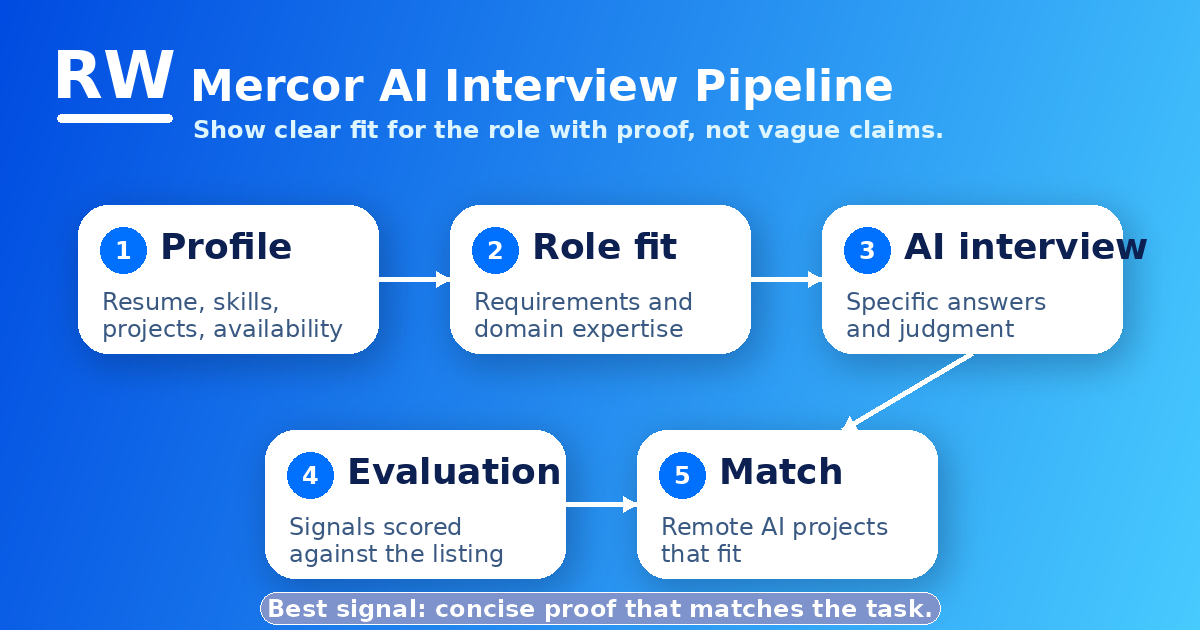
A clean Mercor profile makes the AI interview easier because the questions and matching signals have better information to work from. Before interviewing, update your resume, profile, skills, projects, and availability so they all tell one consistent story.
Your resume should not be a long list of duties. It should show outcomes. Instead of saying responsible for legal research, write something closer to conducted legal research for employment litigation matters, summarized case law for attorneys, and prepared issue-specific memos under deadline. Instead of saying used Excel, write built Excel models to track revenue, churn, inventory, budgets, claims, invoices, or campaign performance. Instead of saying wrote content, write edited long-form technical articles, built content briefs, evaluated factual accuracy, and maintained voice across client deliverables.
Remote AI work rewards specificity. A vague profile makes you look replaceable. A precise profile makes you easier to match. If you are a teacher, state grade levels, subjects, curriculum experience, assessment design, tutoring, rubric creation, and feedback style. If you are in finance, state valuation, FP&A, accounting, equity research, financial modeling, auditing, tax, or compliance experience. If you are a lawyer, state practice areas, document types, research tools, drafting experience, and jurisdictions when appropriate. If you code, state languages, frameworks, review experience, testing habits, and whether you can explain technical decisions clearly.
Do not stuff your profile with every AI keyword you can find. A profile that says you are an expert in everything looks less credible. It is better to build a focused keyword map: AI training, AI model evaluation, LLM evaluation, data annotation, prompt evaluation, rubric writing, factuality review, technical writing, domain expert review, remote contract work, and the specific field you are strongest in.
The Best Answer Format for the AI Interview
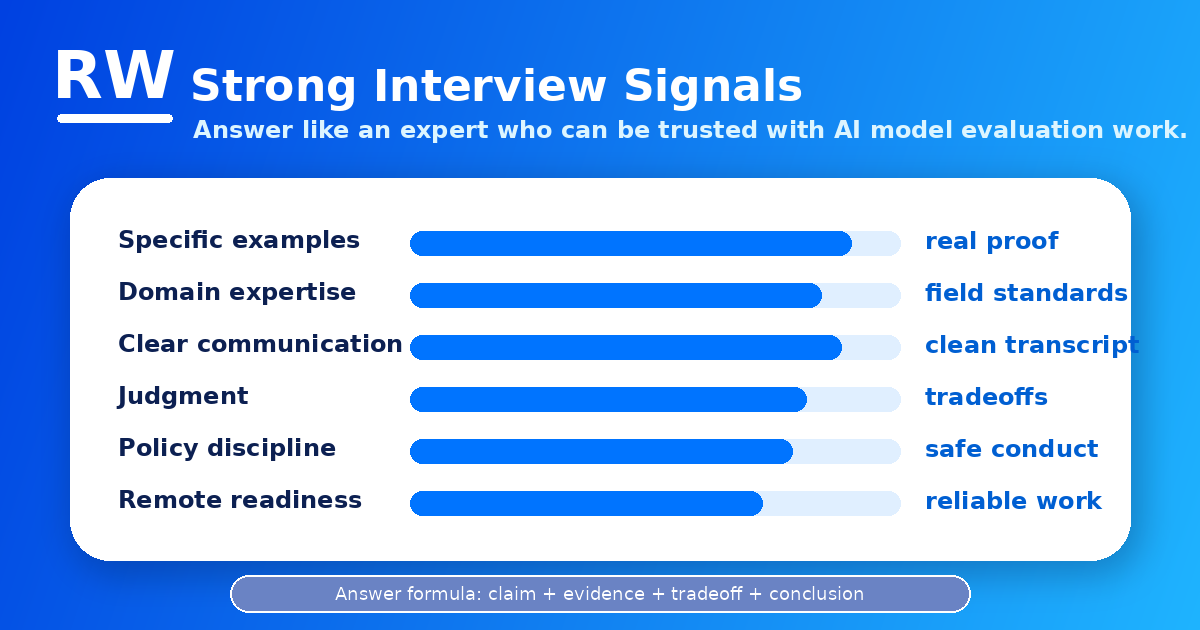
A good Mercor interview answer is short enough to be easy to evaluate and detailed enough to prove expertise. A useful structure is: direct answer, evidence, tradeoff, and conclusion.
Start with the direct answer. If asked how you would evaluate a model response, say the main criteria first. For example: I would first check whether the answer is factually correct, then whether it follows the instructions, then whether the reasoning is complete and appropriate for the audience.
Then give evidence. Tie your answer to a real example from your background. For example: In my last role, I reviewed client-facing research summaries, so I had to separate confident claims from claims that needed sourcing. When an answer sounded plausible but lacked support, I would flag it, verify the underlying source, and rewrite it with clearer caveats.
Then mention a tradeoff. AI evaluation work often involves judgment. The strongest applicants can explain how they handle ambiguity. For example: I would not mark an answer down just because it uses different wording than I would use, but I would mark it down if it changes the meaning, skips a required constraint, or presents uncertainty as fact.
Finally, close the loop. A good conclusion sounds like: So my review would focus on accuracy, instruction following, reasoning quality, and whether the final response would actually help the user.
Examples of Strong Mercor Interview Answers
For a writing or editing role, weak answers often sound like: I am a strong writer and I pay attention to detail. A better answer is: I evaluate writing in layers. First I check whether the response answers the prompt. Then I check factual accuracy and sourcing. Then I look at structure, clarity, tone, and whether the final version removes ambiguity. In my previous work editing long-form articles, I often had to preserve a client voice while cutting unsupported claims, so I am comfortable improving quality without rewriting everything unnecessarily.
For a coding or technical role, a weak answer is: I know Python and JavaScript and can debug code. A stronger answer is: When reviewing code, I first identify the intended behavior, then check edge cases, error handling, performance, and readability. If an AI-generated solution passes the obvious case but fails on null inputs, large inputs, or ambiguous requirements, I would flag that. I try to explain the problem in a way another engineer could act on quickly, not just say the code is wrong.
For a legal role, a weak answer is: I can review legal documents. A stronger answer is: I would evaluate whether the response correctly identifies the legal issue, states the governing standard at the right level of certainty, distinguishes facts from assumptions, and avoids giving overconfident advice where jurisdiction or facts are missing.
For a healthcare or science role, a weak answer is: I know medical terminology. A stronger answer is: I would check whether the answer uses accurate terminology, avoids unsupported diagnosis or treatment claims, distinguishes patient education from clinical instruction, and communicates risk appropriately. If a model gives confident guidance without enough context, I would flag it and rewrite the response to encourage appropriate professional evaluation.
What to Prepare Before the Interview
Prepare five evidence stories. These should be short examples from your work or education that show expertise, judgment, communication, reliability, and problem solving. Keep each one under a minute. A strong evidence story has four parts: the situation, the task, the action, and the result.
Also prepare domain-specific terms. If you are applying for AI training jobs in your field, you should be able to explain the standards that matter in that field. Writers should talk about factuality, tone, structure, concision, citations, and audience fit. Lawyers should talk about jurisdiction, facts, standards, caveats, and document type. Finance professionals should talk about assumptions, valuation methods, model sensitivity, accounting treatment, and risk. Educators should talk about scaffolding, assessment, age level, feedback, rubrics, and learning objectives.
Finally, prepare your remote work logistics. If you can start immediately, say that. If you have 10, 20, 30, or 40 hours per week available, say that clearly. Matching systems cannot use vague availability as easily as clear availability.
How to Sound Natural Without Rambling
AI interviews punish two opposite mistakes: answers that are too thin and answers that wander. Aim for 45 to 90 seconds on normal questions. Use signposts: say there are three things I would check, or my answer is yes but with one caveat, or I would handle this in two steps. These phrases help the transcript read cleanly.
Do not chase perfect wording. A remote AI evaluator does not need to sound like a motivational speaker. You need to sound precise, calm, and useful. If you make a small wording mistake, correct it once and continue.
Use AI Tools for Preparation, Not for Fake Answers
It is reasonable to use ChatGPT, Claude, Gemini, Grok, or another AI assistant before the interview to practice. You can ask for mock questions, turn your resume into practice prompts, or rehearse concise answers.
During the official interview, do not try to feed the question into another AI tool and read back a generated answer. That creates generic responses, slows you down, and can violate platform expectations. More importantly, it removes the one thing that makes you valuable: your actual expertise. The best AI training contractors are not people who can copy an LLM. They are people who can judge an LLM.
Technical Setup Matters More Than Applicants Think
Before the interview, test your microphone, camera, headphones, internet connection, and browser permissions. Use a laptop or desktop. Sit in a quiet place. Keep your face visible if video is required. Close unnecessary tabs and notifications. If screen sharing is required, prepare for full-screen sharing and remove anything private from view.
The reason is simple: your interview must be captured and evaluated. If the transcript is full of missing words, interruptions, background noise, or long silent gaps, the signal becomes weaker.
Common Mistakes That Reduce Your Match Rate
The first mistake is overclaiming. If you say you are an expert in legal, medical, coding, finance, marketing, education, research, and operations, the system has no clear reason to believe you.
The second mistake is answering with opinions instead of criteria. AI model evaluation work depends on standards. Instead of saying I would choose the better answer, explain what better means: more accurate, more complete, more aligned with the prompt, safer, clearer, better sourced.
The third mistake is ignoring the role description. If the listing is for AI data annotation, talk about labeling consistency, edge cases, ambiguity, instructions, and quality control. If it is for domain expert review, talk about the exact field and how expert judgment changes the evaluation.
The fourth mistake is being too casual about remote work. A project may be flexible, but that does not mean informal. Companies need people who can follow written instructions, meet deadlines, communicate when blocked, protect confidential information, and produce consistent work without constant supervision.
The fifth mistake is giving confidential examples. Do not disclose private client data, proprietary documents, patient details, legal client facts, internal company information, or anything you were not allowed to share. Use generalized examples.
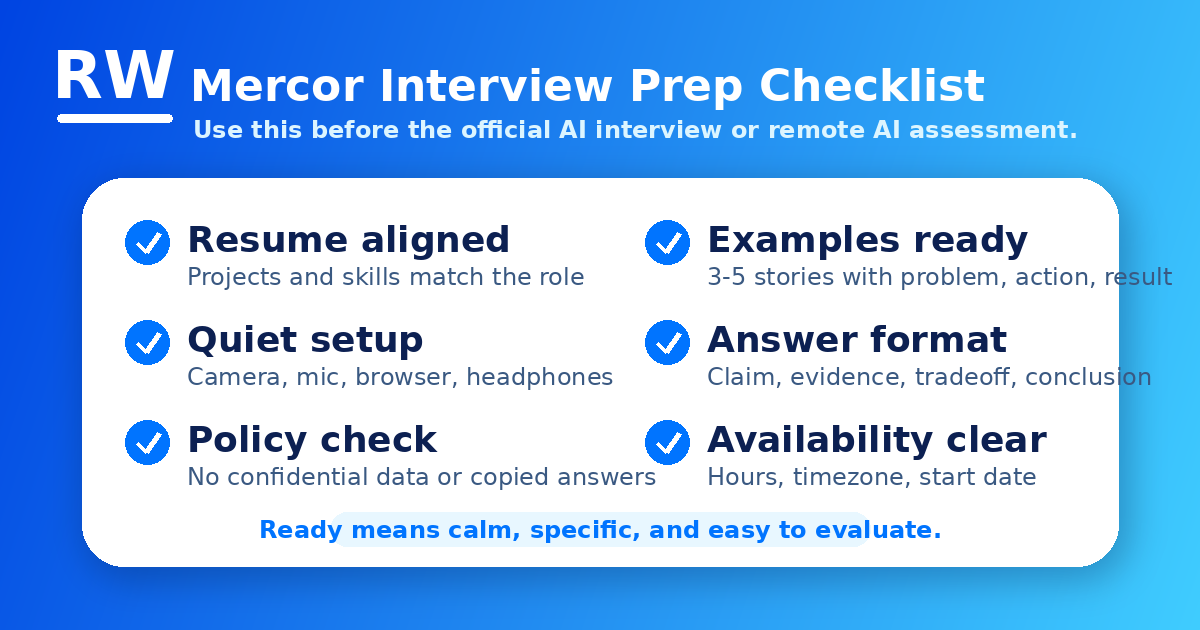
How to Improve Your Chances of Getting Matched After the Interview
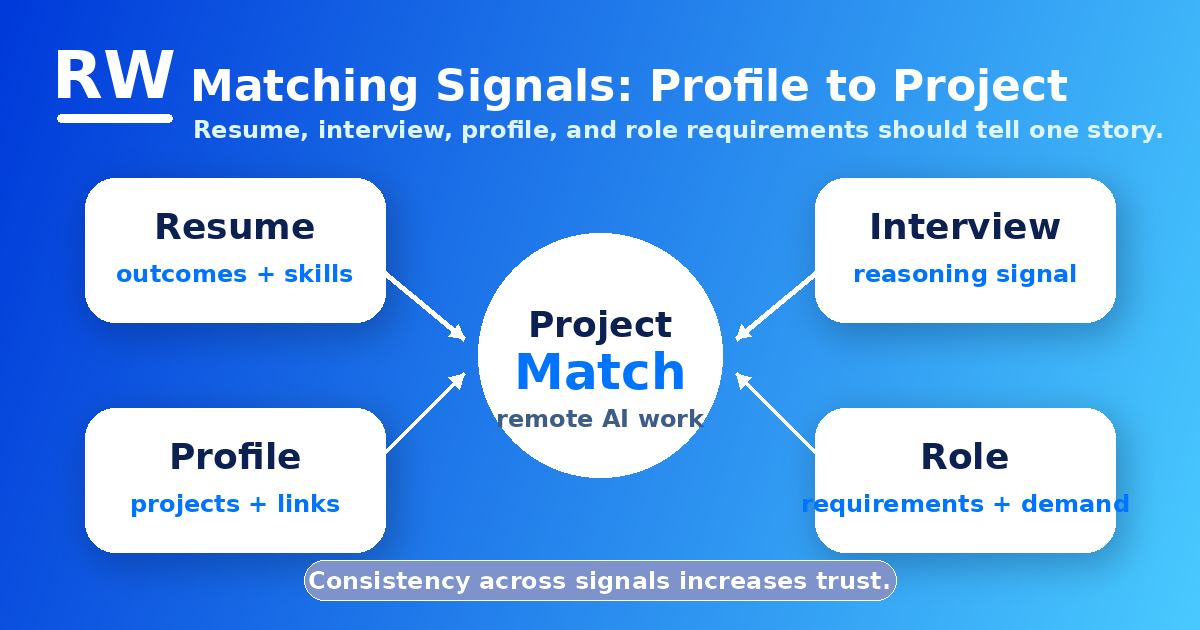
After the interview, keep applying to roles that match your strongest evidence. Do not apply randomly to every role just because it is remote. The best match is usually where your background, resume, interview answers, and role requirements all reinforce each other.
Update your profile when your skills change. Add a stronger project description. Clarify your weekly availability. Add a clean LinkedIn or GitHub if relevant. Remove stale or exaggerated claims. A complete profile is easier to match than a profile that forces reviewers to guess.
Think in role clusters. A strong English writer might apply to AI content editor, writing evaluator, generalist expert, LLM response reviewer, prompt evaluator, and remote AI training jobs that require clear written judgment. A finance professional might apply to financial analyst, accounting expert, investment research, valuation, business analyst, or domain-specific AI evaluation roles.
A Practical Prep Script You Can Use
Before the interview, write a one-page prep sheet. Include your target role cluster, five proof stories, your top skills, your best project examples, your availability, and three standards you use to judge quality in your field.
For example, a writer might write: I am best matched for writing evaluation, AI content editing, model response review, factuality checking, and prompt work. My proof stories are: editing long-form articles, building content briefs, fact-checking claims, adapting tone for different audiences, and meeting weekly publication deadlines. My quality standards are factual accuracy, instruction following, clarity, and usefulness.
This prep sheet keeps your interview consistent. You are not trying to memorize a speech. You are giving yourself a clear map so your answers do not drift.
How to Handle Difficult Questions
If the AI interviewer asks something outside your exact experience, do not pretend. A strong answer can say: I have not done that exact task, but here is the closest relevant experience and how I would approach it.
If the question is ambiguous, say how you interpret it: I am interpreting this as a question about evaluating factual accuracy rather than style. If you mean something different, I would adjust my answer.
If you are asked to evaluate a scenario, explain your criteria before your conclusion. For AI model evaluation work, the reasoning often matters as much as the final answer.
What a Good Final Impression Sounds Like
At the end of the interview, your goal is to leave a simple impression: this person has relevant expertise, communicates clearly, can follow instructions, and is ready for remote AI work.
A good closing answer might sound like: I am most interested in remote AI training and model evaluation work where my background in writing, research, and structured feedback can be useful. I am comfortable reviewing outputs against rubrics, explaining why one response is stronger than another, and working independently with clear deadlines. I am especially interested in projects that require careful judgment rather than simple data entry.
Bottom Line
To pass the Mercor AI interview, do not focus on sounding impressive in the abstract. Focus on being easy to match. Build a precise profile. Apply to roles that fit your real background. Prepare specific examples. Answer with structure. Show how you evaluate quality. Keep your remote work availability clear. Use AI tools to practice, not to fake expertise. Protect confidential information. Make every signal point toward the type of remote AI job you actually want.