AI trainer interviews can sound more technical than they really are. A lot of people hear "AI training job" and assume they need to understand machine learning, write code, or have years of experience working inside an AI lab. That is not usually what these interviews are testing.
For many remote AI training jobs, the interview is testing whether you can think clearly, follow instructions, compare two answers, explain your reasoning, and use your real-world experience to make an AI system better. That matters whether your background is writing, marketing, finance, law, education, engineering, healthcare, sales, accounting, creative work, consulting, research, or operations.
The core skill is judgment. AI companies and AI training platforms need humans who can tell when a model answer is accurate, helpful, incomplete, vague, overconfident, biased, unsafe, or just not useful. That is why people with non-technical backgrounds can still be strong candidates for remote AI trainer roles, AI evaluator jobs, AI research tasks, expert review projects, and online jobs from home that involve model response ranking.
If you have no AI experience, your goal is not to pretend you are an AI engineer. Your goal is to prove that you can review information carefully and communicate your feedback in a way the system can learn from.
What an AI Trainer Interview Is Actually Testing
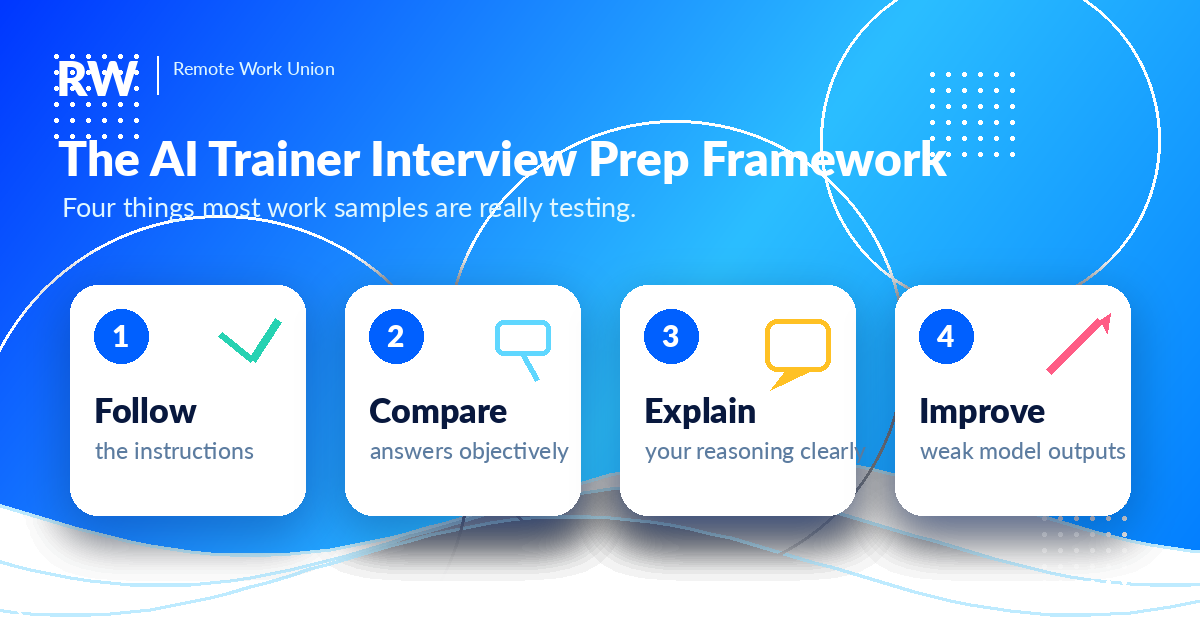
Most AI trainer interviews are not trying to trick you with deep technical questions. They are usually looking for a few practical signals.
First, they want to see if you can follow instructions. In AI training work, the rubric matters. If a task says to rank based on factual accuracy, you should not rank based on which answer sounds friendlier. If a task says to prioritize safety, you should not ignore a risky claim because the answer is well-written. A candidate who follows the instructions closely is more valuable than a candidate who tries to be clever.
Second, they want to see if you can compare answers objectively. Many AI trainer tasks show you a prompt and two model responses. Your job is to decide which response is better and explain why. The strongest candidates do not just say, "Answer A is better." They explain the specific reason: Answer A is more accurate, answers the full question, avoids unsupported claims, gives clearer steps, or better matches the user's intent.
Third, they want to see if you can write short, useful explanations. AI training is not a place for vague feedback. "This is good" is not useful. "This response is better because it directly answers the user's question, avoids inventing numbers, and gives a safer recommendation" is useful. The difference matters.
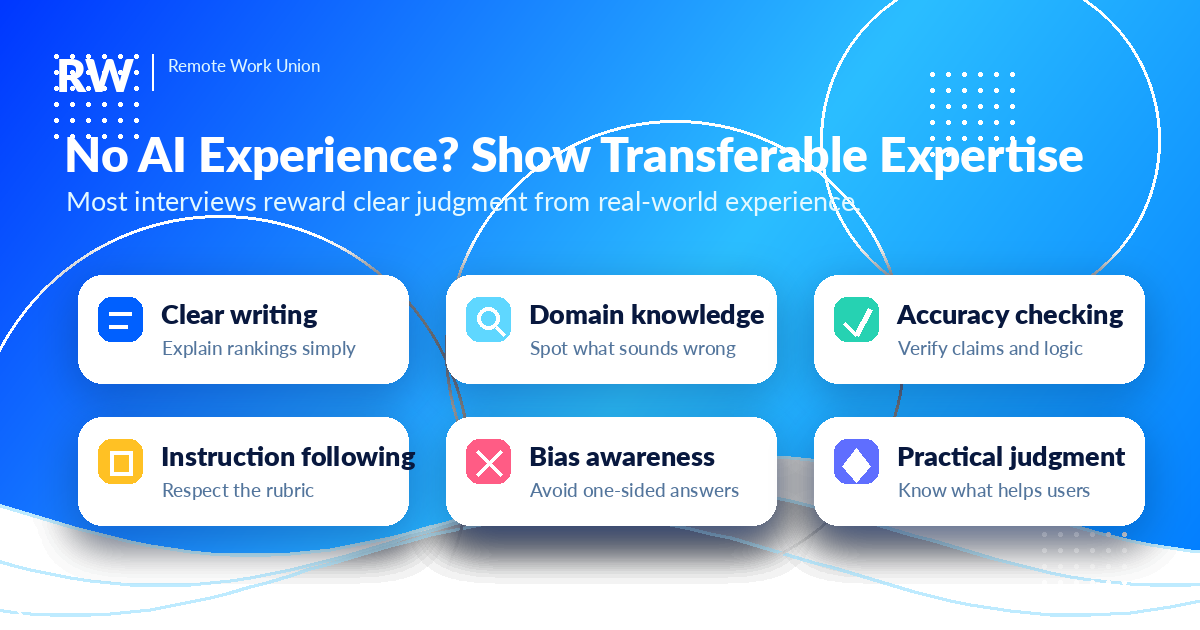
Fourth, they want to see if your real-world knowledge transfers. A lawyer may be asked to review legal reasoning. A finance professional may be asked to judge an answer about accounting, investing, or business analysis. A marketer may be asked to evaluate ad copy, content strategy, customer segmentation, or brand positioning. A teacher may be asked to judge whether an explanation is age-appropriate and clear. A writer may be asked to compare tone, structure, clarity, and originality.
That is the real opportunity. You do not need to enter the interview as an AI expert. You need to enter as a reliable human reviewer.
The Main Types of AI Trainer Interview Tasks
Every platform has its own process, but most AI trainer interviews and work samples fit into a few categories.
1. The Response Comparison Task
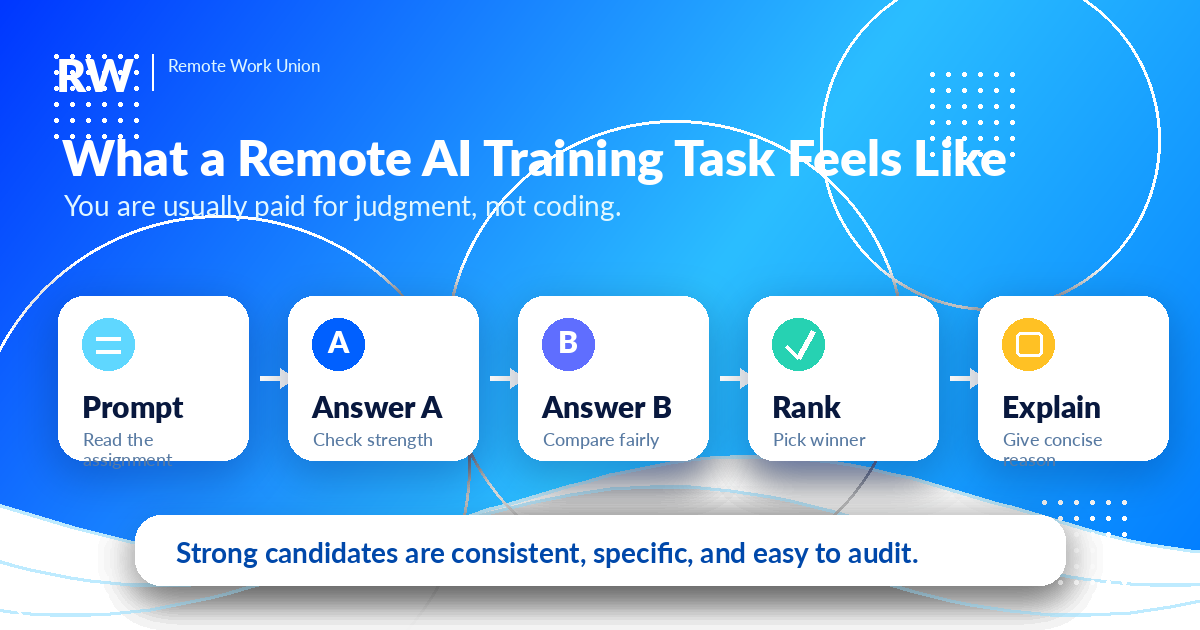
This is the classic AI training work sample. You get a user prompt and two AI-generated answers. You choose which answer is better, then explain your decision.
The mistake most beginners make is picking the answer that sounds smoother. Smooth writing is only one factor. A polished answer can still be wrong. A shorter answer can sometimes be better if it follows the prompt more precisely. The best way to approach this task is to compare accuracy first, then completeness, then clarity, then usefulness.
A strong explanation might sound like this:
That kind of explanation shows judgment.
2. The Rewrite or Improvement Task
Some interviews ask you to improve a weak model answer. This tests whether you can turn feedback into a better output.
A good rewrite should not just be longer. It should be more accurate, more useful, better structured, and more aligned with the user's intent. If the original answer is too vague, add specifics. If it is too confident, add nuance. If it misses the question, bring it back to the actual prompt.
3. The Domain Expertise Screen
For expert AI training jobs, the platform may ask about your background. This is where writers, marketers, lawyers, finance professionals, engineers, accountants, sales leaders, teachers, healthcare workers, and creatives can stand out.
The goal is to show that you have enough real-world experience to judge the quality of answers in your field. You do not need to oversell yourself. Be specific. Mention the work you have done, the tools you know, the types of decisions you have made, and the kind of content or analysis you are comfortable reviewing.
For example, a marketer should not just say, "I have marketing experience." A stronger answer is: "I have experience creating short-form content, writing ad copy, building social media campaigns, reviewing landing pages, and evaluating whether messaging matches a target customer."
4. The Timed Work Sample
Some remote AI jobs use a timed assessment. This is where preparation matters. Candidates often fail because they write too much, overthink the task, or spend too long trying to make the perfect answer.
In a timed task, your goal is to be clear, consistent, and complete enough. You do not need to write an essay. You need to make a defensible decision and explain it cleanly.
A good target is usually three to six sentences for a comparison explanation unless the instructions ask for more.
5. The Interview Conversation
Some platforms or companies may add a short interview after the work sample. This can feel intimidating, but the questions are usually practical. They may ask why you are interested in AI training, what areas you know best, how you would handle ambiguous instructions, or how you decide whether one answer is better than another.
The safest answer style is direct and grounded. Do not try to sound technical just for the sake of it. Talk about your process.
How to Prepare if You Have No AI Experience
The best preparation is simple: learn the task language, practice ranking answers, and build a repeatable review process.
Step 1: Learn the Basic Language of AI Training Work
You do not need to become a machine learning researcher. You should understand the terms that appear in job descriptions and interviews.
An AI trainer is usually someone who helps improve model outputs by reviewing, ranking, rewriting, labeling, or evaluating responses. AI model evaluation means judging how well an AI answer performs against a prompt or rubric. Response ranking means comparing multiple AI answers and deciding which is better. Prompt writing means creating or improving the instructions given to an AI model. Expert review means using your professional background to judge whether an answer is accurate and useful.
Some listings may use terms like RLHF, data annotation, AI evaluator, AI rater, LLM evaluator, AI research assistant, model response reviewer, or human feedback specialist. These labels vary, but the work often comes back to the same question: can you help an AI system produce better answers?
Step 2: Build a Personal Rubric
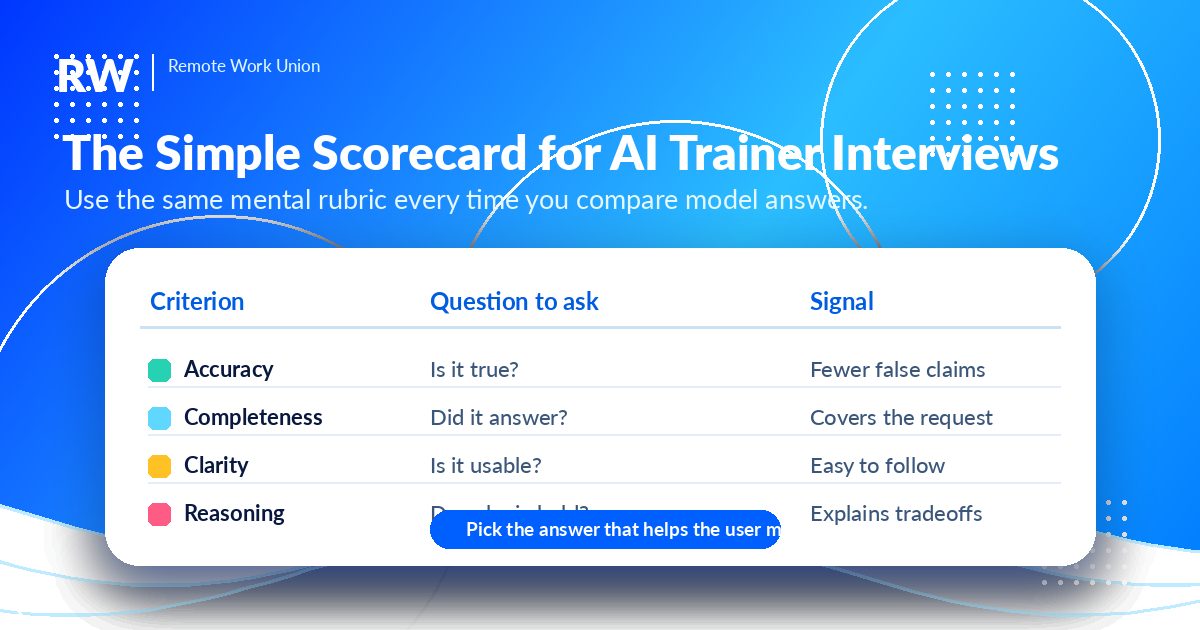
Before the interview, create a simple scorecard you can use in your head. The easiest version is:
- Accuracy: Is the answer true?
- Completeness: Did it answer the full question?
- Relevance: Did it follow the user's intent?
- Clarity: Is it easy to understand?
- Usefulness: Would this actually help the user?
- Safety: Does it avoid harmful, reckless, or misleading advice?
This rubric keeps you from getting distracted by surface-level polish. It also gives you language for your explanations.
Instead of saying, "Answer A is better," you can say, "Answer A is better because it is more complete and directly addresses the user's constraints, while Answer B gives generic advice and misses the main question."
That is the difference between an average candidate and a strong one.
Step 3: Practice Comparing Two Answers
You can practice without any special software. Take a common question in your field and write two possible answers. Make one answer polished but incomplete. Make the other answer slightly less polished but more accurate. Then practice deciding which one is better and explaining why.
For example, if you are a finance professional, compare two answers to a budgeting question. If you are a marketer, compare two answers about a social media campaign. If you are a lawyer, compare two answers about a general legal concept. If you are a teacher, compare two explanations of the same topic for a beginner.
The point is not to memorize answers. The point is to train your judgment.
Step 4: Practice Concise Explanations
A lot of candidates write explanations that are too long. Long does not mean better. AI training feedback should be specific and efficient.
A useful formula is: Winner + reason + flaw in the weaker answer.
Example: "Response A is stronger because it answers the user's question directly, gives specific steps, and avoids making unsupported claims. Response B is easier to read, but it misses the user's main constraint and includes advice that is too generic."
That is enough for many tasks. It is clear, comparative, and specific.
Step 5: Refresh Your Real-World Expertise
If you are applying for a general AI trainer role, focus on reasoning, writing, and instruction following. If you are applying for an expert AI training role, refresh the basics of your field.
Writers should review tone, structure, grammar, originality, audience fit, and editing principles. Marketers should review positioning, funnels, ad copy, SEO, content strategy, conversion basics, and customer psychology. Sales professionals should review objections, discovery questions, lead qualification, and outreach quality. Finance and accounting professionals should review financial statements, basic modeling, budgeting, tax concepts, and investment risk language. Lawyers should review legal reasoning, jurisdiction limits, clarity, and how to avoid overconfident legal conclusions. Engineers should review technical accuracy, step-by-step logic, edge cases, and whether an explanation would actually work.
You do not need to relearn your entire profession. You need to be sharp enough to spot weak answers.
Step 6: Prepare Proof That You Can Work Remotely
Remote AI jobs often require independent work. The platform may not care whether you have managed an AI team, but it will care whether you can work carefully without constant supervision.
Prepare examples that show you can write clearly, meet deadlines, follow instructions, review details, work from home, and handle feedback. This can come from freelance work, full-time work, school, consulting, content creation, research, customer support, operations, or business experience.
If you have a portfolio, resume, LinkedIn profile, writing samples, GitHub, website, case studies, published work, or professional credentials, make sure they are clean and easy to understand.
How to Answer Common AI Trainer Interview Questions
"Why Are You Interested in AI Training?"
A weak answer is: "AI is the future and I want remote work."
A stronger answer is: "I am interested in AI training because it combines clear writing, critical thinking, and domain judgment. I like the idea of helping AI systems produce more accurate and useful answers, especially in areas where human context still matters."
This answer shows that you understand the job.
"What Makes One AI Answer Better Than Another?"
A weak answer is: "The better answer sounds more professional."
A stronger answer is: "I would look at whether the answer is accurate, complete, relevant to the prompt, clear, and useful. If both answers are similar, I would pay attention to which one better follows the user's constraints and avoids unsupported assumptions."
This answer shows a rubric.
"How Would You Handle an Answer That Sounds Good but Might Be Wrong?"
A strong answer is: "I would not reward polish alone. I would check the answer against the prompt and look for unsupported claims, vague reasoning, or missing context. If I could not verify a claim from the prompt or from reliable knowledge, I would flag that as a weakness."
This answer shows skepticism, which is important in AI model evaluation.
"What Is Your Strongest Area of Expertise?"
A weak answer is too broad: "I can do a lot of things."
A stronger answer is specific: "My strongest area is marketing and content strategy. I can evaluate whether copy matches the intended audience, whether the hook is strong, whether the call to action is clear, and whether the content is likely to drive action."
The same structure works for any field. Name the area, then name the decisions you are qualified to judge.
Mistakes That Make Candidates Look Weak
The first mistake is pretending to be more technical than you are. If you have no AI experience, do not fake it. It is better to say that your strength is writing, analysis, domain expertise, or structured review.
The second mistake is giving vague feedback. "This answer is better" is not enough. Explain why.
The third mistake is ignoring the prompt. If the user asks for a short answer and one model gives a long essay, that can be a problem even if the essay is well-written.
The fourth mistake is rewarding confidence. AI answers often sound confident even when they are wrong. Strong AI trainers stay skeptical.
The fifth mistake is overcorrecting everything. Sometimes the best answer is already good. Your job is not to find imaginary problems. Your job is to judge fairly.
The sixth mistake is writing like a school assignment. These platforms usually value clean, practical feedback. Be concise. Be specific. Avoid filler.
How Different Professionals Can Position Themselves
Writers can position themselves around clarity, tone, structure, editing, summarization, and audience awareness. AI companies need reviewers who can tell when an answer is readable, natural, and useful.
Marketers can position themselves around persuasion, customer intent, SEO, ad copy, landing pages, brand voice, and campaign strategy. AI models need human reviewers who know when content sounds generic or fails to match the user.
Finance and accounting professionals can position themselves around accuracy, numbers, risk language, business logic, budgeting, reporting, and financial explanation. These roles can be valuable because mistakes in financial content are easy for AI systems to make and costly for users.
Lawyers and legal professionals can position themselves around careful reasoning, limits, jurisdiction awareness, and avoiding overconfident claims. Legal AI training often needs reviewers who can identify nuance.
Engineers can position themselves around technical correctness, debugging logic, systems thinking, and whether an explanation would work in practice.
Teachers and tutors can position themselves around explaining complex ideas simply, adapting to the learner's level, and spotting confusing explanations.
Healthcare professionals can position themselves around careful language, accuracy, patient-friendly explanations, and knowing when a response should avoid overstepping.
Creatives can position themselves around originality, voice, storytelling, visual concepts, and whether content feels human instead of generic.
The point is simple: AI training work often rewards the expertise you already have.
A One-Week Prep Plan for Your AI Trainer Interview
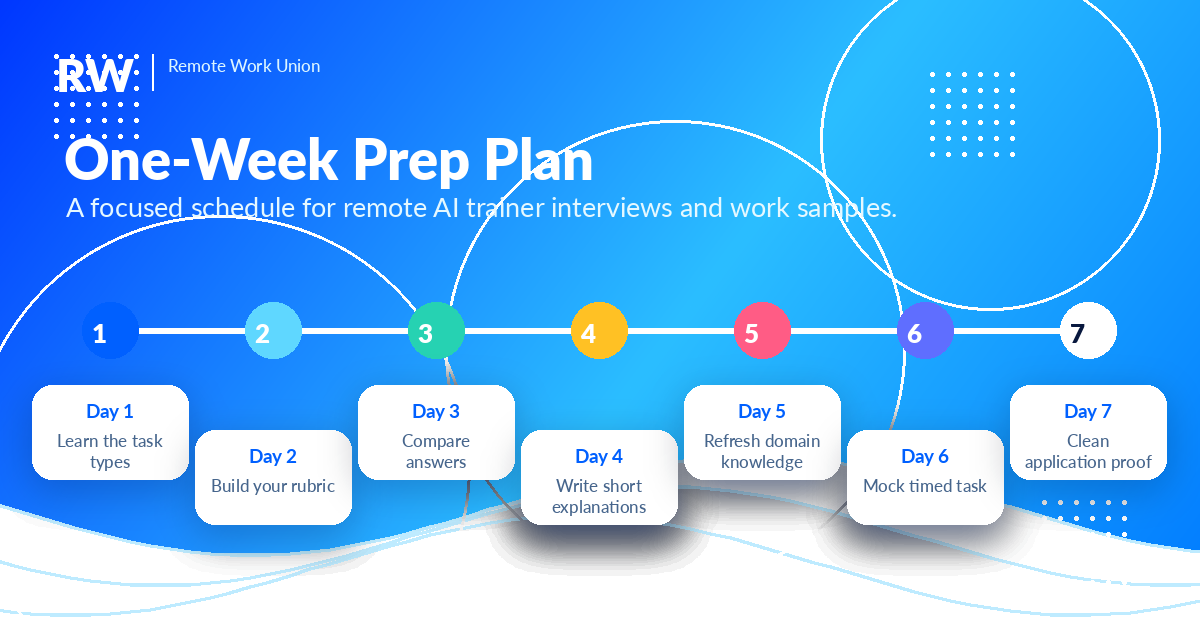
Day 1: Understand the Job
Read several remote AI job descriptions. Look for repeated words like AI trainer, AI evaluator, AI rater, prompt writer, model evaluation, expert reviewer, data annotation, LLM, and AI research. Write down what the roles actually ask you to do.
Day 2: Build Your Rubric
Write your personal review checklist: accuracy, completeness, relevance, clarity, usefulness, and safety. Practice applying it to normal online answers.
Day 3: Compare Answers
Pick five questions in your field. Create or find two possible answers for each. Decide which answer is better and write a three-sentence explanation.
Day 4: Practice Concise Feedback
Take your explanations and cut them down. Remove filler. Make every sentence explain a real difference between the answers.
Day 5: Refresh Your Expertise
Review common concepts in your strongest professional area. Do not study everything. Focus on the areas where you can confidently judge quality.
Day 6: Simulate a Timed Task
Give yourself 30 to 45 minutes. Complete a few answer comparisons without stopping. The goal is to build speed and consistency.
Day 7: Clean Up Your Application Materials
Update your resume, LinkedIn, portfolio, or writing samples. Make sure your background clearly supports the type of AI training job you want.
Final Checklist Before the Interview
Before you start the interview or work sample, make sure you can answer these questions:
- Can I explain what AI training work is in plain English?
- Can I compare two answers using specific criteria?
- Can I write a clear explanation in fewer than six sentences?
- Can I name my strongest area of expertise?
- Can I show that I follow instructions carefully?
- Can I avoid rewarding a response just because it sounds polished?
- Can I spot missing information, unsupported claims, or weak reasoning?
If the answer is yes, you are more prepared than most beginners.
Bottom Line
You do not need years of AI experience to prepare for an AI trainer interview. You need a clear process. Learn the task types, build a simple rubric, practice comparing answers, and position your existing experience as the reason you can judge model outputs well.
Remote AI training jobs are one of the more realistic online work opportunities for people with real-world expertise because the work depends on human judgment. The best candidates are not always the most technical. They are the candidates who can follow instructions, think clearly, explain decisions, and improve an answer in a way that actually helps the user.