Remote AI training jobs are not won by saying, "I am interested in AI." Almost everyone applying can say that. The applications that stand out are the ones that prove the candidate can improve AI outputs with reliable human judgment.
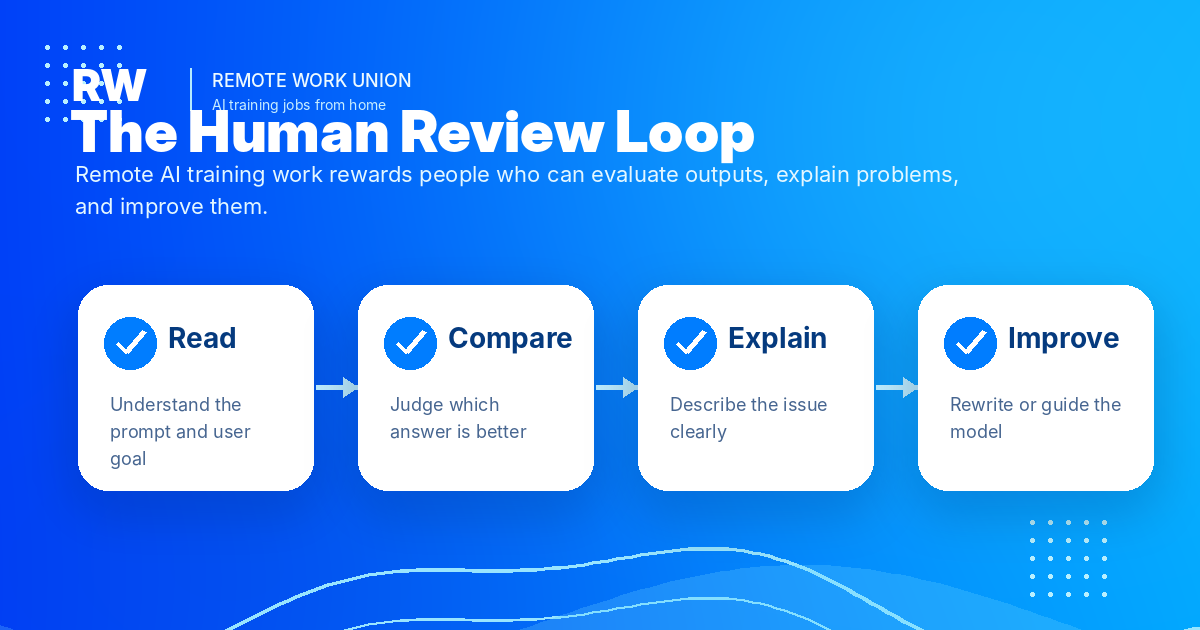
That is the real job behind many remote AI training, AI research, expert review, prompt evaluation, and model response ranking roles. The worker is not just clicking boxes. They are reading prompts, comparing answers, spotting errors, explaining why an answer is weak, rewriting model responses, and helping AI systems become more accurate, useful, safe, and natural.
A strong application makes one thing obvious: this person can be trusted to evaluate answers carefully.
That matters whether someone is applying through Remote Work Union, Handshake AI, Mercor, micro1, Outlier AI, or another remote work platform. It also matters for AI-related contractor roles connected to companies building or improving AI systems, including OpenAI, Anthropic, Google, Meta, Microsoft, Amazon, Apple, xAI, Nvidia, and the broader AI startup ecosystem.
The average applicant sounds excited. The standout applicant sounds useful.
The Best Applications Are Specific, Not Generic
Most weak applications fail because they are too broad. They say things like:
- I am a fast learner.
- I am interested in artificial intelligence.
- I have strong communication skills.
- I am detail-oriented.
- I can work remotely.
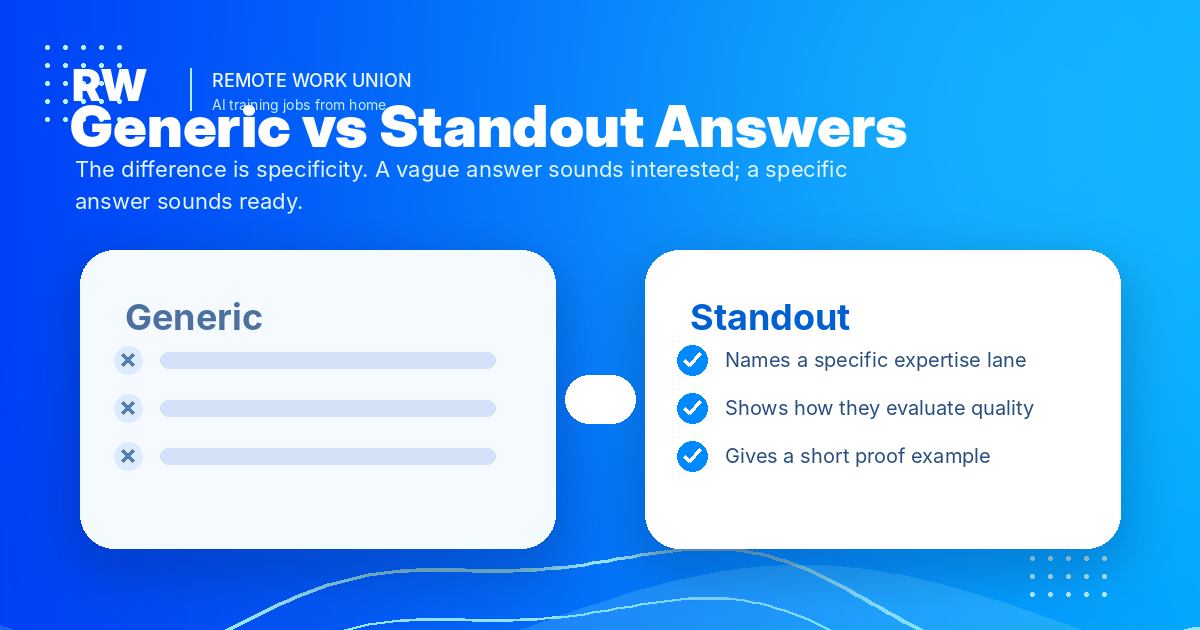
None of those statements are bad, but they do not prove much. AI training platforms are usually evaluating whether you can do a specific type of thinking. A better application connects your background to the work.
For example:
- A lawyer can evaluate legal reasoning, citation quality, argument structure, and whether an answer overstates a claim.
- A finance professional can evaluate investment explanations, accounting logic, Excel formulas, financial assumptions, and business analysis.
- A marketer can evaluate customer personas, ad copy, brand positioning, SEO content, campaign strategy, and conversion-focused writing.
- A teacher can evaluate explanations, lesson plans, student-facing feedback, grading rubrics, and age-appropriate clarity.
- A software engineer can evaluate code correctness, debugging steps, architecture explanations, and technical documentation.
- A healthcare professional can evaluate whether medical explanations are clear, cautious, and aligned with the appropriate level of detail for a general audience.
- A writer or editor can evaluate tone, structure, factual consistency, grammar, and whether an answer actually satisfies the prompt.
That is what platforms are looking for. They do not only need "AI people." They need humans with real judgment in real subject areas.
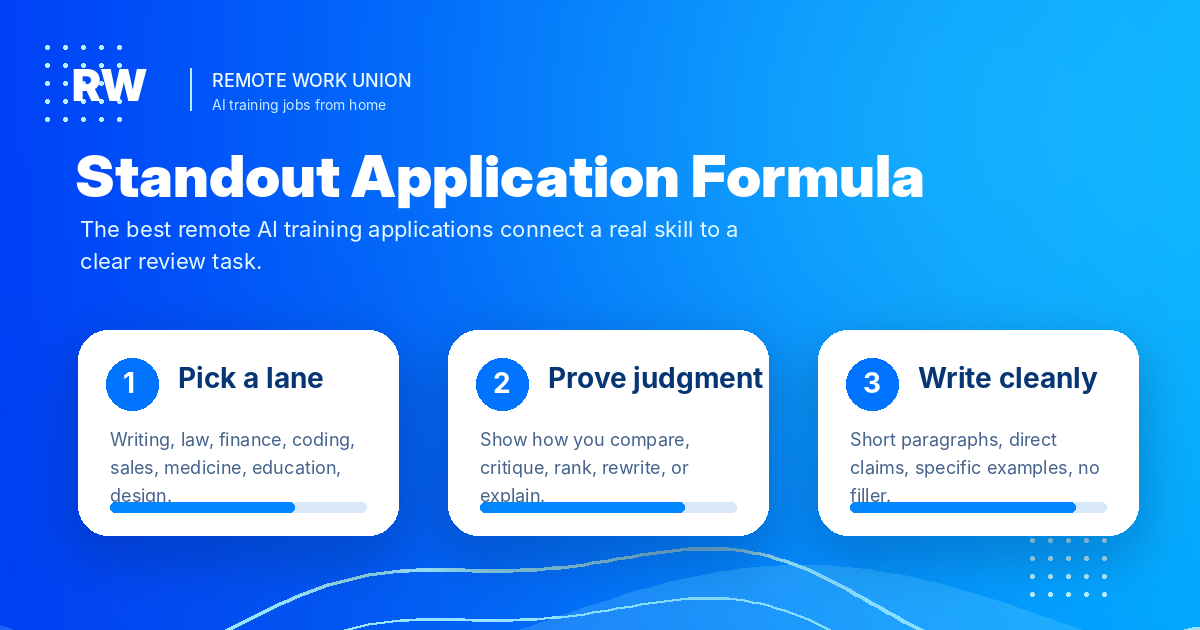
Your Domain Lane Should Be Obvious Within the First 10 Seconds
A reviewer should not have to guess what kind of AI training work you are best suited for. Your application should make your lane clear immediately.
A domain lane is the area where your experience gives you an advantage. It could be sales, marketing, law, finance, accounting, medicine, tutoring, coding, operations, customer support, creative writing, journalism, real estate, product management, HR, engineering, or another professional field.
The mistake is trying to look qualified for everything. That usually makes the application weaker.
A better approach is to lead with a clear sentence like:
Or:
Or:
This kind of positioning helps the platform route you to the right opportunities. It also makes your application sound more professional because it shows you understand that AI training work is often domain-specific.
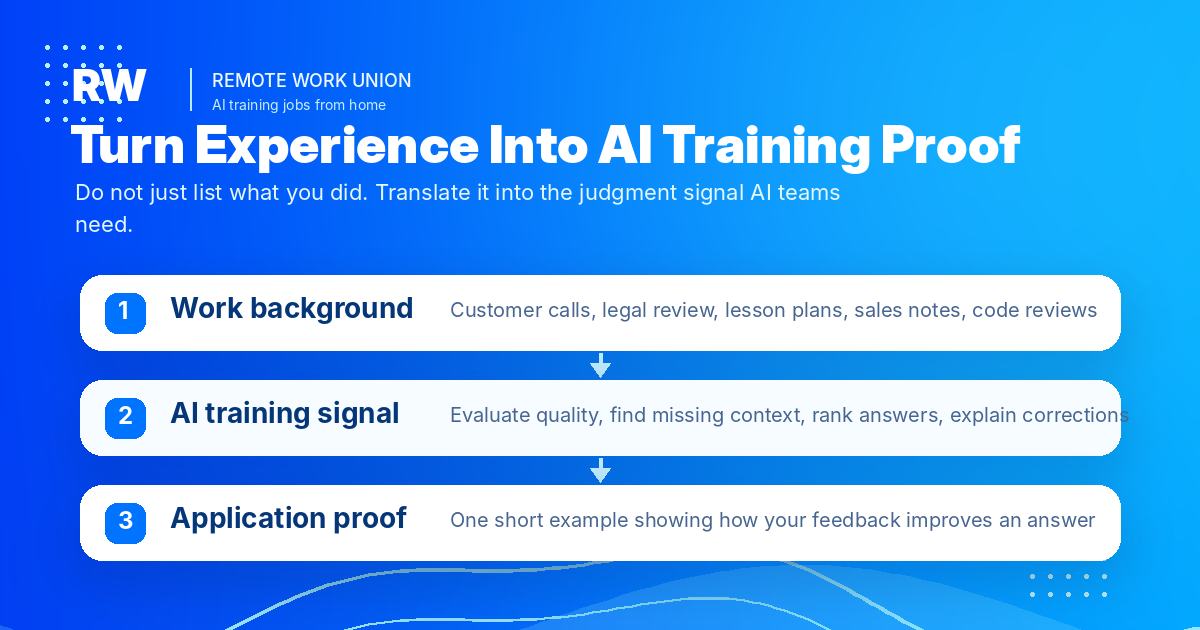
Translate Your Experience Into AI Training Language
A normal resume describes what you did. A strong AI training application explains how what you did prepares you to evaluate model outputs.
That difference matters.
If you worked in sales, do not only say you "managed client relationships." Say you can evaluate whether an AI-generated sales email is persuasive, accurate, appropriately personalized, and aligned with a buyer's stage in the funnel.
If you worked in customer support, do not only say you "resolved customer issues." Say you can identify whether an AI response understands the user's problem, asks the right follow-up questions, avoids making unsupported claims, and gives a clear next step.
If you worked in education, do not only say you "created lesson plans." Say you can evaluate whether an explanation is clear, level-appropriate, logically sequenced, and useful to a student who is learning the concept for the first time.
If you worked in finance, do not only say you "built reports." Say you can evaluate numerical reasoning, business assumptions, financial summaries, and whether the conclusion follows from the data.
If you worked in writing or marketing, do not only say you "created content." Say you can review AI-generated content for clarity, tone, structure, audience fit, keyword relevance, and whether it actually satisfies the user's intent.
This is one of the fastest ways to make an application stronger. You are not inventing new experience. You are translating existing experience into the kind of judgment AI training platforms need.
Show That You Understand the Actual Work
Remote AI training work can include many different tasks. Some roles are simple. Others are highly specialized and require expert judgment. The stronger your application, the more it should show that you understand the type of work being offered.
Common task types include:
- Ranking two AI-generated answers and choosing the stronger response.
- Explaining why one answer is more accurate, helpful, complete, or safe.
- Rewriting an answer to make it clearer, more natural, or more correct.
- Creating prompts that test a model's reasoning or knowledge.
- Checking whether a response follows instructions.
- Reviewing factual claims and identifying unsupported statements.
- Evaluating tone, formatting, and usefulness.
- Testing domain-specific reasoning in fields like law, finance, medicine, coding, education, science, marketing, or business.
- Writing feedback that other reviewers or AI teams can understand.
Your application should use this language naturally. It shows that you are not applying blindly. It also helps with keyword matching when platforms search for AI trainer, AI evaluator, prompt evaluator, model response reviewer, AI research assistant, data annotation, and expert review candidates.
Clear Writing Is a Major Hiring Signal
Many remote AI training jobs are writing-heavy. Even when the role is not called a writing job, the work often requires written explanations. You may need to explain why an answer is inaccurate, why one response is better than another, or how a model should improve.
That means your application is already a writing sample.
A strong application should be easy to read. Use short paragraphs. Avoid corporate filler. Make your claims specific. Do not bury the important details under long introductions.
Weak writing says:
I have always been very passionate about technology and I believe AI is the future, so I am excited to bring my diverse background and strong communication skills to this opportunity.
Stronger writing says:
Better: I am a strong fit for AI response evaluation involving marketing, business communication, and content quality. My background helps me judge whether an answer matches the user's goal, uses the right tone, supports its claims, and gives a useful next step.
The second version is better because it sounds like the actual work. It is concrete. It tells the reviewer what the candidate can evaluate.
Proof Beats Interest
Interest in AI is not enough. The strongest applications include proof.
Proof does not have to mean a formal AI job. It can be a short work sample, a writing sample, a portfolio link, a resume bullet, a project, a published article, a case study, a GitHub profile, a teaching example, a legal memo, a marketing campaign, a research summary, or a before-and-after edit.
Good proof is specific. It shows how you think.
For example, a marketer might include:
Example: I reviewed a landing page and identified that the headline was too broad, the CTA was unclear, and the social proof appeared too late. I rewrote the page around the user's pain point and improved the offer clarity.
A finance applicant might include:
Example: I regularly reviewed financial summaries for assumptions that did not match the underlying numbers. I am comfortable checking whether a conclusion follows from the data and explaining the issue in plain English.
A teacher might include:
Example: I have experience rewriting complex ideas into simpler explanations for students. I can evaluate whether an AI-generated answer is technically correct but still too confusing for the target audience.
A software engineer might include:
Example: I have reviewed code for correctness, edge cases, and maintainability. I can evaluate whether an AI answer gives working code, explains the logic accurately, and avoids creating a misleading solution.
These examples are not long, but they are stronger than generic claims. They show the reviewer how your experience connects to AI model evaluation.
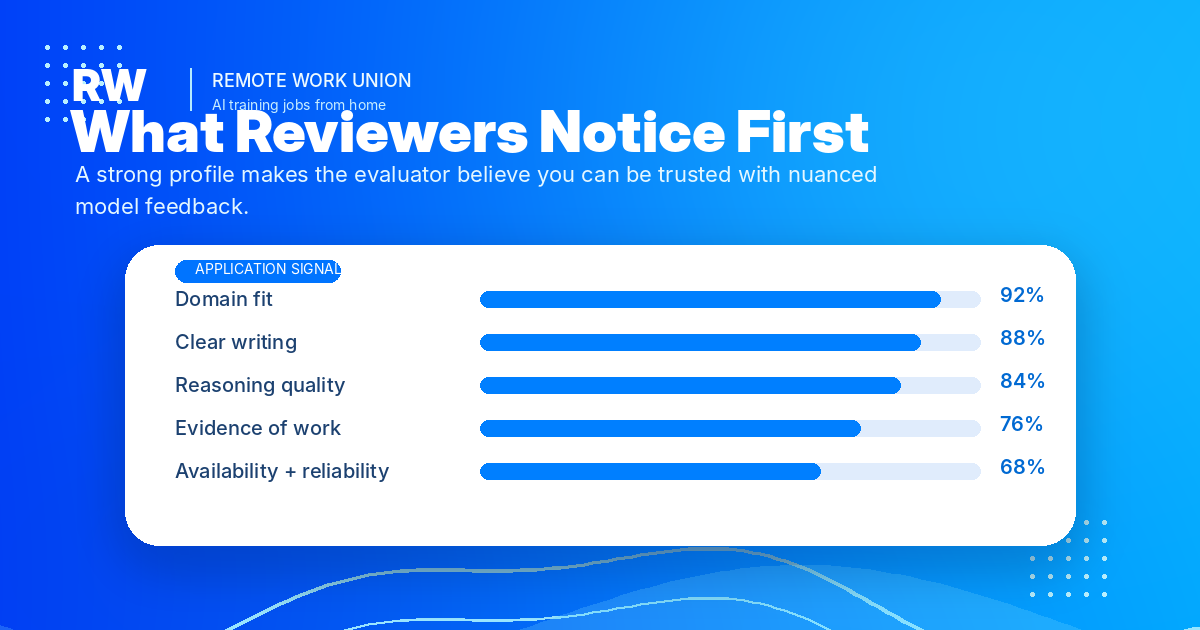
Build Your Application Around Five Signals
The strongest remote AI training applications usually communicate five signals quickly.
1. Domain Expertise
What do you know well enough to evaluate? This is the first question your application should answer. If you have a professional background, use it. If you have deep personal expertise in a field, make it clear. If your experience crosses multiple areas, pick the strongest two or three.
2. Judgment
AI training is not just about knowing facts. It is about making quality judgments. Can you tell when an answer is incomplete? Can you identify a subtle reasoning error? Can you explain why a response is misleading even if it sounds polished?
3. Clear Communication
The person reviewing your application should believe you can write clean feedback. If your application is sloppy, vague, or overcomplicated, it creates doubt.
4. Reliability
Remote work requires trust. Platforms want people who can follow instructions, complete tasks consistently, and communicate clearly without needing constant management.
5. Evidence
A claim is weaker than an example. Add a sample, a short proof point, or a specific description of how you evaluate work.
How to Write a Stronger Application Summary
A good summary should answer three questions:
- What type of AI training work are you best suited for?
- What experience makes you credible?
- How do you evaluate quality?
Here is a simple structure:
Example for marketing:
I am best suited for remote AI training work involving marketing, social media, brand strategy, SEO content, and business communication. My background helps me evaluate whether AI-generated answers match the user's goal, use the right tone, support their claims, and give clear next steps. I am comfortable comparing responses, explaining quality differences, and rewriting content to make it more useful.
Example for finance:
I am best suited for AI training work involving finance, accounting, business analysis, spreadsheets, and investment explanations. My experience helps me evaluate whether an AI-generated answer uses sound assumptions, explains numbers clearly, and reaches a conclusion that follows from the data. I can write concise feedback that identifies the reasoning issue and suggests a clearer response.
Example for writing:
I am best suited for AI response evaluation involving writing quality, editing, tone, structure, and audience fit. I can identify when an answer is technically acceptable but unclear, too generic, poorly organized, or not aligned with the prompt. I am comfortable rewriting responses to make them more direct, useful, and natural.
Example for law:
I am best suited for AI training work involving legal writing, argument structure, issue spotting, and policy interpretation. I can evaluate whether a response distinguishes between general information and legal advice, avoids unsupported certainty, and explains reasoning clearly. I am comfortable reviewing nuanced answers where wording and precision matter.
The goal is not to sound fancy. The goal is to sound precise.
What to Put on Your Resume for AI Training Jobs
If you are applying for remote AI training jobs, your resume should include bullets that match the work. You do not need to fake AI experience. You need to describe your existing work in a way that makes the connection obvious.
Useful resume bullet angles include:
- Reviewed written materials for accuracy, clarity, tone, and audience fit.
- Evaluated competing recommendations and selected the strongest option based on evidence.
- Created clear written feedback for clients, students, customers, managers, or team members.
- Identified errors, missing context, unsupported assumptions, or confusing explanations.
- Translated complex subject matter into simple, practical instructions.
- Followed detailed guidelines and quality standards while completing independent work.
- Used subject-matter expertise to assess whether a response was complete, accurate, and useful.
For AI training roles, these bullets can be more valuable than vague software lists. Many platforms care less about whether you know a specific AI tool and more about whether you can think, write, evaluate, and follow instructions.
How to Answer Screening Questions
Many AI training platforms ask short screening questions. This is where a lot of applicants lose the opportunity.
The mistake is answering like a normal job application. Stronger applicants answer like reviewers.
If the question asks why you are a fit, do not only talk about motivation. Talk about the quality of your judgment.
A weak answer:
I am interested in AI and I think this would be a great remote opportunity for me.
A stronger answer:
Better: I am a strong fit because my background in marketing and content strategy helps me evaluate whether an AI answer matches the user's goal, uses the right tone, and gives a clear recommendation. I am comfortable comparing two responses, identifying missing context, and explaining the quality difference in concise written feedback.
If the question asks about your experience, do not list your whole career. Pick the experience that connects most directly to evaluation.
A weak answer:
I have worked in several roles and have strong communication skills.
A stronger answer:
Better: In my previous work, I regularly reviewed written content for clarity, accuracy, positioning, and audience fit. That experience translates directly to AI response evaluation because I can identify when an answer is too vague, off-target, unsupported, or missing the user's actual intent.
If the question asks about availability, be direct.
A weak answer:
My schedule is flexible and I can probably make time.
A stronger answer:
Better: I can commit consistent weekly hours and complete remote tasks independently. I am comfortable following detailed instructions, meeting deadlines, and communicating clearly if a task requires clarification.
Screening answers should be short, specific, and grounded in the actual task.
Avoid the Biggest Application Mistakes
The most common mistakes are easy to fix.
Mistake 1: Saying You Love AI Without Showing What You Can Evaluate
Interest is not a skill. The platform needs to know what kind of work you can do.
Mistake 2: Applying as a Generalist When You Have a Real Specialty
If you have experience in finance, law, marketing, coding, education, healthcare, operations, sales, or writing, do not hide it. That experience is the value.
Mistake 3: Writing Long Answers That Do Not Say Much
AI training work rewards clarity. A short, specific answer usually beats a long, vague one.
Mistake 4: Overstating AI Experience
You do not need to pretend you have trained models before. It is better to say, clearly, how your existing expertise helps you evaluate outputs.
Mistake 5: Ignoring Instructions
If a platform asks for a specific format, follow it exactly. Many AI evaluation tasks involve detailed guidelines. The application is the first test.
Mistake 6: Using a Resume That Is Too Generic
A normal resume may not highlight the right signals. Add bullets that show review, evaluation, writing, accuracy, research, and judgment.
Mistake 7: Not Preparing for a Skills Test
Some platforms will ask you to complete a writing task, reasoning task, domain test, or AI interview. The best preparation is practicing concise explanations: what is wrong, why it matters, and how to fix it.
What Higher-Paying AI Training Roles Usually Require
Higher-paying remote AI jobs usually require more than basic task completion. They often need one or more of the following:
- Strong professional expertise in a valuable domain.
- Excellent writing and reasoning ability.
- Ability to explain subtle quality differences.
- Careful attention to guidelines.
- Fast but accurate review habits.
- Good judgment around ambiguity.
- Ability to work independently.
- Consistent availability.
- A resume or profile that makes the specialty obvious.
This is why expert roles can pay more than basic surveys, low-level data entry, or generic gig apps. The value is not only time. The value is judgment.
A remote worker with real experience in law, medicine, finance, engineering, coding, marketing, sales, education, or writing may be useful to AI companies because they can evaluate outputs that a general reviewer may miss.
That is the positioning your application should make clear.
A Simple 15-Minute Application Upgrade
If you already have a resume or profile, you can improve it quickly.
Minutes 1–3: Pick Your Strongest Domain Lane
Choose the one or two areas where your experience is most credible. Do not try to be everything.
Minutes 4–6: Add a Clear Summary
Write a short summary that connects your domain to AI response evaluation.
Minutes 7–9: Add Three Proof Bullets
Add bullets that mention reviewing, evaluating, rewriting, explaining, checking accuracy, following guidelines, or improving written outputs.
Minutes 10–12: Prepare One Example
Write one short example of how you would improve or evaluate an AI answer in your field.
Minutes 13–15: Clean the Writing
Remove filler. Shorten long sentences. Make every sentence prove fit.
This small upgrade can make a remote AI training application look much more serious.
Final Takeaway
A remote AI training application stands out when it makes the candidate look useful immediately.
The best application does not simply say, "I want to work in AI." It says:
- Here is the domain I know.
- Here is the kind of AI output I can evaluate.
- Here is how I judge quality.
- Here is proof that I can write clearly.
- Here is why I can be trusted with remote review work.
That is the difference between a generic applicant and someone who looks ready for AI training, expert review, AI research support, model evaluation, prompt testing, and high-quality remote work from home.