The micro1 Zara AI interview can feel intimidating if you have never worked in artificial intelligence before. You may be applying for a remote AI training job, an AI model evaluation role, a writing task, a research project, a data annotation position, or another work from home opportunity that uses your judgment rather than your coding ability. Then you see that an AI interviewer will ask the questions, record your answers, and evaluate your fit.
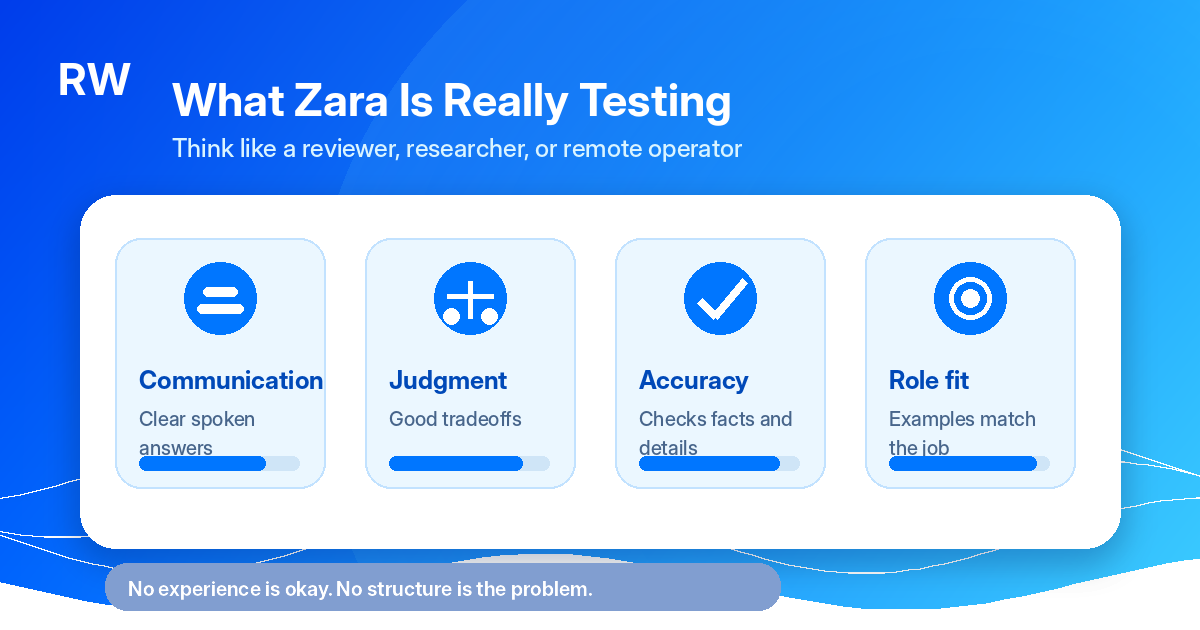
That can make beginners overthink the process. The truth is simpler: Zara is not only testing whether you know AI terms. Zara is testing whether you can communicate clearly, reason through unfamiliar questions, follow instructions, and show the kind of judgment needed for remote work. If you can explain your thinking in a structured way, you have a better chance of performing well even without direct AI experience.
This guide explains how to prepare for the micro1 Zara AI interview with no AI background, what kinds of answers usually work better, what mistakes to avoid, and how to turn your normal work experience into evidence that you can handle remote AI jobs.
In this guide
- What the micro1 Zara AI Interview Is Really For
- No AI Experience Does Not Mean No Relevant Experience
- How to Prepare Before the Interview
- The Best Answer Structure for Zara
- Example Answer for a Beginner
- What to Say If You Have Never Done AI Training
- Common Zara AI Interview Mistakes
- Technical Setup Matters More Than Beginners Think
- Practice Questions to Prepare
What the micro1 Zara AI Interview Is Really For
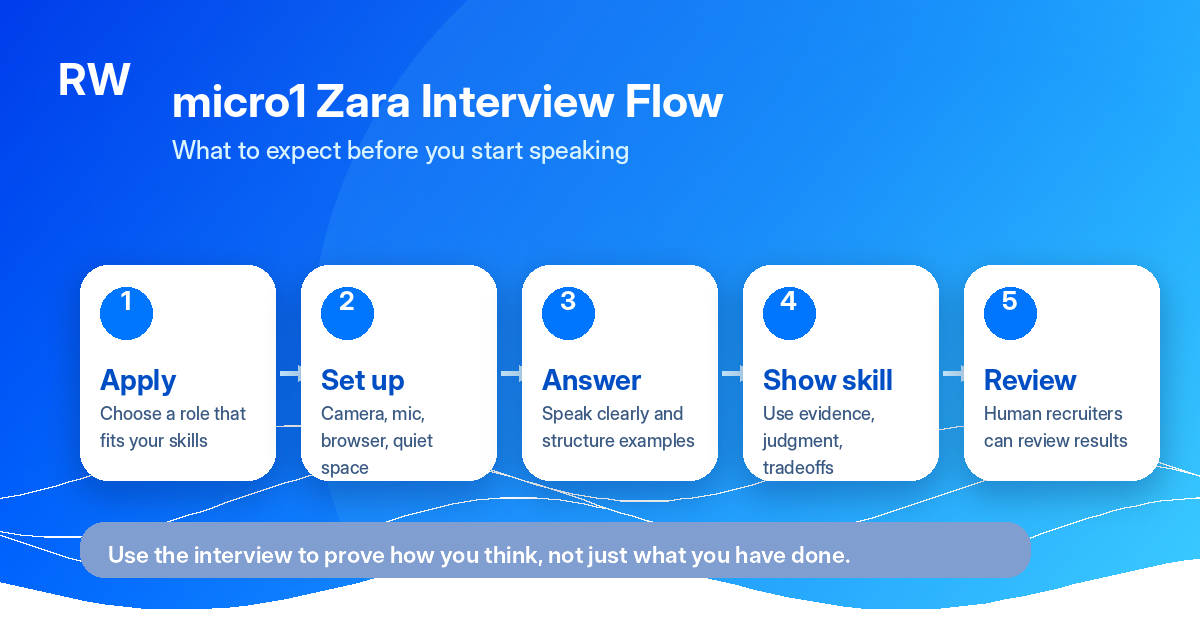
Zara is micro1's AI recruiter and interviewer. The interview is typically designed around the role you applied for, which means a writing role, sales role, research role, coding role, marketing role, or general AI training role may not all receive the same questions. The goal is to evaluate relevant skills in a structured interview format.
A strong written resume may get you into the process, but the interview is where you show whether you can think through problems without needing constant supervision. For many candidates, the interview is spoken out loud in real time, so your delivery becomes part of the signal.
For AI training and model evaluation work, companies often need people who can read carefully, compare outputs, identify errors, judge tone, explain why one answer is better than another, and follow a rubric. Those skills do not require a computer science degree. They do require focus, clarity, and honest reasoning.
No AI Experience Does Not Mean No Relevant Experience
A common mistake is assuming that no AI experience means you have nothing to talk about. That is rarely true. If you have worked in customer service, sales, marketing, teaching, writing, research, operations, finance, recruiting, real estate, design, support, or administration, you probably have examples that connect to AI evaluation work.
Remote AI jobs often reward transferable skills: noticing mistakes, explaining decisions, comparing options, researching facts, following detailed instructions, writing clearly, giving feedback, and staying consistent on repetitive tasks. These are the same skills that show up in many normal jobs.
How to Prepare Before the Interview
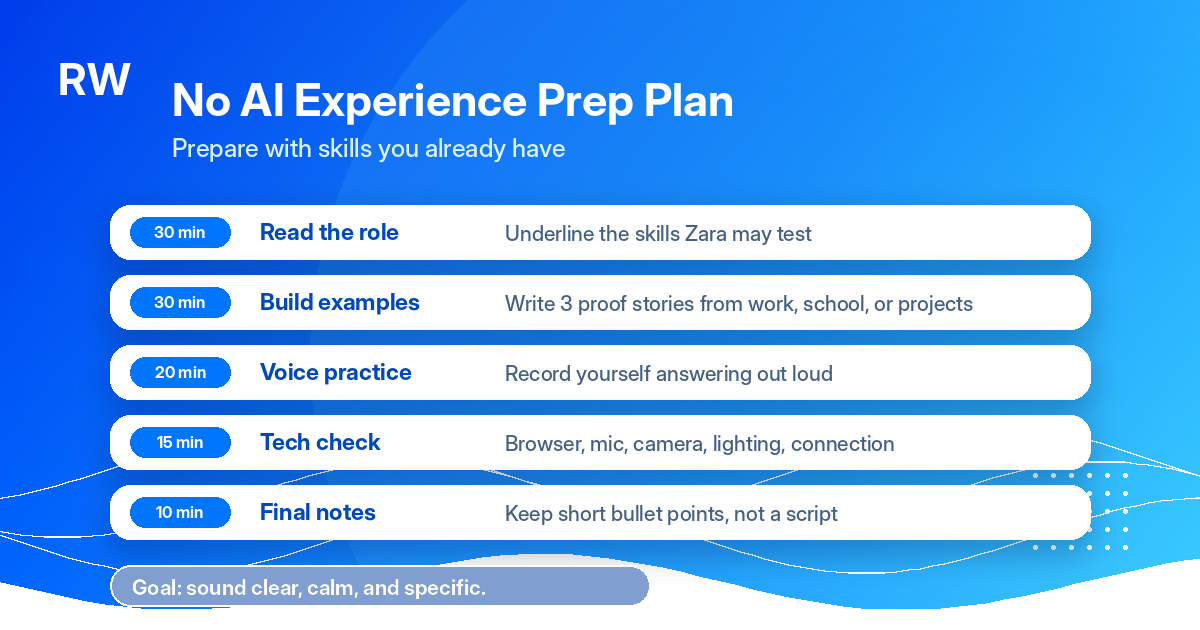
Start with the job description. Do not prepare for a generic interview if the role is specific. Read the posting and underline the actual skills it names: writing, editing, research, math, coding, customer support, sales, legal analysis, finance knowledge, bilingual communication, prompt evaluation, or data annotation. Zara's questions may be tied to those skills, so your examples should be tied to them too.
Next, prepare five short stories you can adapt. Each story should be simple: what the task was, what you did, what judgment you used, and what the result was. Keep them flexible. One story about catching a detail in a spreadsheet could support an answer about accuracy, quality control, or following instructions. One story about explaining a complex topic to a customer could support an answer about communication, empathy, or simplifying information.
Finally, practice out loud. Silent preparation is weaker for a voice interview. Record yourself answering one question for 60 to 90 seconds, then listen back. You are looking for three things: Did you answer the question directly? Did you use a specific example? Did you explain why your choice made sense?
The Best Answer Structure for Zara
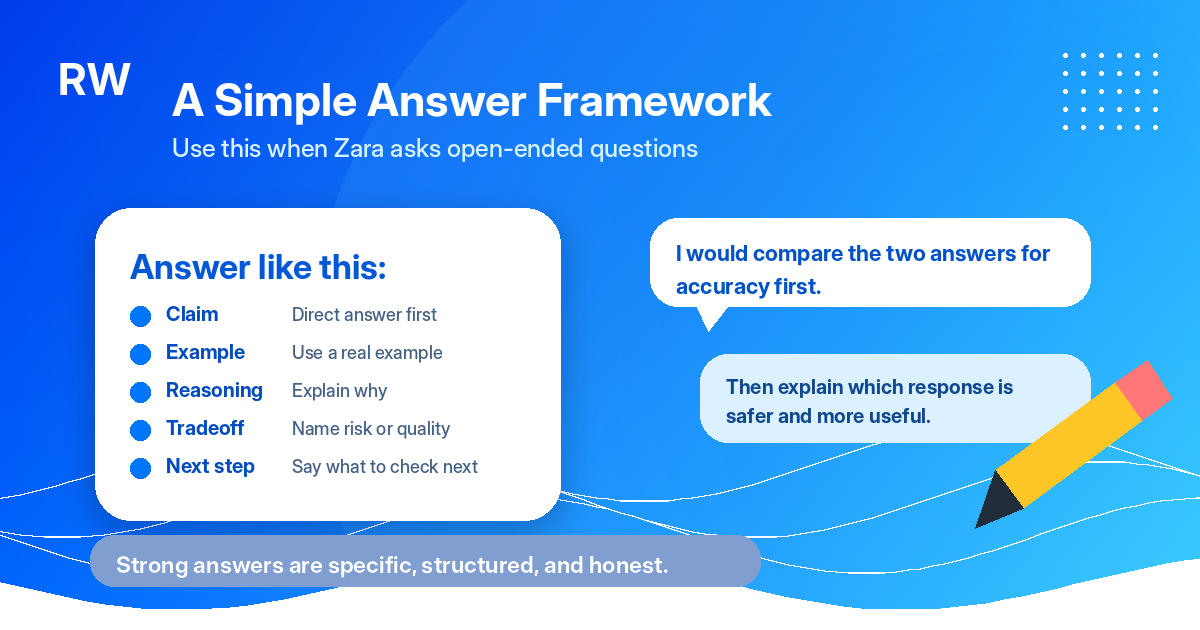
A clear answer beats a long, scattered answer. Use a structure you can remember under pressure: direct answer, example, reasoning, tradeoff, next step.
- Direct answer: Answer the question first. If Zara asks how you would decide which AI response is better, start with the criteria you would use. Do not spend the first minute apologizing for being new.
- Example: Give a specific example from school, work, freelancing, content creation, customer support, sales, research, or any situation where you had to evaluate information.
- Reasoning: Explain why your answer is accurate, useful, safer, more complete, or more aligned with the instructions.
- Tradeoff: Mention a tradeoff. Remote AI work often involves balancing speed with accuracy, helpfulness with safety, and detail with clarity. Candidates who can name tradeoffs sound more thoughtful.
- Next step: Say what you would verify, improve, or ask for if the information were unclear. This shows that you know how to work responsibly when instructions are incomplete.
Example Answer for a Beginner
Question: "Tell me about a time you had to evaluate the quality of someone else's work."
Weak answer: "I am detail-oriented and good at checking things. I have always been careful in my jobs."
Stronger answer: "In a previous role, I had to review written material before it went out to customers. I checked whether the information was accurate, whether the tone matched the brand, and whether anything was confusing. If I found an issue, I did not just say it was wrong. I explained what needed to change and why. I would use the same approach in AI model evaluation: compare the response to the instruction, look for factual or reasoning errors, and explain my judgment clearly."
The stronger answer works because it shows a transferable skill, gives a specific example, and connects that example to the AI training job without pretending to have experience the candidate does not have.
What to Say If You Have Never Done AI Training
Be direct. Do not fake experience. AI interview systems and human reviewers are looking for consistency, clarity, and credible examples. A better line is: "I have not done paid AI training work yet, but the role matches skills I have used in other settings." Then name those skills.
For example: "I have experience reviewing written content for accuracy and clarity." Or: "I have handled customer questions where I had to understand the issue, compare options, and explain the best solution." Or: "I am comfortable researching unfamiliar topics and summarizing what matters."
That kind of answer is stronger than trying to sound technical. Many remote AI jobs do not start with advanced machine learning. They start with human judgment: which answer is better, what is missing, what is unsafe, what is unclear, and how the model could improve.
Ready to find remote AI jobs that match your background?
Join Remote Work Union Free →Common Zara AI Interview Mistakes
- Rambling. Long answers are not automatically better. If your answer has no structure, the useful parts get buried. Aim for a clear answer in about one to two minutes unless the question calls for more detail.
- Being too vague. Words like hardworking, fast learner, passionate, and detail-oriented do not prove much by themselves. Use examples instead.
- Sounding scripted. Preparing is good. Reading a perfect answer in a robotic voice is not. Keep notes short and speak naturally.
- Using AI tools to cheat. Do not try to use AI tools during the interview in a way that violates instructions. Many AI interview systems include timing, video, audio, proctoring, or behavior signals. More importantly, cheating defeats the purpose: the work itself requires reliable human judgment.
- Ignoring the role. A writer should emphasize clarity, tone, editing, and audience judgment. A researcher should emphasize source quality, verification, and synthesis. Tailor your answers to the role you actually applied for.
Technical Setup Matters More Than Beginners Think
Before starting, check your microphone, camera, browser, lighting, and internet connection. Use a quiet room. Close extra tabs. Turn off notifications. Keep a glass of water nearby. Put your short notes on paper or in a separate simple document if the interview rules allow notes, but do not rely on a full script.
If something glitches, stay calm and follow the platform's instructions. If the issue prevents you from completing the interview, document what happened, including time, browser, device, and connection details. Technical problems can happen in remote work, and your response should show that you are calm and organized.
Practice Questions to Prepare
Use these practice questions before the interview. For each answer, use the same structure: direct answer, example, reasoning, tradeoff, next step.
- Tell me about a time you had to learn something unfamiliar quickly.
- How would you decide which of two AI responses is better?
- Describe a time you found an error that someone else missed.
- How do you handle unclear instructions?
- What makes written feedback useful?
- How would you balance speed and accuracy on a remote project?
- Why are you interested in AI training or model evaluation work?
- What skills from your previous work apply to this role?
FAQs
What is the micro1 Zara AI interview?
Zara is micro1's AI recruiter and interviewer. The interview is typically designed around the role you applied for and evaluates communication, reasoning, judgment, and relevant skills through a structured voice or written format.
Can I pass the Zara interview with no AI experience?
Yes. Zara is not only testing whether you know AI terms. It is testing whether you can communicate clearly, reason through unfamiliar questions, follow instructions, and show the kind of judgment needed for remote work. Transferable experience from writing, research, customer service, sales, and other fields is valuable.
What is the best answer structure for the micro1 Zara interview?
A clear structure works best: direct answer, example, reasoning, tradeoff, next step. Answer the question directly first, then give a specific example, explain your reasoning, mention a tradeoff, and close with what you would verify or improve.
What common mistakes should I avoid in the Zara interview?
The most common mistakes are rambling without structure, being too vague with words like "hardworking" instead of examples, sounding scripted, trying to use AI tools to cheat the interview, and ignoring the specific role you applied for when framing your answers.