Mercor interview questions are not something to memorize from a leaked script. The better way to prepare is to understand what the interview is trying to measure: your background, your subject-matter knowledge, your communication skills, and your ability to evaluate AI outputs with clear judgment.
That matters because AI training work is not just generic data entry. Many projects need people who can help large language models produce better answers in specific fields. A strong applicant may be a writer, editor, software engineer, lawyer, medical professional, finance specialist, teacher, consultant, researcher, operator, or someone with deep practical knowledge in a valuable niche.
If you are applying for Mercor AI training work, Mercor expert roles, or similar remote AI evaluator jobs, the interview is usually about fit. Can you explain what you know? Can you think clearly under light pressure? Can you compare answers? Can you spot weak reasoning? Can you communicate feedback in a way that would help an AI system improve?
This guide breaks down the types of Mercor interview questions applicants should prepare for, how to answer them, and how to avoid common mistakes.
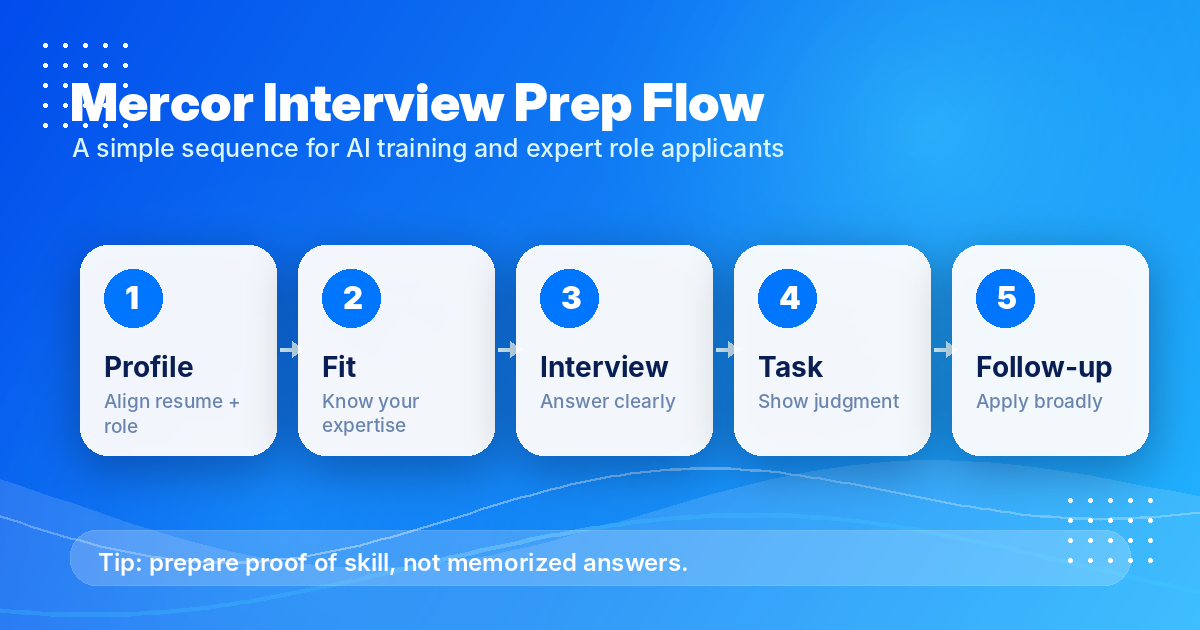
What the Mercor Interview Is Really Testing
For most remote AI training and expert role applications, the interview is not only asking whether you sound smart. It is testing whether your knowledge can be useful inside an AI evaluation workflow.
That workflow may include reviewing AI-generated answers, writing high-quality examples, ranking two model responses, fact-checking claims, improving prompts, explaining what an answer missed, or applying professional standards to a model output.
A good interview answer usually shows four things:
- You have real experience or credible knowledge in the role category.
- You can explain your background without rambling.
- You can apply judgment instead of giving generic opinions.
- You understand that AI training work rewards clarity, accuracy, and consistency.
Mercor and similar platforms often serve applicants across many disciplines. That means a software engineer may get questions about code review, a lawyer may get legal reasoning questions, a writer may get editing or style questions, and a finance expert may get questions about analysis, risk, or valuation. The point is not to sound like every other applicant. The point is to sound useful for the role you selected.
Common Mercor Interview Question Categories
You cannot predict every exact interview question. You can, however, prepare for the categories that show up naturally in AI training and expert screening.
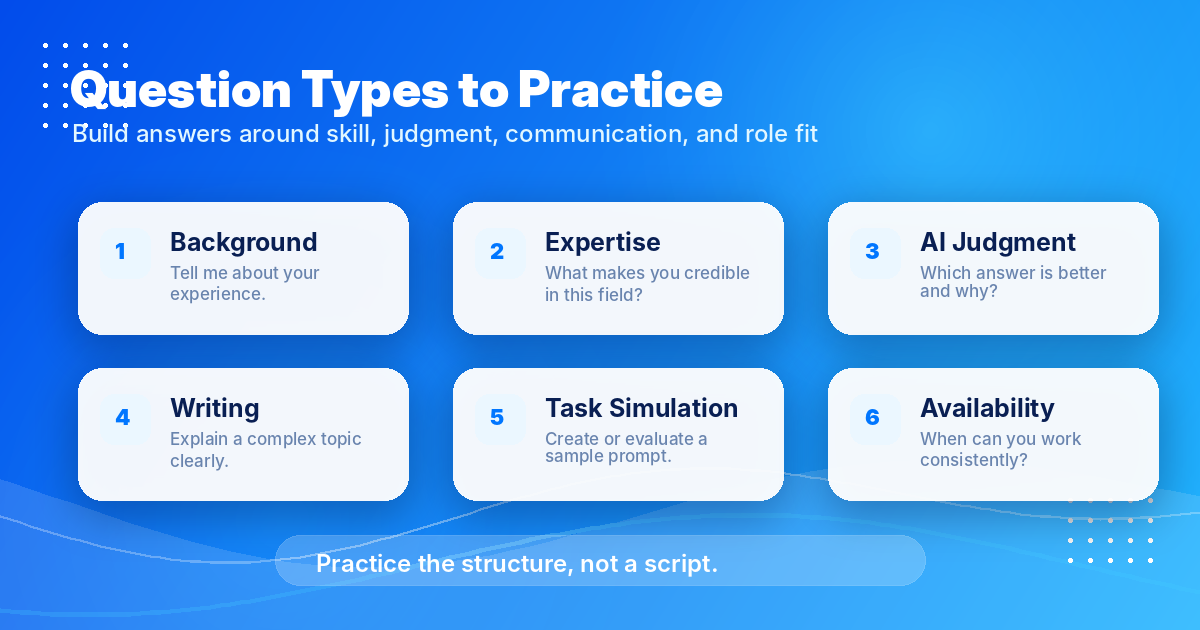
1. Background and Resume Questions
These questions check whether your profile matches the role.
Sample questions:
- Tell me about your professional background.
- What type of work have you done most recently?
- Which part of your experience is most relevant to this AI training role?
- What are your strongest subject areas?
- What tools, platforms, or workflows have you used professionally?
- Walk me through a project where you had to produce accurate work under a deadline.
The best answers are specific. Do not say, "I am good at writing" or "I have a business background." Say what kind of writing, what kind of business work, what kind of deliverables, and what standard you were held to.
A stronger answer sounds like this:
That answer works because it connects the applicant's background to the actual work.
2. Role Fit Questions
These questions test whether you understand the specific project type you are applying for.
Sample questions:
- Why are you interested in this AI training role?
- What makes you a good fit for this specific category?
- Which types of AI outputs would you be most qualified to review?
- What kinds of tasks would you not be qualified to judge?
- How would you handle a task that falls outside your expertise?
The last question is important. A strong evaluator knows the limits of their knowledge. If you pretend to be qualified for everything, that can hurt you. Remote AI jobs often require confidence, but they also require calibration.
A good answer: "If a task falls outside my expertise, I would not guess. I would either skip it, flag the uncertainty, or rely only on parts I can evaluate responsibly. For example, I can review business writing and marketing strategy, but I would not present myself as qualified to evaluate clinical medical advice."
This shows maturity. AI companies and training platforms need reviewers who understand accuracy, not just speed.
3. AI Judgment and Model Evaluation Questions
These questions are central to AI evaluator work. You may be asked how you would compare answers, identify mistakes, or decide which response is better.
Sample questions:
- What makes one AI response better than another?
- How would you evaluate helpfulness, accuracy, and clarity?
- If two answers are both correct, how would you choose the stronger one?
- How would you identify hallucinations in an AI answer?
- What would you do if an answer sounds confident but includes unsupported claims?
- How would you give feedback to improve a model response?
The best answer framework is simple:
- Start with accuracy.
- Then evaluate completeness.
- Then evaluate clarity and usefulness.
- Then mention safety, if relevant.
- Then explain the tradeoff.
Example: "I would first check whether the answer is factually correct. Then I would look at whether it fully addresses the user's request. If both answers are accurate, I would prefer the one that is more direct, better organized, and more useful for the user's situation. I would also watch for overconfident claims, missing caveats, or advice that crosses a safety boundary."
That is the kind of answer that fits AI model evaluation work because it shows a repeatable standard.
4. Subject-Matter Expertise Questions
For expert roles, the interview may probe your actual knowledge. This is where lawyers, consultants, developers, healthcare professionals, finance experts, academics, and technical specialists need to be ready.
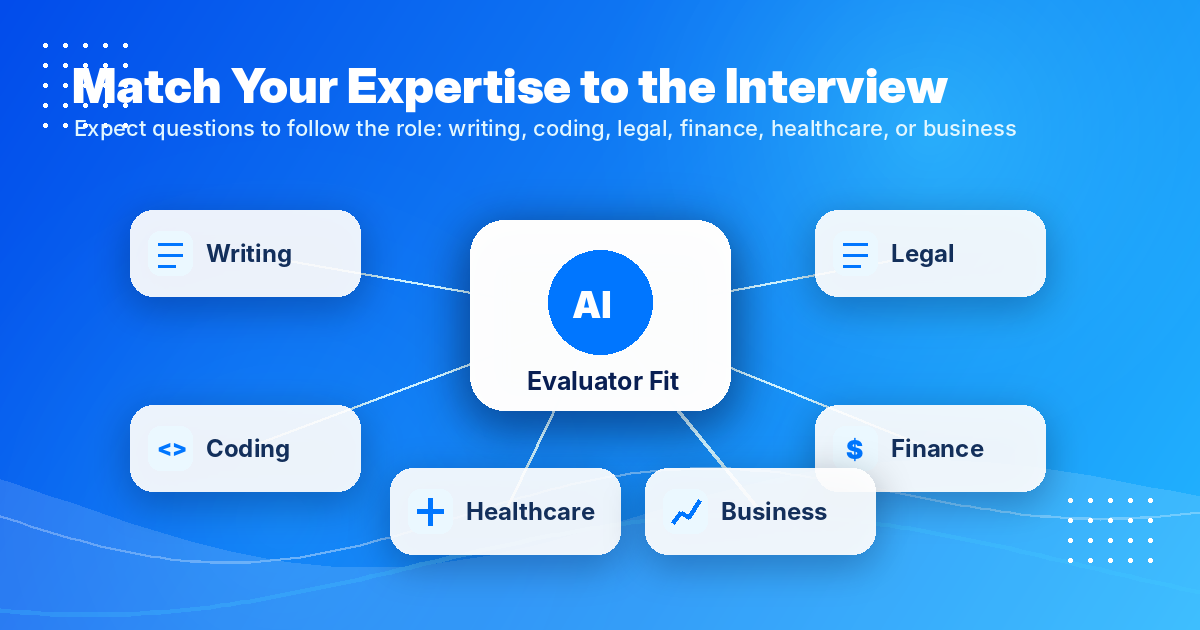
Sample questions by field:
Writing and editing:
- How do you improve a weak paragraph without changing its meaning?
- What makes an answer sound natural instead of AI-generated?
- How do you balance clarity, tone, and accuracy?
Software engineering:
- How would you review code generated by an AI model?
- What makes a coding answer incomplete even if it compiles?
- How do you explain a bug fix clearly?
Legal research:
- How would you evaluate a legal answer for accuracy and jurisdiction limits?
- What disclaimers or caveats matter in legal content?
- How do you distinguish legal information from legal advice?
Healthcare or medical writing:
- How would you review a medical answer for safety?
- What makes a health-related response risky?
- How do you handle uncertainty in clinical information?
Finance and business:
- How would you evaluate an AI answer about valuation, markets, or accounting?
- What makes a business recommendation practical instead of generic?
- How do you assess assumptions in a financial explanation?
The right preparation is not to cram facts. It is to practice explaining your standards. Expert roles reward people who can say why something is right, incomplete, misleading, risky, or useful.
5. Work Style and Availability Questions
Remote AI training work can be flexible, but platforms still care about reliability.
Sample questions:
- How many hours per week are you available?
- Can you work independently without close supervision?
- How do you handle repetitive review tasks?
- How do you maintain quality when working quickly?
- Are you comfortable following detailed instructions or rubrics?
- How do you manage deadlines?
A good answer should be honest. Do not promise full-time availability if you can only work part-time. Do not say you can handle every project if you are still learning the workflow. A strong applicant sounds reliable and realistic.
Example: "I can consistently work 10 to 20 hours per week, with more time available during project ramps. I am comfortable working from detailed rubrics, and I usually keep a checklist for quality so I do not sacrifice accuracy when moving quickly."
That answer communicates consistency, which matters in contract AI work.
Remote Work Union connects you to legitimate remote AI training and evaluation roles across multiple platforms. Apply for free.
Find Roles Hiring Now →How to Answer Mercor Interview Questions Well
Use this structure for most answers:
- Direct answer first.
- One specific example.
- Connection to AI training work.
- Brief closing sentence.
For example, if asked, "Why would you be good at AI model evaluation?" a weak answer would be: "I use AI a lot and I am good at writing."
A stronger answer: "I would be good at AI model evaluation because my background is in editing and research. In my previous work, I had to check claims, improve structure, and explain complicated topics clearly. That translates well to AI evaluation because model outputs often sound fluent but still need a human reviewer to catch missing context, unsupported claims, or unclear reasoning."
The stronger answer is not much longer. It is just more useful.
Questions to Practice Before the Interview
Use these as practice prompts. Do not memorize them word-for-word. Practice answering them out loud in a clear, natural way.
General Practice Questions
- Tell me about yourself and your most relevant experience.
- Why are you interested in remote AI training work?
- Which subject areas are you most qualified to evaluate?
- What type of AI output would you be best at reviewing?
- What kind of work should you not evaluate?
- How do you handle unclear instructions?
- How do you stay consistent across repetitive tasks?
- How many hours per week can you realistically work?
AI Evaluation Practice Questions
- What makes an AI answer high quality?
- How would you compare two responses to the same prompt?
- How do you identify hallucinations?
- What is the difference between a fluent answer and an accurate answer?
- How would you explain why one response is better than another?
- What would you do if a model gave a partially correct answer?
- How do you handle answers that are too vague?
- How do you handle answers that are overconfident?
Expert Role Practice Questions
- What is one advanced concept in your field that you can explain simply?
- What common mistakes do beginners make in your field?
- How would you judge whether an AI answer in your field is trustworthy?
- What sources or standards do professionals in your field rely on?
- How would you rewrite a weak answer to make it more useful?
- How do you balance speed with quality?
- What is a project you worked on that proves your expertise?
- Why should a platform trust you to review expert-level AI outputs?
Tip: Practice questions 17–24 out loud. Expert role interviews often hinge on how confidently and specifically you can explain your own field. The goal is to sound like a practitioner, not a generalist.
How to Prepare Your Resume and Profile Before the Interview
Your interview is easier when your resume, profile, and selected role all tell the same story.
Before applying, make sure your profile clearly communicates:
- Your strongest professional category.
- Your specific niche or subject area.
- The types of outputs you can evaluate.
- The tools and workflows you know.
- Any writing, research, analysis, coding, teaching, consulting, editing, legal, medical, finance, or technical experience.
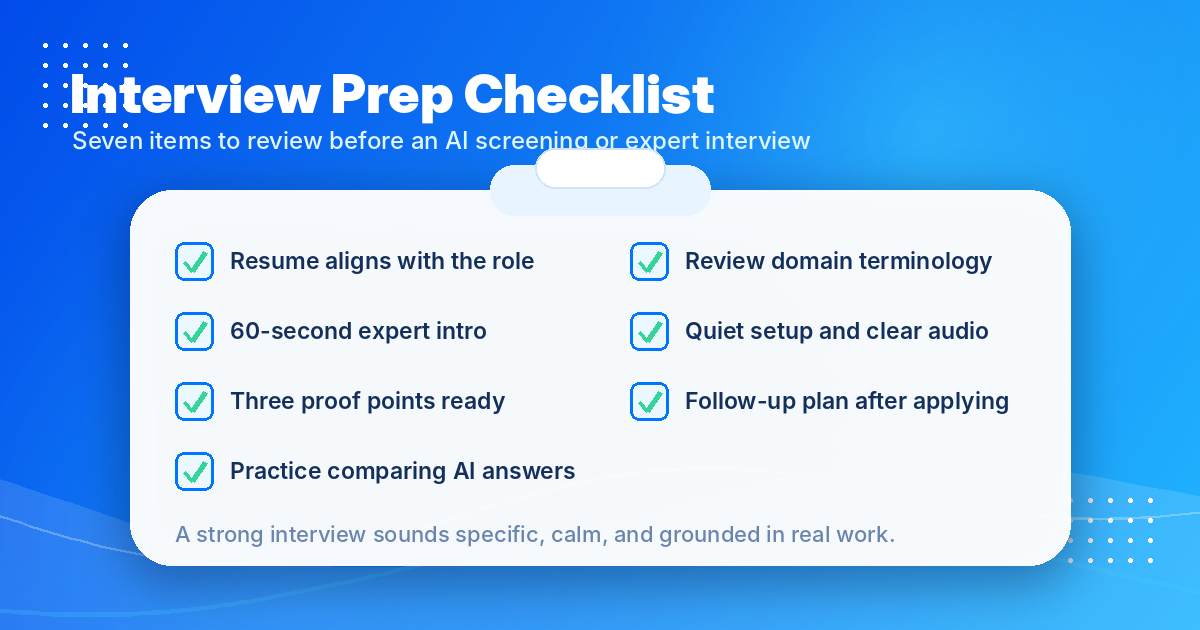
For AI training jobs, a generic resume is weaker than a focused one. You do not need to list every job you have ever done. You need to make it easy for the reviewer, recruiter, or AI screening system to understand where you fit.
For example, "marketing" is broad. "B2B SaaS content strategy, paid social analysis, landing page copy, and campaign reporting" is stronger.
"Finance" is broad. "Equity research, valuation models, Excel analysis, accounting review, and market commentary" is stronger.
"Software" is broad. "Python, data pipelines, API debugging, code review, and technical documentation" is stronger.
Specificity helps you get matched to the right work.
Common Mistakes Applicants Make
Mistake 1: Giving Generic Answers
The biggest mistake is sounding like everyone else. "I am detail-oriented" is not enough. "I have reviewed hundreds of technical documents for factual accuracy and clarity" is better.
Mistake 2: Overclaiming Expertise
Do not claim to be an expert in areas where you are not qualified. AI evaluation depends on trust. A careful applicant is more valuable than a reckless one.
Mistake 3: Ignoring the Actual Task Type
Some people prepare for a traditional job interview when they should be preparing for AI evaluation work. Practice comparing answers, writing feedback, checking claims, and explaining quality differences.
Mistake 4: Rambling
AI interviews and screening calls often reward concise answers. Aim for answers that are complete but not bloated. A good answer may be 30 to 90 seconds.
Mistake 5: Sounding Interested Only in Flexibility
It is fine to want remote work and flexible hours. But if that is your only reason, your answer may sound weak. Connect your interest to the work itself: evaluating AI, applying expertise, improving model quality, writing better responses, or contributing professional judgment.
How Mercor Interview Preparation Compares to Other AI Platforms
Applicants often search for Mercor alongside Outlier, Handshake AI, micro1, Surge AI, Stellar AI, LinkedIn AI jobs, Google AI training jobs, Gemini AI jobs, Claude AI training jobs, Meta AI evaluator work, OpenAI model evaluation, and Grok-related AI training roles.
The details vary by platform, but the preparation overlap is large. Most remote AI evaluator and AI training roles value the same core skills:
- Clear writing.
- Accurate judgment.
- Domain expertise.
- Ability to follow instructions.
- Comfort with rubrics.
- Ability to explain why an answer is better or worse.
- Consistent work quality.
That is why your preparation should be platform-aware but not platform-dependent. You are not only preparing for one interview. You are building the skills needed across the AI training job market.
What to Do After the Interview
After you complete a Mercor interview or AI assessment, avoid refreshing your inbox every hour. Instead, keep your pipeline moving.
Do three things:
- Apply to additional roles that match your actual background.
- Improve your profile based on anything the interview exposed.
- Practice the task types you struggled to explain.
If you realized your intro was vague, rewrite it. If you struggled to explain your expertise, create three proof points. If you found AI evaluation questions difficult, practice comparing two answers and writing a short justification.
Remote AI work can be inconsistent, so it is smart to apply across multiple legitimate platforms while keeping your profile focused and honest.
Quick Answer Framework for the Interview
When you are unsure how to answer, use this framework:
- "My relevant background is..."
- "A specific example is..."
- "The standard I would use is..."
- "For AI evaluation, that matters because..."
This keeps your answers grounded. It also prevents you from drifting into vague motivation statements.
Final Thoughts
The best way to prepare for Mercor interview questions is to stop thinking like a test taker and start thinking like an evaluator. These roles need people who can apply human judgment to AI outputs. That means your answers should prove that you are accurate, specific, calm, and useful.
Prepare your background story. Know your strongest categories. Practice comparing AI responses. Get comfortable explaining why one answer is better than another. Be honest about your limits. Then keep applying across legitimate remote AI platforms so one application does not control your entire job search.
Frequently Asked Questions
What questions does Mercor ask in the interview?
Mercor interview questions vary by role but typically cover professional background, subject-matter expertise, role fit, work style and availability, and AI evaluation judgment. For expert roles, expect questions that connect directly to your field.
Is the Mercor AI interview difficult?
It depends on the role and how well your profile matches. The interview is easier when your background, resume, and selected role are aligned. Applying for a role outside your expertise makes the interview harder because your answers will be less specific.
Should I memorize Mercor interview answers?
No. Memorized answers sound scripted and unnatural. Instead, prepare answer frameworks, concrete examples, and proof points from your background. The goal is to sound clear and credible, not rehearsed.
What should I say when asked why I want AI training work?
Connect your answer to the actual work. Mention remote flexibility if it is true, but also explain that you are interested in applying your expertise to improve AI outputs, evaluate model quality, and help systems produce more accurate and useful answers.
How do I stand out for expert AI training roles?
Be specific about your niche. Explain what you can evaluate, what standards you use, and what types of mistakes you can catch. Strong expert applicants do not just say they know finance or law — they explain the exact areas where their judgment is useful.