Remote workers are searching for micro1 because AI training jobs have become one of the most visible work from home opportunities online. Writers, software engineers, researchers, lawyers, finance professionals, marketers, teachers, analysts, and other skilled workers are seeing platforms promise remote projects where human judgment helps improve AI systems. micro1 is part of that broader conversation.
So, is micro1 legit? The practical answer is: micro1 appears to be a real AI talent and human data platform, but that does not mean every applicant will get accepted, receive projects, or earn consistent income. A legitimate platform can still have competitive screening, delayed responses, limited project availability, changing role requirements, or uneven applicant experiences. The right question is not only "Is this real?" The better question is: "What should I verify before I apply, interview, share data, or depend on this platform for income?"
What micro1 Is, in Plain English
micro1 is generally described as a platform that connects skilled people with AI-related work. That work can include AI training, model evaluation, data annotation, expert review, coding tasks, interview screening, and other human-in-the-loop projects. The basic idea is simple: AI companies and enterprise teams need humans to create, review, rank, correct, and evaluate data so models can improve.
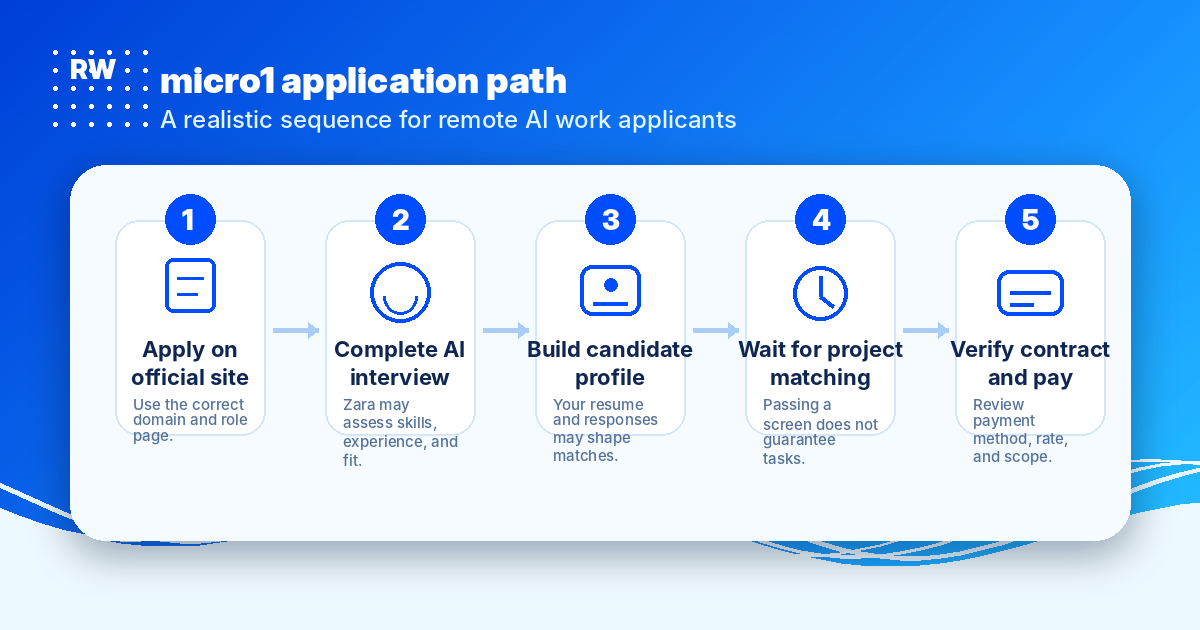
This is the same broad category that includes platforms people often search for alongside micro1, including Mercor, Handshake AI, Outlier, DataAnnotation, Turing, Alignerr, and other remote AI work marketplaces. The details vary by company, but the applicant pattern is often similar: create a profile, submit a resume, complete a skills screen or interview, wait for matching, and then work on projects if selected.
The important point is that micro1 should not be understood as a simple survey app or instant gig app. It is closer to an AI talent pipeline. That means skills, communication, availability, country eligibility, interview performance, domain expertise, and project demand can all affect whether you receive work.
What "Legit" Actually Means for Remote AI Jobs
When people ask whether micro1 is legit, they often mean several different things at once: Is micro1 a real company? Are there real remote AI jobs? Does the application process actually lead to paid work? Is the Zara AI interview real? Is it safe to upload a resume or complete an AI interview? Will I personally get paid?
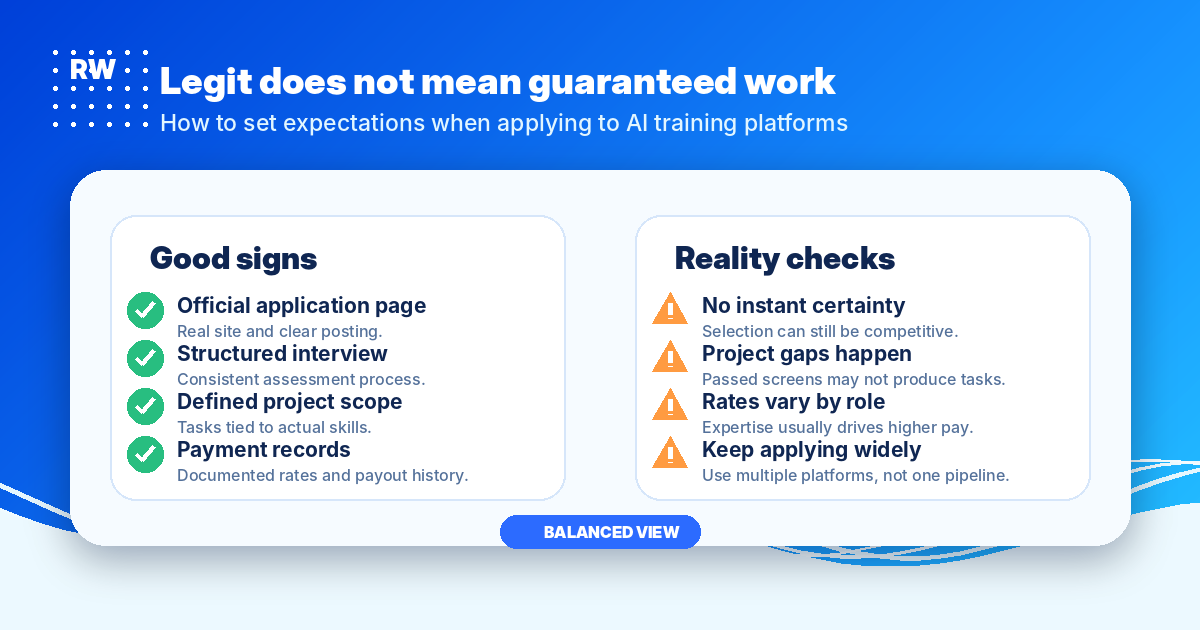
Those are not the same question. A platform can be real and still not be a guaranteed source of income. A company can have legitimate clients and still reject most applicants. A project can pay well and still disappear when client demand changes. A profile can be approved and still sit with no active tasks.
Key distinction: Legitimacy means the platform is real, uses official channels, and does not charge applicants to start. Reliability means it consistently provides enough work to matter financially. Evaluate both before depending on any single platform.
What to Know Before Taking the Zara AI Interview
The Zara AI interview is one of the main reasons applicants search for micro1. Before taking it, treat it like a real professional screening. Do not treat it like a casual chatbot conversation.
Prepare the same way you would prepare for a remote contract interview: review the job description before the interview, know your resume and be ready to explain specific experience, use a quiet room with stable internet, answer directly instead of rambling, explain your reasoning when asked judgment-based questions, and avoid exaggerating skills you cannot demonstrate.
For AI training roles, the strongest answers are specific. Instead of saying "I am good at writing," explain the kind of writing you do, the topics you understand, the editorial standards you follow, and how you judge whether an answer is accurate. Instead of "I know finance," mention analysis, modeling, valuation, accounting, markets, risk, or compliance — whatever applies to your actual background.
The Privacy Question: What Data Are You Sharing?
Before applying to any AI recruiting platform, read the privacy notice and candidate data policy. This matters more with AI interviews because the process may involve more than a resume upload. Depending on the platform and role, an AI interview process may involve resume data, profile data, interview audio, video, transcripts, screen information, proctoring signals, assessment results, and matching data.
That does not automatically mean the platform is unsafe. It means you should understand what is collected, why it is collected, how long it may be retained, who can access it, and whether you can request deletion or review.
A simple rule: share professional application data only through official channels, and do not provide sensitive information until you have verified the company, role, contract, and payout process.
How to Verify You Are Applying Through the Real micro1
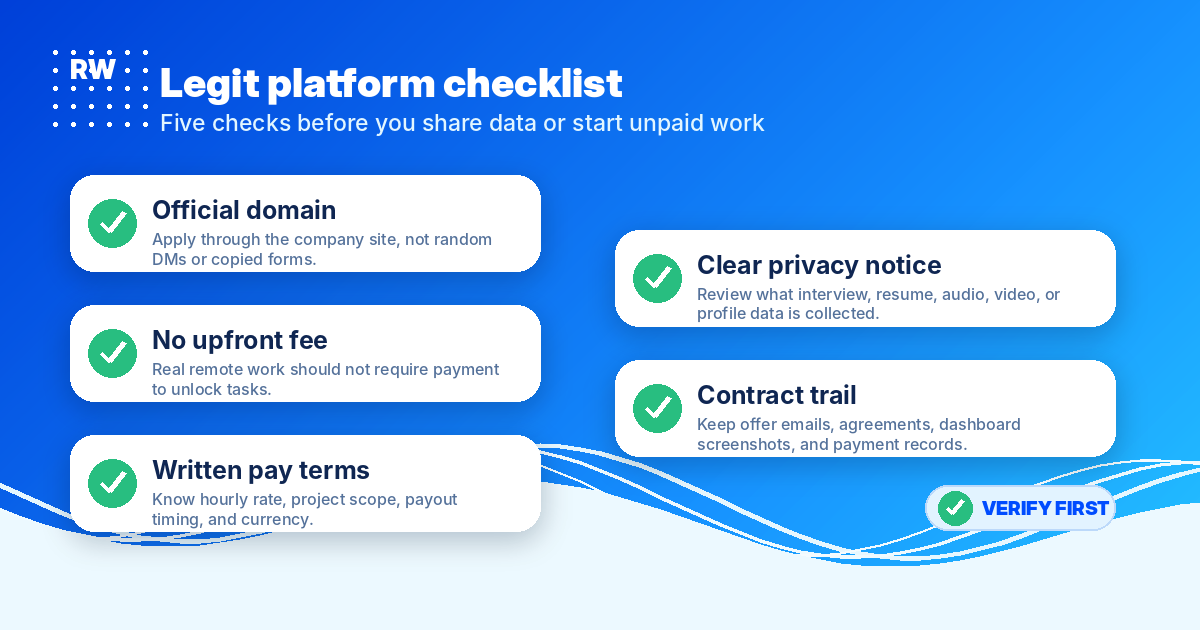
Scammers copy real company names because recognizable brands make applicants lower their guard. Before applying, check these items:
The website domain. Use the official company website or a role page linked from it. Be cautious with lookalike domains, misspellings, extra hyphens, or forms hosted on random sites.
The sender email. A real company email should come from an official domain. Be careful with Gmail, Outlook, ProtonMail, Telegram, WhatsApp-only communication, or recruiter emails that cannot be verified.
The application path. The process should make sense: role page, application form, interview, profile, contract, and project assignment. If someone skips straight to "send payment" or "send bank details," stop.
The no-fee rule. You should not pay to apply, pay to unlock a remote job, pay for mandatory software through a recruiter, or send a deposit to receive tasks.
Red Flags That the Opportunity Is Not Legitimate
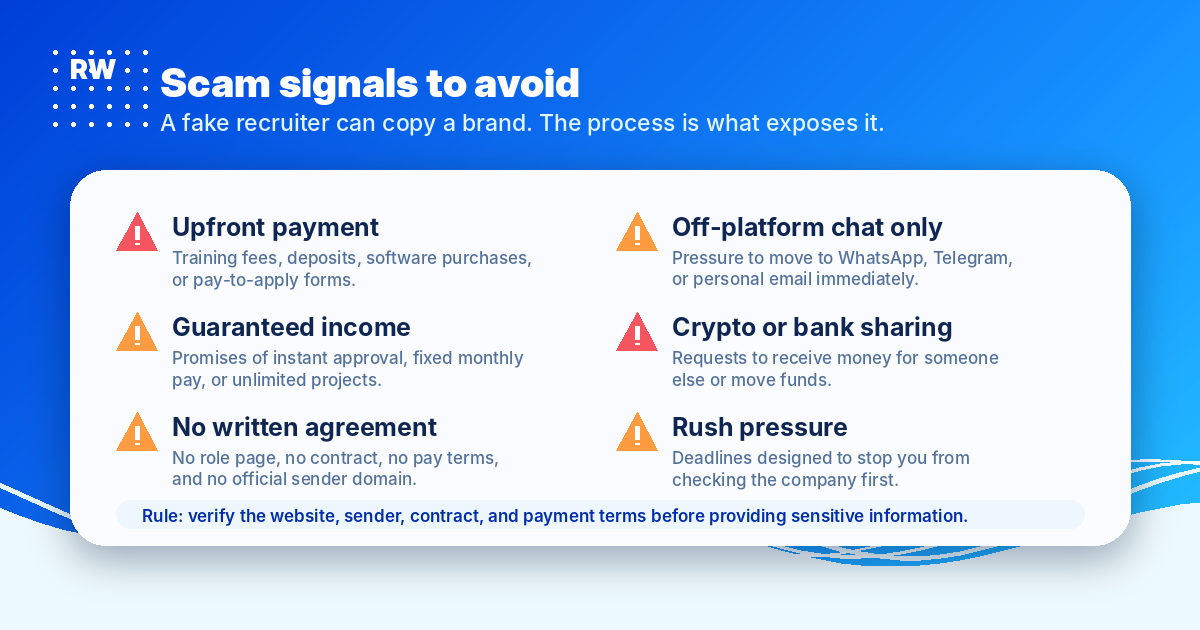
Even if micro1 is real, a message claiming to represent micro1 may not be real. Watch for these signals:
- A recruiter asks for upfront payment
- You are promised guaranteed income before screening
- You are told to buy equipment from a specific vendor with a mailed check
- You are asked to receive money and forward it elsewhere
- You are pushed to crypto payments or wallet transfers
- You are asked for bank login, verification codes, or full identity documents too early
- The job has no official role page and the sender refuses to use official email
- The pay sounds unrealistic for the skill level and task type
These red flags apply not only to micro1, but also to fake versions of Mercor, Handshake AI, Outlier, DataAnnotation, and other remote work platforms.
Remote Work Union connects you to legitimate AI training and evaluation roles. Start your application today.
Find Roles Hiring Now →How Much Can micro1 Pay?
Pay can vary widely. Remote AI training jobs may pay differently based on role, country, project, client, skill level, and domain expertise. General annotation work usually pays less than expert review. Coding, advanced math, law, finance, medicine, cybersecurity, technical writing, and specialized research can pay more when demand is high. When evaluating a micro1 role, look for the actual rate on the specific listing or agreement. Do not rely only on screenshots from other workers in different countries or skill categories.
Ask these questions before you count the income: Is the rate hourly, per task, or milestone-based? How often are payouts sent? What payment method is used? Are there minimum payout thresholds? Can work volume fluctuate week to week? The best way to think about AI training income is as a pipeline, not a paycheck.
What If micro1 Does Not Respond After You Apply?
No response does not automatically mean the platform is fake. It can mean the role is full, your profile did not match, your country is not eligible for that project, your interview score was not high enough, or there are no active projects for your skill set.
If you do not hear back: check that you applied to the correct role and official site, review your resume for keywords that match the job description, improve your profile with clearer skills and stronger work examples, apply to roles that match your real background, and keep a spreadsheet of applications, dates, emails, and status. Apply to multiple legitimate platforms instead of waiting on one.
Who Should Apply to micro1?
micro1 may be worth considering if you have skills that can transfer into AI training, model evaluation, or expert review. Good candidates often include writers and editors who can judge clarity, tone, and accuracy; software engineers who can evaluate code and technical answers; researchers who can fact-check and synthesize information; finance professionals who understand analysis or accounting; legal professionals who can review reasoning and document logic; marketers and SEO specialists who understand content quality; teachers and tutors who can explain concepts clearly; and bilingual professionals who can evaluate language quality.
The stronger strategy is to position your real skills in a way AI training platforms can understand. "Marketing experience" is broad — "SEO content strategy, keyword research, conversion copywriting, and analytics reporting" is much stronger. "Finance background" is broad — "financial modeling, valuation, accounting review, and public markets research" is stronger.
Frequently Asked Questions
Is micro1 a legitimate company?
micro1 appears to be a real AI talent and human data platform. However, legitimate does not mean guaranteed income. A real platform can still have competitive screening, limited project availability, or uneven applicant experiences. Always verify the official domain, read the privacy policy, and apply through official channels.
What is the Zara AI interview on micro1?
Zara is micro1's AI recruiter and interviewer. It conducts automated interviews for applicants and may involve audio, video, screen sharing, and assessment data. Prepare as you would for a real professional interview: review the job description, have clear examples ready, and explain your reasoning directly.
What should I do if micro1 does not respond after I apply?
No response can mean your profile did not match, the role filled, your country is not eligible, or the platform is still reviewing. Check your dashboard and spam folder first, then improve your profile keywords, apply to better-fit roles, and keep applying to other legitimate AI training platforms while you wait.