Reviewing chatbot answers sounds simple until you are staring at two long responses, a task rubric, and a timer. Many new AI evaluators slow themselves down because they try to rewrite the answer in their head, research every small claim, or find the perfect reason for every rating. That is usually the wrong approach.
In remote AI training work, your job is not to become the chatbot's editor, lawyer, teacher, and safety team all at once. Your job is to make a clear, consistent judgment about whether an answer satisfies the user's request. The best reviewers are not the people who overanalyze every word. They are the people who can identify the main issue, apply the instructions, and explain their decision in plain language.
What Reviewing Chatbot Answers Actually Means
A chatbot answer review usually asks you to judge one or more model outputs. You may compare two responses, rate one response on a scale, identify factual errors, flag safety problems, or write a short explanation of why one answer is better. The format changes by platform, but the underlying skill is the same: evaluate whether the response helps the user in a reliable way.
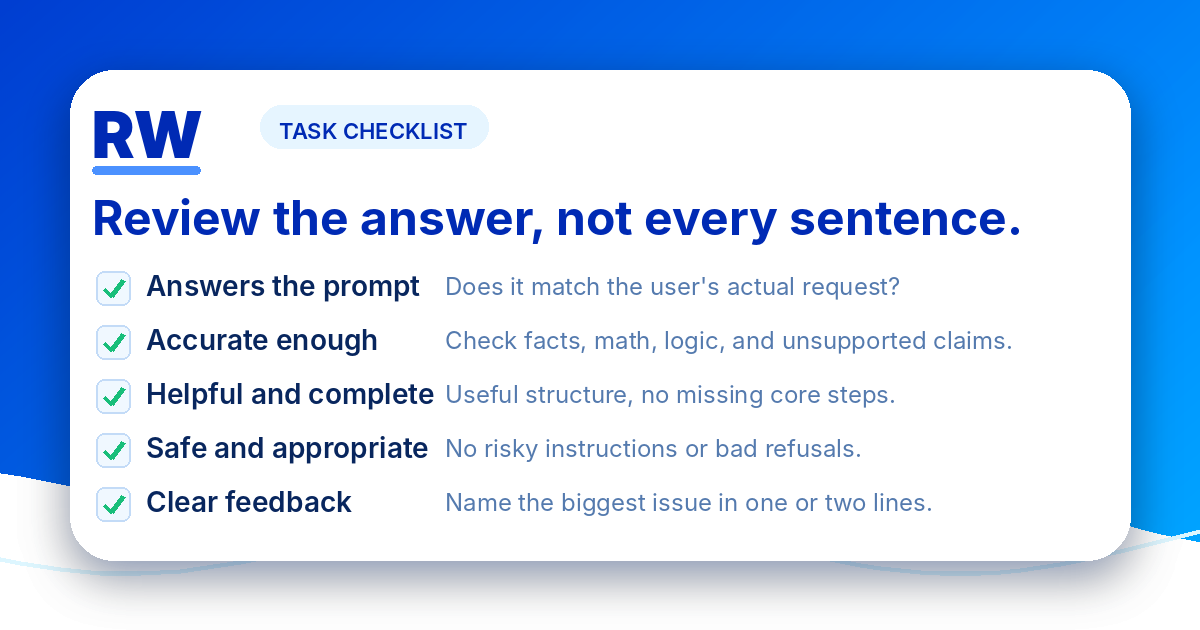
Most tasks are built around a few core dimensions: helpfulness, accuracy, instruction following, safety, clarity, and completeness. You do not need to invent a new standard for every task. You need to read the prompt, understand the user's intent, check the answer against the rubric, and make the most defensible rating.
Why Overthinking Makes You Worse at AI Evaluation
Overthinking feels responsible, but it often produces weaker work. When you spend too much time on minor wording, you lose sight of the user's actual request. When you search for perfect proof on every minor claim, you may miss the one major factual error that should decide the rating. When you write a long explanation, you may make your feedback harder to grade.
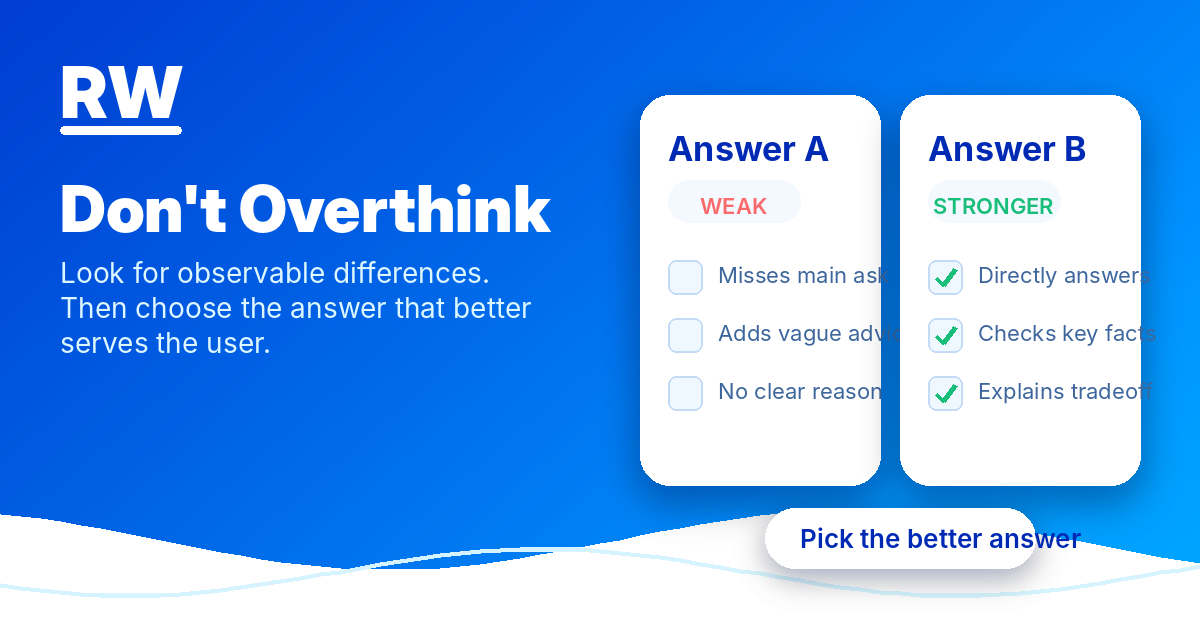
Good reviewers stay focused on observable differences. Did the answer follow the prompt? Did it make a factual error? Did it refuse when it should have answered? Did it give unsafe advice? Did it leave out a key step? Those are rating-relevant issues. Small preferences, minor phrasing differences, and style quirks usually matter only when the responses are otherwise close.
The Simple Review Order
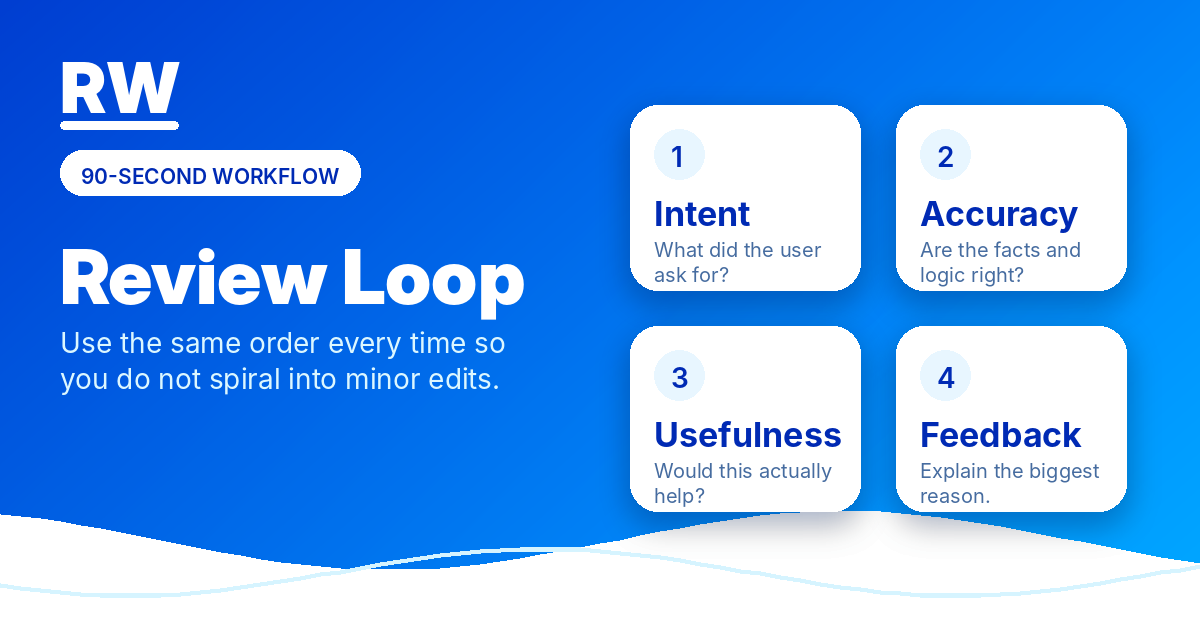
Use the same order every time. First, read the user's prompt and identify the main request. Second, read the task instructions or rubric. Third, check whether the answer directly addresses the request. Fourth, look for accuracy, logic, and safety issues. Fifth, compare usefulness and clarity. Sixth, write the shortest explanation that captures the biggest reason for your rating.
This order matters because it prevents you from getting trapped in details. If the user asked for a budget travel plan and one answer never discusses budget, that may matter more than whether its tone is pleasant.
Start With User Intent
Before judging the answer, ask what the user actually wanted. Were they asking for a direct fact, a comparison, a recommendation, a rewrite, code help, career advice, a summary, or a step-by-step plan? The answer should be evaluated against that intent.
Intent is the anchor. Without it, reviewers drift into personal taste. If the user asks for a concise answer, a long but technically correct response may still fail. If the user asks for a practical application plan, a high-level explanation may be incomplete.
Check Instruction Following Before Style
Instruction following is often the easiest place to make a confident judgment. Did the response do what the user asked? Did it use the requested format? Did it respect constraints like word count, tone, language, number of examples, or no extra explanation?
A response can sound professional and still fail the task. If the user asked for three bullets and the model gave a long essay, that is an instruction-following issue. Do not over-penalize harmless variation, but do not ignore explicit constraints.
Use Accuracy Checks Strategically
Accuracy does not always mean verifying every sentence. It means checking the claims that affect the usefulness of the answer. Focus on numbers, dates, names, laws, medical guidance, technical steps, financial claims, and confident statements that could change the user's decision.
A useful question: if this claim is wrong, would it materially hurt the answer? If yes, check it. If no, keep moving unless the rubric says otherwise.
Rate Helpfulness Like a User, Not a Critic
Helpfulness means the answer moves the user closer to what they wanted. A helpful answer is direct, relevant, structured, and actionable. It does not need to be beautiful. When two answers are both mostly accurate, helpfulness often decides the better response. Choose the one that better solves the user's problem.
Remote Work Union connects you to legitimate remote AI evaluation and chatbot review roles. Apply for free to find roles hiring now.
Find Roles Hiring Now →Do Not Confuse Length With Quality
Longer answers are not automatically better. A long answer can be repetitive, unfocused, or filled with unsupported claims. A short answer can be excellent if the user asked for a quick answer. The right length depends on the prompt. Reward useful substance, not word count.
Handle Safety Without Freezing
Safety can feel intimidating because reviewers do not want to miss a risky issue. The practical approach is to identify whether the answer enables harm, gives dangerous instructions, ignores a sensitive context, or refuses a safe request unnecessarily.
Not every serious topic requires refusal. A safe answer can often provide general information, encourage professional help when needed, or redirect away from harmful steps. Safety review is not about being alarmist. Recognize when the answer increases risk or fails to handle risk responsibly, and rate accordingly.
Write Feedback in One or Two Clear Moves
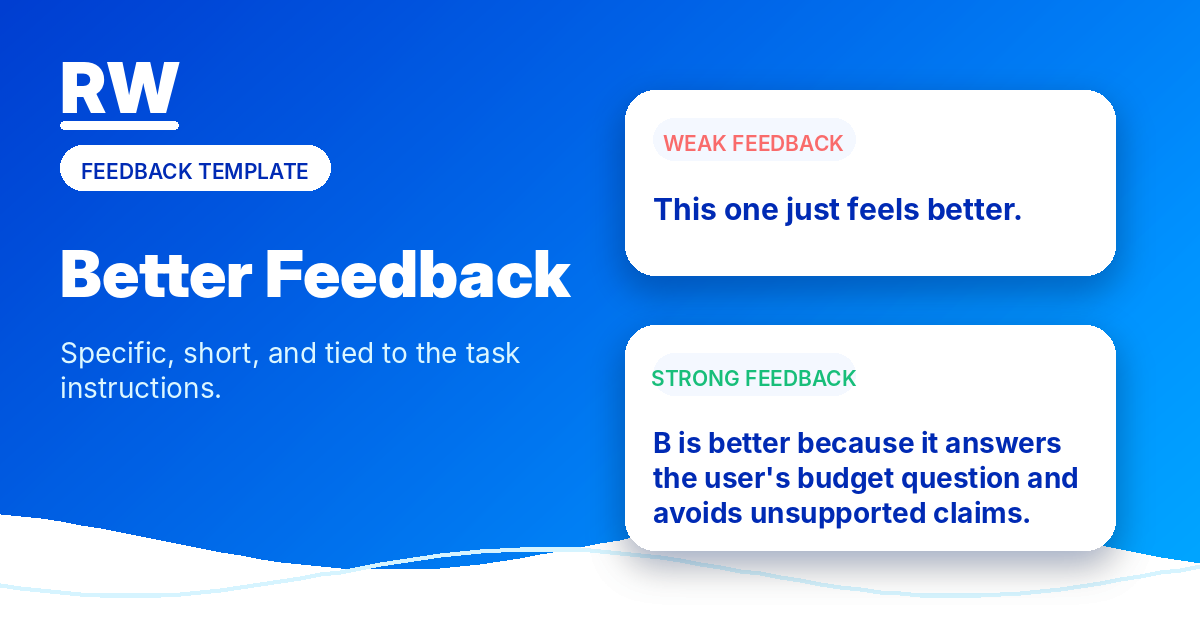
Strong evaluator feedback does not need to be long. A useful structure is: state which answer is better, then give the main reason. If needed, add one supporting detail. That is enough for many tasks.
Weak feedback says, "B is better because it sounds better." Strong feedback says, "B is better because it directly answers the user's question and includes the key limitation that A misses." Weak feedback says, "A is bad." Strong feedback says, "A is worse because it invents a statistic and does not follow the requested bullet format."
Common Traps That Make Reviewers Overthink
The first trap is trying to improve the response instead of rating it. The second trap is treating every style difference as a quality difference. The third trap is searching too broadly when you only need to check one specific claim. The fourth trap is writing feedback for yourself instead of the grader. The fifth trap is being afraid to choose when both responses have flaws.
Tip: In many tasks, you still need to select the better answer even when both responses have problems. A good reviewer is decisive because they know what matters most.
A Practical 90-Second Workflow
For simple side-by-side tasks, use a 90-second review loop:
- 15 seconds: Read the prompt and rubric.
- 25–35 seconds: Read both answers for alignment and obvious issues.
- 20 seconds: Check the most important factual or safety concern.
- 10 seconds: Choose the stronger response.
- 10–20 seconds: Write the reason.
Complex tasks may take longer, especially legal, medical, coding, finance, or research-heavy prompts. But the same structure still helps. The timer is not a rule; it is a discipline. It reminds you to review in order instead of drifting into endless analysis. The more you practice, the faster you will spot decisive differences.
Frequently Asked Questions
What does reviewing chatbot answers actually involve?
Chatbot answer review usually asks you to judge one or more model outputs. You may compare two responses, rate one on a scale, identify factual errors, flag safety problems, or write a short explanation of why one answer is better. The underlying skill is evaluating whether the response helps the user in a reliable way.
Why does overthinking make AI evaluators worse?
Overthinking often causes evaluators to lose sight of the user's actual request. When you spend too much time on minor wording, you may miss the one major factual error that should decide the rating. Good reviewers stay focused on observable differences that affect the user's outcome.
What is the 90-second review workflow?
The 90-second workflow is: 15 seconds on the prompt and rubric, 25-35 seconds reading both answers for alignment and obvious issues, 20 seconds checking the most important factual or safety concern, 10 seconds choosing the stronger response, and 10-20 seconds writing the reason. Complex tasks may take longer, but the structure still applies.
How do I handle safety concerns without freezing during a review?
Identify whether the answer enables harm, gives dangerous instructions, ignores a sensitive context, or refuses a safe request unnecessarily. Not every serious topic requires refusal. Safety review is not about being alarmist. Recognize when the answer increases risk or fails to handle risk responsibly, and rate accordingly.