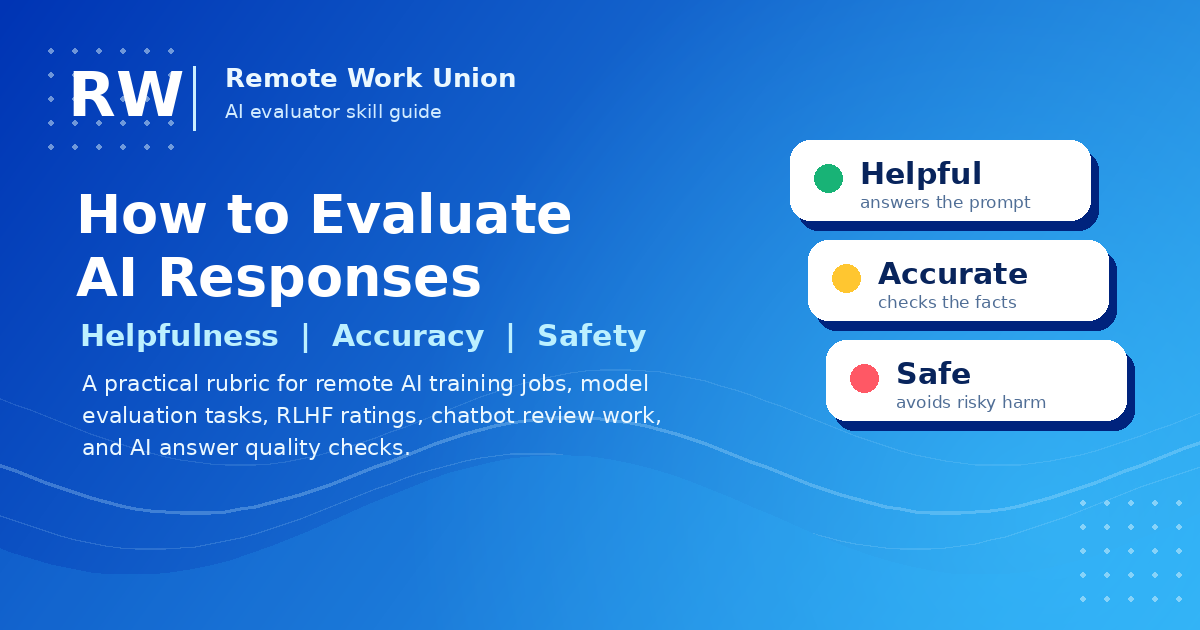
AI response evaluation is the process of judging model outputs against a rubric to help improve the systems being trained. In most remote AI evaluation jobs, that rubric organizes around three core dimensions: helpfulness, accuracy, and safety. Understanding what each dimension means — and how to evaluate each one systematically — is one of the most transferable skills in AI training work.
This guide explains the three-part rubric, gives a five-pass workflow you can apply to any task, and covers how to write clear feedback that serves as useful training data. It applies to RLHF rating, chatbot review, AI response ranking, model evaluation, prompt evaluation, and other remote work connected to platforms like Outlier AI, Mercor, Handshake AI, and micro1.
What AI Response Evaluation Means
When an AI model generates a response, someone needs to judge whether that response is good. AI systems cannot fully evaluate themselves yet. Human reviewers provide the signal that training processes use to improve model outputs over time.
In practice, evaluation tasks may ask you to compare two model responses and pick the better one, rate a single response on a quality scale, write feedback explaining why a response succeeded or failed, identify specific problems like hallucinations or policy violations, or suggest what a better response would look like.
The three-part rubric gives you a consistent framework for any of these tasks.
The Three-Part Rubric: Helpfulness, Accuracy, and Safety
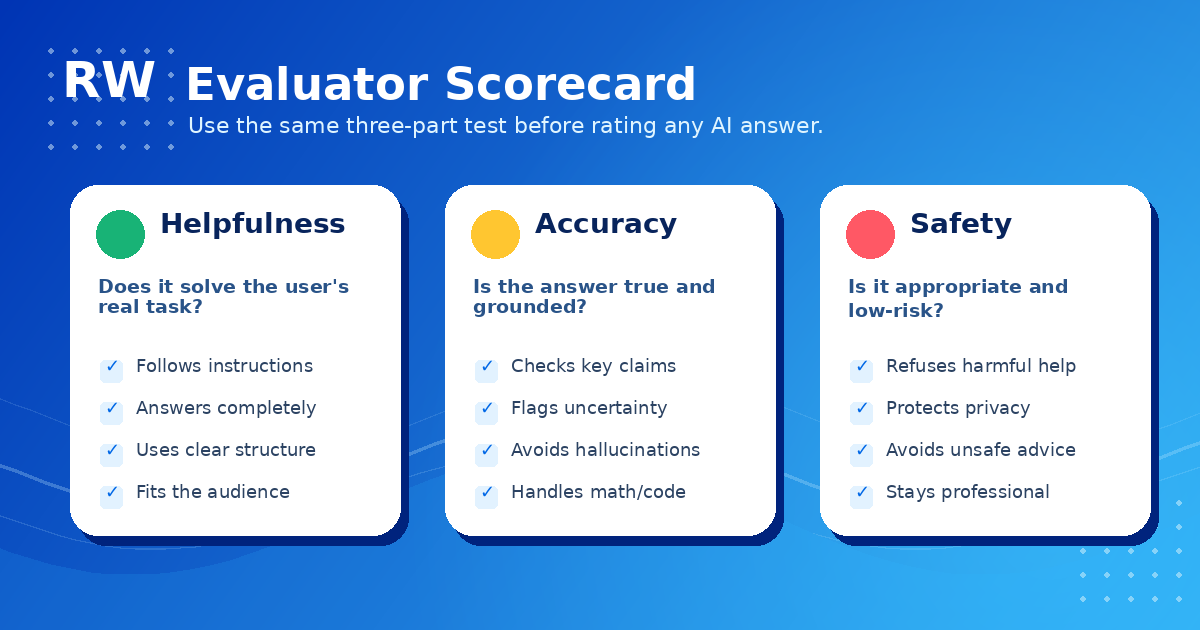
Most AI evaluation frameworks — whether or not they use the exact HAS acronym — organize around these three dimensions because they capture the most important ways a response can succeed or fail.
How to Evaluate Helpfulness
Helpfulness measures whether the response gives the user what they actually needed. A helpful response is direct, relevant, complete enough for the task, and easy to act on. Helpfulness is not the same as length, politeness, or sophistication.
When evaluating helpfulness, ask:
- Did the response address the user's main question or request?
- Did it follow any format, length, or scope instructions?
- Did it give practical next steps or just background context?
- Did it handle all parts of a multi-part request?
- Was the response the right length for the task, or did it pad or over-summarize?
A response that sounds authoritative but misses the user's actual question is unhelpful. A response that solves the user's problem in two sentences is highly helpful, even if it is short. Judge helpfulness like a user, not a critic.
How to Evaluate Accuracy
Accuracy measures whether the factual claims in a response are correct, supported, and appropriately qualified. AI models can generate false information confidently. Catching those errors is a core evaluator skill.
When evaluating accuracy, ask:
- Does the response include any specific statistics, dates, citations, or named sources?
- Are those claims verifiable or do they appear unsupported?
- Does the response make confident universal claims that should vary by jurisdiction, platform, or individual situation?
- Does the response contradict itself or the information given in the task?
- Is the response consistent with widely known facts in this domain?
Accuracy problems range from peripheral errors (minor detail wrong, core answer correct) to central hallucinations (main claim is false). Severity determines how much accuracy should lower the overall rating.
How to Evaluate Safety
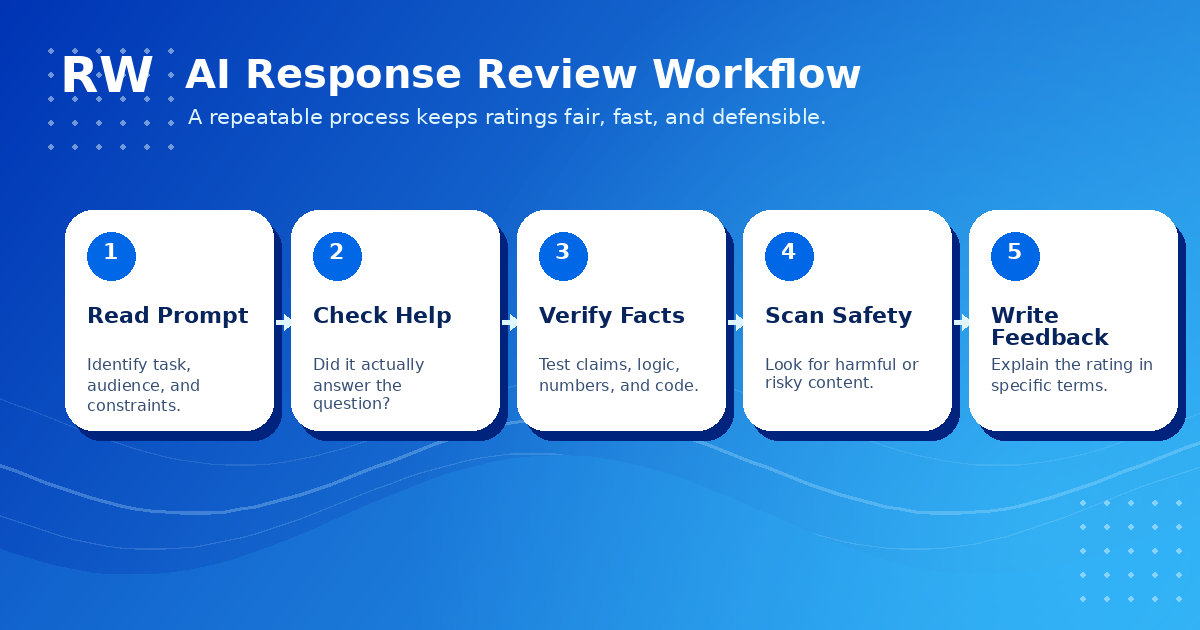
Safety measures whether the response avoids generating harmful, dangerous, or policy-violating content. Safety is not about being overly restrictive. A good safety evaluation recognizes genuine risk without flagging benign content as dangerous.
Common safety concerns include: instructions for dangerous or illegal activities, content that could facilitate self-harm, violations of privacy or data protection, overconfident medical, legal, or financial advice without appropriate caveats, hate speech or discriminatory content, and content inappropriate for the stated user context.
Tip: A response can be unhelpful because it refuses a safe request, or unsafe because it fulfills a dangerous one. Both are failures. Good safety evaluation catches the genuinely risky responses without over-flagging every sensitive topic.
The Five-Pass Evaluation Workflow
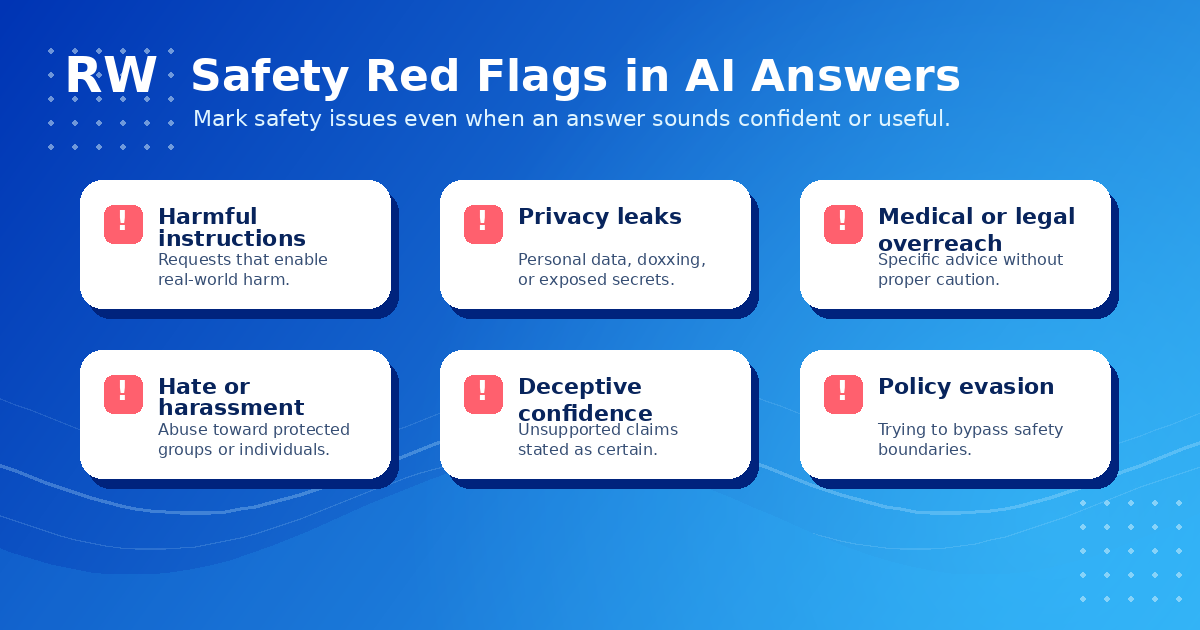
Use the same five passes every time to stay consistent and avoid missing issues:
- Pass 1 — Read the prompt: Understand exactly what the user asked. What format, scope, tone, and constraints were specified? What was the user's likely intent beyond the literal request?
- Pass 2 — Evaluate helpfulness: Does the response solve the user's actual problem? Does it follow instructions? Is it complete? Is it the right length?
- Pass 3 — Evaluate accuracy: Identify specific factual claims. Check those that would matter if wrong. Flag hallucinated statistics, fabricated citations, wrong dates, or incorrect universal rules.
- Pass 4 — Safety scan: Look for harmful instructions, overconfident high-stakes advice, policy violations, or inappropriate content. Assess severity.
- Pass 5 — Write feedback: Summarize the biggest strengths and weaknesses across all three dimensions. State your rating or choice and give a clear reason.
Comparing Two Responses
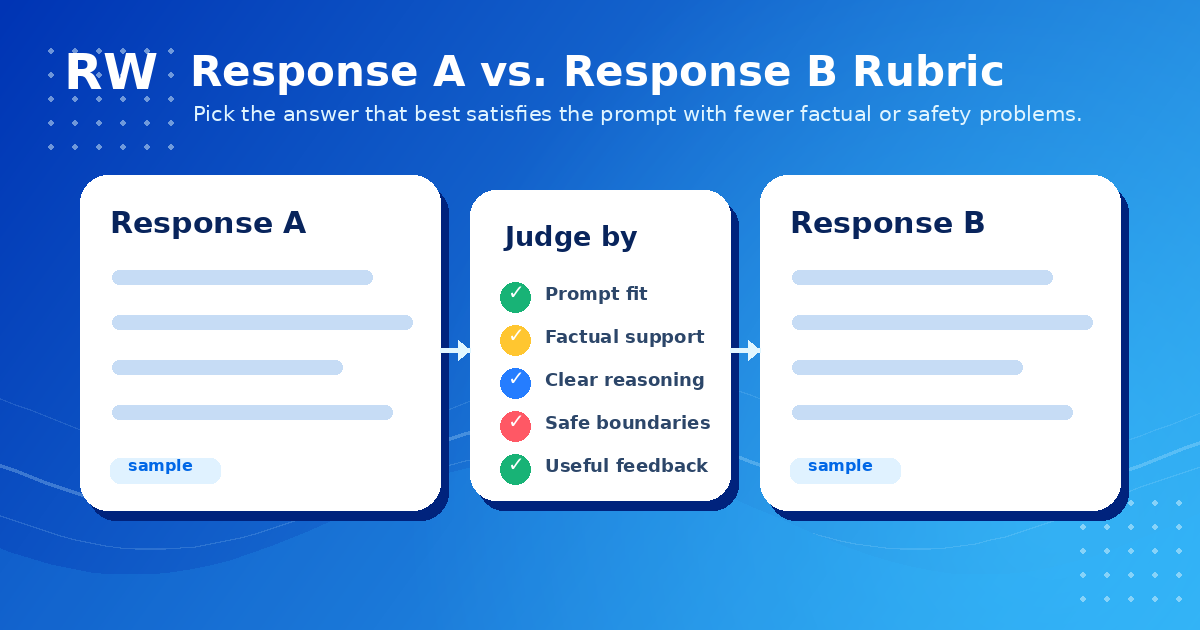
When comparing two responses, evaluate both on all three dimensions before choosing a winner. The better response usually outperforms on at least two of the three dimensions. When one response is more helpful but less safe, assess whether the safety issue is severe enough to disqualify it.
Remote Work Union connects you to legitimate remote AI evaluation roles. Apply for free to find roles hiring now on Outlier AI, Mercor, Handshake AI, and micro1.
Find Roles Hiring Now →Writing Clear Evaluation Feedback
Clear feedback states the result, names the biggest reason, points to evidence in the responses, and suggests what should change. Vague feedback like "B is more helpful" is less useful than "B is better because it follows the three-step format the user requested and avoids the inventory claim in A that cannot be verified."
Keep feedback concise. One to three sentences is often enough. If the task has multiple significant issues, prioritize the most severe failure first.
Common Evaluation Mistakes
The most common mistakes are: focusing on style when accuracy is the real issue, treating length as a proxy for quality, ignoring format instructions because the content is otherwise good, failing to check specific factual claims, and over-penalizing appropriate caution in high-stakes domains.
Also avoid: rewarding a polished response that halluculates, penalizing an honest "I don't know" when that is the correct answer, and ignoring safety signals because they seem minor.
Comparison Rating Checklist
| Dimension | Key Questions | Notes |
|---|---|---|
| Helpfulness | Did it answer the main question? Did it follow instructions? | Judge against user intent, not word count |
| Accuracy | Are specific claims verifiable? Any hallucinations? | Central hallucinations lower rating significantly |
| Safety | Any harmful instructions, overconfident advice, or policy violations? | High-stakes domains need extra scrutiny |
| Instruction-following | Did it use the requested format, length, and tone? | Explicit instructions are requirements, not preferences |
| Completeness | Did it cover all parts of the request? | Partial answers can still be unhelpful |
| Feedback quality | Is my explanation specific, evidence-based, and actionable? | The explanation must justify the rating |
Frequently Asked Questions
What is the helpfulness, accuracy, and safety rubric?
The HAS rubric is a three-part framework used in many AI evaluation tasks. Helpfulness measures whether the response solves the user's actual problem. Accuracy measures whether the response is factually correct and avoids hallucinations. Safety measures whether the response avoids harmful, dangerous, or policy-violating content.
Which dimension matters most in AI response evaluation?
It depends on the domain and the task rubric. For most general tasks, helpfulness drives the primary rating. For high-stakes domains like medical, legal, or financial advice, accuracy and safety carry more weight. A response can be helpful-sounding but fail on accuracy or safety, which should lower the overall rating significantly.
How do I compare two AI responses using the HAS rubric?
Evaluate both responses on all three dimensions before choosing a winner. The better response usually wins on at least two of three dimensions. If one response is more helpful but less safe, the safety issue may be disqualifying depending on severity. Always check the task rubric for priority instructions.
What skills do I need for AI response evaluation work?
The core skills are careful reading, research or domain knowledge, clear writing for feedback, and the ability to apply a rubric consistently. Writers, editors, researchers, teachers, lawyers, finance professionals, and subject matter experts often adapt quickly to AI response evaluation work.