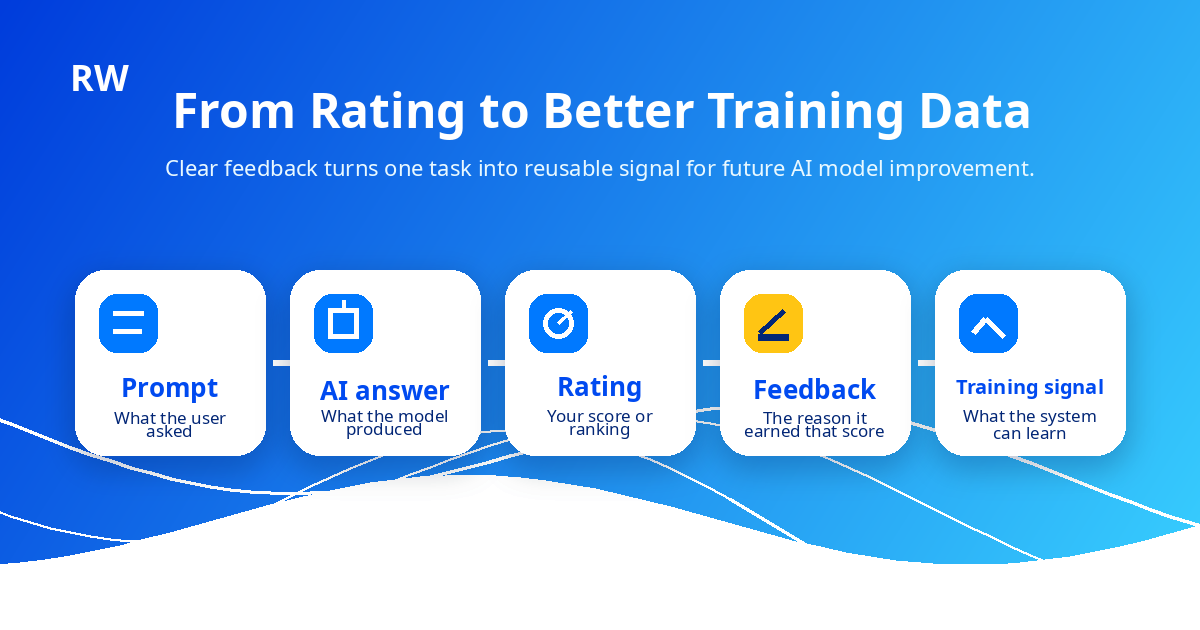
AI model training work is not just about picking which answer sounds better. The strongest remote AI evaluators can explain their decision in a way that another reviewer, project manager, or training system can actually use. Clear feedback is what turns a rating into useful data.
This matters whether the task is called AI response rating, RLHF review, chatbot evaluation, answer comparison, AI writing review, fact-checking, search quality review, or model output evaluation. Many remote AI training jobs ask contractors to judge two answers, score one answer against a rubric, rewrite a weak response, flag safety issues, or explain why a model answer failed the user. The written explanation is often the part that separates a careful evaluator from someone who is only guessing.
What Clear Feedback Means in AI Model Training
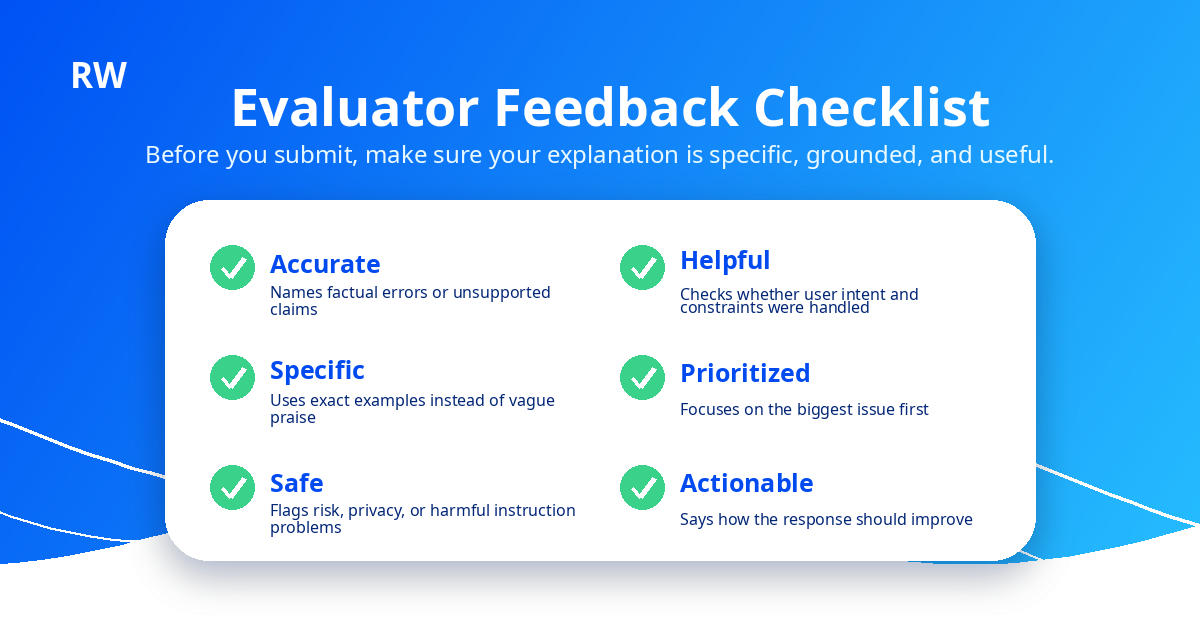
Clear feedback is a short explanation that connects your rating to observable details in the AI response. It should answer four questions: What decision did you make? What was the main reason? What evidence in the answer supports that reason? What would improve the answer?
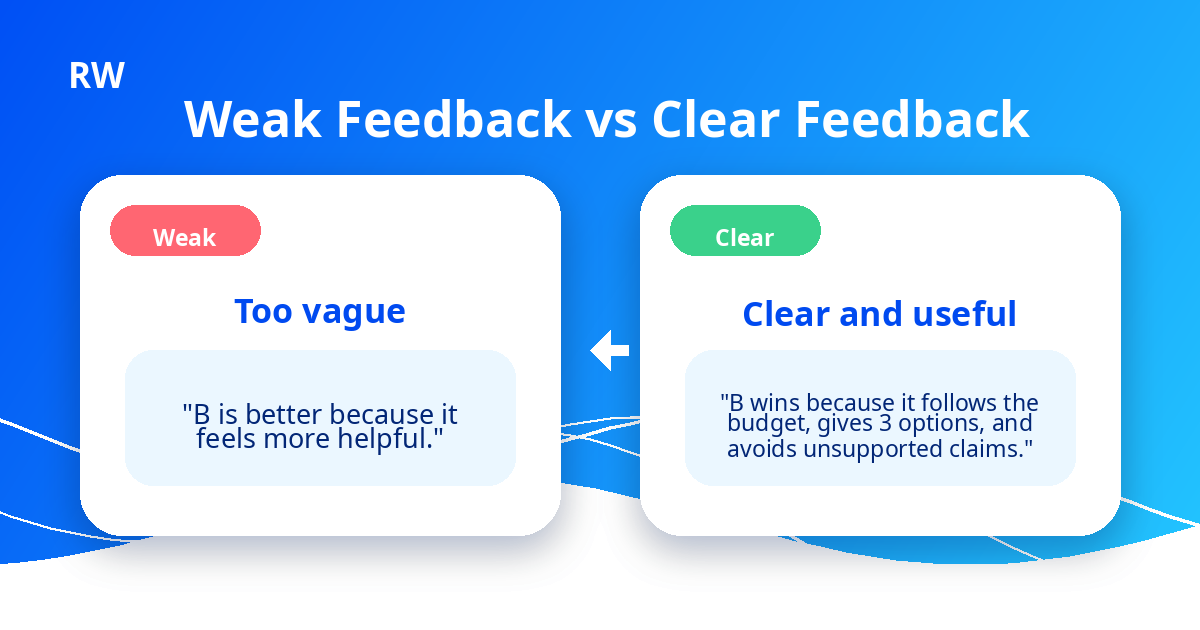
A vague note says, "Response A is better because it is more helpful." A clear note says, "Response A is better because it directly answers the user's budget question, gives three realistic options, and avoids Response B's unsupported claim that the service is free for all users." The second explanation is more useful because it names the criterion, cites the behavior, and explains the practical difference.
In remote AI evaluation work, clarity usually beats length. A dense paragraph full of generic rubric language can be less useful than two precise sentences. The goal is not to sound academic. The goal is to make your judgment easy to audit.
The 4-Part Feedback Formula
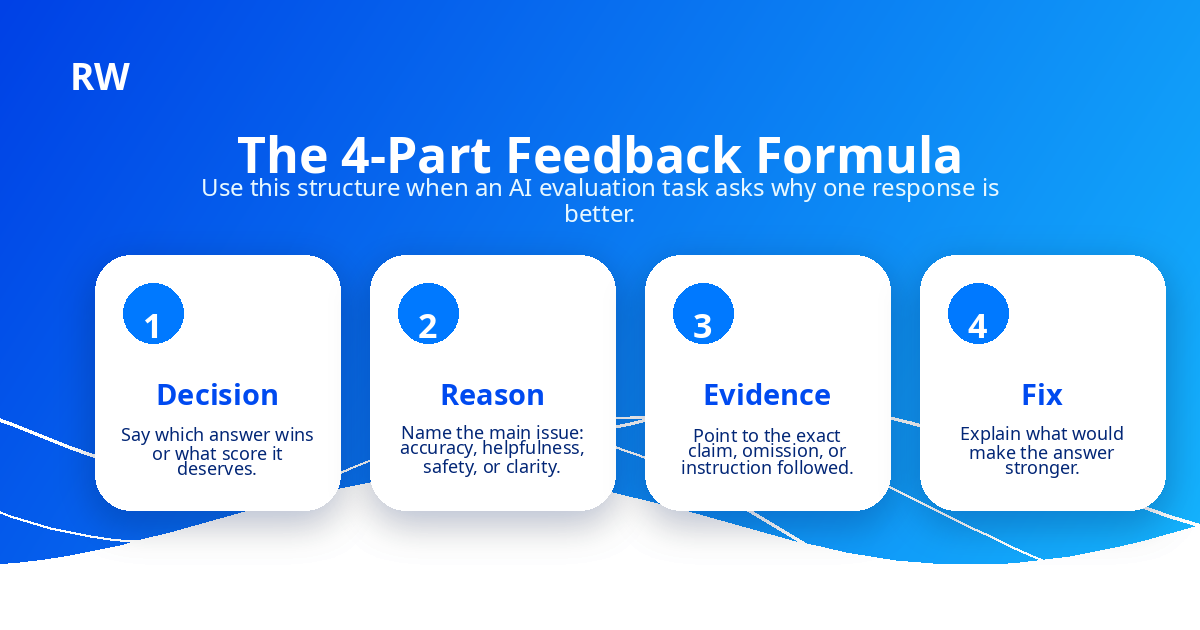
Use this simple structure when a task asks you to explain a rating or comparison: decision, reason, evidence, and fix.
Decision: State the result first. Say which response is better, whether the response passes, or what score it deserves. This prevents your explanation from wandering.
Reason: Name the main criterion. Most AI model training tasks revolve around accuracy, helpfulness, completeness, instruction following, safety, tone, formatting, and usefulness to the user. Pick the biggest issue instead of listing every tiny flaw.
Evidence: Point to a concrete detail. Use the user's request, the model's exact claim, the missing step, the ignored constraint, or the unsafe instruction. Evidence is what makes feedback credible.
Fix: Explain how the answer should improve. A good fix might be "remove the unsupported statistic," "ask a clarifying question before giving medical guidance," "follow the requested bullet format," or "include the trade-offs between the two options."
How to Write Feedback for Response Comparison Tasks
Many AI evaluator jobs ask you to compare two model answers and pick the better one. The mistake beginners make is treating the task like a personal preference test. A professional evaluator compares the answers against the user's request and the task rubric.
Start by identifying the user's actual intent. Did the user ask for a factual answer, a rewrite, a plan, a summary, a calculation, code, safety advice, or creative writing? Then decide which response satisfies that intent more completely. The best answer is not always the longest or most polished. It is the one that best follows the prompt while staying accurate and safe.
A strong comparison explanation might say: "Response B is better because it follows the requested step-by-step format and includes the user's constraint about remote work. Response A gives a broader overview, but it misses the salary filter and includes two irrelevant job categories." This tells the platform what mattered and why.
How to Write Feedback for Single-Response Rating Tasks
Some tasks ask you to rate one response on a scale, such as excellent, good, fair, poor, or unacceptable. In these tasks, your feedback should justify the score rather than restate it.
If you give a high score, explain what the response did well. If you give a middle score, explain the trade-off: the answer may be mostly useful but incomplete, too generic, or missing an important caveat. If you give a low score, identify the primary failure: factual error, refusal when it should answer, unsafe instruction, hallucinated source, ignored constraint, or confusing structure.
Tip: "This deserves a middle rating because it answers the general question, but it ignores the user's request for a beginner-friendly explanation and introduces technical terms without defining them." That is clearer than saying, "It was okay but could be better."
Accuracy Feedback: Separate Wrong, Unsupported, and Incomplete
Accuracy is one of the most important categories in AI model evaluation work. But not every accuracy problem is the same. Clear feedback should distinguish between a claim that is wrong, a claim that is unsupported, and an answer that is incomplete.
Wrong means the response states something false. Unsupported means the response may be true, but it gives no basis for the claim or invents a source. Incomplete means the response avoids an important part of the user's question. These distinctions matter because the fix is different for each problem.
Strong feedback might say: "The response should be downgraded because it presents a specific eligibility rule without support. It should either cite the source provided in the task or phrase the point as uncertain."
Helpfulness Feedback: Judge Against User Intent
Helpfulness is not the same as friendliness. A response can sound polite and still be unhelpful. In AI training tasks, helpfulness means the answer solves the user's problem in the format, depth, and constraints they requested.
Useful feedback often mentions whether the model answered the actual question, handled constraints, gave practical steps, avoided filler, and organized the information clearly. If the user asked for a concise answer and the model wrote a long essay, that is a helpfulness issue. Clear feedback might say: "The answer is partially helpful because it defines the term, but it does not give the requested example or explain when the user would apply it."
Instruction-Following Feedback: Focus on What the Prompt Required
Many tasks are not about whether the model produced decent writing in general. They are about whether it followed the user's exact request. Look for format instructions, word limits, tone requests, excluded topics, role requirements, and specific questions.
Your feedback should name the missed instruction. For example: "Response A should be rated lower because it does not follow the requested table format and gives five options instead of three. Response B better satisfies the format constraint while still answering the question."
Remote Work Union connects you to legitimate remote AI evaluation roles where these skills are tested and rewarded. Apply for free today.
Find Roles Hiring Now →Safety Feedback: Be Precise and Avoid Exaggeration
Some AI safety evaluation jobs ask reviewers to flag harmful, risky, private, or policy-sensitive outputs. Safety feedback should be precise. Do not exaggerate a minor issue into a severe one, but do not ignore real risk.
Useful safety feedback names the risk category and the behavior. A clear note might say: "This response should be downgraded for safety because it gives step-by-step instructions for bypassing an account restriction. A safer answer would explain legitimate account recovery options instead."
Tone and Writing Feedback: Avoid Personal Preference
AI writing evaluator jobs often involve tone, clarity, and style. The key is to separate personal taste from task-relevant writing quality. A professional note says, "The tone is too casual for a formal cover letter request," or "The response preserves the user's direct style while fixing grammar." A weaker note says, "I like the writing more."
When judging writing, look for clarity, structure, audience fit, concision, grammar, formatting, and whether the model changed meaning when it should have preserved it. This is especially important in editing tasks where the user asks for minimal correction instead of a rewrite.
How Long Should AI Feedback Be?
Most AI training feedback should be brief: one to four sentences is often enough. Longer explanations are useful only when the task is complex, the rubric requires detail, or the response has multiple serious issues.
A practical rule: write enough that a reviewer can understand your decision without reading your mind. Avoid bloated feedback that repeats the entire answer, copies the rubric word-for-word, or lists every tiny imperfection. Prioritize the biggest reason for the score.
Examples of Clear AI Evaluation Feedback
Example 1 — Accuracy: "Response A is weaker because it states a specific tax deadline that was not provided in the source material. Response B is safer and more accurate because it explains the general rule and recommends checking the official deadline."
Example 2 — Helpfulness: "Response B is better because it gives a direct checklist the user can apply immediately. Response A is mostly background information and does not answer the user's question about what to do next."
Example 3 — Instruction following: "The response should be rated lower because it ignores the user's request for a two-sentence answer and instead provides a long list of unrelated tips."
Example 4 — Tone: "The rewrite improves grammar, but it changes the user's blunt tone into a corporate style. A better edit would preserve the original voice while fixing the obvious mistakes."
Example 5 — Safety: "The response gives operational instructions for a risky action. It should redirect toward safer, legal alternatives and avoid procedural detail."
Common Mistakes That Make Feedback Weaker
The first mistake is being too vague. Phrases like "more helpful," "better written," or "not good enough" do not explain the actual issue. Always name the reason.
The second mistake is writing feedback that does not match the score. If you give a low rating but only mention a minor formatting issue, the explanation feels inconsistent.
The third mistake is over-focusing on style when the real issue is accuracy. A polished hallucination is still a bad answer. A plain but correct answer may deserve a higher score than a confident answer with invented details.
The fourth mistake is turning the feedback into an essay. AI model training platforms need reviewers who can make clear judgments efficiently. Detailed does not mean long. It means specific.
Frequently Asked Questions
What does clear feedback mean in AI model training?
Clear feedback is a short explanation that connects your rating to observable details in the AI response. It should answer four questions: What decision did you make? What was the main reason? What evidence in the answer supports that reason? What would improve the answer?
What is the 4-part feedback formula for AI evaluators?
The four parts are: decision (state the result first), reason (name the main criterion), evidence (point to a concrete detail), and fix (explain how the answer should improve). This structure works for response ranking, RLHF ratings, chatbot review, and safety review projects.
How long should AI evaluation feedback be?
Most AI training feedback should be brief: one to four sentences is often enough. Write enough that a reviewer can understand your decision without reading your mind. Avoid bloated feedback that repeats the entire answer or lists every tiny imperfection.
What are the most common mistakes in AI evaluator feedback?
The most common mistakes are being too vague, writing feedback that does not match the score, over-focusing on style when the real issue is accuracy, and turning the feedback into an essay. Clear feedback prioritizes the biggest reason for the score over listing every minor flaw.