High-paying AI training jobs are not always listed the same way in every country. A role that appears as "AI model evaluator" in one market might be called "AI rater," "AI data annotation specialist," "LLM evaluator," "search quality rater," "AI writing reviewer," "RLHF contractor," or "prompt response evaluator" somewhere else. Some opportunities are fully remote, while others are remote only for applicants in a specific country because of payment systems, tax rules, language requirements, client needs, time zones, or compliance requirements.
That is why country-based searching matters. If you only search for "remote AI jobs," you will miss roles that are targeted to US-based applicants, Canadian English speakers, UK reviewers, Australian evaluators, or bilingual contractors in specific markets. The smartest approach is to search in layers: country, language, expertise, task type, platform, and pay signal.
Why AI Training Jobs Are Different by Country
AI training work is global, but the hiring process is not always global. Large AI companies and AI labs need human feedback from many types of workers: writers, researchers, programmers, lawyers, finance professionals, teachers, healthcare experts, editors, analysts, and everyday English speakers with strong judgment. Platforms that support work connected to OpenAI, Anthropic, Google, Meta, Microsoft, xAI, and other AI ecosystems may need reviewers who understand local language, local culture, local search behavior, or country-specific professional standards.
Country also affects logistics. A platform may support payments in one country before another. A company may require contractors to be in a country where it has a legal hiring pathway. Some clients also prefer reviewers in overlapping time zones so tasks, audits, and feedback cycles move faster.
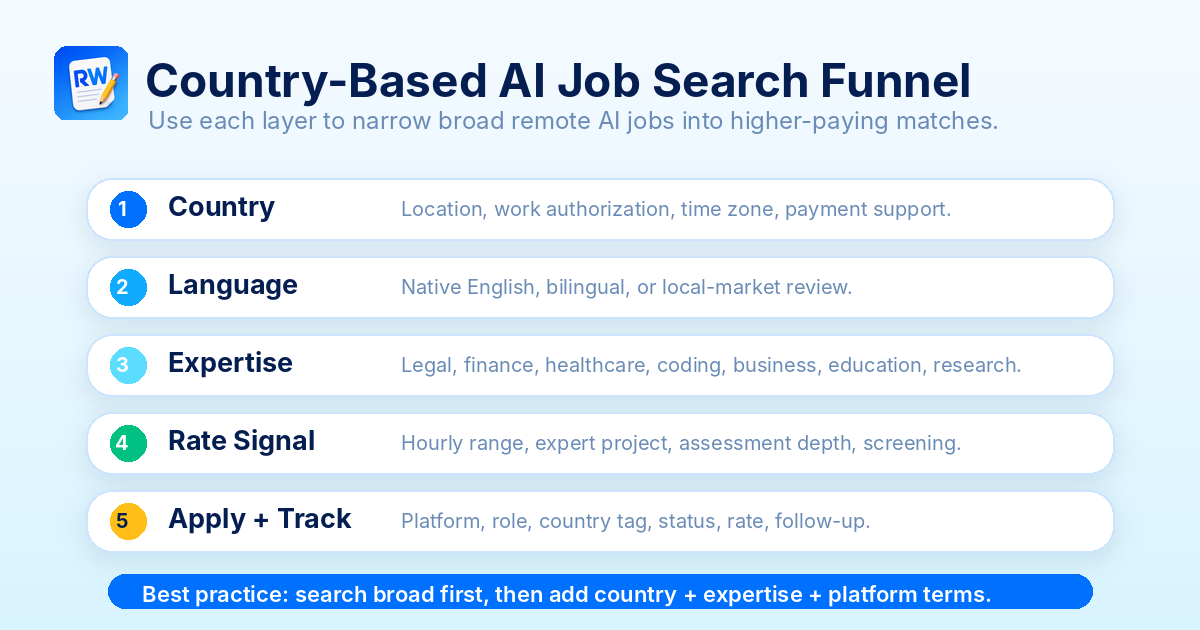
Start With Country-Specific Search Terms
Begin with direct country searches. Do not rely only on the word "remote." Many good AI training roles are remote but still country-restricted. Add your country name, nationality adjective, and common abbreviations. For example, a US applicant should search both "US" and "United States." A UK applicant should search both "UK" and "United Kingdom."
Useful base searches include "AI training jobs United States," "remote AI evaluator jobs Canada," "AI data annotation jobs UK," "AI model evaluation jobs Australia," "LLM evaluator jobs US," "RLHF jobs Canada," "AI writing evaluator United Kingdom," and "remote AI reviewer Australia." Once you find the terms that show real opportunities, combine them with skill and domain keywords.
Use Platform Names With Country Terms
Many applicants search only through broad job boards, but higher-quality AI training roles often appear on specialized platforms or through platform-specific landing pages. Search platform names with your country terms: "Mercor AI jobs US," "Outlier AI jobs Canada," "Handshake AI remote jobs UK," "micro1 AI jobs Australia," "Surge AI jobs United States," "Stellar AI jobs Canada." This strategy works because platform pages, referral pages, job descriptions, social posts, and discussion threads often use slightly different language.
A serious applicant should search across several sources: AI training platforms, LinkedIn, job boards, company career pages, remote work newsletters, niche communities, and referral pages. The best opportunities can move quickly, and not every role is visible through one search engine.
Search by Pay Signals, Not Just Job Titles
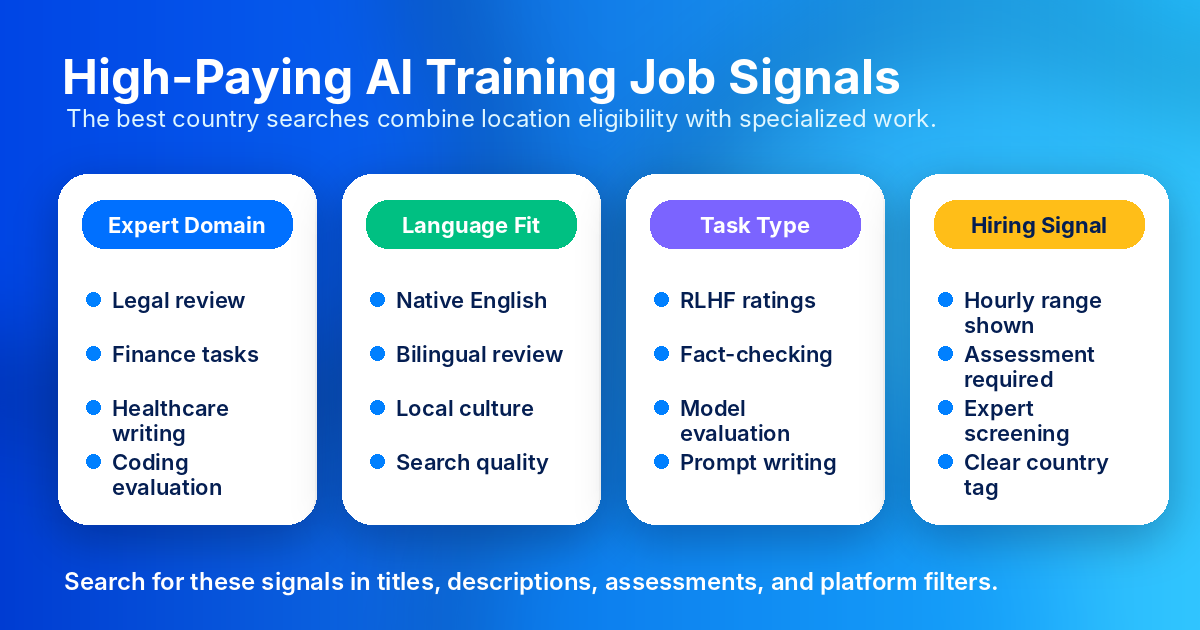
High-paying AI training jobs usually give off clues in the description. Look for phrases like expert review, subject matter expertise, advanced degree preferred, professional background, coding assessment, legal reasoning, finance experience, medical writing, PhD research, technical evaluation, safety evaluation, model behavior review, or complex rubric-based feedback.
A job called "AI Data Annotator" may be low-level labeling, or it may involve detailed reasoning and expert review. When searching by country, add pay-signal terms to the query: "US AI training finance expert," "Canada AI evaluator legal review," "UK AI writing evaluator advanced degree," or "Australia AI model evaluation coding." These searches are more specific, which means fewer results, but the results are often closer to what higher-income applicants are looking for.
Remote Work Union connects you to legitimate remote AI training and evaluation roles. Apply for free and find roles hiring now.
Find Roles Hiring Now →Search by Language and Local Knowledge
English-language AI training roles are especially common, but not all English roles are the same. US English, Canadian English, UK English, and Australian English can differ in spelling, tone, cultural assumptions, search behavior, legal terms, healthcare phrasing, education language, and consumer habits.
Use language-focused searches such as "native English AI evaluator US," "Canadian English AI training jobs," "UK English AI writing reviewer," "Australian English AI data annotation," "bilingual AI evaluator remote," or "localized AI model evaluation jobs." If you speak another language at a high level, add it to your country searches. Bilingual and localization work can be valuable because AI systems need human review across many languages and markets.
Look Beyond General Remote Job Boards
General remote job boards can be useful, but they are noisy. Many listings that mention AI are full-time engineering jobs, sales roles, customer support roles, or software roles that have nothing to do with human AI training. To find AI training work, search for the actual task language: evaluate AI responses, rate model outputs, compare chatbot answers, write prompts, fact-check AI answers, review LLM responses, improve AI model quality, label data, annotate data, or test AI safety.
Use multiple channels. Search LinkedIn with country filters. Search Google with exact phrases. Search platform websites directly. When you find a good listing, copy the strongest phrase from the description and search it with your country as a reverse-search to uncover similar roles.
Build a Country-Based Application Tracker
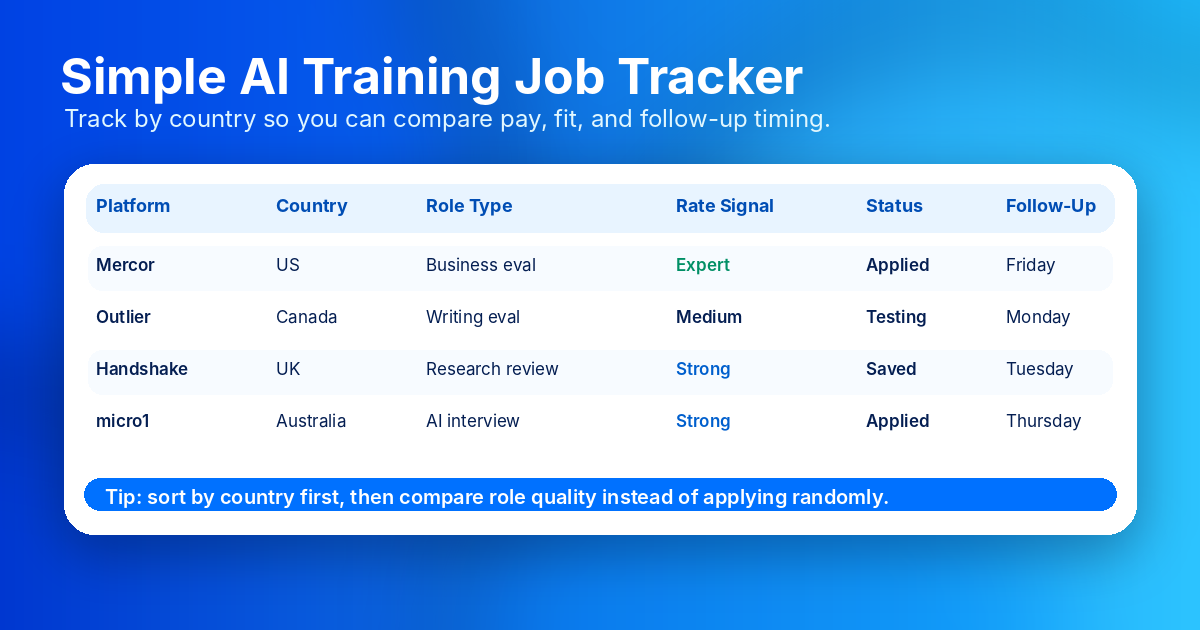
A country-based search only works if you track what you find. Create a simple spreadsheet with columns for platform, job title, country eligibility, remote status, rate or pay signal, expertise required, application date, assessment status, response status, and follow-up date.
Track whether each role is "work from anywhere," "US-only," "Canada-only," "UK-only," "Australia-only," "English-speaking markets," or "country not specified." Also track whether the role is beginner-friendly, writing-focused, expert-level, coding-focused, legal, healthcare, finance, business, research, education, or search quality. Over time, patterns appear.
How to Evaluate Whether a Country-Restricted Role Is Worth Applying To
A country-restricted role is not automatically better. Before applying, check whether the listing explains the task, the expected skills, the contractor status, the pay structure, the payment method, the assessment process, and the location requirement. Be careful with listings that promise unrealistic income, ask for payment from applicants, hide the company name entirely, or require sensitive personal information before a normal application process.
Country Search Examples to Try
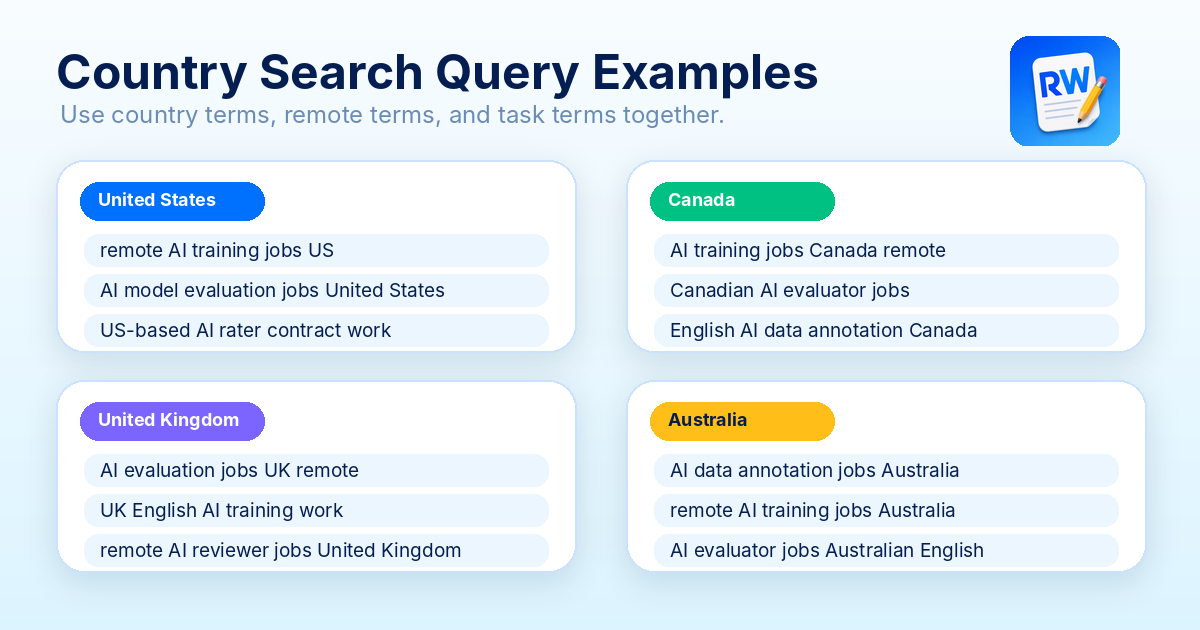
For US applicants: "US-based AI training jobs," "remote AI model evaluation jobs United States," "AI writing evaluator jobs US," "AI data annotation jobs USA," "RLHF contractor US." Then add specialty: legal, finance, healthcare, coding, business, education.
For Canadian applicants: "Canada AI training jobs remote," "Canadian AI evaluator jobs," "AI data annotation Canada English," "remote LLM evaluator Canada," "AI writing reviewer Canada." Add bilingual terms if relevant.
For UK applicants: "AI evaluation jobs UK remote," "UK AI training jobs," "AI writing evaluator United Kingdom," "LLM evaluator UK English," "AI data annotation jobs UK." Add terms like legal, finance, healthcare, academic, editor, journalist, tutor, or researcher.
For Australian applicants: "AI training jobs Australia remote," "AI model evaluator Australia," "Australian English AI evaluator," "AI data annotation Australia," "remote AI writing reviewer Australia." Add local English and time-zone terms where relevant.
Mistakes to Avoid
The biggest mistake is searching too broadly. "Remote jobs" is too wide. "AI jobs" is too wide. You need searches that combine location, task, and skill. The second mistake is assuming a job is global just because it says remote. Always check eligibility. Some roles are remote within one country only.
The third mistake is applying with a generic resume. AI training platforms often care about clear writing, careful judgment, research ability, subject matter expertise, and familiarity with AI tools like ChatGPT, Claude, Gemini, Grok, or other LLM products. Your resume should make those skills obvious. If you have professional expertise, connect it directly to AI review work.
A Simple Country-Based Search Workflow
Use this workflow once or twice a week. First, search your country plus broad AI training terms. Second, search your country plus task terms like evaluator, rater, annotator, RLHF, LLM, fact-checking, writing review, or model evaluation. Third, search your country plus your specialty. Fourth, search platform names plus your country. Fifth, save promising roles in a tracker. Sixth, apply to the best matches first instead of applying randomly to everything.
This process is simple, but it compounds. You learn which keywords produce real roles, which platforms accept your country, which types of assessments you pass, and which specialties generate better pay signals. Over time, your search becomes less about guessing and more about repeating the combinations that actually work.
Frequently Asked Questions
Why does country matter when searching for high-paying AI training jobs?
AI training work is global but the hiring process is not always global. Some projects target specific markets, language contexts, professional expertise, or time zones. Searching with country-specific terms uncovers roles that are filtered from generic remote job searches.
What search terms work best for US AI training jobs?
Try: US-based AI training jobs, remote AI model evaluation jobs United States, AI writing evaluator jobs US, AI data annotation jobs USA, RLHF contractor US, and AI fact-checking jobs remote US. Then add your specialty: legal, finance, healthcare, coding, business, education, writing, editing, research, or product.
How do I identify high-paying AI training roles from job descriptions?
Look for signals in the description: expert review, subject matter expertise, advanced degree preferred, professional background, coding assessment, domain knowledge, technical evaluation, safety evaluation, or complex rubric-based feedback. These phrases suggest higher-value tasks compared to basic labeling work.
Should I apply across multiple platforms or focus on one?
Applying across several legitimate AI training platforms gives you a more consistent pipeline because project availability can change quickly. Track applications in a spreadsheet by platform, country, role type, and assessment status to identify which combinations produce the best results for your background.
What makes a strong application for AI training jobs?
A strong application is specific rather than generic. It highlights AI model evaluation, writing, research, domain expertise, AI tool familiarity, and instruction-following discipline. Country eligibility and professional background should be easy to see. Assessments should be completed carefully, not rushed.