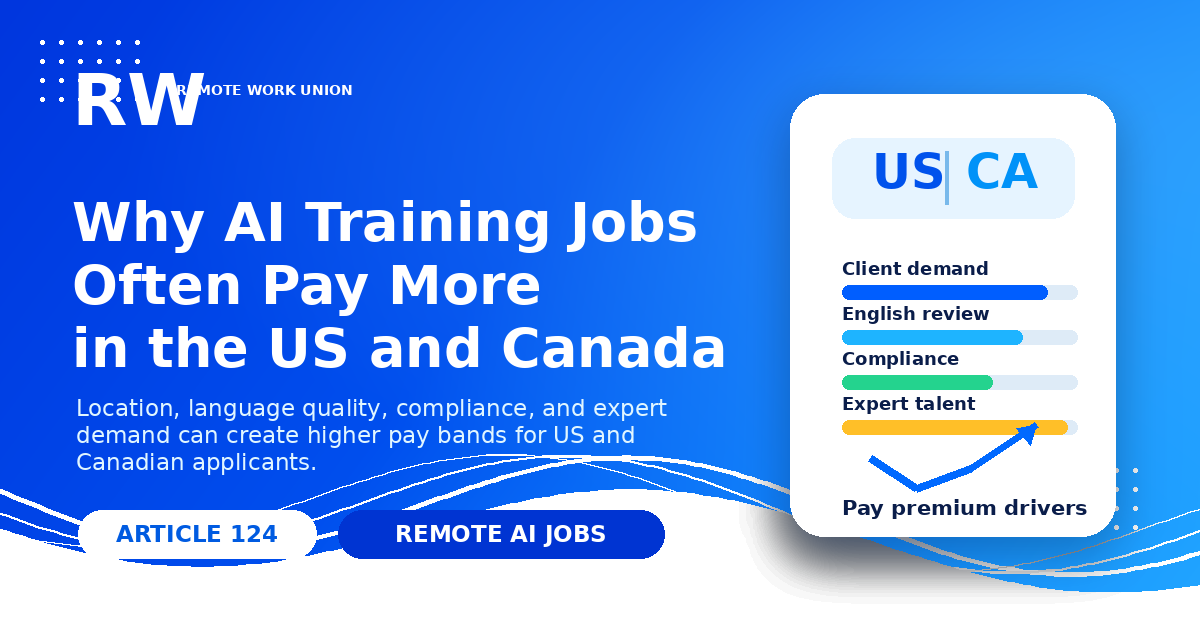
Many remote workers notice the same pattern when they search for AI training jobs: some of the highest-paying AI model evaluation, RLHF, data annotation, and prompt review roles are limited to applicants in the United States or Canada. That does not mean every US or Canadian applicant earns more, and it does not mean every international role is low quality. It usually means the project has a specific business reason for paying more in those markets.
AI training work is not one single job. It can include comparing two chatbot answers, rating helpfulness and accuracy, fact-checking AI outputs, writing ideal responses, reviewing search results, labeling data, testing prompts, evaluating reasoning, or giving feedback on domain-specific answers. When a project needs reviewers who understand North American users, English-language expectations, local business context, or specialized professional standards, the pay band may rise.
What AI Training Companies Are Actually Paying For
A beginner may think AI training is simply clicking labels or marking whether an answer is good or bad. Some tasks are that simple. Higher-paying work is usually different. The platform may need a contractor who can explain why an answer is better, identify missing context, catch hallucinations, rewrite a response in a natural tone, or evaluate whether a model handled a complex user request correctly.
Large AI labs and AI product companies, including companies associated with ChatGPT, Claude, Gemini, Llama, Copilot, and Grok-style products, depend on human judgment to improve model quality. The human reviewer gives the model a better target. The more valuable the target, the more a project may be willing to pay.
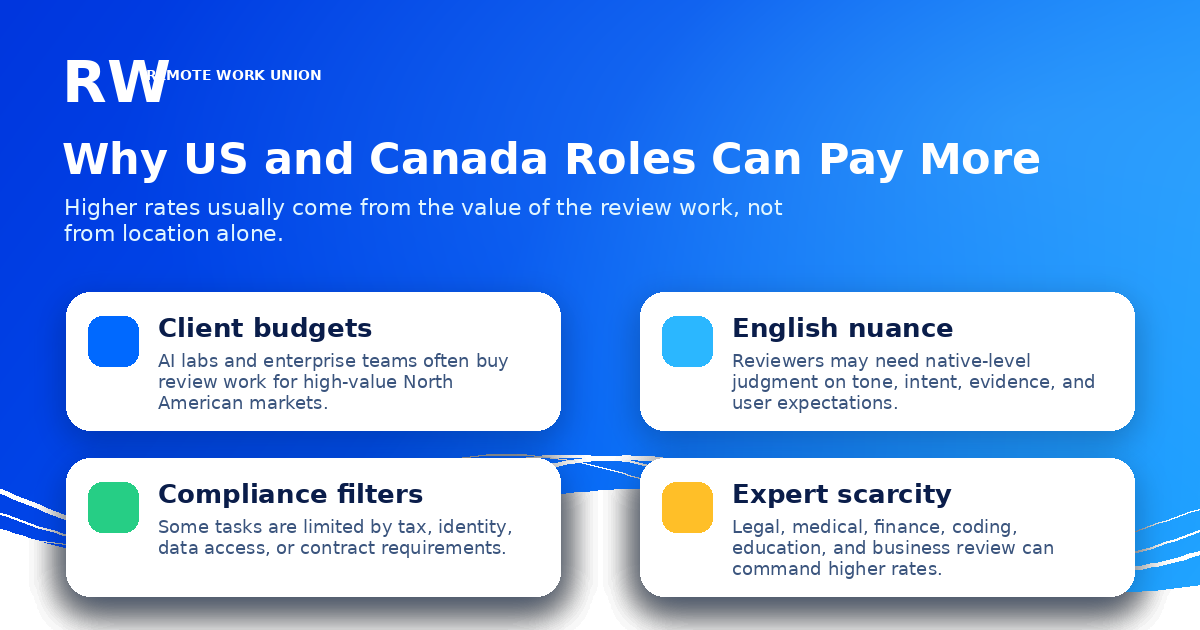
Reason 1: US and Canadian Users Are High-Value Markets
The United States and Canada are important markets for AI companies, enterprise software vendors, search products, education tools, coding assistants, productivity apps, legal tools, healthcare tools, customer support software, and business automation platforms. If a company is building AI for North American customers, it may need reviewers who understand how those customers ask questions and judge answers.
A model that writes a resume, explains a mortgage concept, summarizes a business email, helps a student, drafts a customer support reply, or evaluates a local search result has to match the expectations of the target market. A US-based reviewer may immediately understand references to American job applications, college degrees, insurance language, tax forms, employment norms, state-level differences, or customer service expectations.
Reason 2: English-Language Judgment Is Not Just Grammar
Many AI training roles are English-language roles, but the valuable skill is not only grammar. Higher-paying English-language AI evaluation work often requires tone judgment, argument quality, factual accuracy, instruction following, clarity, concision, and common-sense reasoning.
A strong reviewer can tell when an answer is technically grammatical but still awkward. They can spot when a chatbot sounds too vague, too salesy, too robotic, too formal, too risky, or too confident. They can explain why one response is more helpful than another. This is why strong writers, editors, researchers, teachers, journalists, consultants, lawyers, analysts, and other educated professionals often fit remote AI training work well.
Remote Work Union connects you to legitimate remote AI training and evaluation roles. Apply for free and find roles hiring now.
Find Roles Hiring Now →Reason 3: Time Zones and Communication Reduce Project Friction
Some AI training projects move quickly. Contractors may need to join a training call, respond to clarifications, complete calibration tasks, handle quality feedback, or work during a client review window. US and Canadian contractors may be easier to coordinate for North American teams. Shared or overlapping time zones can make it faster to launch projects, fix misunderstandings, review edge cases, and keep quality consistent.
Reason 4: Compliance, Contracts, and Data Access
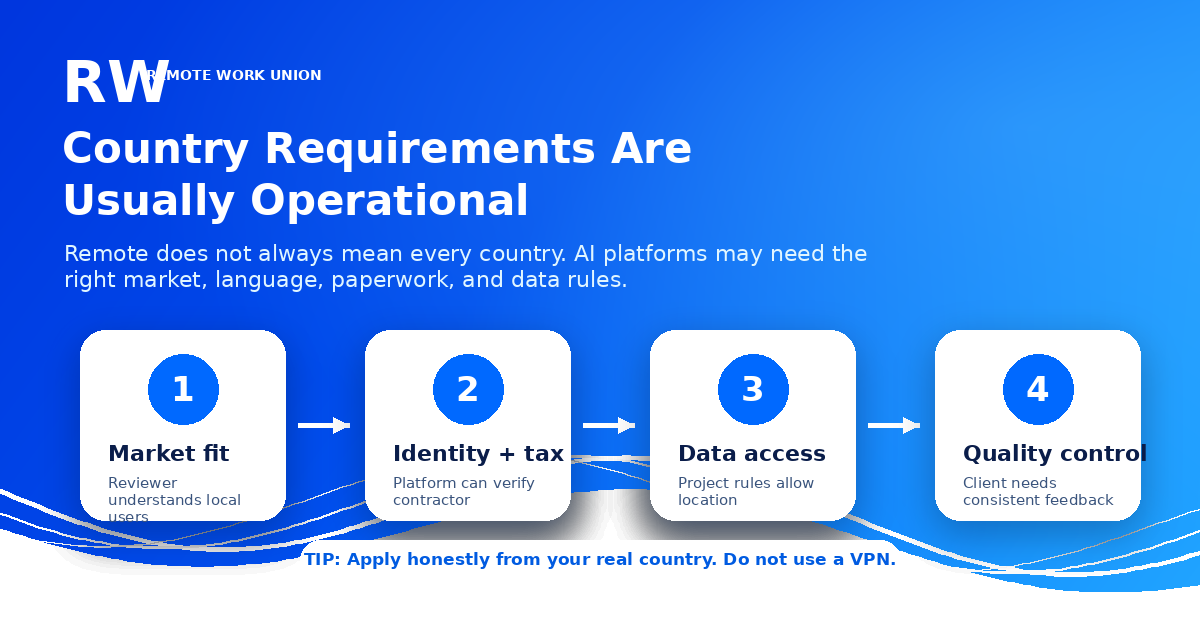
Some people assume country requirements are arbitrary. Sometimes they are simply operational. AI training platforms may have to follow client contracts, tax rules, identity verification rules, data access rules, privacy requirements, or internal risk policies. A project may be remote, but still limited to certain countries.
This is especially common when the work involves sensitive content, proprietary client material, enterprise customer data, financial topics, legal topics, healthcare topics, or unreleased AI product features. Applicants should treat country requirements seriously. Do not use a VPN, fake an address, or claim eligibility you do not have.
Reason 5: Higher Baseline Wages Change the Pay Band
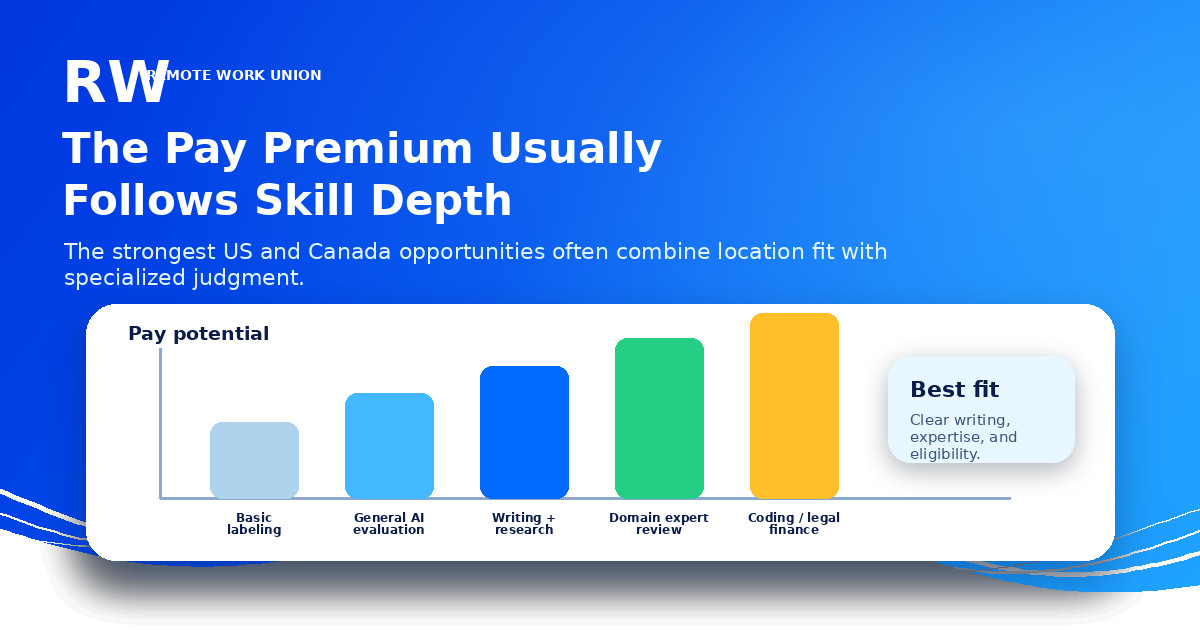
A skilled writer, analyst, coder, lawyer, nurse, accountant, consultant, or researcher in the US or Canada may already have access to other professional work. If an AI training platform wants that person to spend time reviewing model outputs, the pay must compete with other options. This does not mean every task pays a premium — simple labeling work can still be moderate paid. But when the project needs careful judgment, domain expertise, reliable writing, or a fast turnaround from qualified contractors, higher-wage markets tend to influence the rate.
Reason 6: Specialized Expert Review Is Harder to Replace
The highest-paying AI training jobs are often not generic. They are specialized. A legal AI project may need people who can review contract clauses, legal reasoning, citations, or jurisdiction-sensitive language. A finance project may need people who understand accounting, valuation, investing, compliance, spreadsheets, or business analysis. A healthcare project may need clinicians, medical writers, or people who can evaluate health information carefully.
Why the Same Platform May Show Different Rates by Country
Two applicants can join the same AI training platform and see different opportunities. This can happen because of country eligibility, language, assessment results, professional background, client demand, available project volume, and timing. The platform may also segment projects by client request. A company testing an AI assistant for US job seekers may need US reviewers. A project focused on Canadian English or Canadian policy context may need Canadian reviewers.
US Versus Canada: Similar Advantages, Different Contexts
The US and Canada are often grouped together in English-language AI training because both markets offer large pools of college-educated, English-speaking, professionally experienced remote workers. Both markets also have strong demand for AI tools in business, education, software, healthcare, finance, and media.
There are still differences. US projects may focus more heavily on American consumer products, state-specific context, employment language, legal terminology, healthcare systems, or business norms. Canadian projects may value Canadian spelling, province-level context, bilingual awareness, local institutions, and Canadian professional norms. The practical takeaway is the same: make your location and context useful by showing what you understand about the market.
How to Position Yourself for Higher-Paying AI Training Work
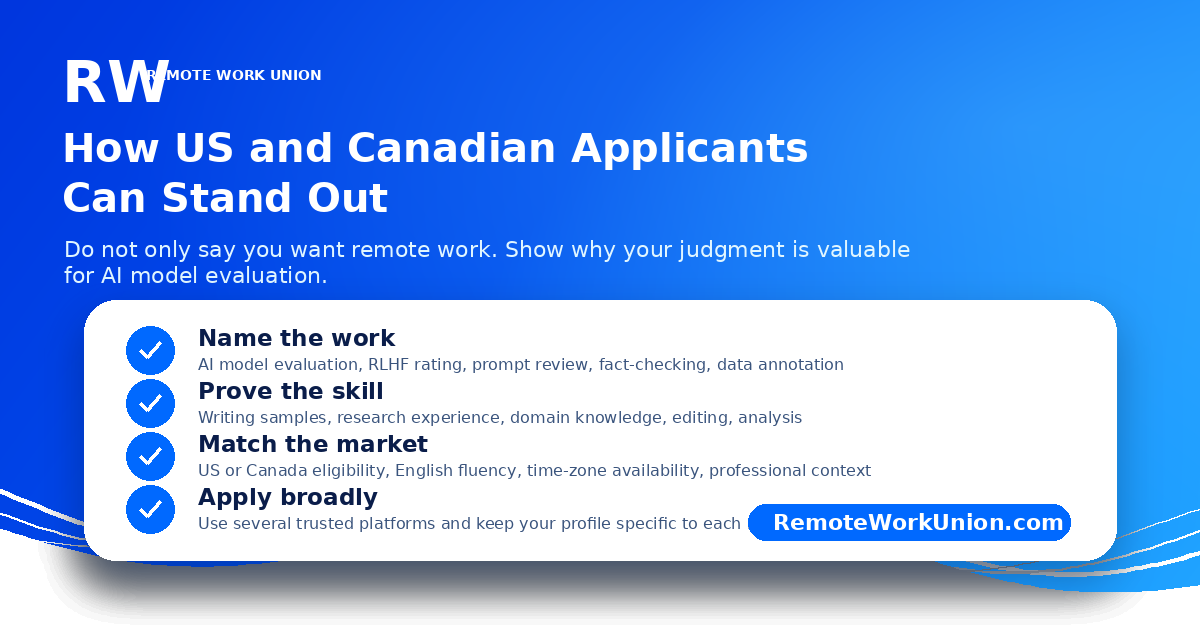
If you are in the US or Canada, your location can help, but it is not enough by itself. The stronger strategy is to present yourself as a high-quality reviewer. Start by making your resume and profile direct. Include terms that match the work: AI model evaluation, AI training, data annotation, RLHF, prompt evaluation, response ranking, fact-checking, research, editing, writing, quality assurance, and subject matter expertise.
Next, apply to roles that match your strongest skills. A strong writer should look for AI writing evaluator, prompt response, editing, and research roles. A coder should look for code evaluation and technical review. A finance person should look for business analysis, accounting, spreadsheet, or investment review projects. Finally, apply across multiple trusted platforms.
Common Mistakes That Reduce Your Chances
The first mistake is applying too broadly with a generic remote-work resume. AI training companies need someone who can evaluate AI outputs, not just someone who wants to work from home. The second mistake is ignoring instructions during assessments. Many AI evaluator tests are less about being clever and more about being consistent.
The third mistake is chasing only the highest advertised rate. The fourth mistake is treating country requirements as something to bypass. If a project requires US or Canada eligibility, the platform may verify it through documents, payment setup, identity checks, or account activity.
Frequently Asked Questions
Why do AI training jobs pay more in the US and Canada?
These markets often combine high-value AI product demand, English-language review requirements, compliance infrastructure, time-zone alignment, and a large pool of educated professionals whose judgment is valuable for AI model evaluation. The higher pay is usually tied to the project's target market and the specialized judgment it requires.
Do all US and Canadian AI training applicants get higher pay?
No. Pay varies significantly by task type, platform, expertise level, project, and timing. General labeling tasks may pay modestly regardless of country. Higher-value projects reward specific skills and domain knowledge. Location is one factor, not a guarantee.
How can a US or Canadian applicant qualify for higher-paying AI training roles?
Build a profile that highlights specific skills like AI model evaluation, research, writing, fact-checking, domain expertise, and AI tool familiarity. Apply to projects that match your background rather than applying generically. Complete assessments carefully and consistently.
Why do AI training platforms use country filters?
Country filters can reflect client market requirements, language needs, compliance rules, payment infrastructure, data access policies, or timezone coordination. A project built for US or Canadian consumers typically performs better when reviewers understand those markets.
Is AI training work full-time or part-time?
Most remote AI training and evaluation roles are contract-based, part-time, or project-based rather than full-time employment. Task volume changes as projects start and pause. Applying across multiple legitimate platforms creates a more consistent income pipeline.