A remote AI training job can look like it should be open to anyone with a laptop. The work is online. The tasks are often text-based. Many roles involve reading prompts, comparing AI answers, fact-checking model outputs, rating helpfulness, writing explanations, or reviewing whether a response sounds natural. So when an application says a project is limited to the United States, Canada, the United Kingdom, Australia, or another specific country, it can feel confusing.
Country and location requirements are common in AI evaluation work. They do not always mean the job is fake, and they do not always mean the platform dislikes applicants from other countries. In many cases, the restriction comes from the project itself. A client may need reviewers who understand a specific English market, a legal system, a tax framework, a payment setup, a time zone, or local cultural references. The platform then has to match the right people to that project.
What Location Requirements Usually Mean
A location requirement is not always the same thing as an office requirement. Many remote AI jobs are still fully remote, but they may only accept workers from certain countries or regions. A listing might say US-only, Canada-only, UK applicants preferred, Australia-based reviewers needed, or English-language evaluators in specific countries. In that case, the work can still be done from home, but the applicant pool is limited.
The requirement usually tells you which market the project is built around. For example, an AI model may need help answering questions for American consumers, Canadian professionals, UK students, or Australian users. If the task depends on local phrasing, local examples, local institutions, or local standards, reviewers from that location may produce more accurate feedback.
Why English-Speaking Countries Show Up So Often
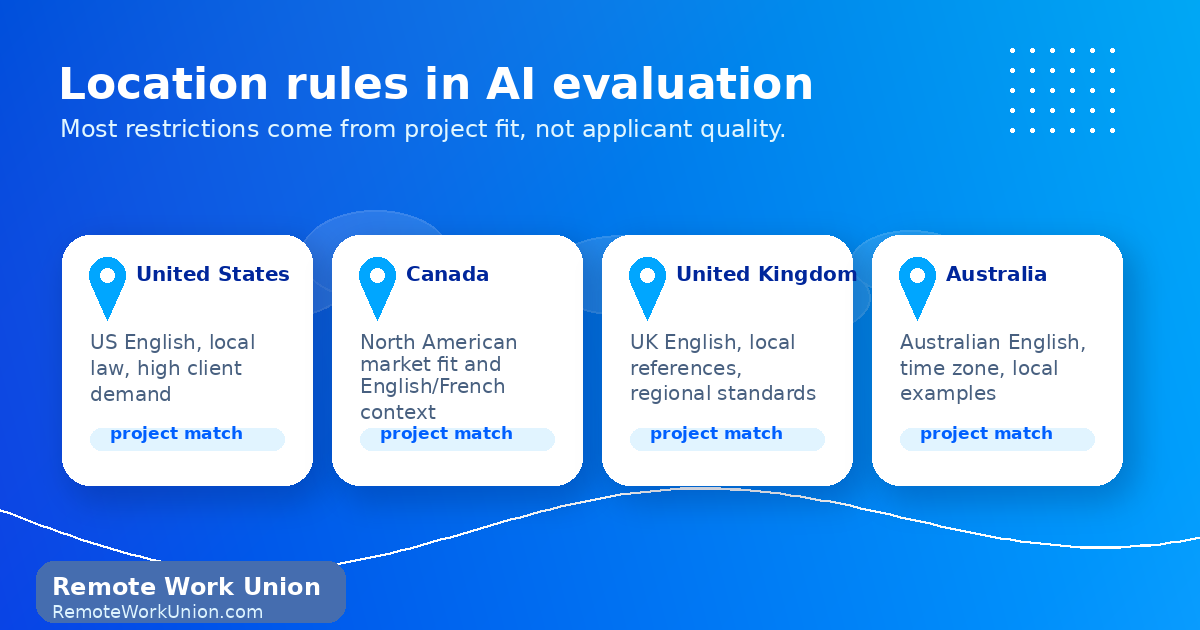
The United States, Canada, the United Kingdom, and Australia appear frequently in remote AI training searches because they are large English-speaking markets with high demand for model evaluation, writing review, research review, and domain-specific judgment. These countries also have different versions of English. US English, UK English, Canadian English, and Australian English can differ in spelling, tone, examples, legal references, education systems, workplace norms, healthcare terminology, and everyday phrasing.
For an AI writing evaluator job, those differences matter. A response that sounds polished to an American reader may sound slightly off to a UK reader. A financial answer written for a US audience may not fit an Australian applicant's expectations. This is why English-language AI training jobs often ask for native or near-native fluency plus country context.
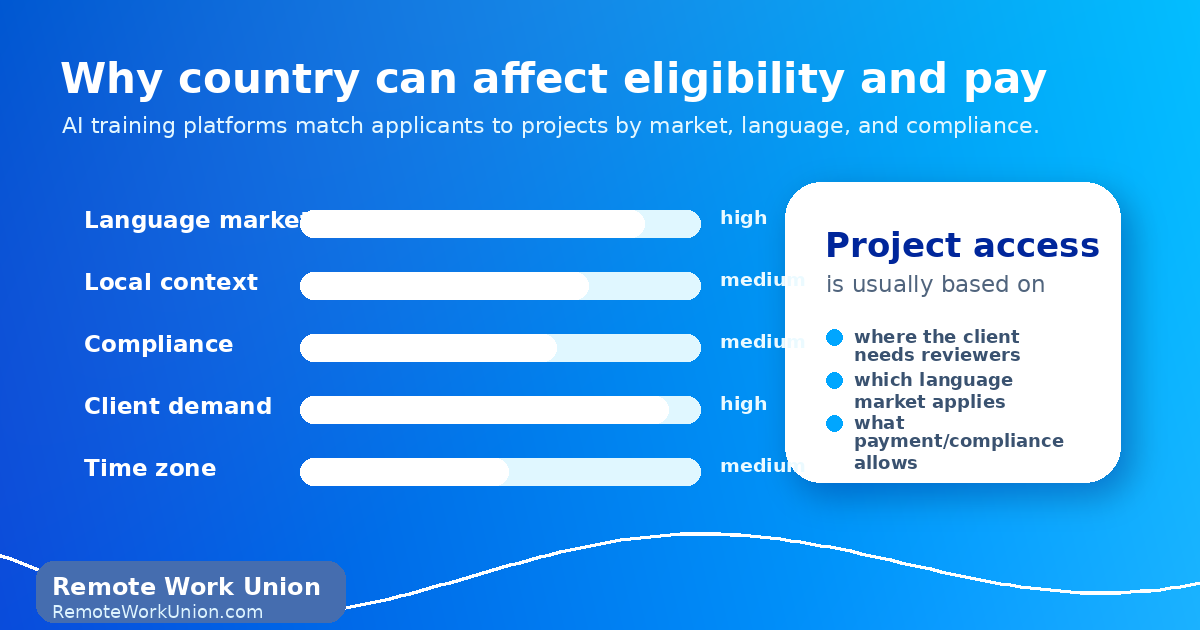
Major Reasons AI Training Jobs May Require a Specific Country
1. Language and cultural context. AI systems are trained and evaluated for real users. If a project is focused on US users, reviewers may need to understand US spelling, consumer habits, sports references, healthcare language, school levels, government agencies, and common workplace terms.
2. Legal and compliance requirements. Some AI training projects involve regulated topics such as law, finance, healthcare, insurance, taxes, education, or employment. Platforms may restrict these projects by country because the underlying rules are different.
3. Client requirements. Many AI evaluation projects are created for specific clients. The client may tell a platform that it needs US reviewers, Canadian writers, UK editors, Australian subject matter experts, or people in a certain time zone. The platform then builds its applicant filters around that request.
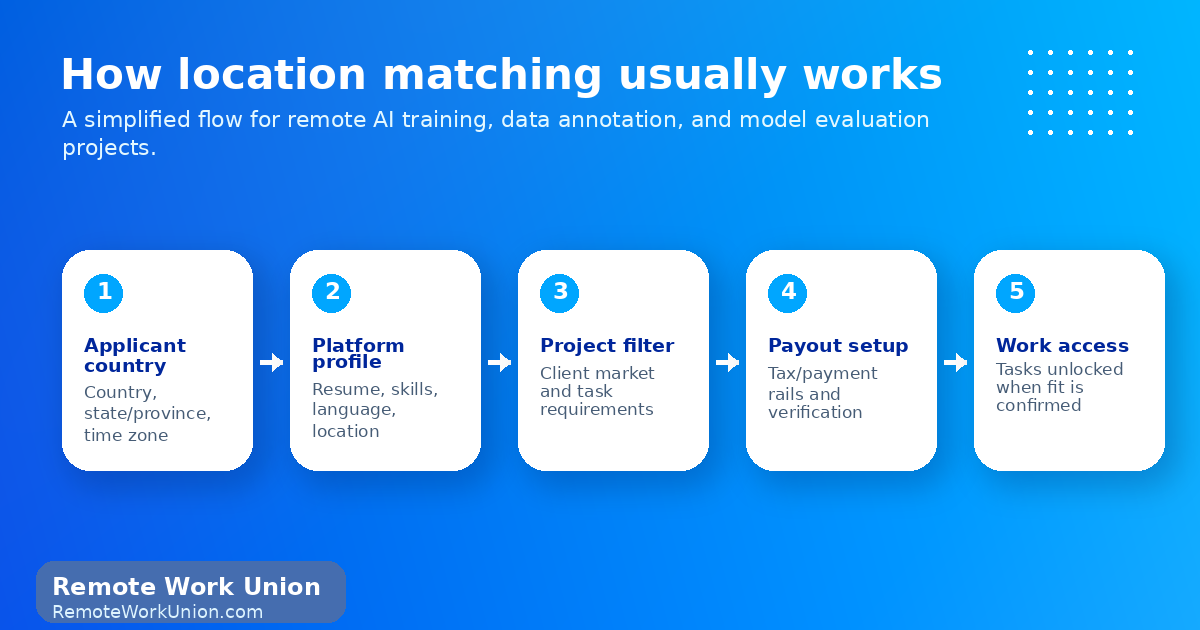
4. Payment and tax setup. Remote contractor platforms have to pay workers through supported payment systems and handle tax documentation, identity verification, and compliance checks. If a platform cannot support payments or contractor onboarding in a country, it may not open that project there.
5. Time zone and operations. Some AI training jobs are asynchronous, but not all of them are completely flexible. A project may need reviewers online during certain hours, fast turnaround on tasks, or communication with a project manager in a related time zone.
6. Data access and privacy controls. Some projects may restrict where data can be viewed or processed. Even if the task looks simple, the platform may have rules about where workers can access the material.
Why a Job Can Be Remote But Not Work-From-Anywhere
Remote does not always mean global. A remote job means you do not have to report to a physical office. A work-from-anywhere job means the company or platform is willing and able to hire people from many locations. AI training jobs can be remote without being work-from-anywhere.
This is one reason two people can apply to the same platform and see very different results. One applicant may be routed into high-paying English evaluation tasks because their country, background, and profile match the available project. Another applicant may pass the initial assessment but see no tasks because their location does not match current demand.
Remote Work Union connects you to legitimate remote AI training and evaluation roles. Apply for free and find roles hiring now.
Find Roles Hiring Now →How Location Affects AI Evaluator Task Quality
Human review is valuable because AI models need judgment that goes beyond grammar. A good evaluator can tell whether an answer is helpful, accurate, safe, natural, and appropriate for the user's context. Location can shape every one of those judgments.
Imagine a prompt asks for a resume format, a tax explanation, a healthcare referral, a college admissions plan, a local job search strategy, or a comparison of phone plans. A reviewer with the right country context is more likely to know what sounds normal, what assumptions are risky, and what details should be flagged.
Common Location-Based AI Training Roles
Location requirements can appear across several types of remote AI work. English-language AI evaluators may review whether chatbot answers sound natural for a local audience. AI writing evaluators may compare two responses and explain which one is clearer, more accurate, or more useful. Data annotation contractors may label examples based on local language, policy, or market knowledge. Search quality raters may judge whether results satisfy users in a particular country. Subject matter experts may review AI outputs in law, finance, accounting, medicine, education, coding, marketing, product management, or research.
These jobs can appear under many names: AI evaluator, AI trainer, AI model reviewer, AI response rater, AI content editor, AI fact-checker, RLHF evaluator, data annotation specialist, search quality rater, prompt response reviewer, and domain expert reviewer.
What Applicants Should Do When a Role Asks for Country or Location
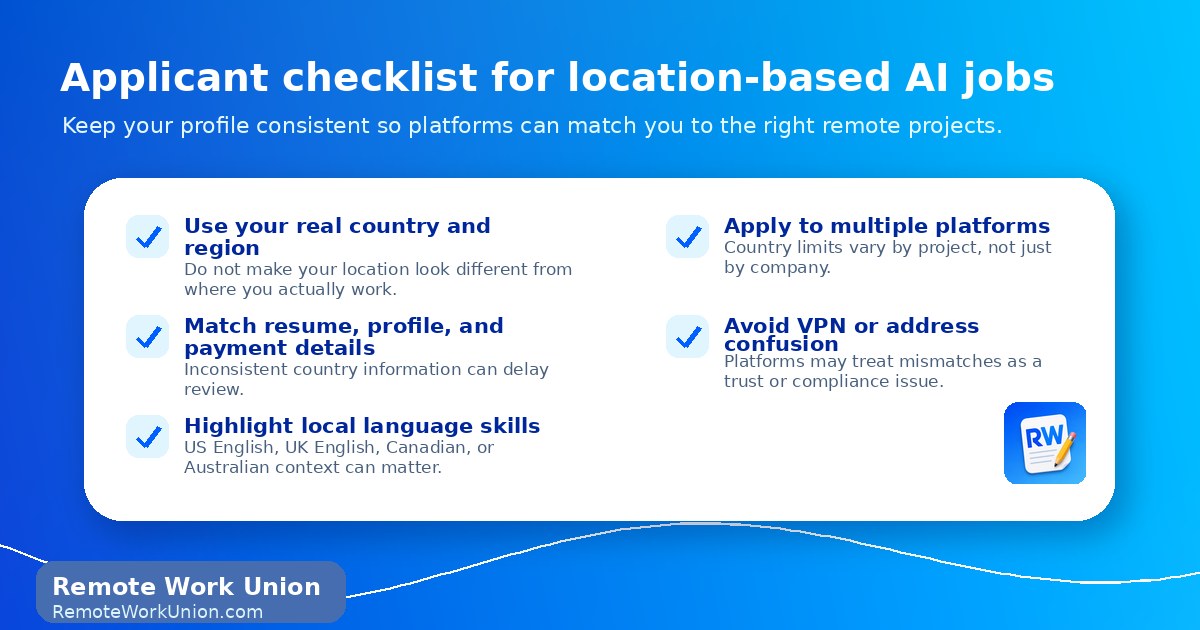
The best approach is to be accurate and consistent. Do not claim a country you do not actually work from. Do not use a VPN to make your application appear to come from a different location. Those mismatches can slow down review, block onboarding, or make the platform treat the account as risky.
Instead, build a clean profile that makes your real location easy to understand. List your country and time zone clearly when asked. Use the same location on your resume, application, tax/payment setup, and platform profile. If you have lived, studied, or worked in multiple English-speaking markets, mention that accurately. Apply broadly — a US-only project may not fit you, but a global English writing project might.
How to Search Smarter by Country
Applicants should combine broad AI job keywords with location-specific searches. Instead of only searching "remote AI jobs," try more targeted terms: US AI training jobs, Canada AI evaluator jobs, UK AI writing evaluator jobs, Australia AI data annotation jobs, remote AI model evaluation jobs for English speakers, AI training jobs for native English speakers, and work from home AI jobs for subject matter experts.
You can also search by skill and location: remote AI jobs for lawyers in the US, AI finance evaluator jobs for Canadian applicants, healthcare AI training jobs for UK professionals, AI writing review jobs for Australian editors, and coding evaluation jobs for English-speaking software engineers.
Why Honesty Matters More Than Trying to Bypass the Filter
Location requirements can be tied to client contracts, data policies, identity checks, payment systems, tax forms, or local expertise. If a platform discovers that your location does not match your application, it may remove task access or close the account.
Honesty also helps you get better matches. A platform cannot route you to the right projects if your profile is inaccurate. If you are in the UK and have strong editing experience, you want the platform to know that. Your real location can be an advantage when the project needs it.
Frequently Asked Questions
Why do some remote AI training jobs require a specific country?
Country requirements often reflect the project's target market, client contracts, compliance obligations, payment infrastructure, language needs, time zone requirements, or data access policies. A project built for US consumers may need US reviewers who understand local language and cultural context.
Does a country requirement mean a job is fake?
No. Country requirements are common in legitimate remote AI work. They usually indicate a project has operational, legal, or language reasons for restricting applicants to specific locations. They are separate from the question of whether the employer or platform is legitimate.
Can I use a VPN to get around a country requirement?
Attempting to bypass country requirements using a VPN or false location information is strongly discouraged. Platforms often verify location through tax documentation, payment setup, identity checks, or activity monitoring. Misrepresentation can result in account closure or lost payments.
What should I do if a role says country not specified?
Apply and check the application form, contractor terms, payment options, and onboarding documents to determine if your country is supported. If you cannot confirm eligibility and it matters, apply to other roles while still attempting this one — there is limited cost to applying when the requirement is unclear.
How do I find AI training jobs that accept my country?
Use country-specific search terms like "AI training jobs [your country]", "global AI evaluator jobs English speakers", "remote AI jobs open to [country]", or "work from anywhere AI training jobs". Apply to multiple platforms and look for listings that explicitly name your country, use terms like global contractors or English-speaking markets, or do not list country restrictions.