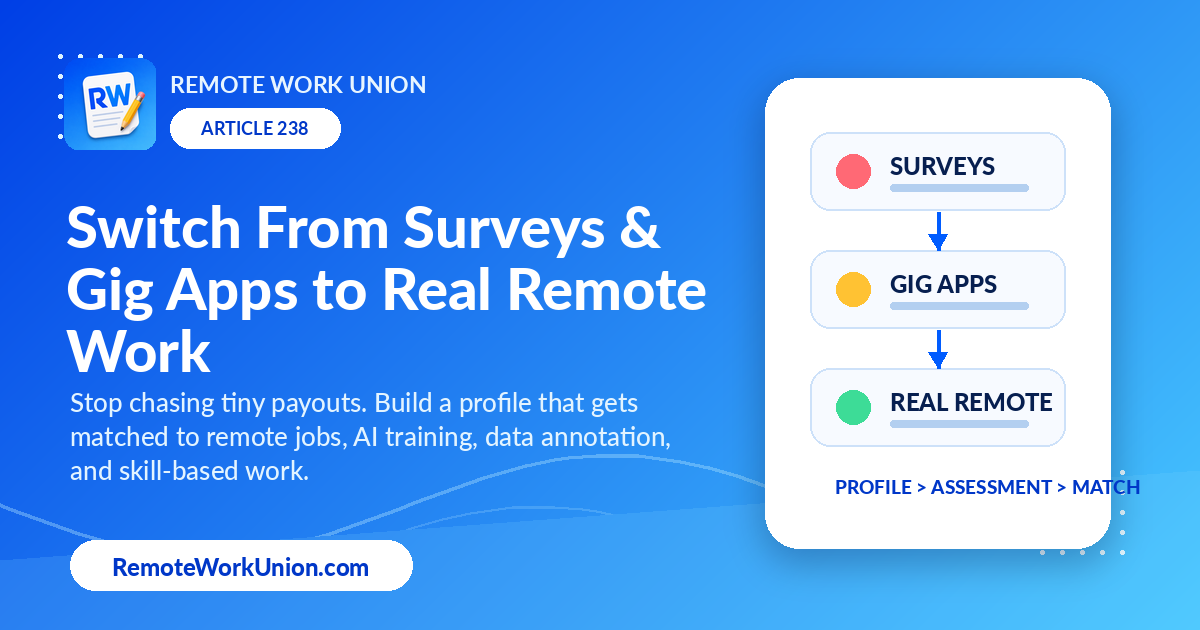
Survey apps, reward apps, and low-paying gig apps are often the first place people go when they want to make money online. They are easy to understand. You sign up, complete a small task, and hope the payout adds up. For a beginner, that can feel useful. It proves that remote income is real. It also teaches you a bad habit: trading large blocks of time for tiny, disconnected payouts.
The problem is not that surveys or gig apps are fake. Some are legitimate. The problem is that most of them are not designed to turn your time into a serious remote work profile. Real remote work is different — it pays for your skills, accuracy, communication, and judgment in ways that make you more valuable over time.
The Real Difference: Tiny Tasks vs Skill-Based Remote Work
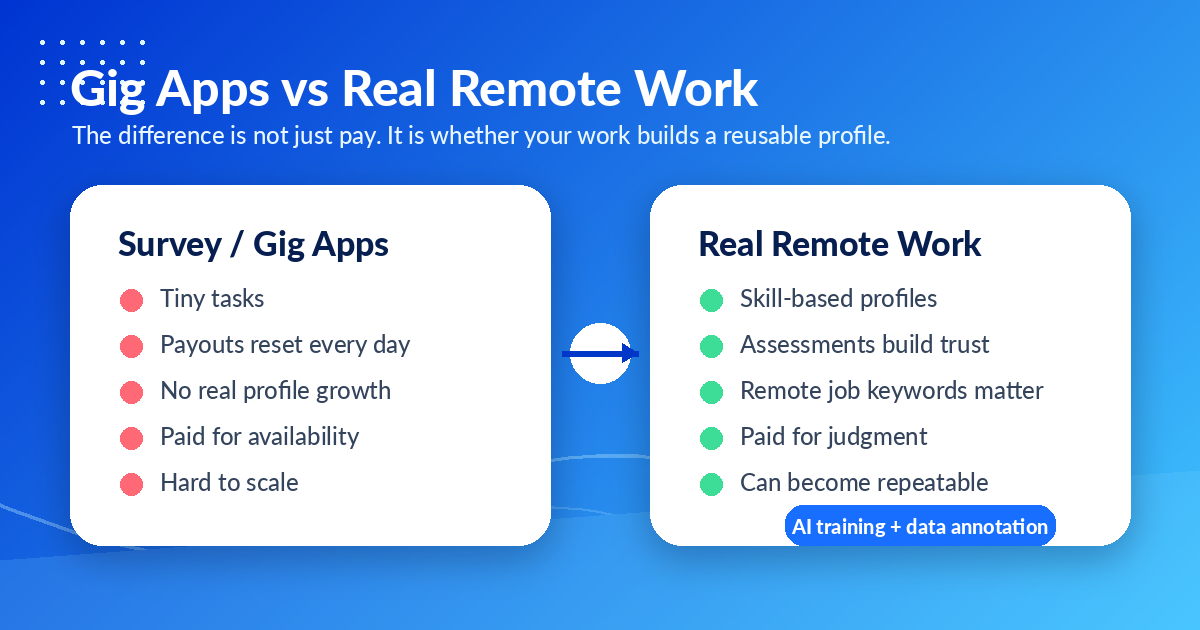
Survey apps usually pay for participation. Gig apps usually pay for availability. Real remote work pays for useful output. That is the key difference.
A survey app may ask you to answer questions. A gig app may ask you to be available at the right time in the right place. A remote AI training platform may ask you to judge whether an AI answer is accurate, safe, useful, well-written, or properly researched. A remote operations job may ask you to organize a spreadsheet, respond to customers, clean up a process, or manage information. A content editing role may ask you to improve clarity, catch mistakes, and understand tone.
Those tasks are not all the same, but they have one thing in common: they depend on judgment. Judgment is harder to automate than tapping buttons. It is also easier to describe on a resume, profile, or application.
Signs You Have Outgrown Surveys and Gig Apps
You do not need to delete every app from your phone immediately. But you should recognize when the apps have stopped helping you. The biggest warning sign is that your effort is not compounding.
You have probably outgrown survey apps or low-end gig apps if you are spending hours chasing small rewards, refreshing for tasks, cashing out tiny amounts, repeating the same beginner work, or feeling like you have no better resume after weeks of effort. You may also be stuck if you cannot explain what skill you improved, what portfolio you built, what platform rating you earned, or what type of remote role you are now more qualified for.
The goal is not just to make money online. The goal is to build a remote work path. A path has direction. It has a profile, a set of target roles, a process for applying, a way to track results, and a way to improve after rejection or silence. Surveys rarely give you that. Real remote work can.
Start With the Skills You Already Have
The easiest mistake is assuming that real remote work requires a completely new identity. It usually does not. Most people already have some useful remote skills. They just have not translated those skills into remote work language.
If you write clearly, you may qualify for content review, AI response evaluation, prompt writing, editing, or customer support. If you notice mistakes quickly, you may be a fit for data annotation, quality assurance, transcription review, search evaluation, or proofreading. If you are bilingual, translation, localization, voice AI, and multilingual model evaluation may be relevant. If you worked in sales, recruiting, real estate, finance, law, healthcare, education, marketing, operations, hospitality, or customer service, you may have subject matter knowledge that remote platforms can use.
AI companies and the platforms that support them need human feedback. Systems built by OpenAI, Anthropic, Google, Meta, Grok, and other AI labs depend on people who can evaluate language, reasoning, accuracy, safety, formatting, and usefulness. Many of those workers are not software engineers — they are writers, teachers, researchers, analysts, editors, support reps, operations people, consultants, lawyers, finance professionals, and generalists with strong judgment.
Build a Remote Work Profile Before You Apply Everywhere
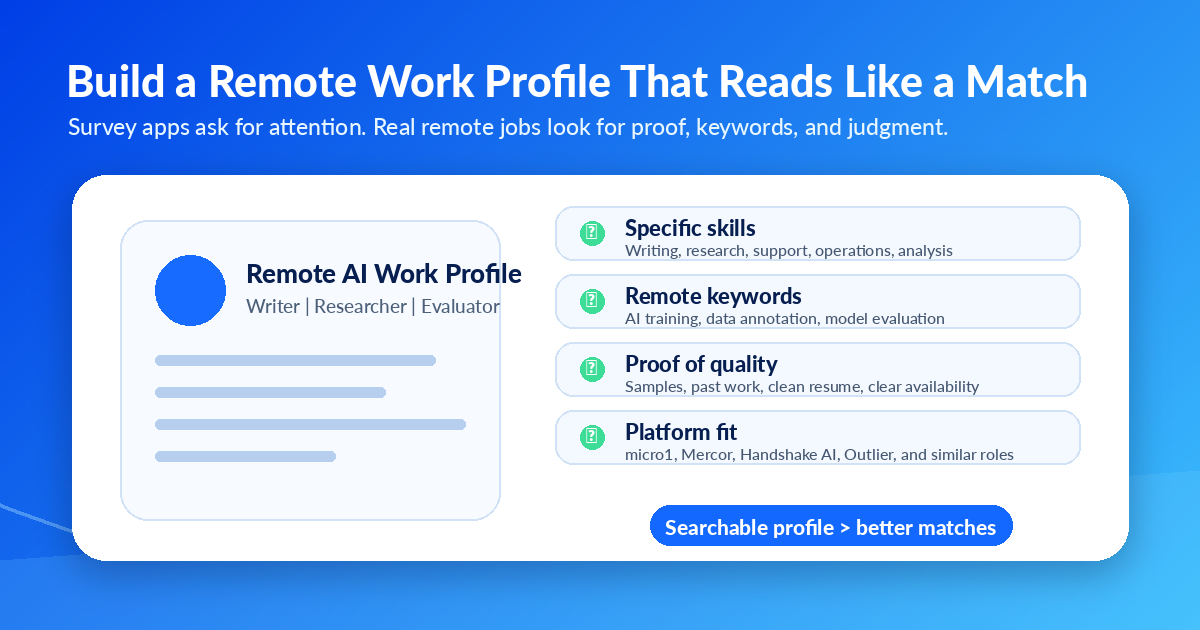
Random applications create random results. Before applying to every platform you can find, build a clean remote work profile that makes you easy to match. Your profile should answer four questions quickly: what can you do, what proof do you have, what roles are you targeting, and why would a platform trust your judgment?
A generic profile that says "hard worker looking for remote work" is weak because it gives the platform nothing to match. A stronger profile says something like: "Detail-oriented writer and researcher with experience reviewing content, comparing AI responses, fact-checking claims, improving clarity, and completing structured online tasks independently."
Key insight: Use the job titles and task names that platforms already understand. Good keywords include AI evaluator, AI trainer, data annotator, model evaluator, search evaluator, content reviewer, prompt writer, fact-checker, online researcher, virtual assistant, customer success assistant, operations assistant, transcription reviewer, localization reviewer, and remote quality analyst.
Where to Apply After You Leave the Low-Ceiling Apps
The next step is to create a broader application pipeline. Do not depend on one platform. Remote work is inconsistent when you rely on a single company, a single app, or a single inbox.
For AI training and remote evaluation work, applicants often look at platforms such as micro1, Mercor, Handshake AI, Outlier, and similar remote work marketplaces. These platforms can change, pause projects, open new categories, or move applicants between queues — so the best approach is to keep your profile updated and apply across multiple places. The goal is not to find one magic website. The goal is to build a system.
You should also apply to direct remote roles that fit your background. A former customer service rep can target non-phone support, customer success, chat support, onboarding support, and quality assurance. A writer can target editing, AI content review, SEO content, prompt review, and research. A paralegal can target legal research, document review, contract analysis, and legal AI evaluation. A generalist can target virtual assistant, operations assistant, recruiter support, data entry, and research assistant roles.
Ready to build a real remote work pipeline and move past low-ceiling apps?
See Roles Hiring Now →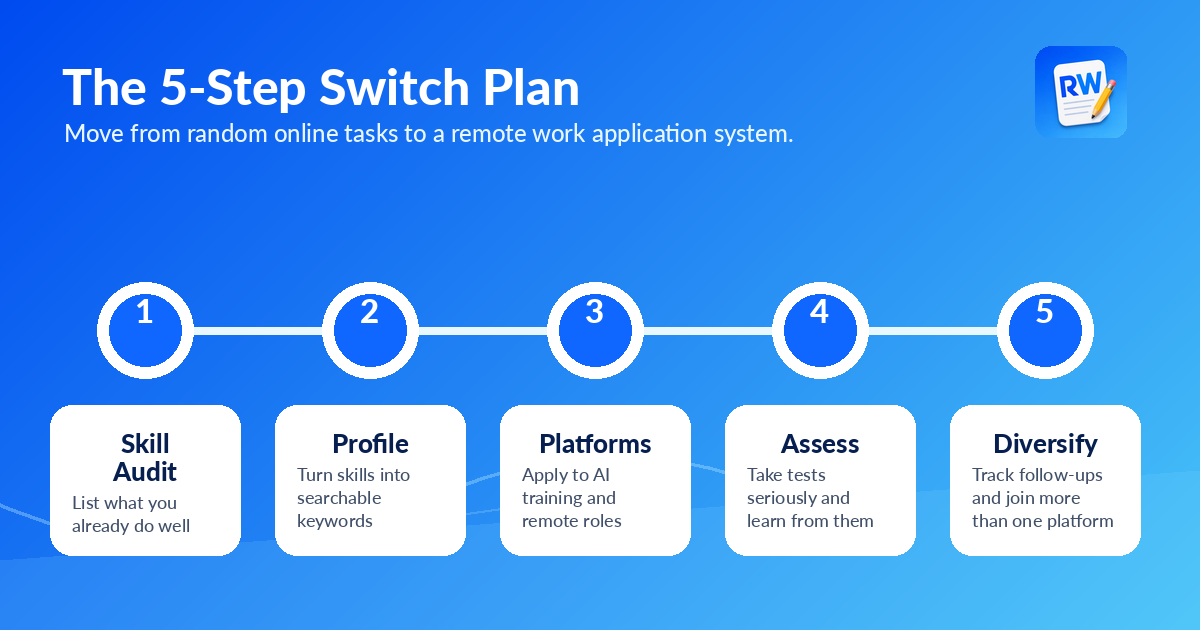
Take Assessments Seriously
Survey apps can train people to move fast and chase volume. Remote assessments require the opposite. You need to slow down, read instructions, follow formatting rules, explain your reasoning clearly, and avoid careless mistakes.
Many AI training and model evaluation tasks are not testing whether you know a secret answer. They are testing whether you can follow directions, compare outputs, spot factual errors, evaluate tone, recognize unsafe content, and write a useful explanation. A rushed assessment can make a qualified person look careless. A careful assessment can make a beginner look credible.
Before taking an assessment, close distractions. Read the entire instruction set. Look for examples. Notice how the platform defines quality. If it asks for explanations, write explanations that are specific. Do not say, "This one is better." Say why it is better: more accurate, clearer, better sourced, more complete, less speculative, safer, or more directly responsive to the user request.
Replace Random App Time With an Application Schedule
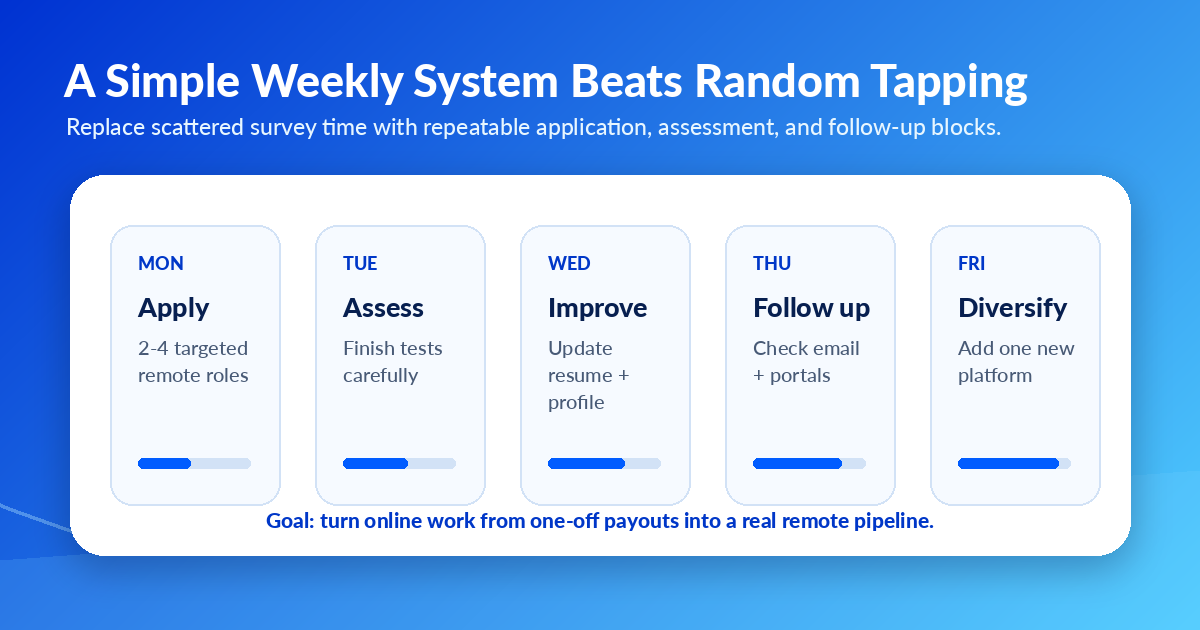
If you are used to opening apps whenever you are bored, replace that habit with scheduled remote work blocks. A simple weekly system works better than constant refreshing: on Monday, apply to targeted roles; on Tuesday, complete assessments carefully; on Wednesday, improve your resume and profile based on the roles you are seeing; on Thursday, check portals and follow up where appropriate; on Friday, add one new platform, one new role category, or one new proof point to your profile.
Track everything. Keep a simple spreadsheet with platform name, role type, application date, status, assessment date, pay structure if listed, login link, and next step. This keeps you from applying blindly and helps you see patterns. If writing roles respond better than data entry roles, lean into writing. If bilingual roles respond faster, strengthen that profile.
Watch for Scams While You Upgrade
People leaving surveys and gig apps are often targeted by fake remote work offers because scammers know they want fast online income. Real remote work platforms should not charge you to start. Be careful with any job that asks for upfront fees, crypto payments, gift cards, fake equipment checks, bank login information, or personal documents before a credible application process.
Also be cautious with vague offers that promise easy money but cannot explain the work. Real remote work may be flexible, but it still has a task. You should be able to understand what you are being paid to do: review AI outputs, label data, support customers, edit content, research information, organize files, or complete a defined business process.
What to Do in the Next 30 Days
In week one, write down every skill you can use remotely. Include writing, research, customer service, sales, organization, spreadsheets, editing, bilingual ability, subject knowledge, attention to detail, and any software tools you know. Then rewrite your resume and profile around three target categories.
In week two, apply to several AI training, data annotation, model evaluation, and work-from-home platforms. Do not rush the applications. Use the same core profile, but adjust the first few lines to match the role. In week three, complete assessments and improve your explanations. In week four, review what worked. Which profiles received responses? Which roles matched your skills? Use that information to narrow your focus and improve your next round.
The biggest change is mental. Surveys and gig apps train you to think like a task chaser. Real remote work requires you to think like an applicant, contractor, and professional. A survey task disappears when it is done. A better profile can help you again and again.
Frequently Asked Questions
What is the difference between survey apps and real remote work?
Survey apps pay for participation and availability. Real remote work pays for useful output — writing, research, judgment, customer communication, organization, bilingual ability, editing, analysis, or attention to detail. The key difference is whether your work builds a reusable profile that makes you more hireable over time.
Can beginners transition from survey apps to remote AI training jobs?
Yes. Many AI training platforms do not require coding or prior AI experience. They screen for reading ability, writing ability, attention to detail, and reliability. Beginners should apply to multiple platforms, take assessments seriously, and position their existing skills in the language remote platforms search for.
How do I build a remote work profile from scratch?
Start by listing every skill you can use remotely: writing, research, customer service, sales, organization, spreadsheets, editing, bilingual ability, subject knowledge, and attention to detail. Then translate those skills into searchable remote work language: AI evaluator, AI trainer, data annotator, model evaluator, content reviewer, search evaluator, customer success, and remote operations.
Which AI training platforms should I apply to first?
Platforms like micro1, Mercor, Handshake AI, and Outlier are commonly used for remote AI training and model evaluation work. The best approach is to apply to several at once rather than waiting on one. Keep your profile updated and your availability clear to improve matching.