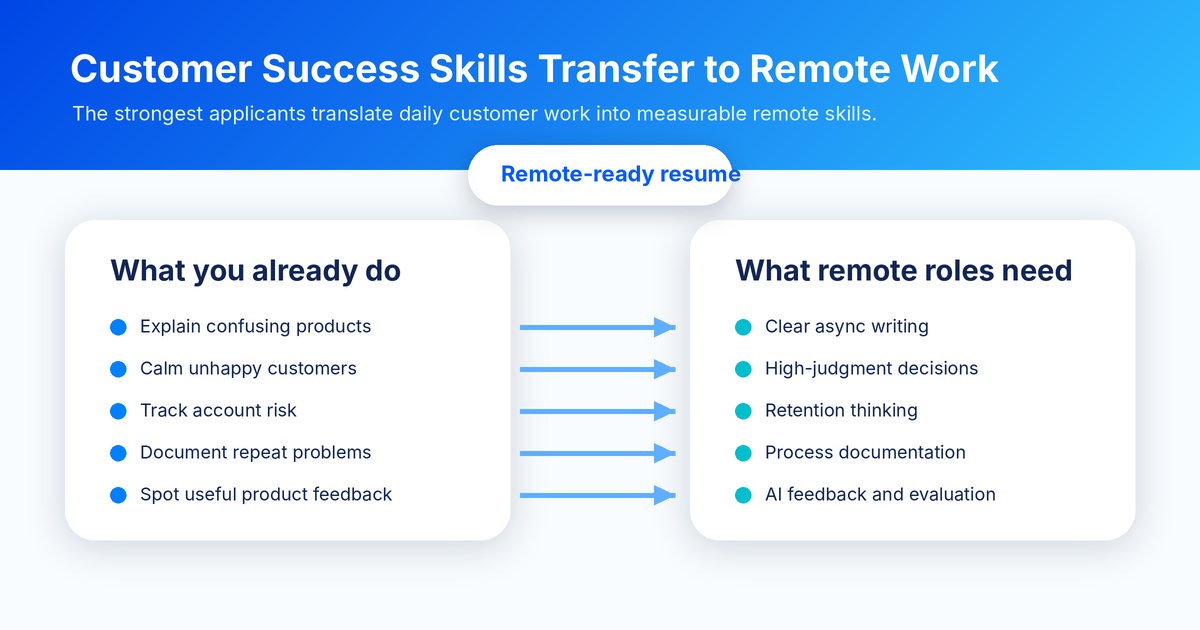
Customer success is one of the most natural backgrounds for remote work. The core job is not tied to an office. It is tied to customer outcomes. A good customer success professional can understand a user problem, explain the product clearly, document what happened, follow up without being chased, and make decisions with limited supervision.
That is exactly what remote teams need. Distributed companies cannot rely on someone walking over to a desk. They need people who can write clean notes, summarize risk, communicate across time zones, and make judgment calls. Customer success professionals already do all of that.
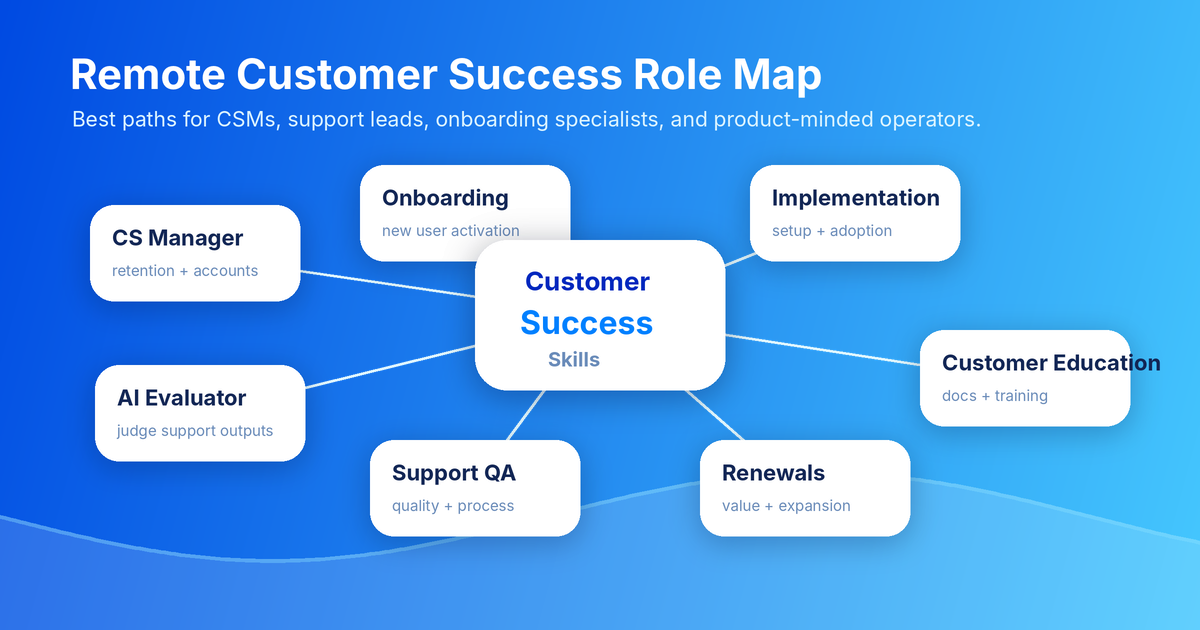
The best remote paths are not limited to full-time Customer Success Manager roles. Customer success experience can also translate into onboarding, implementation, renewals, support QA, customer education, community management, voice-of-customer research, and remote AI training work.
Why Customer Success Is Built for Remote Work
Customer success fits the way AI products and online platforms are growing. Tools from companies such as OpenAI, Anthropic, Google, Meta, and Grok have made more teams depend on product education, support quality, user feedback, and human review. You do not need to be a software engineer to be useful in that ecosystem. If you understand customers, explain products well, and can judge whether an answer actually helps someone, you already have skills that many remote roles need.
1. Remote Customer Success Manager
A remote Customer Success Manager helps customers get value from a product after they buy it. The job usually involves onboarding calls, account check-ins, renewal support, product education, customer health tracking, and coordination with sales, support, and product teams.
To apply well, do not just describe yourself as friendly or helpful. Use remote work keywords and outcome language. Mention customer retention, onboarding, renewals, customer health scores, product adoption, account management, CRM hygiene, stakeholder communication, and customer feedback. If you have numbers, use them.
2. Associate Customer Success Manager
An Associate Customer Success Manager is often a better entry point than a senior CSM role. These jobs usually support a larger customer success team by handling smaller accounts, helping with onboarding, preparing account notes, tracking customer activity, and assisting with renewal workflows.
This is a strong option for people coming from customer service, account coordination, sales support, retail management, hospitality, education, or administrative work. You may not have owned a book of business before, but you can show that you know how to communicate clearly, organize customer information, and identify problems early.
3. Remote Onboarding Specialist
An onboarding specialist helps new customers get started. This can include kickoff calls, setup checklists, product walkthroughs, training sessions, and explaining best practices. In many remote companies, onboarding is one of the most important jobs because a customer who starts badly is more likely to churn later.
Customer success professionals should position onboarding experience around activation, time-to-value, training, product adoption, and customer confidence. Even if you did not have the title "onboarding specialist," you may have done the work — teaching customers how to use a product, walking them through setup, or creating guides.
4. Implementation Specialist
Implementation specialist roles are a good remote path for customer success professionals who are more technical or process-oriented. These jobs focus on helping customers configure software, move from an old workflow to a new one, connect basic tools, or set up account structures.
You usually do not need to be a full engineer for implementation work, but you do need to be comfortable learning software, following detailed steps, and staying organized. Useful resume keywords include implementation, configuration, SaaS onboarding, workflow mapping, migration, integrations, project coordination, and go-live support.
5. Remote Customer Support Specialist
Customer success professionals should be selective when looking at support roles. Not every support job is equal. The best roles are usually product support, SaaS support, customer operations support, client support specialist, or technical customer support — not generic call center jobs.
If you want to avoid phones, look for listings that mention email support, live chat, ticketing systems, async communication, knowledge base, or written support. These roles value writing, judgment, documentation, and product knowledge.
6. Support Quality Assurance Analyst
Support QA is one of the best overlooked remote jobs for people who notice details. A support quality assurance analyst reviews customer conversations and checks whether support agents followed the right process, answered accurately, used the right tone, escalated correctly, and solved the real issue.
Key insight: Support QA connects naturally to AI training work. Many AI training and model evaluation tasks involve reviewing conversations, rating answers, identifying mistakes, and judging whether a response would help a real user. A customer success background makes you stronger at exactly that kind of evaluation work.
7. Customer Education Specialist
Customer education specialists create materials that help customers succeed without needing one-on-one help every time. This can include help center articles, onboarding guides, tutorials, webinars, training decks, product walkthroughs, and FAQs.
This is a strong remote job for customer success professionals who write well. To apply, show examples. A sample knowledge-base article, onboarding checklist, or customer email sequence can matter more than a generic resume. The best proof is not that you say you communicate well — it is a clear piece of writing that helps a customer understand something quickly.
8. Renewal or Retention Specialist
Renewals and retention roles focus on keeping customers. This path is a good fit if you are comfortable discussing business value, not just product features. Customers renew when they believe the product is worth the cost.
Use keywords such as renewal management, retention, churn reduction, expansion, account risk, customer health, save conversations, customer value, and stakeholder communication.
9. Community Manager for a Product or Platform
Community management can be a good remote path for customer success professionals who like helping users in public spaces. Instead of working only through tickets or account calls, you may support users in Slack, Discord, Circle, forums, or product communities.
Customer success experience helps because you already understand the difference between a loud complaint and a real product issue. You can identify repeat questions, turn them into resources, and help the company understand what users are struggling with.
10. Voice-of-Customer or Customer Insights Analyst
Voice-of-customer work turns customer conversations into useful business insight. These roles may review support tickets, survey responses, sales calls, churn reasons, feedback forms, and product requests to find patterns that help the company improve.
Strong keywords include customer feedback, voice of customer, customer insights, product feedback, churn analysis, sentiment, ticket trends, survey analysis, user research, and customer journey. This is one of the best remote roles for customer success professionals who are analytical.
11. Remote AI Trainer or AI Response Evaluator
AI training work is an increasingly relevant path for customer success professionals because many tasks depend on the same judgment used in customer-facing roles. A remote AI evaluator may review answers, compare responses, label customer intent, judge whether a reply is helpful, identify hallucinations, or rate how well an AI system handled a user question.
Customer success professionals know when an answer is clear, complete, polite, and useful. They know when a response ignores the customer goal. They know when a conversation needs empathy, directness, or escalation. Those are human judgment skills that AI systems still need reviewed and improved.
Ready to find remote work that uses your customer success skills?
Find Roles Hiring Now →How to Position Customer Success Experience for Remote Work
The main mistake customer success professionals make is describing responsibilities instead of outcomes. A weak resume says: "Handled customer accounts and answered questions." A stronger resume says: "Managed customer onboarding, documented account risks, coordinated follow-up, and helped customers adopt product features." The second version shows ownership, writing, systems, and judgment.
Another mistake is leaving out tools. Remote teams often search resumes by software keywords. Mention the CRM, ticketing system, documentation platform, analytics tool, communication tool, and project management system you actually used. Do not keyword-stuff tools you do not know, but do not hide the tools you do know.
A third mistake is ignoring written communication. In an office, verbal communication may carry you. In remote work, written communication becomes evidence. Your resume, application answers, follow-up emails, and portfolio samples all show whether you can communicate clearly without a meeting.
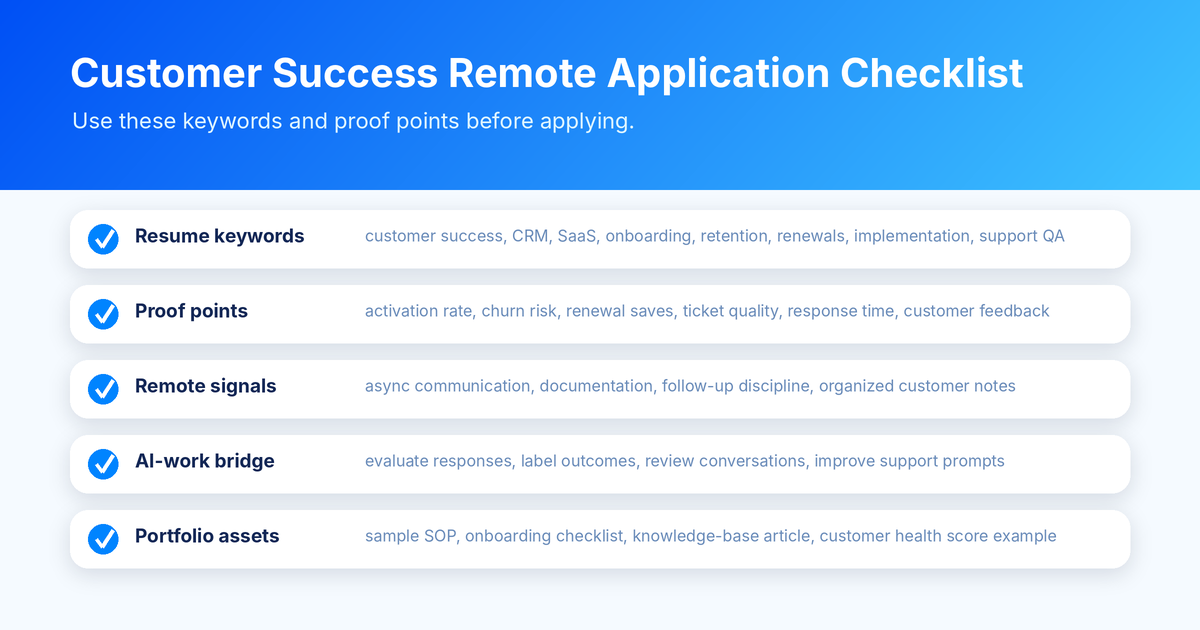
Resume Keywords for Customer Success Remote Applications
For customer success manager roles: customer success, account management, onboarding, retention, renewals, customer health, product adoption, QBR, stakeholder communication, CRM, and churn risk.
For onboarding and implementation roles: onboarding, implementation, setup, configuration, workflow, training, product walkthrough, migration, go-live, documentation, and customer requirements.
For support QA and AI evaluation roles: quality assurance, ticket review, conversation review, response evaluation, rubric, accuracy, helpfulness, escalation, data annotation, model evaluation, prompt review, and AI training.
Frequently Asked Questions
Can customer success professionals work fully remote?
Yes. Customer success is one of the most natural backgrounds for remote work because the core job is not tied to an office. The work depends on written communication, customer judgment, follow-up discipline, and product knowledge — all skills that translate directly to distributed teams.
What remote jobs can customer success professionals get?
Customer success professionals can apply for remote CSM roles, onboarding specialist jobs, implementation specialist positions, customer education roles, support QA analyst jobs, renewals or retention specialist roles, voice-of-customer analyst work, and remote AI training or model evaluation jobs.
How does customer success experience transfer to AI training jobs?
Customer success professionals know when an answer is clear, complete, and useful — and when it ignores the customer goal. Those same judgment skills are what AI training platforms need when reviewing responses, comparing outputs, and rating whether a chatbot answer would actually help a real user.
Do I need a technical background to get remote customer success jobs?
Not for most roles. Many remote customer success, onboarding, support QA, and AI evaluation positions do not require coding. What they do require is strong written communication, product knowledge, customer judgment, and the ability to follow structured processes and document work clearly.