In This Article
- Short answer
- Why this question matters
- What Mercor-style AI work usually values
- Is Mercor better for experts?
- Is Mercor still worth trying for beginners?
- The beginner profile that works better
- The expert profile that works better
- Mercor vs Outlier vs Handshake AI for beginners and experts
- How to know whether you are applying as an expert or a beginner
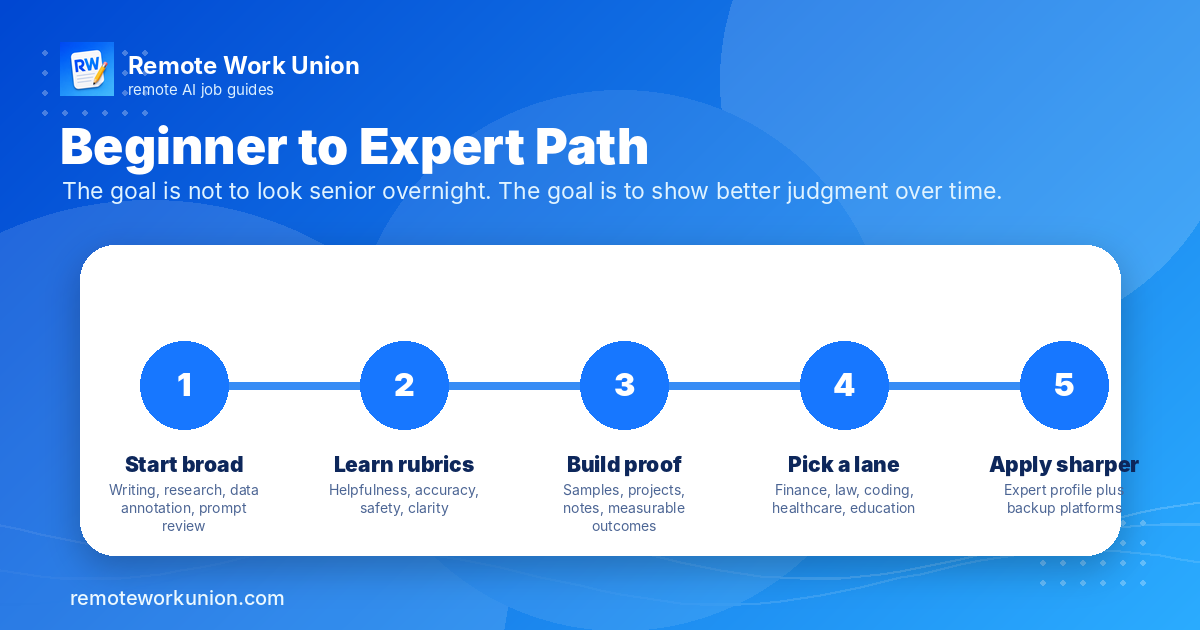
- What beginners should do before applying again
- What experts should do before applying again
- The real answer: Mercor is better for applicants with proof
- Practical recommendation
- Frequently asked questions
Short answer
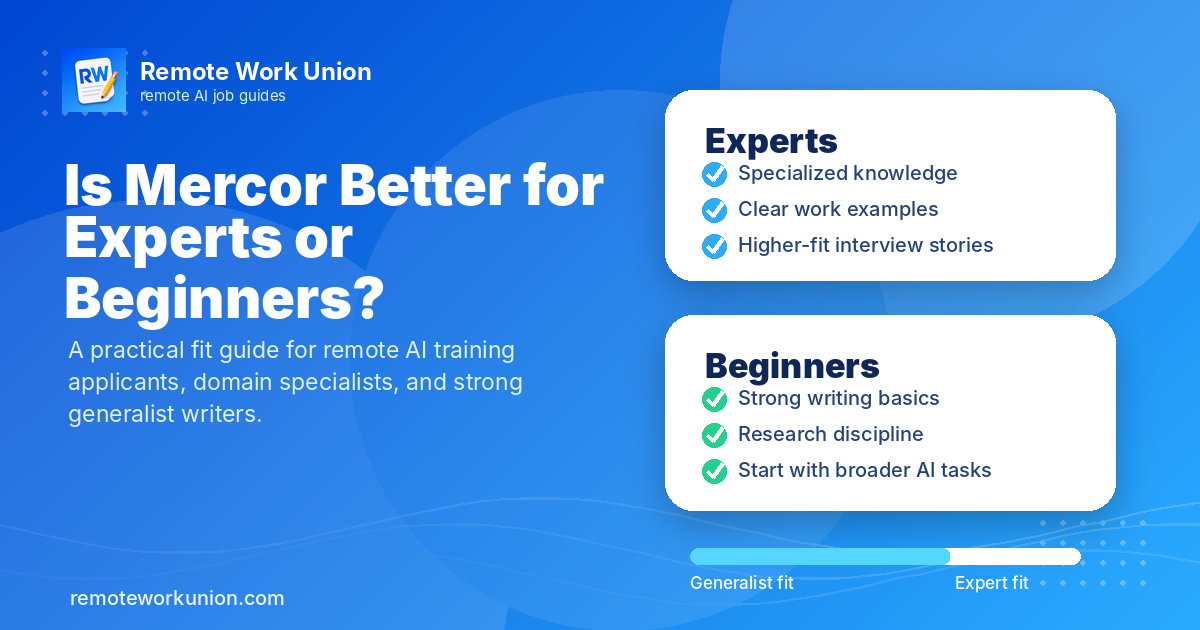
Mercor-style AI training work is usually easier to understand through one question: what kind of proof do you bring to the platform?
If you already have professional expertise, advanced education, technical experience, writing credentials, finance knowledge, legal research experience, healthcare knowledge, teaching experience, coding ability, product strategy experience, or serious analytical work in your background, platforms like Mercor may be a strong fit because they often reward clear subject-matter judgment.
If you are a beginner, the answer is more nuanced. You may still be a good fit if you can write clearly, follow instructions, compare two answers carefully, research facts, explain your reasoning, and present your background in a credible way. But beginners should not treat Mercor, Outlier AI, Handshake AI, micro1, Surge AI, Stellar AI, or any single AI training platform as a guaranteed job source. These platforms can be selective, project-based, and inconsistent.
The best way to think about Mercor is not "experts only" or "beginner friendly." It is better described as a fit-based marketplace for remote AI work. The stronger your proof of skill, the easier it is to look like a good applicant.
Why this question matters
Searches for Mercor jobs, AI training jobs, remote AI evaluator work, data annotation jobs, RLHF jobs, AI writing evaluator jobs, and model evaluation roles usually come from two very different groups of people.
The first group is made up of experts. These are marketing and sales professionals, social media managers, finance professionals, accountants, business operators, consultants, MBAs, customer service and success leads, writers, editors, journalists, creatives, teachers, data analysts, product managers, software engineers, lawyers, doctors, nurses, researchers, and other people with specialized knowledge. "Expert" here does not mean a fancy title — it means you have a real skill area. They are not just looking for generic remote work. They are trying to turn their existing judgment into paid online work.
The second group is made up of beginners. These applicants may not have a niche professional credential, but they can read carefully, write clearly, use ChatGPT, Claude, Gemini, or other AI tools, and complete detail-oriented online tasks. Many are looking for flexible work from home jobs that are better than customer support, phone sales, low-paid data entry, or low-skill gig work.
Both groups can be interested in Mercor. But they should not apply the same way. Experts should lead with credibility. Beginners should lead with clarity, consistency, and evidence that they can learn the evaluator workflow quickly.
What Mercor-style AI work usually values
Remote AI training work is broad. Depending on the platform and project, the work can include evaluating AI responses, ranking chatbot answers, writing prompts, checking factual accuracy, reviewing model outputs, judging helpfulness, improving instruction-following, identifying hallucinations, editing generated text, testing reasoning, or applying expert knowledge to specialized tasks.
This is why companies and AI labs need human reviewers. AI systems associated with major companies and products — such as OpenAI, Anthropic, Google, Meta, Microsoft, ChatGPT, Claude, Gemini, and other large language model ecosystems — improve when human feedback helps identify better answers, safer answers, more useful explanations, and more reliable reasoning.
That does not mean every applicant is training models for a famous AI lab directly. Many remote AI jobs are offered through contractor platforms, staffing marketplaces, research vendors, data labeling companies, AI evaluation platforms, and specialized recruiting channels. The applicant experience can vary a lot.
Still, the underlying skills are consistent:
- Read instructions carefully.
- Compare AI answers without overthinking the task.
- Explain why one response is better than another.
- Catch hallucinations and factual errors.
- Write clear feedback.
- Understand the audience and task goal.
- Apply domain knowledge when the task requires it.
- Stay consistent across repetitive evaluations.
Experts often have an advantage because they can apply real professional judgment. Beginners can still compete when the project is generalist, writing-focused, research-focused, or designed for people who can learn a rubric quickly.
Is Mercor better for experts?
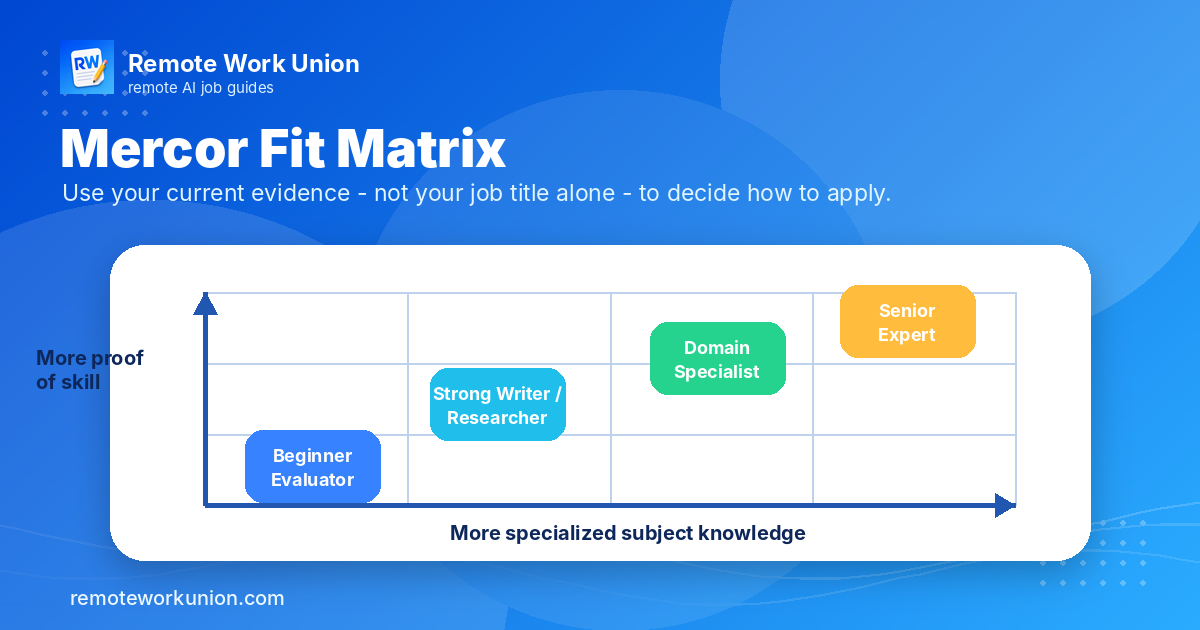
For many applicants, yes — Mercor-style opportunities may be more attractive if you have a clear area of expertise. That does not mean you need to be famous, elite, or unusually credentialed. It means you can point to a real skill category and explain why your judgment is useful. A marketer can judge whether messaging is persuasive and on-brand. A salesperson can tell whether an outreach email would actually get a reply. A social media manager can evaluate tone, hooks, and platform fit. A finance analyst can review business reasoning. A customer service lead can spot a reply that would frustrate a real customer. A consultant can review strategy answers. A teacher can judge educational answers. A writer can evaluate tone, clarity, and factual accuracy. A software engineer can review code. A lawyer or law student can evaluate legal explanations.
Experts tend to have three advantages.
1. Their background is easier to match to projects
AI training platforms need people for specific projects. Some projects need general writing ability. Others need math, coding, legal reasoning, healthcare knowledge, financial analysis, scientific research, education expertise, or business judgment. An expert profile is easier to route because the platform can understand what kind of work the person should review. "Corporate finance analyst with Excel modeling experience" is clearer than "hard worker looking for remote work." "Former teacher with curriculum writing experience" is clearer than "good with AI." "Software engineer comfortable reviewing Python code" is clearer than "tech savvy." This is why experts should avoid vague profiles. A strong Mercor profile should make the match obvious.
2. Expert tasks may have fewer qualified applicants
Generic remote jobs attract huge applicant pools. Customer support, virtual assistant work, data entry, social media moderation, and general online jobs are easy for many people to apply to. Specialized AI model evaluation work is different. If a project needs a tax professional, legal researcher, advanced math tutor, medical writer, or experienced software reviewer, the pool of credible applicants is narrower. That can help experts stand out. The key is credibility. A platform does not know your skill level just because you say you are an expert. You need to show it with a resume, short examples, project history, education, credentials, writing samples, code samples, publications, client work, teaching experience, or a clean explanation of your background.
3. Expert judgment is harder to replace with generic effort
Some AI evaluation work is about discipline. Other work is about judgment. A beginner can learn to follow a simple rating rubric. A beginner can learn to identify whether an answer follows instructions. A beginner can learn the difference between a vague answer and a useful answer. But some tasks require more than careful reading. They require knowing what a good answer looks like in a real field. A legal answer may sound confident but miss a key limitation. A medical answer may sound helpful but be too direct for a safety-sensitive topic. A finance answer may use the right vocabulary but make a basic accounting mistake. A coding answer may compile but be inefficient, insecure, or poorly structured. That is where experts are especially valuable.
Is Mercor still worth trying for beginners?
It can be, but beginners need to be realistic. A beginner should not apply as if every AI training platform is a simple online side hustle. Some projects are selective. Some applications involve interviews, assessments, profile reviews, or skill screening. Some applicants never receive tasks. Some receive tasks for a while and then see work slow down. This is true across many remote AI platforms, not just Mercor.
But beginners are not automatically disqualified from AI evaluation work. Many useful evaluator skills are learnable. A beginner may be a fit if they can:
- Write in clear, clean English.
- Follow detailed instructions without improvising.
- Compare two AI responses calmly.
- Explain their choice in one or two direct paragraphs.
- Research claims before accepting them.
- Notice when an AI answer sounds plausible but is unsupported.
- Avoid exaggerating credentials.
- Present school, work, freelance, volunteer, or project experience clearly.
For beginners, the biggest mistake is applying with a profile that says nothing specific. "Looking for remote work" is not enough. "Good at ChatGPT" is not enough. "Fast learner" is not enough. The profile needs evidence. A beginner can frame experience around writing, research, editing, administrative work, spreadsheets, tutoring, customer communication, operations, marketing, social media, documentation, quality control, or academic projects. The goal is to show that you can evaluate information, not just that you want a remote job.
The beginner profile that works better
A beginner does not need to pretend to be an expert. In fact, pretending usually hurts. Platforms want reliable reviewers, not inflated resumes.
A stronger beginner profile might say something like:
That is much stronger than: "I am interested in AI and want remote work." The first version describes evaluator behavior. The second version describes a desire.
Beginners should also choose the right starting points. General AI evaluator jobs, AI writing evaluator roles, data annotation tasks, search quality rating, prompt evaluation, fact-checking tasks, and entry-level model response review may be better starting points than expert-only projects.
The expert profile that works better
Experts can also make mistakes. The most common expert mistake is assuming that the credential explains everything. A lawyer should not only say "JD." A finance applicant should not only say "worked in finance." A software engineer should not only list languages. A teacher should not only list a school. The profile should explain how the expertise helps with AI evaluation.
A stronger expert profile connects the background to the work:
- "I can evaluate whether a business answer uses sound assumptions and explains tradeoffs clearly."
- "I can review legal research-style answers for nuance, unsupported claims, and missing caveats."
- "I can compare coding answers for correctness, readability, edge cases, and maintainability."
- "I can judge whether educational explanations are age-appropriate, accurate, and easy to follow."
- "I can review healthcare writing for clarity, safety, and responsible limitations."
This framing matters because AI training work is not just about what you know. It is about whether you can turn that knowledge into consistent feedback.
Looking for remote AI training jobs, model evaluation roles, or expert reviewer positions? RemoteWorkUnion.com tracks current openings across top platforms.
Find Roles Hiring Now →Mercor vs Outlier vs Handshake AI for beginners and experts
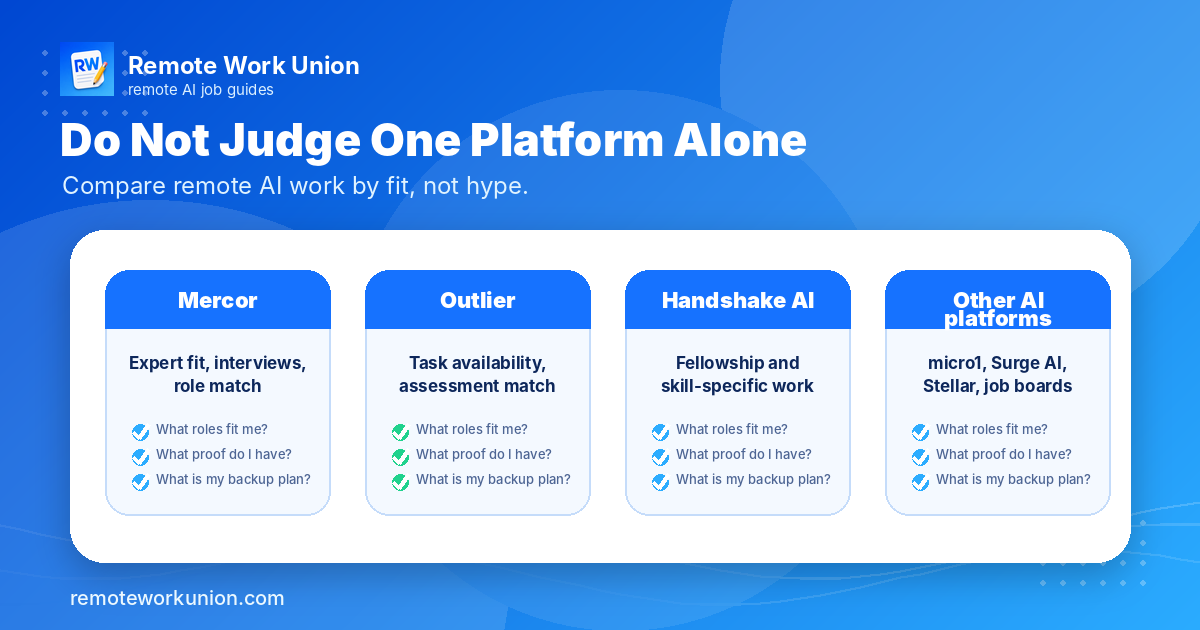
Applicants often compare Mercor with Outlier AI, Handshake AI, micro1, Surge AI, Stellar AI, LinkedIn AI jobs, and other remote AI work sources. The right comparison is not "which platform is best?" The better question is "which platform matches my proof of skill right now?"
Mercor may appeal to applicants who want role matching, interviews, expert projects, and profile-driven opportunities. Outlier AI may appeal to people looking for task-based AI training projects, though task availability can vary. Handshake AI may appeal to applicants who fit fellowship-style or skill-specific opportunities. micro1 and other platforms may appeal to applicants looking for additional expert AI training marketplaces.
That does not mean one platform is always better. It means the applicant should avoid relying on one source. A serious remote AI job search should include several categories:
- AI training platforms such as Mercor, Outlier AI, Handshake AI, micro1, Surge AI, Stellar AI, and similar marketplaces.
- Job boards such as LinkedIn, Indeed, Wellfound, FlexJobs, and remote-specific boards.
- Staffing and professional recruiting channels for contract AI work.
- Company career pages where AI evaluation, search quality, data annotation, trust and safety, content quality, or model evaluation roles may appear.
- Niche professional networks for legal, healthcare, finance, coding, education, research, and writing work.
The more specialized you are, the more important it is to search beyond generic job boards. The more beginner-level you are, the more important it is to apply broadly and avoid waiting on one platform.
How to know whether you are applying as an expert or a beginner
Use this simple test: could a stranger understand your useful skill in ten seconds?
If the answer is yes, you may be closer to an expert applicant than you think. For example:
- "I review Python code for correctness and edge cases."
- "I edit academic writing for clarity and structure."
- "I build financial models in Excel."
- "I teach high school math and write lesson plans."
- "I summarize medical information for general readers."
- "I review legal documents and research case law."
- "I analyze marketing campaigns and customer data."
Those are clear skill identities. If your profile sounds more like "I am organized, hardworking, and want to work remotely," you are applying as a beginner. That is not bad, but it changes the strategy. You need to build evidence before trying to compete for specialized projects.
Quick test: Could a stranger understand your useful skill in ten seconds? If yes, lead with that skill. If not, your first step is defining it — not applying broadly with a vague resume.
What beginners should do before applying again
If you applied to Mercor or a similar platform and did not get a response, do not immediately assume you are banned from AI work. Improve the profile first.
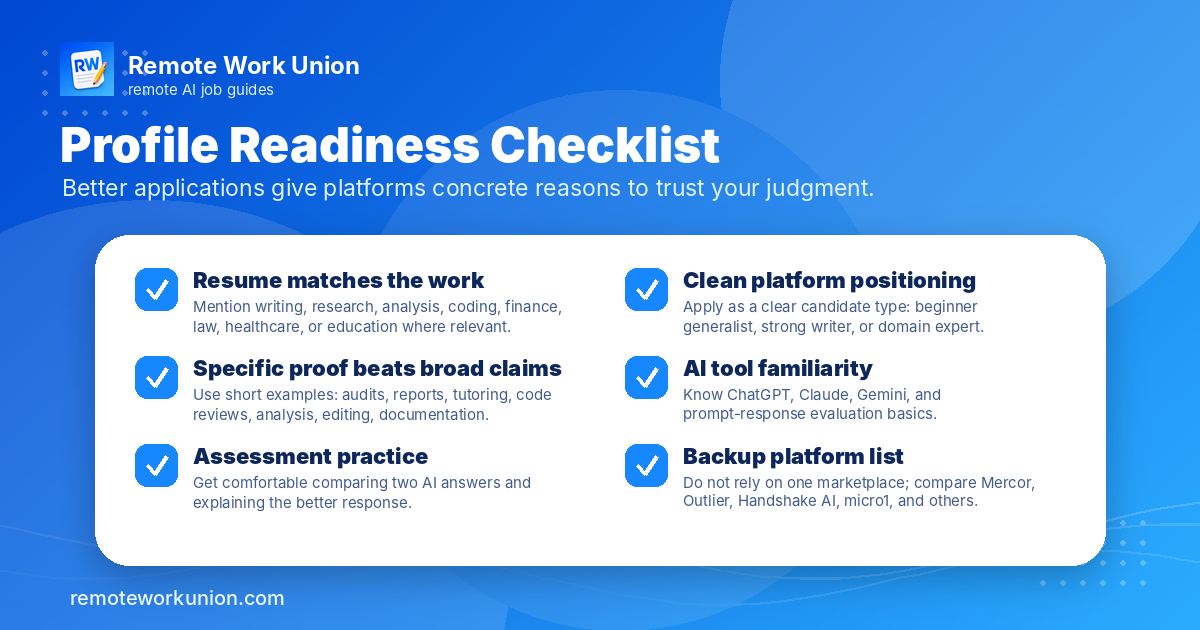
Start with your resume. Remove vague filler. Add skill categories that matter for AI model evaluation: writing, research, editing, analysis, Excel, coding, tutoring, fact-checking, content review, documentation, quality assurance, operations, customer communication, and AI tool use.
Then write a short profile summary that explains how you evaluate information. Do not overclaim. Do not stuff keywords randomly. Use natural language.
Next, practice the core task. Take two AI-generated answers to the same question and compare them. Which one is more helpful? Which one follows the prompt? Which one is more accurate? Which one is safer? Which one is clearer? Can you explain the better answer in plain English? That is the muscle behind many AI evaluator jobs.
Finally, apply to more than one platform. If Mercor is quiet, look at Outlier AI, Handshake AI, micro1, Surge AI, Stellar AI, LinkedIn AI roles, remote job boards, and direct contractor listings. Remote AI income is often inconsistent, so one platform should not be the whole plan.
What experts should do before applying again
If you are an expert and still not getting traction, the issue may not be your skill. It may be your positioning. Make your profile less generic. Add your field to the headline. Put your strongest skill in the first sentence. Mention concrete tools, industries, subjects, or types of analysis. Add proof. Show the platform what to do with you.
A finance expert should mention financial modeling, valuation, accounting, Excel, business analysis, or investment research if those are real skills. A legal applicant should mention legal research, contract review, case analysis, compliance, legal writing, or law school training if accurate. A coder should mention languages, code review, debugging, testing, system design, or documentation. A teacher should mention lesson design, grading, tutoring, curriculum, subject area, and student level.
Experts should also prepare for interviews or assessments by translating expertise into evaluator language. The platform is not only asking, "Do you know this field?" It is also asking, "Can you judge AI output clearly and consistently?"
The real answer: Mercor is better for applicants with proof
The cleanest answer is this: Mercor is likely better for applicants who can prove useful judgment. Experts often have that proof already. Beginners need to create it.
That proof can come from a degree, a professional role, a portfolio, a writing sample, a code sample, a project, a teaching background, a research history, a freelance track record, or a strong assessment. It does not always need to be prestigious. It needs to be relevant.
A beginner with excellent writing, careful research habits, and a clean profile can sometimes look better than an expert with a vague resume. An expert with strong credentials but poor communication may struggle. The best applicant is not always the most senior. The best applicant is the one whose profile makes the platform confident that they can do the specific work.
Practical recommendation
If you are an expert, apply to Mercor-style opportunities with a focused profile and treat your field as the center of the application. Do not bury your expertise under generic remote-work language.
If you are a beginner, apply only after you have cleaned up your resume, practiced AI response evaluation, and written a profile that shows real evaluator skills. Do not depend on Mercor alone. Use it as one part of a broader remote AI job search.
If you are somewhere in the middle — a strong writer, researcher, editor, analyst, tutor, marketer, operator, or spreadsheet-heavy worker — you may have more transferable value than you think. Many AI training jobs need people who can judge clarity, accuracy, usefulness, tone, logic, and completeness. That is not the same as data entry. It is judgment work.
Frequently Asked Questions
Is Mercor a good platform for beginners with no AI experience?
Mercor can work for beginners, but only if they apply with a specific, evidence-based profile. Beginners with clear writing skills, research experience, analytical habits, or a demonstrated ability to evaluate information can be competitive. The mistake most beginners make is applying with a vague profile that says nothing about how they judge quality. A stronger beginner profile describes evaluator behavior, not just remote-work interest.
What credentials do experts need to get accepted on Mercor?
Mercor does not require a single specific credential. What matters is a clear domain signal — law, finance, healthcare, engineering, software, research, education, or another professional area — combined with proof of judgment. That proof can come from a degree, a job title, a portfolio, writing samples, code samples, certifications, or a track record of analytical work. The profile should connect the credential to AI evaluation, not just list it.
How do I make my Mercor profile stand out as a beginner?
Focus on evaluator behavior, not generic remote-work interest. Describe how you compare information, check for accuracy, follow instructions, and explain reasoning. Mention tools you use responsibly, such as ChatGPT, Claude, or Gemini. Highlight writing, research, editing, analysis, quality review, documentation, or any experience that shows you can judge information rather than just find it.
Can generalists without a niche specialty succeed on Mercor?
Yes, but they need to identify their strongest transferable skill and frame it as evaluator-relevant. Strong writers, researchers, editors, marketers, analysts, administrators, tutors, and operations workers may have more value than they think for AI evaluation work. The key is specificity. A generalist with a clear, honest profile outperforms a generalist with a vague one.
What is the biggest mistake applicants make on Mercor?
The biggest mistake is applying with a generic profile that does not show how the applicant evaluates quality. Experts who list credentials without connecting them to AI evaluation miss the point. Beginners who describe themselves as fast learners or ChatGPT users without showing specific judgment habits miss the point. The platform wants reviewers who can judge AI output, not just people who want flexible remote work.