Quick Verdict: Is Outlier AI Legit?
Yes, Outlier AI appears to be a real remote AI training platform, not a fake job scam. Its own materials describe the platform as working with freelance experts, AI companies, and research labs to improve AI model performance through human input and training data.
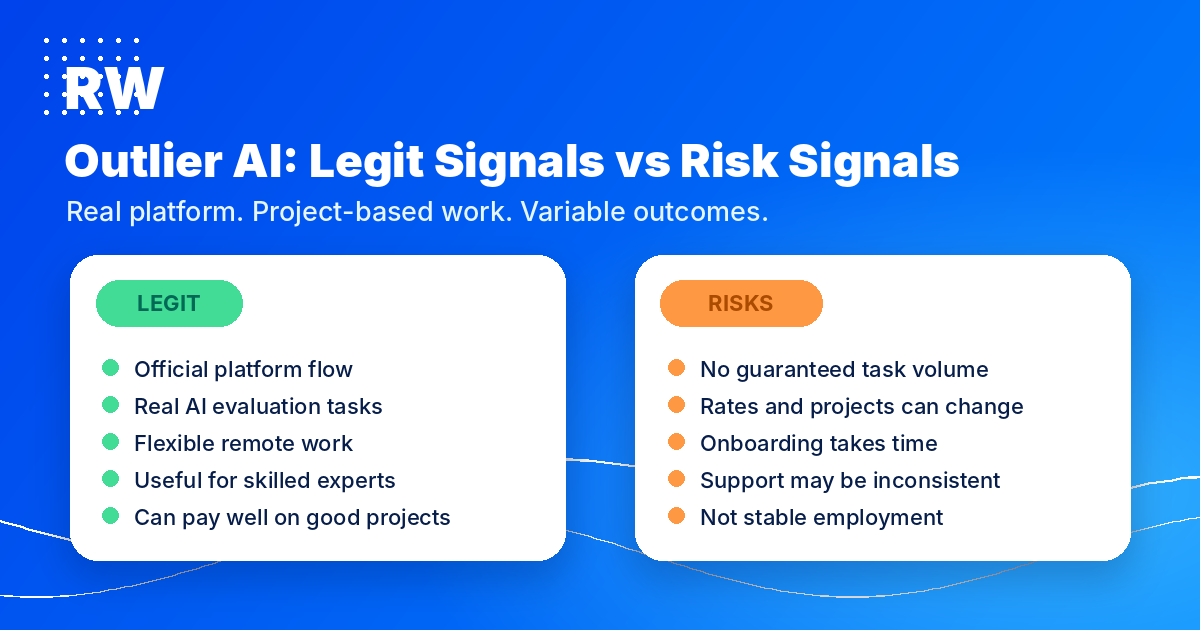
The important distinction is that legitimate does not mean guaranteed, stable, or right for everyone. Outlier AI is best understood as a project-based remote work platform. You may get invited to a project, pass an assessment, complete onboarding, receive tasks, and earn solid hourly pay. You may also pass onboarding and then wait with no available work. Both experiences can happen on legitimate freelance platforms.
What Is Outlier AI?
Outlier AI is a platform where remote contributors help train, evaluate, and improve artificial intelligence systems. The work can include AI response ranking, prompt writing, fact-checking, rewriting model answers, evaluating reasoning, reviewing code, checking math, assessing language quality, or applying professional expertise to specialized tasks.
In plain English, companies building AI models need humans to tell the model what good answers look like. AI systems do not improve only by reading more data. They also need human feedback, expert examples, quality control, and structured evaluations. That is where remote AI training platforms come in.
Outlier AI markets itself toward educated contributors and domain experts. Its public materials reference MAs, PhDs, college graduates, and specialists across fields. Depending on the project, the useful backgrounds can include writing, editing, law, coding, math, science, finance, healthcare, teaching, languages, marketing, and general analytical work.
The important point: Outlier AI is not one single job. It is a platform with many possible projects. Two contributors may have completely different experiences depending on their country, qualifications, project match, timing, assessment score, task quality, and availability.
Why People Ask If Outlier AI Is Legit
People search "is Outlier AI legit" because the pitch includes several details that naturally make remote workers suspicious. The work is fully online. Remote job scams often use phrases like "work from home," "flexible hours," and "high pay" — and Outlier AI uses some of those same general categories. That overlap creates confusion.
AI training is also still a new job category for many people. A person may not immediately understand why a company would pay someone to rate chatbot answers or write prompts. Because the job sounds unusual, people assume it might be fake.
Additionally, pay can be uneven. Some contributors report strong earnings. Others report unpaid onboarding time, long waits, task shortages, sudden project changes, or confusion about rates. Mixed reviews are common on gig platforms, but they make applicants wonder whether the platform itself is illegitimate.
How Outlier AI Works
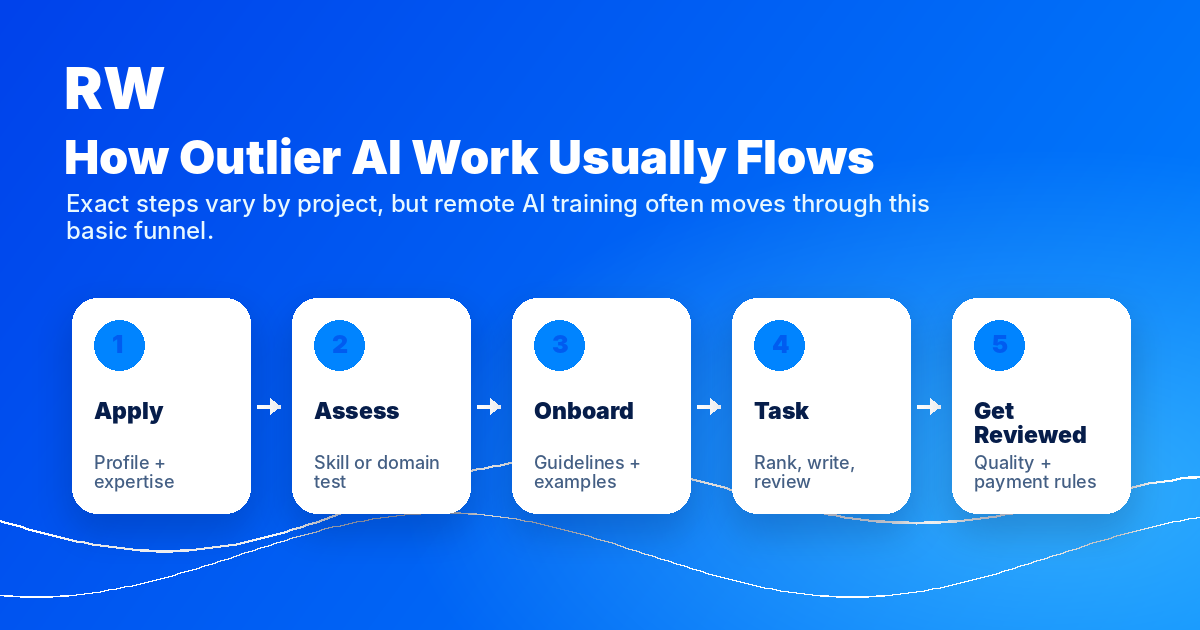
1. You Apply
You create a profile and apply for one or more opportunities. The platform may ask for your background, education, skills, work history, language fluency, and domain expertise. The most valuable thing you can show is not simply that you want remote work — it is that you have judgment in a useful area. Examples of useful expertise include writing and editing, legal analysis, coding, math and statistics, finance, medical or healthcare knowledge, scientific research, teaching, foreign languages, and marketing.
2. You Take an Assessment
Many AI training platforms use assessments to test whether you can follow instructions, reason carefully, write clearly, evaluate answers, or apply domain-specific knowledge. For writing-heavy projects, expect tasks that test clarity, grammar, logic, tone, and accuracy. For coding projects, expect technical questions or code evaluation. For math projects, expect step-by-step reasoning. The assessment may feel annoying, but it serves a purpose: AI clients need contributors who can follow detailed rules and produce consistent judgments.
3. You Complete Onboarding
If matched, you may receive project guidelines, examples, training modules, calibration tasks, or tests. The instructions can be long and the guidelines can change. Some setup time may not be paid the same way as live tasking. And after onboarding, there still may not be a large queue of work. This does not automatically mean the platform is fake — it means the platform is project-based and quality-controlled. Still, track your time carefully so you know whether the work is worth it.
4. You Work on Tasks
Typical remote AI training tasks may include writing prompts for AI models, ranking two AI-generated answers, rewriting weak model responses, checking factual accuracy, evaluating reasoning quality, labeling or classifying content, reviewing code output, solving math problems step by step, and testing model behavior on real-world questions. The work can be intellectually interesting, but it can also be repetitive. The best contributors tend to be people who can read detailed instructions, stay patient, and maintain accuracy even when the task is boring.
5. Your Work Is Reviewed
AI training platforms usually review contributor quality. If your work does not match project standards, you may receive corrections, lose access to tasks, or get moved to another project. If your work is strong, you may get more consistent assignments or better matches. This is why Outlier AI should not be approached like survey work or casual data entry. The people who do best treat it like skilled remote contract work.
How Outlier AI Pay Works
Outlier AI pay can vary by project, location, skill, expertise, and task type. Official Outlier materials state that pay rates for different forms of expertise may differ based on market conditions, and that demonstrating more skills may open access to more projects.
Do not evaluate Outlier AI only by the highest rate you see in a job posting. Evaluate it by effective weekly earnings.
The practical formula: Effective weekly income = paid task hours available × realistic effective hourly rate.
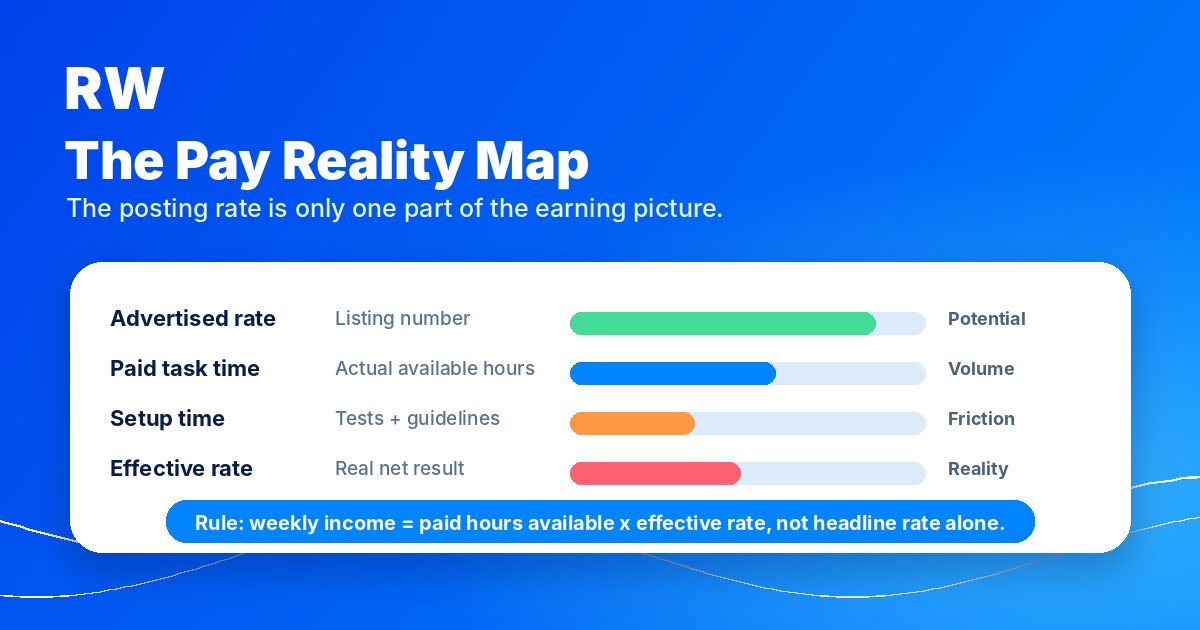
When evaluating Outlier AI pay, separate these four numbers:
- Advertised Rate — the rate you see in a listing or recruiter message. It is only the starting point.
- Paid Task Time — the hours you can actually bill or complete paid tasks. If your queue is empty, your advertised rate does not matter.
- Unpaid or Lower-Paid Setup Time — assessments, onboarding, guideline reading, calibration tasks, and project changes can reduce your effective rate. Count the time.
- Effective Rate — what you actually earn after factoring in task availability, waiting time, setup time, and project friction. This number matters more than the headline rate.
The most realistic way to approach Outlier AI is to run a two-week test. Track every hour spent applying, onboarding, reading guidelines, completing assessments, waiting for tasks, and doing paid work. At the end, calculate your effective hourly rate. If it is strong, continue. If it is weak, keep the account active but prioritize better platforms or more stable remote jobs.
Is Outlier AI a Scam?
Outlier AI itself should not be treated as a simple scam. It has a public website, a visible application flow, a large contributor base, and real AI training work. However, there are three separate issues people often confuse:
- A fake job scam — a fraudulent recruiter pretending to offer work.
- A real but inconsistent platform — legitimate work, but unstable task volume and mixed contributor experiences.
- A job that is not right for you — real opportunity, but poor fit for your income needs or work style.
Outlier AI belongs closer to the second category. The platform can be real and still frustrating. It can pay some contributors and still disappoint others. It can be useful for side income and still be a poor replacement for a full-time job. That is the honest middle ground.
Who Outlier AI Is Best For
Outlier AI is most likely to make sense for people who already have a useful skill and want flexible remote side income — especially people who can turn their existing knowledge into AI feedback.
Writers and Editors
Writers, editors, content marketers, journalists, copywriters, and proofreaders often have skills that translate well to AI training. AI models need help with clarity, structure, tone, factual accuracy, and instruction-following. If you can quickly tell why one answer is better than another, you may be a good fit.
Teachers and Tutors
Teachers are often strong AI trainers because they know how to explain ideas, catch reasoning mistakes, and evaluate whether an answer would help a learner. Math teachers, science teachers, English teachers, coding tutors, and language instructors may find relevant projects.
Lawyers and Legal Professionals
Legal AI training often requires careful reading, precision, and issue spotting. Lawyers, paralegals, law students, and legal writers may be good candidates for specialized projects. Legal contributors should be careful about confidentiality, jurisdiction, and the difference between general analysis and legal advice.
Coders and Engineers
Software engineers, developers, data analysts, and technical reviewers may qualify for higher-skill projects. These tasks may include code generation review, debugging, evaluating technical explanations, or comparing model outputs.
Finance, Accounting, and Business Professionals
Finance and accounting professionals can be useful for projects that require spreadsheet logic, valuation thinking, business analysis, compliance awareness, or numerical judgment. Even general business professionals can be useful if they can evaluate realistic workplace scenarios.
Bilingual and Multilingual Contributors
Language expertise is valuable because AI models need to work across cultures, dialects, and local contexts. Translation, localization, grammar, idioms, and cultural nuance can all matter.
Who Should Avoid Outlier AI
Outlier AI is probably not the right fit if you need guaranteed income immediately. You may also want to avoid it if you hate detailed instructions, get frustrated by changing rules, need a manager to provide clear daily direction, do not want to take assessments, expect employee benefits, need full-time stability, are unwilling to track your own time and effective rate, or dislike repetitive evaluation tasks.
This does not mean you should avoid all remote AI jobs. It means you may need a more stable remote role, such as AI content specialist, AI operations associate, customer success at an AI company, prompt QA analyst, technical writer, implementation specialist, or a remote marketing role at an AI startup.
How to Make Your Outlier AI Application Stronger
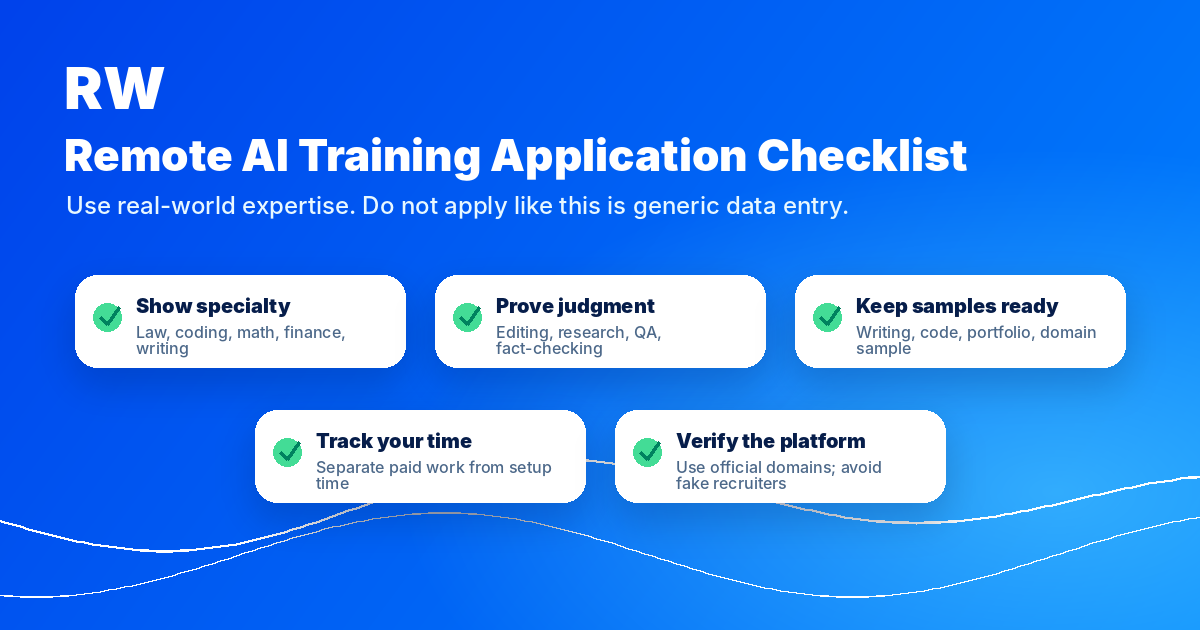
The biggest mistake applicants make is treating Outlier AI like generic online work. The better you can show judgment, expertise, and reliability, the stronger your application becomes.
Lead With a Clear Specialty
Do not present yourself as simply "open to remote work." Present yourself as someone who can help AI models improve in a specific area. Specificity helps because AI training platforms do not only need people with time — they need people with judgment.
Emphasize Quality Control Skills
Useful keywords include editing, research, fact-checking, grading, QA, analysis, reasoning, compliance, documentation, technical review, content evaluation, prompt writing, and response ranking. If you have ever reviewed work, trained people, edited content, graded assignments, checked numbers, managed documentation, or compared options, you have relevant experience.
Prepare Samples
Have a few simple samples ready: a short writing sample, a before-and-after edit, a technical explanation, a code sample, a finance or business analysis sample, a teaching explanation, a translation sample, or a portfolio link. You may not need all of these, but having them ready makes applying easier.
Take Assessments Seriously
Remote AI assessments can feel casual because they happen online. Do not treat them casually. Read instructions slowly, avoid rushing, and answer like you are already doing paid work. Many applicants fail because they skim.
Track Your Time From Day One
Create a simple spreadsheet with columns for date, platform, project, paid task time, unpaid setup time, earnings, and notes. A platform that feels productive may not be productive after you count unpaid time. Track the math.
How to Avoid Fake Outlier AI Job Scams
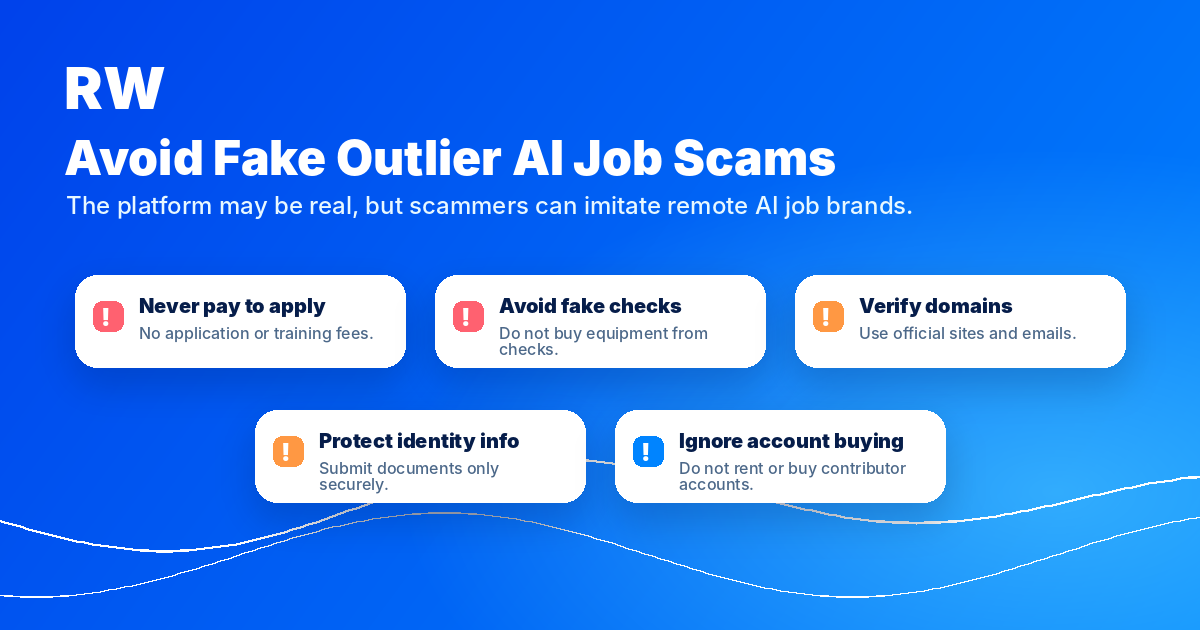
Even if Outlier AI is real, scammers can imitate real platforms. Remote job scams often copy the names of legitimate companies because the brand makes the scam feel safer.
Do Not Pay to Apply
You should not pay an application fee, training fee, equipment fee, account activation fee, or background check fee to a random recruiter. Real remote platforms make money from clients, not from charging applicants upfront.
Watch for Fake Check Scams
A classic remote job scam sends you a check and tells you to buy equipment from a specific vendor. The check later bounces, and you lose the money. Do not participate in any process like that.
Verify the Domain
Use official websites and be cautious with lookalike domains. Be extra careful with recruiters who only communicate through Telegram, WhatsApp, Discord, or personal email addresses. Official onboarding should not feel like a secret side deal.
Protect Sensitive Documents
Some legitimate platforms may eventually require identity or tax verification. That does not mean you should send sensitive documents to an unverified person in a chat. Only submit sensitive information through a secure, official onboarding flow.
Do Not Buy or Rent Accounts
There have been reports across the AI training economy of account selling, account renting, or people trying to bypass country restrictions. Avoid this completely. It can get you banned, expose your identity, and connect you to fraud.
Be Skeptical of Guaranteed Income Claims
No one can honestly guarantee that you will make a specific amount on a task-based AI training platform. Project availability changes. Client needs change. Treat guaranteed-income promises as a red flag.
Outlier AI vs Other Remote AI Platforms
Outlier AI is only one platform in the broader remote AI training category. Remote workers also search for platforms like Mercor, Handshake AI, DataAnnotation, Prolific, Appen, Telus, RWS, and other expert review or data annotation sites.
The smart approach is not to pick one platform and hope it solves your income problem. Apply to several legitimate AI training platforms, track which ones actually give you paid work, compare effective hourly rate — not advertised hourly rate — keep the best platforms active, and use slow periods to apply for more stable remote jobs. Do not let one empty queue destroy your week.
A Practical Decision Framework
Apply if: You want flexible remote side income. You have writing, coding, language, teaching, legal, finance, healthcare, science, or analytical experience. You can handle project-based work. You are comfortable reading detailed instructions. You will track your time and pay. You understand that work may be inconsistent.
Be careful if: You need immediate stable income. You are relying on one platform only. You cannot afford unpaid setup time. You are applying because of a high advertised rate but have not checked task availability.
Avoid if: Someone asks you to pay to apply. A recruiter sends a suspicious equipment check. The process happens only through unofficial chat accounts. You are told income is guaranteed. You are asked to buy, rent, or share an account.
Final Verdict: Should You Apply to Outlier AI?
Outlier AI is worth trying if you understand what it is: a real but inconsistent remote AI training platform. It is not a guaranteed full-time remote job. It is not passive income. It is not a magic AI side hustle. It is project-based freelance work where your outcome depends on your skills, project match, task availability, assessment performance, and patience.
For writers, editors, teachers, coders, lawyers, finance professionals, healthcare workers, scientists, bilingual contributors, and sharp generalists, Outlier AI may be a useful place to test the remote AI training market. But do not rely on it alone. Apply, test it, track your effective rate, and compare it against other remote AI jobs and work-from-home opportunities.
Source Notes
Sources include Outlier AI's public FAQ, homepage, and blog posts describing contributor tasks, pay structures, and platform characteristics; Business Insider reporting on AI training contractors; The Guardian reporting on Scale AI worker conditions; and public Indeed and Glassdoor contributor reviews, which are anecdotal and should not be treated as universal outcomes.