Applying to Mercor and hearing nothing back can feel confusing, especially when the role sounds like a strong match for your background. Remote AI training platforms often move differently from traditional employers. You may not receive a clean yes, a clean no, or a detailed hiring update. Sometimes the platform is reviewing your profile. Sometimes the project is full. Sometimes your application is sitting in a queue until a matching client, subject area, language, or availability window opens up.
That silence does not automatically mean you failed. It also does not mean you should sit still and wait. The best response is to understand what a no-response period can mean, clean up the parts of your application you control, and keep applying to other legitimate remote AI jobs while you wait.
This guide explains what remote AI applicants should know after applying to Mercor and getting no response. It also covers how to improve your profile, when to follow up, what mistakes to avoid, and how to keep your search moving across Mercor, Outlier AI, Handshake AI, micro1, LinkedIn, and other AI model evaluation opportunities.
What "No Response" Usually Means in Remote AI Hiring
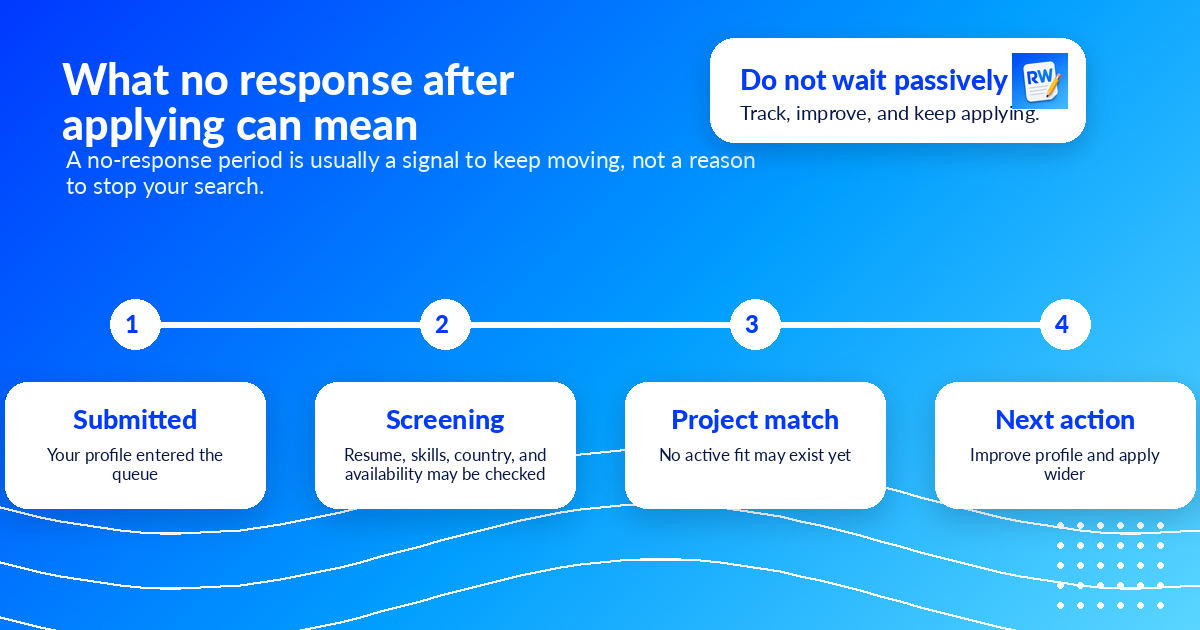
A no-response period is not the same as a formal rejection. In remote AI training, applications often depend on project availability. A platform may have plenty of applicants, but only a limited number of active projects that need a specific type of reviewer. One project may need legal researchers. Another may need finance experts. Another may need strong general writers, coding evaluators, data analysts, teachers, healthcare professionals, or native English speakers. If your background does not match a currently active project, the application may stay quiet even if your profile is not bad.
This is different from a normal job posting where one employer is hiring one person for one role. AI training platforms often match many contractors to many short-term or ongoing projects. That means the timing can be uneven. You might apply during a high-demand window and hear back quickly. You might also apply during a slow window and hear nothing for weeks.
The most useful mindset is simple: silence is information, but it is incomplete information. It tells you that you do not yet have an active next step. It does not tell you that you are permanently blocked from remote AI work.
Common Reasons Mercor Applicants Do Not Hear Back
There are several common reasons an applicant may not receive a fast response after applying to Mercor or a similar AI training platform.
First, your profile may not be specific enough. If your resume says you are a strong communicator but does not show writing, research, analysis, tutoring, coding, finance, legal, medical, or editing experience, the platform has less reason to route you into a specific project. AI model evaluation jobs reward clear proof of skill.
Second, the project may not be open anymore. Some remote AI roles get filled quickly. A listing can remain visible while the most urgent hiring need has already slowed down. That does not mean the platform is fake or that you did something wrong. It may simply mean the active batch of work changed.
Third, there may be a mismatch between your background and the role you selected. Applying to an expert role without showing expert evidence can produce silence. Applying to a writing role with a resume focused only on unrelated operations can also make the profile harder to place. The issue is often positioning, not intelligence.
Fourth, your location, language, or availability may matter. Some AI training jobs are global. Others are limited by country, native-language needs, client requirements, tax setup, or time-zone coverage. If a role needs US-based, Canada-based, UK-based, or Australia-based applicants, a profile outside that group may not move forward for that specific role.
Fifth, the platform may simply be dealing with high applicant volume. Remote AI jobs attract writers, researchers, coders, students, editors, consultants, teachers, analysts, and people searching for flexible online work. When application volume is high, response time becomes less predictable.
How Long Should You Wait Before Taking Action?
There is no universal waiting period that applies to every Mercor application. The better approach is to use stages.
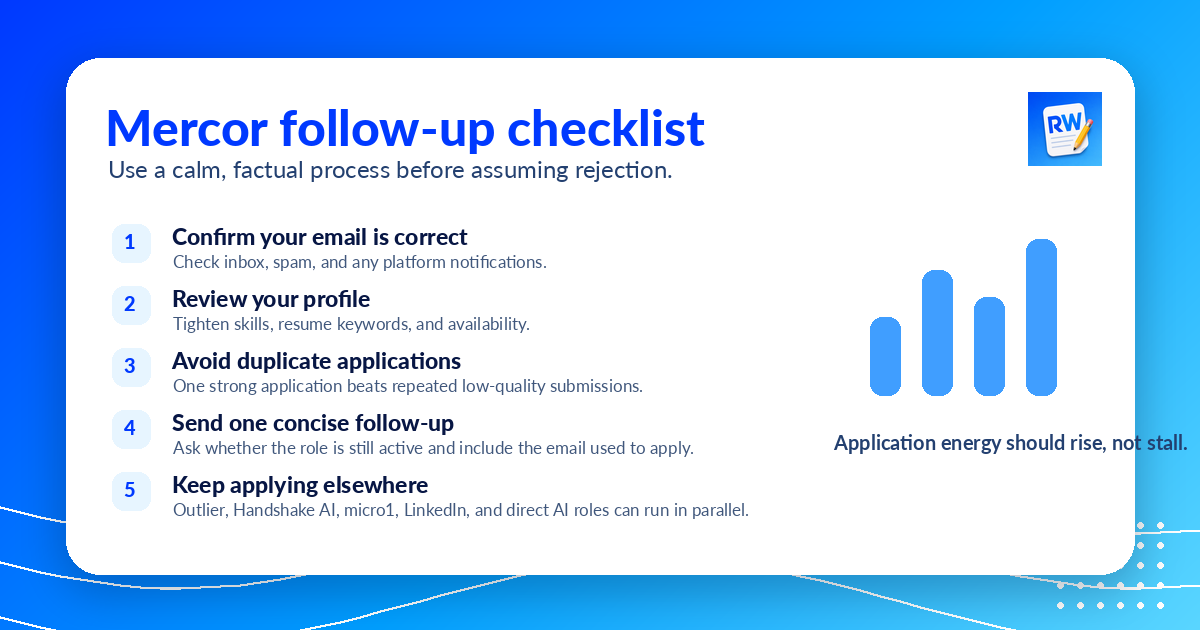
After a few days, make sure the basics are correct. Confirm that you used the right email address. Check spam, promotions, and any alternate inboxes. Make sure your resume uploaded correctly. Review your profile for obvious gaps, unclear job titles, missing skills, or outdated information.
After about one to two weeks, it is reasonable to improve your profile and apply to additional matching roles if they are available. This does not mean applying to every listing. It means applying more precisely. If you are a teacher, target AI evaluator work connected to education, tutoring, writing, curriculum, or student feedback. If you are a lawyer or law student, target legal research and legal reasoning projects. If you are a strong writer, target AI writing evaluator jobs, prompt response review, editing, and model answer comparison. If you are technical, target coding evaluation, data analysis, and software review work.
After several weeks, treat the original application as uncertain and move on operationally. You can still be open to a later response, but your job search should not depend on it. The remote AI work market is broader than one platform.
What to Improve Before Applying Again
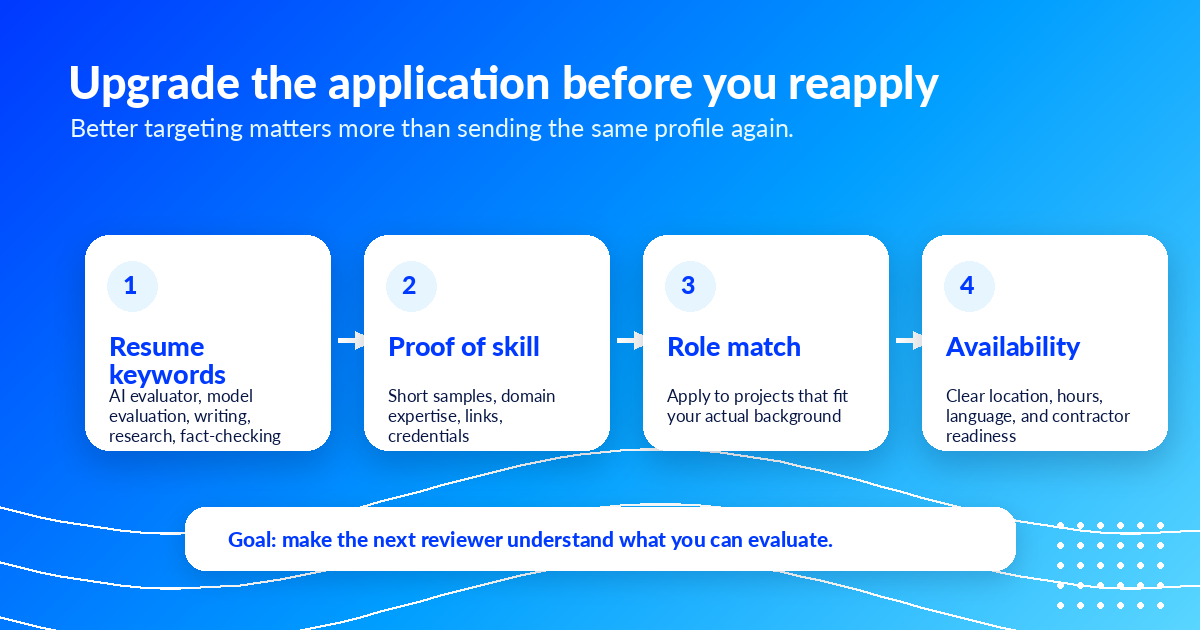
Before you reapply or apply to another AI training role, improve the application inputs. A stronger profile can make a meaningful difference across Mercor, Outlier AI, Handshake AI, micro1, Surge AI, Stellar AI, LinkedIn postings, and direct AI contractor opportunities.
Start with your headline or profile summary. It should quickly explain what kind of AI evaluation work you fit. A vague line like "hardworking professional seeking remote work" is weaker than a specific line like "Finance graduate and research writer available for AI model evaluation, business analysis, and fact-checking tasks."
Then update your resume keywords. Remote AI training platforms often care about writing, research, editing, prompt evaluation, fact-checking, AI outputs, data annotation, coding review, mathematical reasoning, domain expertise, language fluency, and clear written feedback. Use the keywords that honestly match your background. Do not fake expertise, but do not hide relevant skills under generic job descriptions.
Add evidence. If you have written articles, edited documents, tutored students, built spreadsheets, analyzed data, reviewed legal documents, worked in healthcare, managed operations, coded software, or done academic research, say so clearly. AI evaluator jobs are built around judgment. The platform needs to understand what kind of judgment you can provide.
Finally, make sure your availability is realistic. If you only want five hours per week, that is different from being ready for twenty flexible hours. If you can work evenings, weekends, or specific time zones, make that clear where the platform allows it.
Remote Work Union connects you to legitimate remote AI training and evaluation roles across multiple platforms. Apply for free.
Find Roles Hiring Now →How to Follow Up Without Hurting Your Chances
A follow-up should be calm, short, and factual. Do not send a frustrated message. Do not accuse the company of ignoring you. Do not send the same message repeatedly. One concise follow-up is enough.
A useful follow-up can say that you applied, identify the role or project if you know it, include the email address used for the application, and ask whether there is an active next step. Keep it professional. The goal is not to pressure the platform. The goal is to make it easy for someone to locate your application and clarify whether the role is still active.
If there is no reply after that, move forward. Repeated follow-ups are usually less valuable than strengthening your application and applying to more roles.
Do Not Pause Your Search for One AI Platform
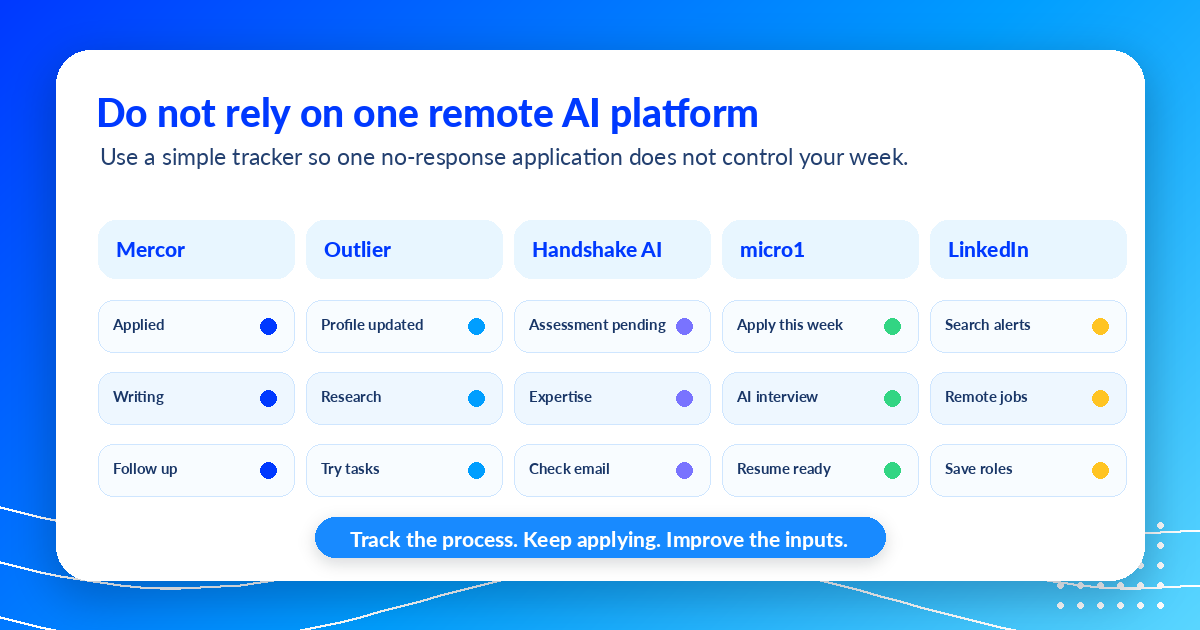
The biggest mistake is building your entire remote work plan around one application. Mercor can be a useful platform for AI training and expert work, but it should not be your only path. Remote AI applicants should treat the search like a pipeline.
That pipeline can include Mercor, Outlier AI, Handshake AI, micro1, Surge AI, Stellar AI, LinkedIn AI jobs, remote job boards, university networks, professional communities, and direct company searches. People searching for OpenAI jobs, Anthropic-style AI evaluation, Google Gemini-related work, Meta AI review roles, Microsoft AI projects, or Claude AI training jobs are often searching for the same broad category: paid human review of AI outputs. The exact hiring path may be through a platform, a staffing partner, a contractor marketplace, or a direct employer.
A simple tracker helps. Record the platform, role, date applied, email used, assessment status, follow-up date, and next action. This prevents confusion and keeps your search active. It also helps you see patterns. If writing roles respond but expert roles do not, adjust your positioning. If you pass assessments but receive no tasks, broaden your platform list. If your resume is not getting responses anywhere, rewrite it for AI evaluation keywords.
How to Tell Whether You Should Reapply
Reapplying can make sense when something material has changed. A stronger resume, a clearer profile, a new credential, a better role match, or a different project can justify a new application. Reapplying with the same weak profile usually does not solve the problem.
Before reapplying, ask four questions. Does this role match my actual skills? Does my profile prove that match quickly? Have I fixed obvious gaps? Am I applying to a current role rather than an old or generic listing? If the answer to those questions is yes, a new application may be reasonable. If the answer is no, improve the profile first.
Avoid creating duplicate accounts or trying to game the system. That can create identity, compliance, or trust issues. A professional applicant should keep records clean and accurate.
What Strong Applicants Do Differently
Strong remote AI applicants do not rely on hope. They package their background clearly. They apply to roles that fit. They prepare for assessments. They write clean explanations. They understand that AI model evaluation work is not just clicking boxes. It often requires reading carefully, comparing outputs, spotting errors, explaining reasoning, and giving feedback that a model training team can use.
They also understand the difference between entry-level AI data annotation and higher-skill AI evaluation. Data labeling may involve categorizing, tagging, or cleaning information. AI model evaluation may involve ranking chatbot answers, writing ideal responses, judging factual accuracy, checking safety, reviewing code, or evaluating domain-specific answers. Expert projects may require legal, medical, finance, math, coding, language, or academic expertise.
A strong applicant makes that fit obvious. The reviewer should not have to guess whether you can do the work.
Resume and Profile Keywords to Consider
Use keywords that match your real background. For general AI evaluation work, relevant terms may include AI model evaluation, AI training, prompt evaluation, response ranking, RLHF, fact-checking, research, writing, editing, data annotation, chatbot evaluation, accuracy review, safety review, and feedback writing.
For expert applicants, add the domain. A finance applicant might include financial analysis, Excel, valuation, accounting, market research, and business writing. A legal applicant might include legal research, case analysis, contracts, compliance, and legal writing. A healthcare applicant might include clinical writing, medical terminology, patient education, and healthcare research. A software applicant might include code review, Python, JavaScript, debugging, algorithms, and technical documentation.
The point is not to stuff keywords randomly. The point is to make the profile searchable and understandable. Remote AI hiring teams often need to place applicants quickly. Clear keywords help them understand where you fit.
Red Flags to Avoid While Waiting
Do not pay someone who promises a guaranteed Mercor approval. Legitimate remote AI work should not require paying a stranger for access. Do not share login credentials. Do not let someone else complete assessments under your name. Do not copy assessment answers from forums. Do not exaggerate credentials you cannot support.
Also be careful with fake job posts that use famous AI company names to attract applicants. Searches like OpenAI remote jobs, Anthropic AI evaluator jobs, Google AI training jobs, Gemini AI jobs, Meta AI jobs, and Claude AI jobs can bring up legitimate opportunities and low-quality pages. Look for clear company information, realistic application steps, and normal contractor or employment terms.
Tip: Legitimate remote AI platforms do not charge application fees or guarantee placements. If someone asks for payment in exchange for access or a guaranteed job, it is a scam.
The Practical Next Move
If you applied to Mercor and received no response, your next move is not to panic. Check your inbox. Review the application. Improve your resume and profile. Send one concise follow-up if appropriate. Then keep applying to other legitimate remote AI jobs.
The remote AI market rewards people who can write clearly, reason carefully, evaluate outputs, and explain decisions. Your job is to make those strengths visible. A no-response application is frustrating, but it can also be a useful prompt to improve your positioning and build a wider pipeline.
Frequently Asked Questions
Why hasn't Mercor responded to my application?
Common reasons include a profile that is too general, the role being filled, a mismatch between your background and the project needs, location or language requirements, or simply high application volume. Silence is not always a rejection.
How long should I wait before assuming Mercor will not respond?
Give the process one to two weeks before shifting your energy elsewhere. If you have received no update after two weeks, treat the application as uncertain and apply to other relevant AI training and evaluator roles.
Should I reapply to Mercor if I got no response?
Only reapply if you can make a materially stronger application. Sending the same generic profile again typically does not change the outcome. Improve your keywords, proof of skill, and role match before submitting again.
What should I improve to get a response from Mercor or similar AI training platforms?
Make your profile specific to your strongest skill category. Use resume keywords that reflect AI evaluation work: model evaluation, response ranking, research, editing, fact-checking, prompt writing, domain expertise. Concrete proof of skill — work samples, credentials, specific role descriptions — matters more than generic enthusiasm.