An Outlier AI application rejection can feel final, especially when you were hoping to start remote AI training work quickly. The important thing to understand is that not every rejection means the same thing.
Sometimes it means your resume did not match the project you applied for. Sometimes it means the platform did not have enough demand for your location, domain, language, or experience level. Sometimes it means an assessment result was not strong enough. And in more serious cases, it may relate to identity, location, account, or platform-policy issues.
Those situations require very different responses. This guide explains what an Outlier AI rejection can mean, whether you can reapply, how to improve your chances before trying again, and why smart remote workers should also apply to other AI training platforms instead of waiting on one account.
First: Know What Kind of Rejection You Received
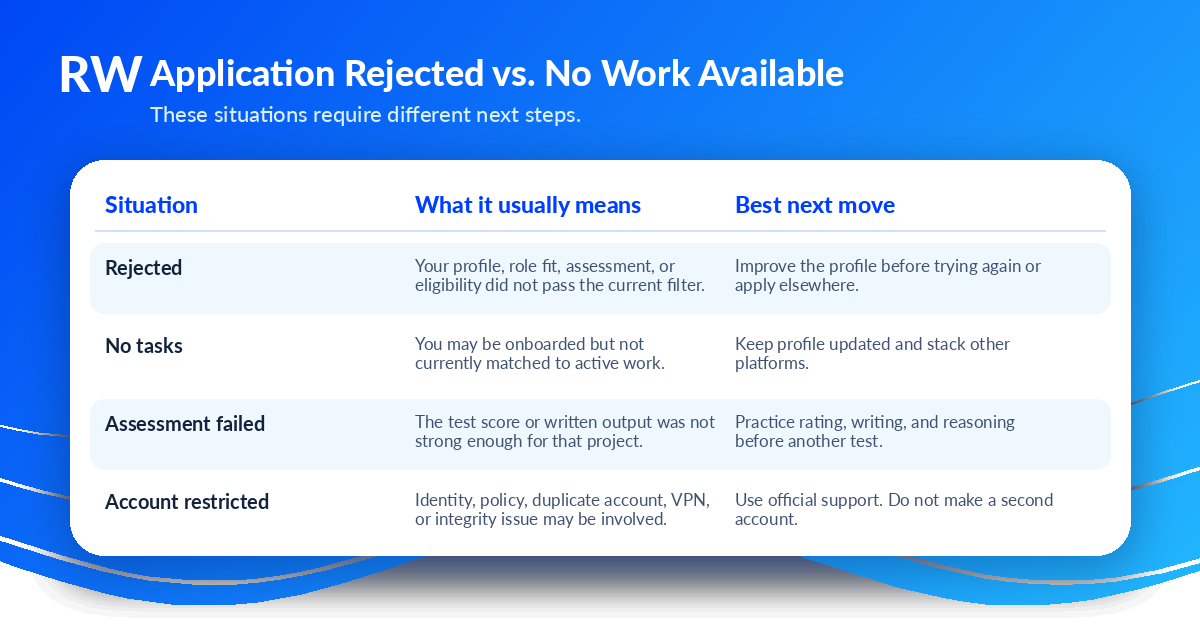
Before you decide whether to reapply, separate the rejection into one of four categories.
1. Your application was rejected
This usually means the platform reviewed your profile, resume, LinkedIn, eligibility, or application details and decided you were not a match for that opportunity at that time. That does not always mean you are unqualified for AI training work. It may mean the specific role was looking for a different background, stronger writing samples, a clearer resume, a different location, or a more specialized area of expertise.
2. You failed or did not pass an assessment
This is different from a general application rejection. In AI model evaluation work, assessments often test your ability to follow instructions, compare two AI answers, explain your reasoning, identify factual errors, and write clearly. If your assessment failed, the best response is not to rush into another test. You should practice the skills that remote AI evaluator jobs actually measure.
3. You passed onboarding but have no tasks
Many applicants confuse "no tasks available" with rejection. They are not the same thing. On platforms like Outlier AI, Mercor, Handshake AI, micro1, Surge AI, and other AI training marketplaces, available work can vary by customer demand, project budget, location, domain, language, and quality needs. Having no tasks does not necessarily mean you failed. It may mean you are not currently matched to active work.
4. Your account was restricted, disabled, or flagged
This is the most serious category. If the issue involves duplicate accounts, identity verification, location inconsistency, VPN use, account sharing, task integrity, confidentiality, or platform rules, do not try to work around the decision by creating a second account. That can make the situation worse. Use the official support or appeal route if one is available.
Can You Reapply to Outlier AI After Being Rejected?
The honest answer is: it depends on why you were rejected.
If your application was rejected because you were not a fit for a specific project, you may be able to apply to a better-fitting opportunity later. AI training platforms often need different types of contributors at different times: writers, business professionals, lawyers, teachers, doctors and nurses, scientists, coders, data analysts, editors, finance experts, and multilingual reviewers. A rejection for one role does not automatically mean you are a bad fit for every AI evaluation job.
But if the rejection is connected to account integrity, identity verification, location misrepresentation, multiple accounts, confidentiality, or platform violations, the safer move is not to reapply through a workaround. You should follow the platform's official process and avoid doing anything that looks like evasion.
The key is to treat reapplying as a profile-quality decision, not an emotional reaction.
Remote Work Union tracks legitimate remote AI training roles across top platforms. Find opportunities that match your background without sorting through scam listings.
Find Roles Hiring Now →Why Outlier AI Applications Get Rejected
Remote AI training work is competitive because the jobs can be flexible, remote, and better paid than many basic work-from-home roles. Platforms are not only looking for people who want online work. They are looking for people who can produce reliable training data for AI systems.
That means your application may be rejected for reasons like these:
- Your resume does not clearly show expertise.
- Your LinkedIn profile is incomplete or inconsistent.
- You applied to a domain that does not match your background.
- Your writing sample was vague, sloppy, or generic.
- Your assessment answers did not follow instructions.
- Your explanations were too short, too long, or not specific enough.
- Your location, phone, ID, or profile details did not match eligibility requirements.
- The platform did not need more workers in your field at that moment.
- The role required stronger experience, credentials, or domain knowledge.
This is why "Can I reapply?" is not the only question. The better question is: "What would be different if I applied again?" If nothing changes, the result may not change either.
What to Do in the First 24 Hours After an Outlier Rejection
Do not immediately create a new account. Do not submit random applications with the same weak resume. Do not message support with a long emotional explanation unless there is a clear error to correct.
Instead, take a structured approach.
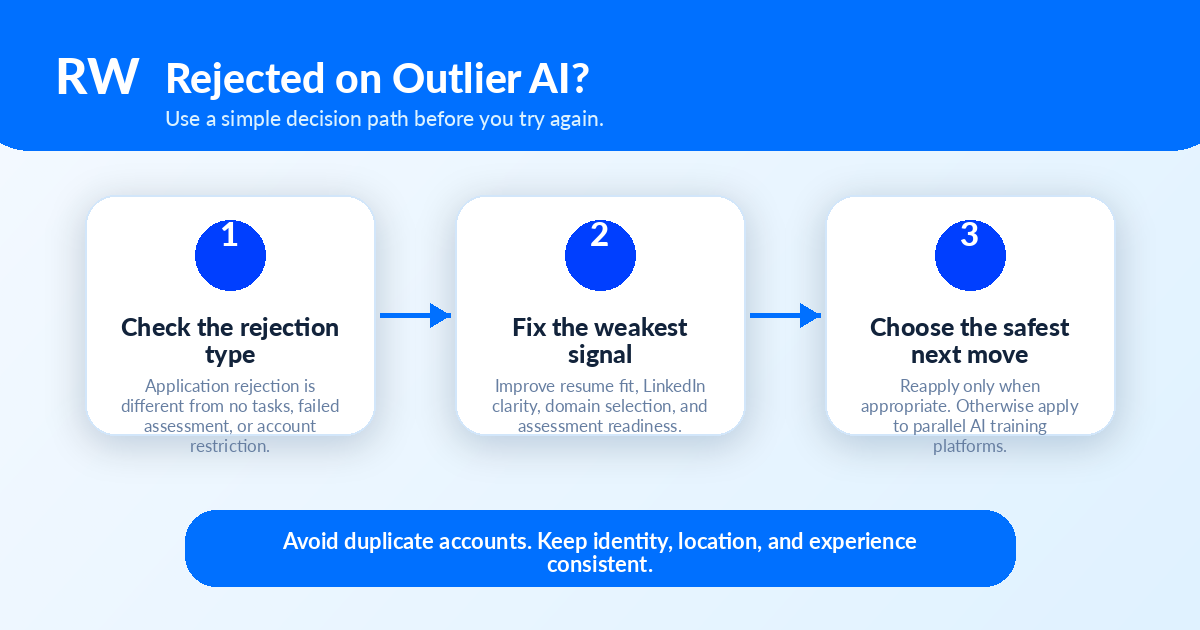
First, save the rejection message. Look for specific language. Did it mention qualifications? Assessment results? Verification? Project availability? Account status? A policy issue? A general "not selected" message?
Second, identify which part of your application may have failed: resume, LinkedIn, role match, assessment, eligibility, or account status.
Third, review the role you applied for. Was it actually aligned with your background, or did you apply because it was remote and available?
Fourth, make a short improvement plan before trying again. That may sound obvious, but most applicants skip this step. They keep applying with the same unclear profile and assume the platform is the problem. Sometimes the platform is inconsistent. But sometimes the application is not showing the applicant's strongest qualifications.
How to Improve Your Profile Before Trying Again
A strong AI training profile should make your value obvious quickly.
If you are a business professional, highlight analysis, operations, strategy, client communication, spreadsheets, market research, and clear decision-making. If you are a writer or editor, highlight research, proofreading, fact-checking, tone control, structure, and experience evaluating written work. If you are a teacher or tutor, highlight explanations, grading, curriculum, subject knowledge, and feedback. If you are a lawyer or legal researcher, highlight careful reading, issue spotting, precision, and compliance-aware reasoning. If you are technical, highlight coding languages, debugging, data analysis, math, statistics, or software review.
Remote AI evaluation jobs are not only for coders. Many projects need people who can judge whether an AI answer is helpful, accurate, safe, well-written, and appropriate for the user's request. That is why your profile should not just say "I am interested in AI." It should show why you are useful for AI model evaluation.
Resume improvements that matter
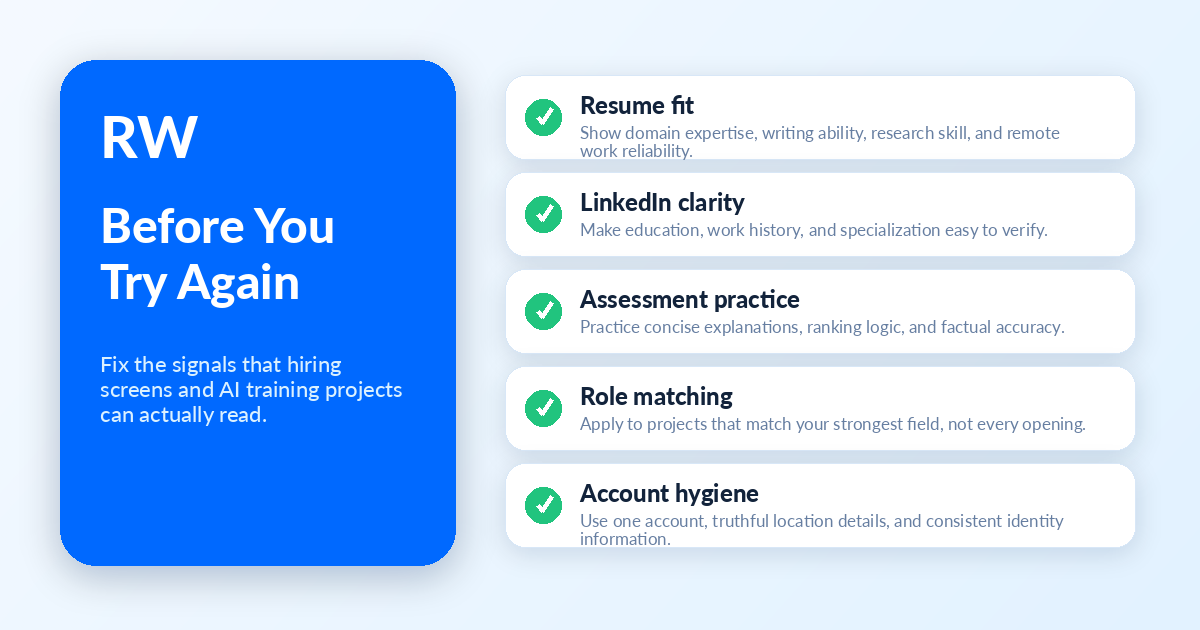
Your resume should include keywords that match AI training work, such as:
- AI training
- AI model evaluation
- data annotation
- prompt evaluation
- response ranking
- RLHF
- fact-checking
- research
- writing and editing
- subject matter expertise
- quality assurance
- content review
- instruction following
- analytical reasoning
You do not need to stuff keywords unnaturally. But the platform should be able to understand your skills quickly. A vague resume that says "hard worker with good communication skills" is weaker than a resume that says "Reviewed written content for accuracy, clarity, tone, and adherence to guidelines."
Strengthen your LinkedIn before reapplying
Many AI training platforms look for consistency across your application, resume, and LinkedIn profile. If your resume says you are a finance expert but your LinkedIn has no finance history, that creates friction. If your application says you are a legal researcher but your profile only shows unrelated retail work, the reviewer may not understand the match.
Your LinkedIn should make three things clear: what field you know, what kind of work you have done, and why you can evaluate AI outputs in that field. You do not need a perfect corporate profile. You need a believable, complete, and consistent one. For example, instead of only writing "Freelancer," use descriptions that show the actual skills: research, writing, editing, customer support, operations, tutoring, coding, analysis, recruiting, marketing, finance, healthcare writing, legal support, or content quality review.
What to Practice Before Another AI Training Assessment
Outlier AI assessments and similar AI evaluator tests often reward careful reasoning more than speed. Practice these skills before your next test:
Compare two AI answers
Do not just say one answer is "better." Explain why. A strong evaluator can point to accuracy, completeness, instruction following, tone, structure, safety, and usefulness.
Spot hallucinations
AI models can sound confident while being wrong. Practice checking whether an answer invents facts, misstates numbers, overpromises, or gives unsupported claims.
Follow the rubric exactly
Many applicants fail because they answer based on personal preference instead of the project's criteria. In model evaluation work, the rubric matters more than your instinct.
Write concise feedback
Good feedback is specific but not bloated. Explain the issue, point to the relevant part of the answer, and state what would make the response better.
Avoid overusing AI tools
Do not use unauthorized tools, automation, scripts, or outside help on assessments or tasks. AI training platforms care about authentic human judgment. If a project allows a tool, follow the project instructions exactly. If it does not, do not assume it is allowed.
Should You Appeal an Outlier Rejection?
Appealing may make sense if there is a clear mistake: wrong identity information, a technical issue, a duplicate record you can explain, a location error, or a misunderstanding that you can document. An appeal is weaker if it only says, "Please give me another chance."
A better appeal is short, factual, and specific:
- State what happened.
- Explain the issue clearly.
- Provide the correct information.
- Avoid accusations.
- Ask whether the account or application can be reviewed.
Do not send multiple angry messages. Do not exaggerate your credentials. Do not threaten the platform. Do not create a new account while waiting.
When You Should Not Reapply Right Away
There are times when trying again immediately is the wrong move. Do not reapply right away if your resume is still weak, your LinkedIn is unfinished, you do not understand the assessment format, or you are applying to roles outside your real skill set.
Also do not reapply through a duplicate account if the issue involves verification, location, account status, or platform rules. If you are not sure what caused the rejection, pause and improve your broader AI training profile first.
Apply to More Than One AI Training Platform
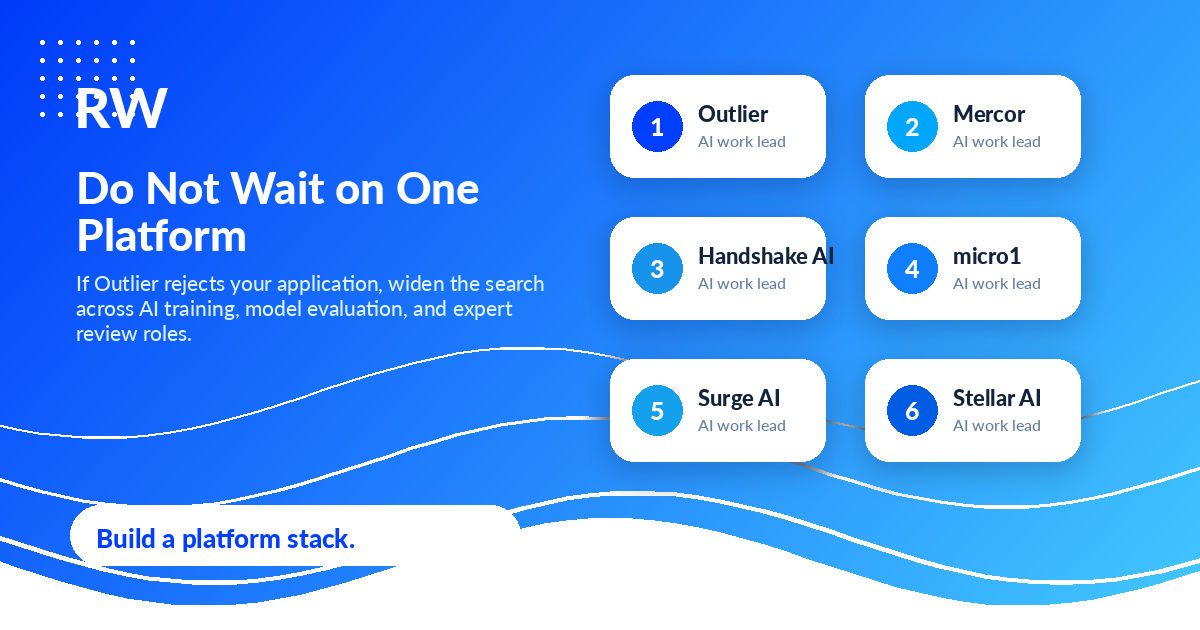
One of the biggest mistakes remote workers make is treating one platform like a full-time employer. Outlier AI, Mercor, Handshake AI, micro1, Surge AI, Stellar AI, data annotation platforms, search quality rater companies, and AI research vendors can all have uneven project flow.
A rejection on one platform does not mean you should leave the entire AI training category. AI companies and labs need human feedback for many types of systems, including chatbot answers, search results, code generation, creative writing, business analysis, healthcare information, legal reasoning, math, science, and multilingual responses. The end customers may include major AI companies and products connected to OpenAI, Anthropic, Google Gemini, Meta AI, Microsoft Copilot, Grok, and other large AI systems.
You may not know which company is behind a project. But you can still position yourself for the kind of work these projects need. The safest strategy is to build a platform stack. Apply to several legitimate AI training and AI evaluation opportunities, keep your profiles updated, and avoid depending on one dashboard for all of your income.
A Simple Reapplication Checklist
Before you try again, ask yourself:
- Is my resume clearly matched to the kind of AI training role I want?
- Does my LinkedIn support the same story as my resume?
- Am I applying to the right domain for my background?
- Have I practiced rating, ranking, and explaining AI answers?
- Can I write clear feedback without rambling?
- Are my location, identity, phone, and profile details consistent?
- Am I using only one account?
- Am I following all platform rules around tools, confidentiality, and assessments?
- Have I also applied to other platforms instead of waiting on one?
If you cannot answer yes to most of these, fix your materials first. See the platform comparison guide for a broader look at where to apply.
Tip: The strongest applicants treat a rejection as a checklist, not a verdict. Identify the gap, fix it, and apply to multiple platforms simultaneously.
Bottom Line
If your Outlier AI application was rejected, you may still have options. A rejection may mean poor role fit, weak profile signals, assessment issues, limited project demand, or an eligibility problem. It does not always mean you are permanently blocked from remote AI training work.
But the next step depends on the reason. Improve your resume. Clean up your LinkedIn. Apply to roles that match your real expertise. Practice model evaluation skills. Avoid duplicate accounts and shortcuts. And most importantly, do not rely on one platform. Remote AI work is broader than one application. Strong writers, business professionals, creatives, researchers, educators, healthcare professionals, legal professionals, finance experts, data analysts, and coders can all find opportunities in AI training when they position themselves correctly.
Frequently Asked Questions
What does an Outlier AI application rejection actually mean?
It depends on the type. A general application rejection means your profile did not match the role at that time. A failed assessment means your evaluation quality did not meet the project standard. No tasks available is different from a rejection — it means the platform has no matching work right now. An account restriction is the most serious case and usually involves a policy or verification issue that requires the official support process.
Can you reapply to Outlier AI after being rejected?
It depends on why you were rejected. If the rejection was about role fit or assessment quality, you may be able to apply to a better-matching project or improve your skills before trying again. If the rejection involves account integrity, identity, location, or platform policy issues, do not try to work around it with a new account. Follow the official process.
How can I improve my chances if I reapply to Outlier AI?
Improve your resume to highlight AI evaluation skills: writing, research, fact-checking, domain expertise, and rubric-based judgment. Clean up your LinkedIn so it matches your resume. Practice comparing AI answers and explaining your reasoning in specific, concise terms. Make sure your location, identity, and account details are accurate. Apply to other AI training platforms at the same time rather than depending on one queue.
Is it a good idea to create a second Outlier AI account after being rejected?
No. Creating duplicate accounts violates platform terms and can result in permanent access loss. The better approach is to address the actual cause of the rejection: improve your profile, practice assessment skills, and apply to other legitimate AI training platforms while keeping your existing account in good standing.