Not getting tasks on Outlier AI is frustrating because it feels unclear. You may have passed onboarding, completed an assessment, joined a project, or worked for a while, and then the dashboard suddenly shows an empty queue. For remote workers trying to earn from AI training jobs, model evaluation, prompt writing, RLHF rating, data annotation, or AI response review, that silence can feel like a rejection.
But an empty task queue does not always mean your account is banned, your application failed, or your profile is worthless. In many cases, it means the platform does not currently have a matching project for your skills, location, language, availability, or qualification status. The right move is not to panic. The right move is to diagnose the situation, improve the parts you can control, and build a broader remote AI work pipeline so one platform does not control your income.
This guide explains what it usually means when Outlier AI is not giving you tasks, what to check first, what not to do, and how to improve your chances of getting more AI evaluator work.
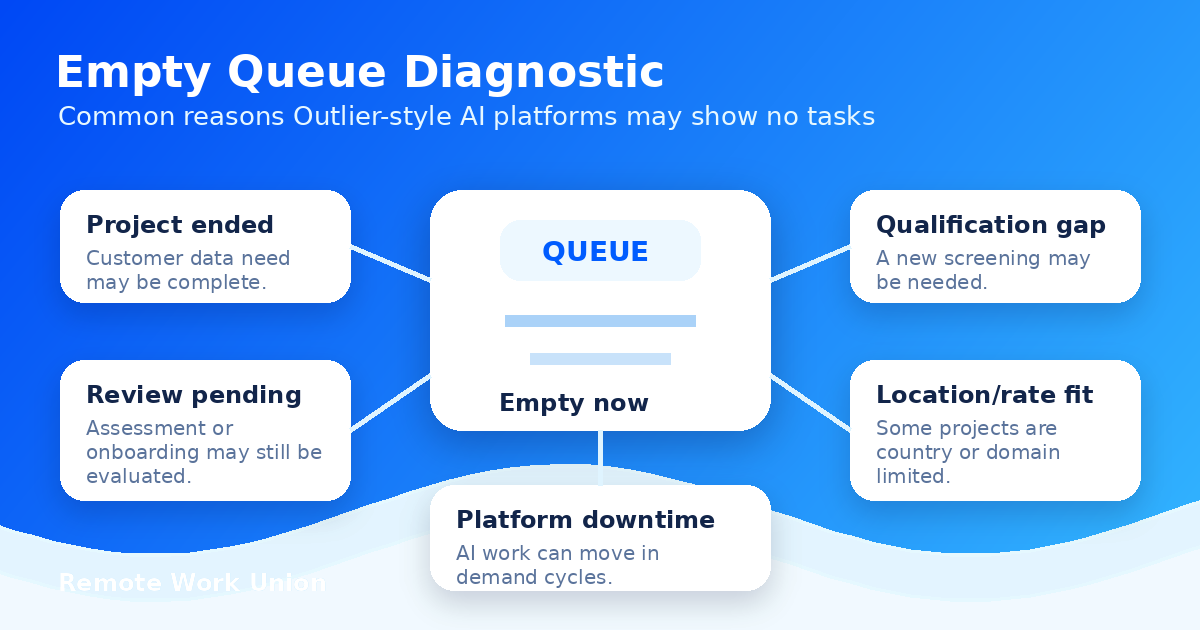
Why Outlier AI task queues go empty
Outlier-style platforms depend on active customer projects. AI companies, research teams, and data vendors need human reviewers to help improve AI models, but those needs change quickly. One week a platform may need thousands of people rating chatbot answers. Another week it may need legal experts, finance specialists, coders, bilingual reviewers, math evaluators, healthcare writers, or people in a specific country.
That means task availability can change for reasons that have nothing to do with your personal performance. A project can end. A batch of work can be completed. A customer can pause a workflow. A new qualification can be required. The platform may have more approved workers than available tasks. A marketplace or project tab may also change as platforms test new systems.
The most important idea is this: no tasks is a status, not a final verdict. You should treat it as a signal to check your account, improve your profile, and apply elsewhere at the same time.
Common reasons you are not getting tasks
1. The project ended or paused
This is the most common reason remote AI work slows down. AI training projects are often batch-based. When the customer gets enough data, the work can stop. If the project is paused, the queue may go empty even if you did nothing wrong.
This happens across AI training platforms, not just Outlier. Human AI reviewers often work on temporary batches: ranking two model responses, writing ideal answers, fact-checking chatbot claims, testing AI safety behavior, labeling data, or reviewing prompts. Once the project quota is met, the task flow can dry up.
What to do: check whether there are other available projects, assessments, or marketplace options. If none appear, keep your account clean and active, but do not wait passively for weeks.
2. Your assessment or onboarding is still under review
Sometimes people assume they are ready to work because they completed a test, but the platform may still be reviewing the result. Some roles require general onboarding, identity verification, a domain screening, and project-specific onboarding before paid tasks appear.
This matters for Outlier AI jobs because many projects are not general data entry jobs. The platform may need evidence that you can evaluate AI answers with accuracy, follow instructions, write clear explanations, and avoid guessing.
What to do: look for dashboard messages, training modules, email notices, or required qualification steps. If the platform gives you a way to complete missing onboarding, do that first.
3. You passed one step, but not the project-specific qualification
Passing a general test does not always unlock every project. You may be approved for the platform but not approved for a specific task type. A writing evaluator project may require different skills than a coding evaluation project. A math reasoning project may require a more technical assessment. A safety evaluation task may require stricter instruction-following.
This is why some applicants say, "I passed the Outlier AI test but still have no work." It may mean you passed one gate, but the platform still does not have a matching live project for you.
What to do: add stronger proof of your real skills. If you are a writer, emphasize editing, research, factual accuracy, and clear feedback. If you are a business professional, show analysis, operations, Excel, strategy, or consulting experience. If you are a teacher, show grading, explanation, curriculum, and subject matter expertise. If you are a coder, show languages, debugging, code review, and technical documentation.
4. Your skills do not match current demand
AI training demand changes by domain. A platform may currently need advanced math, biology, chemistry, law, finance, accounting, medicine, software engineering, multilingual evaluation, or creative writing. If your profile is broad but not specific, you may not match the highest-value queues.
This does not mean you need to be a coder. Many AI evaluator jobs need strong writers, business professionals, teachers, researchers, lawyers, doctors, nurses, editors, analysts, and creatives. But you do need to make your expertise obvious.
What to do: update your resume and profile so the platform can understand where you fit. Use concrete skills: AI model evaluation, prompt writing, response ranking, research, fact-checking, editing, Excel, legal research, medical writing, financial analysis, tutoring, coding, QA testing, or technical review.
5. Your location does not match available projects
Some remote AI jobs are work-from-anywhere. Others are country-specific or region-specific. Platforms may need contributors from the United States, Canada, the United Kingdom, Australia, or specific language markets. They may also limit work based on tax rules, customer requirements, identity verification, or location policy.
This is important: do not try to fake your location, use a VPN to appear elsewhere, create a second account, or change account details dishonestly. That can create a much bigger problem than an empty task queue.
What to do: keep your location accurate. If you move, travel, or relocate, follow the platform's official process. Long-term access is more valuable than trying to force your way into a project that does not match your real location.
6. Your quality score or recent performance may have affected access
If you previously had tasks and then lost them, quality can be one possible factor. AI training work is judged on accuracy, instruction-following, consistency, writing clarity, and whether your explanations help the model improve. If reviewers disagree with many of your ratings, if your justifications are thin, or if you rush tasks, you may receive fewer opportunities.
Do not assume this is the cause unless the platform tells you. But you should use downtime to improve the skills that matter.
What to do: practice writing short, clear explanations for why one AI answer is better than another. Focus on helpfulness, factual accuracy, completeness, safety, relevance, and whether the answer followed the user's instructions.
What to check first when you have no Outlier AI tasks
Start with the simplest checks. Do not overthink it.
- Check your dashboard for missing onboarding, pending reviews, warnings, or project messages.
- Check your email for assessment results, project invitations, support updates, or required action.
- Check whether the Marketplace or project tab is available to you.
- Check whether your profile, resume, LinkedIn, payment method, and identity information are complete and accurate.
- Check whether you recently changed location, device, payment details, or account information.
- Check whether you were removed from a project or simply reached the end of the available task batch.
- If the platform has an official support channel for your issue, use that instead of guessing.
A clean account matters. Your goal is to be the kind of contributor a platform can trust when new work appears.
What not to do when tasks disappear
Do not create a second account. Do not buy or borrow an account. Do not use someone else's identity. Do not use a VPN to fake your work location. Do not share confidential project screenshots online. Do not ask strangers to help you pass assessments. Do not spam support with angry messages. Do not claim expertise you do not have.
These shortcuts can make the situation worse. Most serious AI training platforms care about identity, location, confidentiality, and quality because the work supports real AI systems used by companies like OpenAI, Anthropic, Google, Meta, xAI/Grok, Microsoft, and other AI labs or enterprise customers.
If you want long-term remote AI work, trust is part of the job.
Remote Work Union tracks legitimate remote AI training roles across top platforms. Find opportunities that match your background without sorting through scam listings.
Find Roles Hiring Now →How to improve your chances of getting tasks again
Strengthen your resume for AI evaluation work
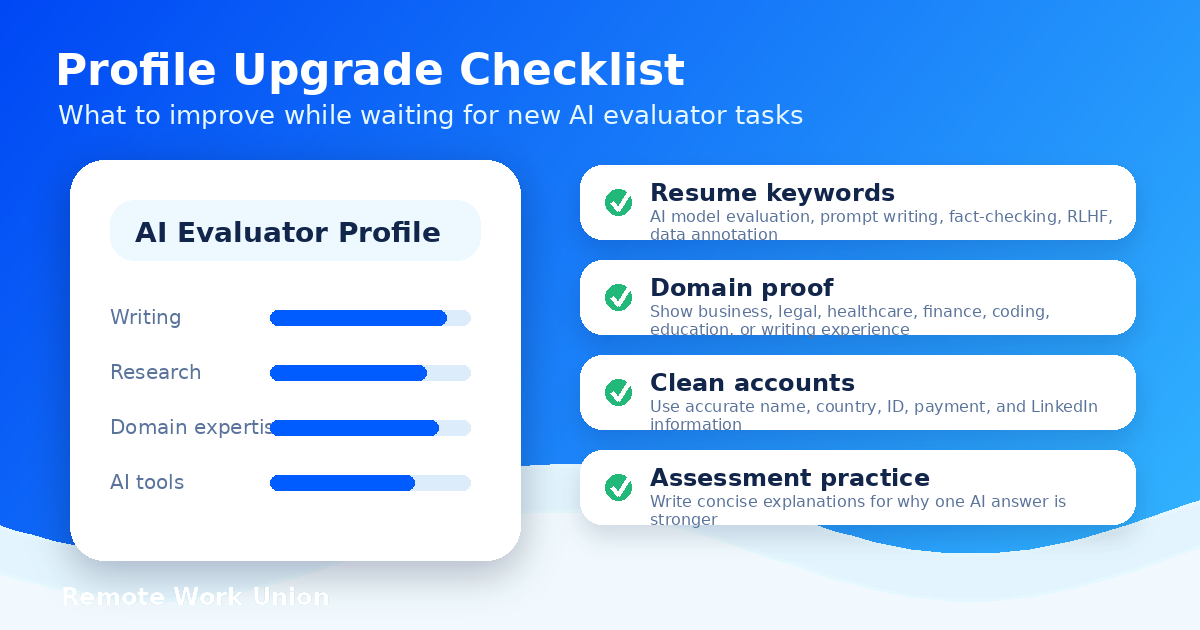
Your resume should not only say that you want remote work. It should explain why you are useful for AI training. Add keywords that match the work you can actually do:
- AI model evaluation
- AI response rating
- Prompt writing
- RLHF feedback
- Fact-checking
- Data annotation
- Search quality evaluation
- Editing and proofreading
- Research
- Domain expertise
- Technical review
- Legal research
- Medical writing
- Financial analysis
- Code review
- Excel analysis
- Teaching and tutoring
Do not stuff keywords randomly. Use them in truthful bullet points. For example: "Reviewed written content for accuracy, clarity, tone, and instruction-following" is more useful than "hard worker seeking remote job."
Make your domain expertise obvious
AI training platforms often pay more for expertise. If you have experience in business, writing, education, law, healthcare, finance, science, coding, product management, operations, or research, make that clear. A broad profile can be harder to match than a specific one. "Remote worker" is vague. "Business analyst with Excel, market research, writing, and AI evaluation experience" is much stronger.
Practice the core evaluator skill
The core skill in many AI evaluator jobs is not simply knowing the answer. It is explaining the difference between two answers. A strong reviewer can say which answer is more accurate, which answer follows the prompt better, which answer is more complete, which answer is safer, which answer is clearer, and why the weaker answer failed. This matters for RLHF jobs, AI response ranking, chatbot evaluation, search quality review, and AI safety testing. During downtime, practice comparing two AI answers and writing a short justification in plain English.
Apply to more than one platform
The biggest mistake is depending on one task queue. Outlier AI may be a real opportunity, but remote AI work is inconsistent. If your income depends on this category, you should build a platform stack. That can include Outlier, Mercor, Handshake AI, micro1, Stellar AI, Surge AI, LinkedIn AI evaluator roles, data annotation platforms, search quality rater jobs, freelance AI writing projects, and direct job posts from AI companies or AI vendors.
You do not need to apply everywhere in one day. But you should not let an empty Outlier queue stop your job search.
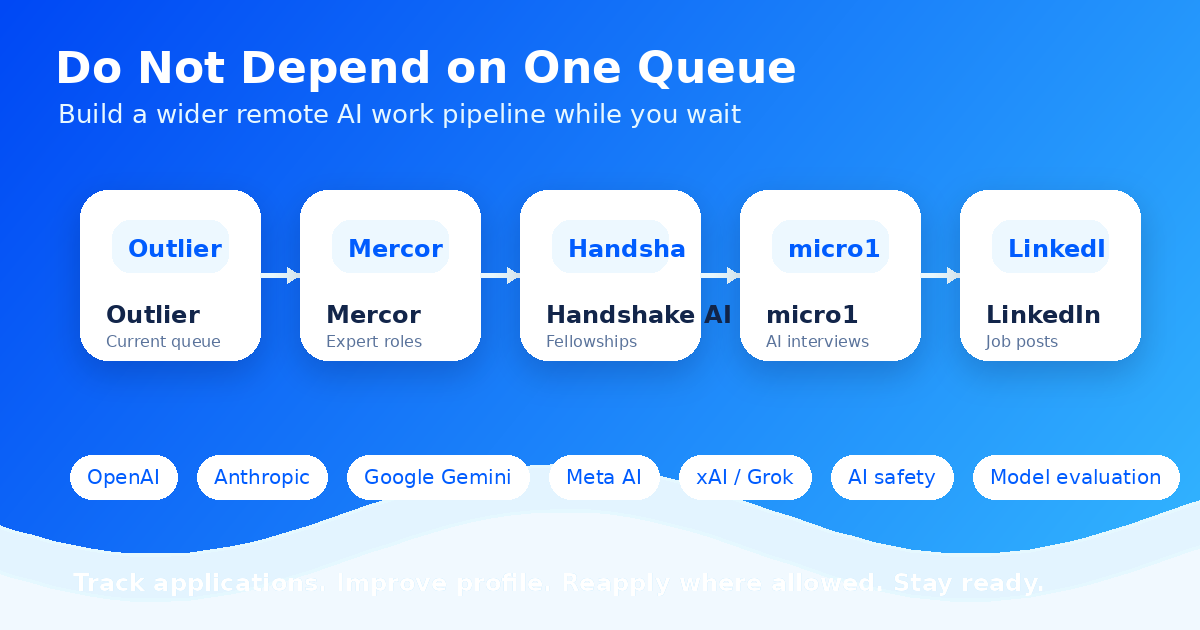
Track your applications like a pipeline
Use a simple spreadsheet with columns for platform, role, date applied, assessment status, pay rate, country requirement, domain, next step, and follow-up date. This turns a confusing remote job search into a system. When one platform slows down, you should know exactly where to apply next.
How long should you wait for tasks?
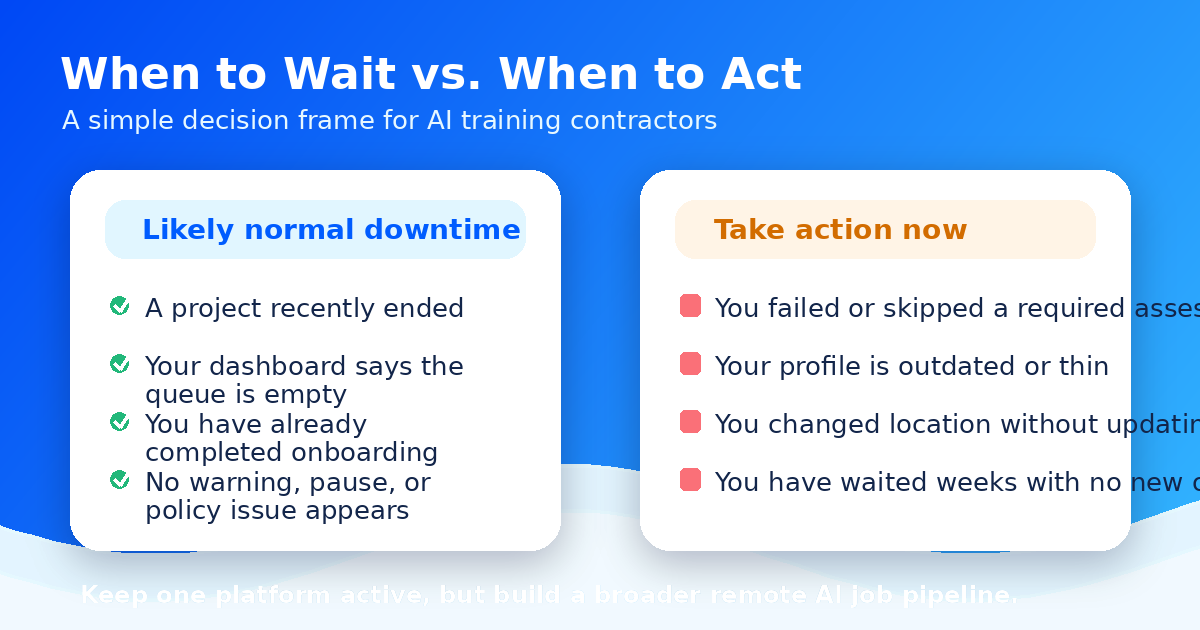
There is no universal timeline. Some contributors see tasks return quickly. Others wait weeks or never get a matching project. Because task availability depends on customer demand, skills, qualifications, location, and platform needs, you should not treat waiting as a strategy.
A practical rule is:
- If tasks disappeared recently, check your dashboard and email, then wait a few days while staying ready.
- If you have waited a week with no movement, update your profile and apply to other AI training platforms.
- If you have waited several weeks, assume you need a broader pipeline rather than relying on one platform to recover.
You are not giving up on Outlier by applying elsewhere. You are protecting your income.
Is "no tasks" the same as being rejected?
Not necessarily. A rejection usually means you were not selected, failed a required assessment, or received a clear status saying you cannot continue. "No tasks available" or an empty queue can simply mean there is no matching work right now.
However, if your account has warnings, failed verification, policy issues, project removal notices, or assessment failure messages, that is different from normal downtime. In that case, follow the official process and avoid guessing.
Better searches to use when looking for similar work
Do not only search for "Outlier AI jobs." Search for the type of work behind the platform. Try keywords like:
- remote AI evaluator jobs
- AI training jobs
- AI model evaluation jobs
- AI response rating jobs
- RLHF jobs
- data annotation jobs from home
- prompt writing jobs
- AI fact-checking jobs
- AI safety evaluation jobs
- search quality rater jobs
- remote jobs reviewing AI answers
- work from home AI training contractor
These searches are broader and usually produce more opportunities than searching for one company name. See the platform comparison guide for a wider look at where to apply.
The bottom line
If Outlier AI is not giving you tasks, it may mean the project ended, your assessment is pending, your skills do not match current demand, your location does not match available projects, or the platform simply has more contributors than work at the moment. It does not automatically mean you failed.
The best response is controlled and practical: check your dashboard, complete missing steps, keep your account accurate, improve your resume, strengthen your AI evaluation skills, and apply to multiple remote AI job platforms. Remote AI work can be real, flexible, and high-paying for the right applicants. But it is not always consistent. Treat it like a pipeline, not a single button that either works or does not.
Tip: An empty queue is a signal to act, not to wait. Check your account, improve your profile, and apply to other legitimate AI training platforms before the gap in income grows.
Frequently Asked Questions
Why is Outlier AI not giving me tasks?
There are several common reasons. The project may have ended or paused. Your assessment or onboarding may still be under review. Your profile skills may not match current demand. Your location may not be eligible for active projects. Or the platform may have more approved contributors than available tasks. An empty queue does not always mean rejection — it often means a temporary mismatch between your profile and available work.
What should I check first if Outlier AI is not giving me tasks?
Check your dashboard for missing onboarding steps, pending assessments, or warnings. Check your email for assessment results or required actions. Check whether your profile, payment method, and identity information are complete. Check whether there are any available projects or marketplace listings you can apply to. Check whether your location details are accurate and consistent.
Should I create a new Outlier AI account if I am not getting tasks?
No. Creating duplicate accounts can lead to account restrictions or permanent loss of access. The better approach is to keep your existing account accurate, complete any missing onboarding steps, improve your profile, and apply to other AI training platforms while waiting for tasks to return.
How long should I wait before applying to other AI training platforms?
Do not wait more than a week with no movement before widening your search. AI training work is project-based and can be inconsistent. Build a pipeline that includes multiple legitimate platforms — such as Mercor, Handshake AI, micro1, Surge AI, Stellar AI, and direct job board searches — rather than depending on any one platform. Apply to others while keeping your Outlier account in good standing.