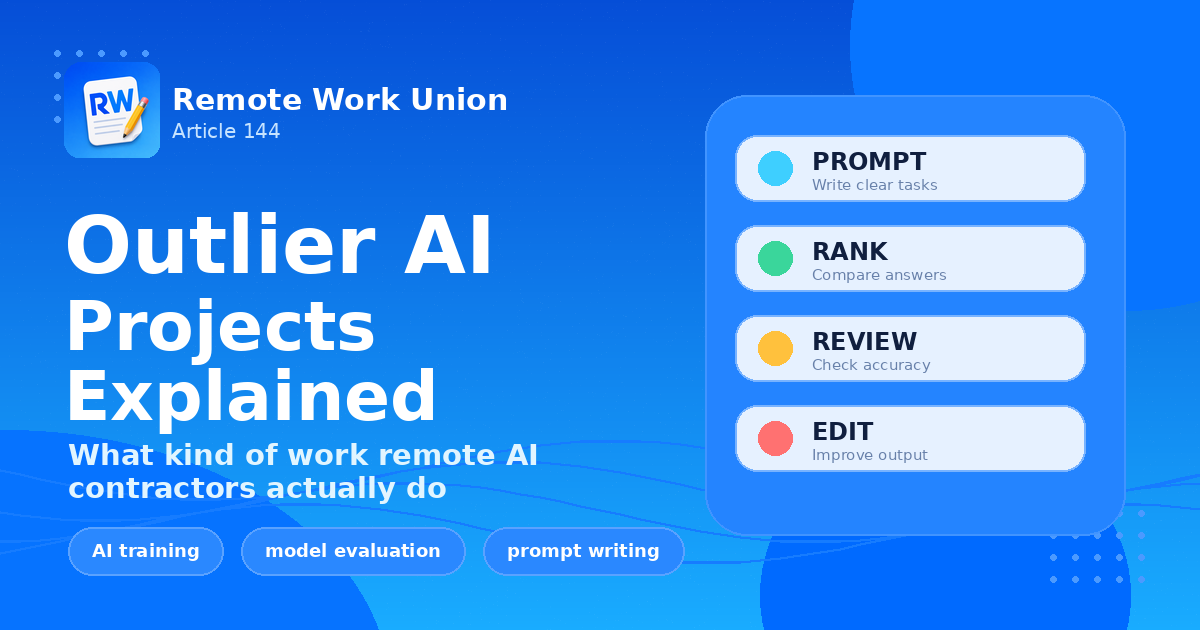
People searching for Outlier AI projects usually want a direct answer: what kind of work is actually inside the platform? They are not only asking whether Outlier is legitimate. They want to know whether the projects match their skills, whether the work is writing-heavy or technical, whether it is remote, and whether it can fit around a full-time job, school, consulting, freelancing, or another AI training platform like Mercor, Handshake AI, Surge AI, micro1, Stellar AI, or LinkedIn job postings.
This guide answers those questions directly. Outlier AI projects are remote contract projects where human contributors help improve AI models. The work can include writing prompts, comparing two AI answers, ranking outputs, editing weak responses, checking factual accuracy, solving domain-specific problems, reviewing code, evaluating math reasoning, labeling data, and explaining why one answer is better than another. Some projects are general writing or reasoning tasks. Others require specific backgrounds in math, coding, finance, law, healthcare, science, education, business, or another expert domain.
What Outlier AI Is in Plain English
Outlier is a platform associated with Scale AI that connects freelance contributors with AI training and evaluation projects. The basic idea is simple: large AI systems improve when skilled humans create examples, identify mistakes, rate model outputs, and give structured feedback. That human feedback can help language models become more useful, more accurate, safer, and better aligned with user intent.
Outlier is not a traditional employer. It is a contractor platform. That means you work on projects, not for a company in the traditional sense. There are no guaranteed hours, no manager giving you daily instructions, and no single fixed schedule. What you get is access to project-based AI work that you can do from home, on your own schedule, as long as project demand exists.
What an Outlier Project Usually Looks Like
An Outlier project is not usually a normal remote job with a manager, daily meetings, fixed hours, and a predictable list of duties. It is closer to a project-based AI training assignment. A contractor may qualify for a project, read a detailed guideline, complete training or assessments, then receive tasks inside a dashboard. Each task has instructions, quality rules, and examples. The contributor completes the task, submits it, and may receive feedback or quality review.
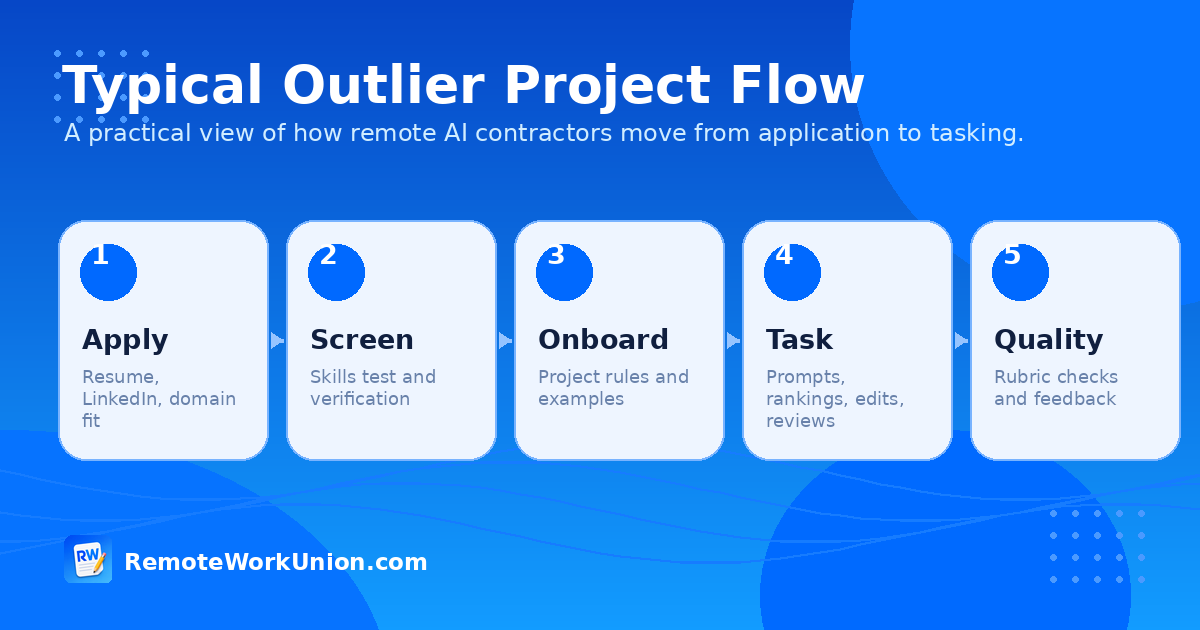
Projects can last days, weeks, or months depending on client demand. Some contractors qualify for a single project and never see another one immediately. Others qualify for several project types and maintain a steady task volume. Project-specific onboarding often matters more than the general signup process — contractors who read the guidelines carefully tend to pass quality review more consistently.
The Core Pattern: Judge AI Output
Most AI evaluation work comes down to judgment. The model gives an answer. The contractor decides whether the answer is correct, helpful, safe, well-written, complete, and faithful to the instructions. That judgment may be expressed as a rating, a ranking, a written explanation, a revised answer, a corrected solution, or a label.
You do not need to be an AI engineer to do this work. You need to be someone who can evaluate quality. That is a skill that many professionals, writers, educators, researchers, and domain experts already have — it just needs to be framed correctly when applying.
Project Type 1: Prompt Writing
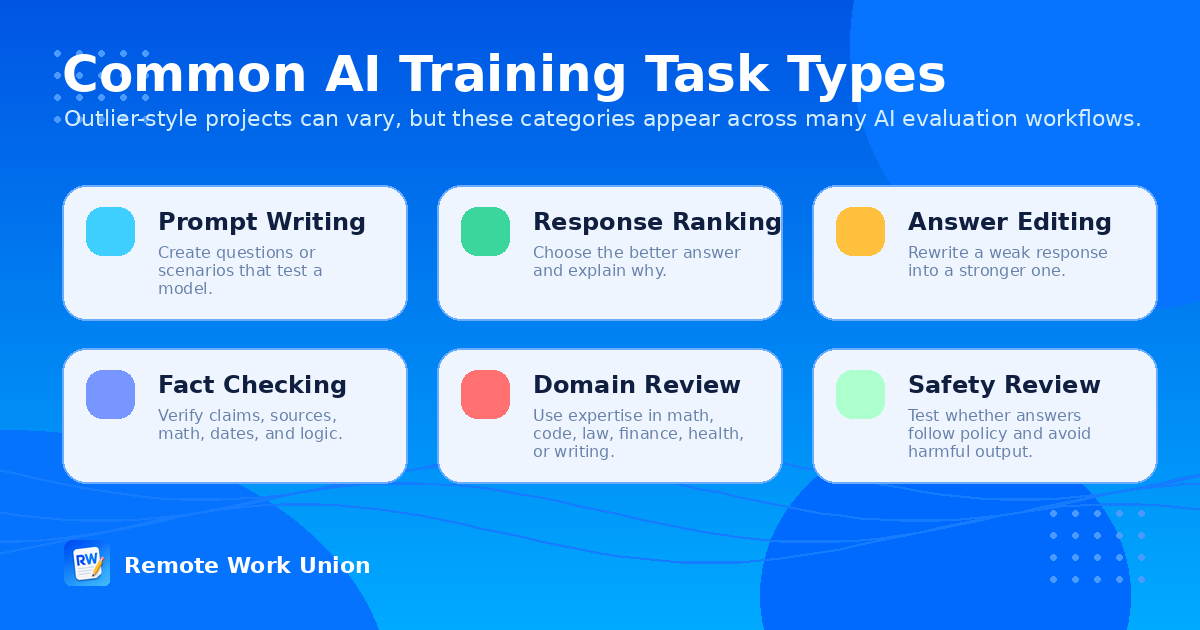
Prompt writing projects ask contributors to create questions, instructions, scenarios, or tasks for an AI model to answer. These are not random ChatGPT prompts. Good project prompts are specific, testable, and designed to reveal whether a model can follow instructions. A writing prompt might ask for a structured email, a comparison, a summary, or a reasoning task. A technical prompt might ask for code, math, data analysis, or domain-specific judgment. Strong prompts avoid ambiguity unless the project intentionally tests ambiguity.
Tip: When writing prompts for AI projects, aim for prompts that have a single correct interpretation. Vague prompts produce inconsistent model outputs, which makes it harder for the training data to be useful. The clearer the instruction, the more valuable the prompt.
Project Type 2: Response Ranking
Response ranking is one of the most common AI model evaluation tasks. The contributor sees a prompt and two or more AI-generated answers. The job is to decide which response is better based on the rubric. The best answer may be more accurate, more complete, more concise, better organized, safer, or more faithful to the user's request. Many projects ask for a short written rationale explaining the choice. That explanation matters because it teaches the evaluation system what kind of human judgment was applied.
Response ranking is a good entry point for contractors who have strong general reasoning and writing skills but may not have deep domain expertise. The task is to evaluate quality, not to invent new content — and quality evaluation is a transferable skill across many backgrounds.
Project Type 3: Answer Editing and Rewriting
Some projects ask contributors to improve an AI answer instead of only rating it. This can include fixing factual errors, making the response clearer, adding missing steps, removing unsupported claims, improving formatting, or rewriting the answer so it better matches the user's intent. Editors, journalists, teachers, tutors, copywriters, technical writers, and strong general writers can be good fits for this kind of work.
Answer editing tasks typically require closer reading than ranking tasks. You are not just picking a winner — you are improving the output until it meets a defined standard. Contractors who do this work well often have a background in quality control, editorial review, content strategy, or professional writing.
Project Type 4: Fact-Checking and Hallucination Review
AI models can sound confident even when they are wrong. Fact-checking projects ask contractors to identify unsupported claims, incorrect details, bad math, outdated information, citation problems, invented sources, or reasoning gaps. This work is especially relevant for people with research backgrounds, journalists, analysts, academics, paralegals, medical writers, financial analysts, and anyone who is comfortable checking details before making a judgment.
Tip: When evaluating AI answers for factual accuracy, do not assume the model is correct just because its answer sounds confident. Look up specific claims, check cited statistics, and flag anything that seems suspiciously precise without a clear source.
Project Type 5: Domain Expert Review
Domain expert projects ask contributors to use specialized knowledge. A math expert may check a proof or solve a problem. A software engineer may review code, debug an explanation, or compare two programming answers. A legal researcher may evaluate whether an answer uses legal concepts responsibly. A healthcare expert may assess whether a medical explanation is appropriately cautious. A finance professional may evaluate spreadsheet logic, accounting language, business reasoning, or investment-related explanations. These projects often pay more than general tasks because they require real expertise.
If you have a background in a specific professional field, domain expert projects are often the most rewarding fit on Outlier and similar platforms. The quality of the work tends to be higher, the rubrics are more specific, and the feedback loop helps you develop as an AI evaluator over time.
Project Type 6: Safety, Policy, and Edge-Case Review
Some AI training work involves testing whether a model handles sensitive or risky prompts correctly. These projects may focus on safety rules, harmful content, misinformation, privacy, or refusal behavior. Not every contractor will see this kind of work, and some people may prefer to avoid it. The important rule is to read project details carefully before accepting a task. Remote AI work should fit both your skills and your boundaries.
Project Type 7: Data Labeling and Classification
Some projects may look more like traditional data annotation. Instead of writing long explanations, the contractor may label whether content belongs in a category, whether an answer follows a policy, whether an image or text contains a certain attribute, or whether a model's response meets a defined quality standard. This can be simpler than expert review, but quality standards can still be strict. Labeling tasks require careful attention to rubric details even when the individual decisions seem straightforward.
Remote Work Union connects you to Outlier-style AI training jobs and model evaluation work across multiple platforms. Apply for free.
Find Roles Hiring Now →How Outlier Decides Which Projects You See
Project access can depend on your location, resume, degree, professional experience, test performance, language ability, domain tags, identity verification, client demand, and project availability. Two qualified people may not see the same work. A writer may see general language evaluation. A coder may see programming tasks. A math tutor may see math reasoning tasks. A finance analyst may see business or quantitative tasks. Someone with a weak profile may see fewer invitations even if they could do the work.
This is why a clear, well-targeted profile matters even on platforms like Outlier where the work seems task-based rather than interview-based. The platform needs to understand what kind of AI outputs you are qualified to evaluate before it can route you to the right project.
What Onboarding Can Involve
Outlier-style onboarding can include account setup, identity verification, profile details, resume review, skill screenings, project-specific instructions, training modules, and assessment tasks. The general onboarding may be short, but project-specific onboarding can be more important than the initial signup. Contractors should not rush the guidelines. Many task failures happen because a contributor understands the subject but ignores the rubric.
What Makes a Strong Outlier Contractor
The best contractors are not always the people with the fanciest resumes. They are the people who combine subject knowledge with clean written reasoning. A strong contributor reads the prompt carefully, follows the exact grading criteria, explains decisions clearly, avoids guessing, and treats quality feedback seriously. In AI model evaluation work, consistency is valuable. A platform does not only need smart opinions. It needs reliable judgments that match the project rules.
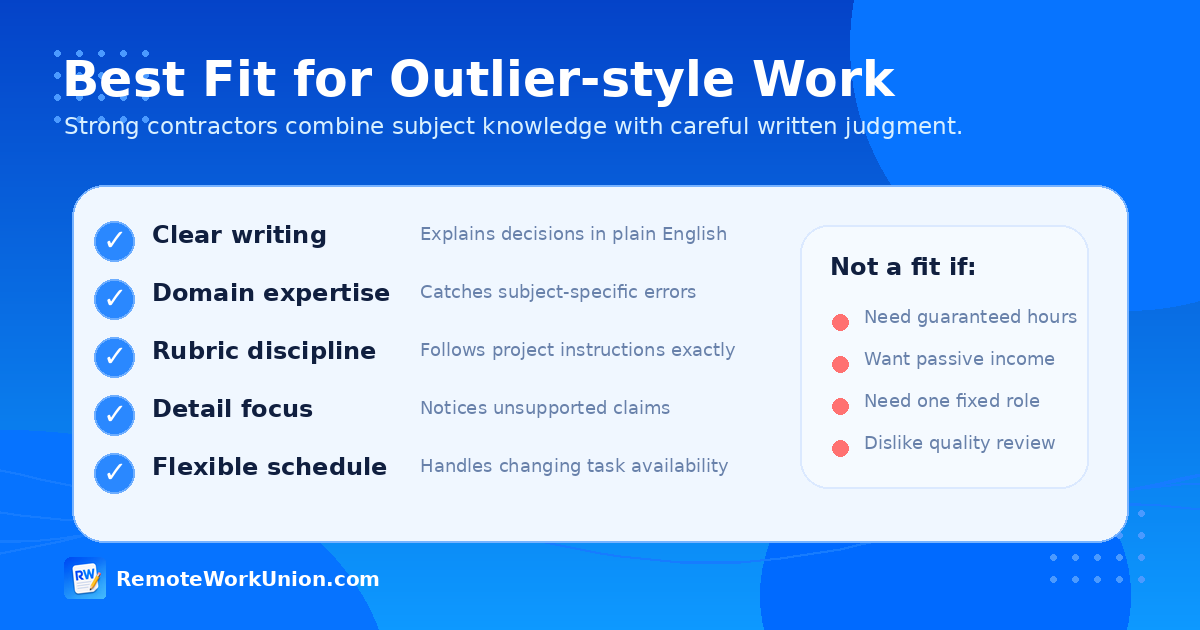
Strong Outlier-style contractors also tend to be patient with instructions. Longer guidelines are not a burden — they are a map. The more carefully you read the rubric, the more confidently you can make consistent decisions. That consistency is what earns higher project access over time.
What Outlier Is Not
Outlier should not be treated as guaranteed full-time employment, passive income, a fixed salary, or a permanent remote role. It is independent contractor work, and projects can change. Task volume can rise or fall. You may pass onboarding and still wait for tasks. You may get a project that lasts a short time, then need to qualify for another one. For many people, the smartest approach is to treat Outlier as one platform in a broader remote AI work stack, not the only income source.
How Outlier Compares With Mercor and Handshake AI
Outlier, Mercor, and Handshake AI all sit in the broader remote AI training market, but they can feel different to applicants. Mercor is often searched by people looking for expert interviews, high-paying AI training contracts, and professional matching. Handshake AI is often associated with fellowship-style expert work and selective projects. Outlier is commonly searched by people looking for task-based AI evaluation, data annotation, prompt writing, AI response ranking, and project availability. The best platform depends on your skills, country, availability, and tolerance for variable work.
Tip: Applying to multiple platforms simultaneously is a common strategy for remote AI workers. Each platform has different project pipelines, and qualifying on several platforms means you are less affected when any one of them has a slow period.
Who Outlier AI Projects May Fit
Outlier may fit strong writers, editors, coders, math experts, teachers, tutors, researchers, finance professionals, legal researchers, medical writers, scientists, bilingual speakers, data analysts, and people who already use AI tools like ChatGPT, Claude, Gemini, Grok, or Copilot. It may also fit college students or professionals who want flexible online work, assuming they meet the platform's requirements and are legally allowed to work in their country.
Be cautious if you need a guaranteed schedule, a traditional employee role, manager-led training, predictable income, or work that never changes. Also be cautious if you dislike detailed instructions. Many AI training tasks require close reading and patience. A person who wants to move quickly without following a rubric may struggle even if they are intelligent.
How to Think About Pay
Rates can vary by project, expertise, complexity, location, and demand. Some expert projects may advertise higher hourly rates than general tasks, but the rate is only one part of the equation. A high rate with few available tasks may produce less income than a lower rate with steady work. Remote AI workers should track actual weekly earnings, not just advertised hourly rates.
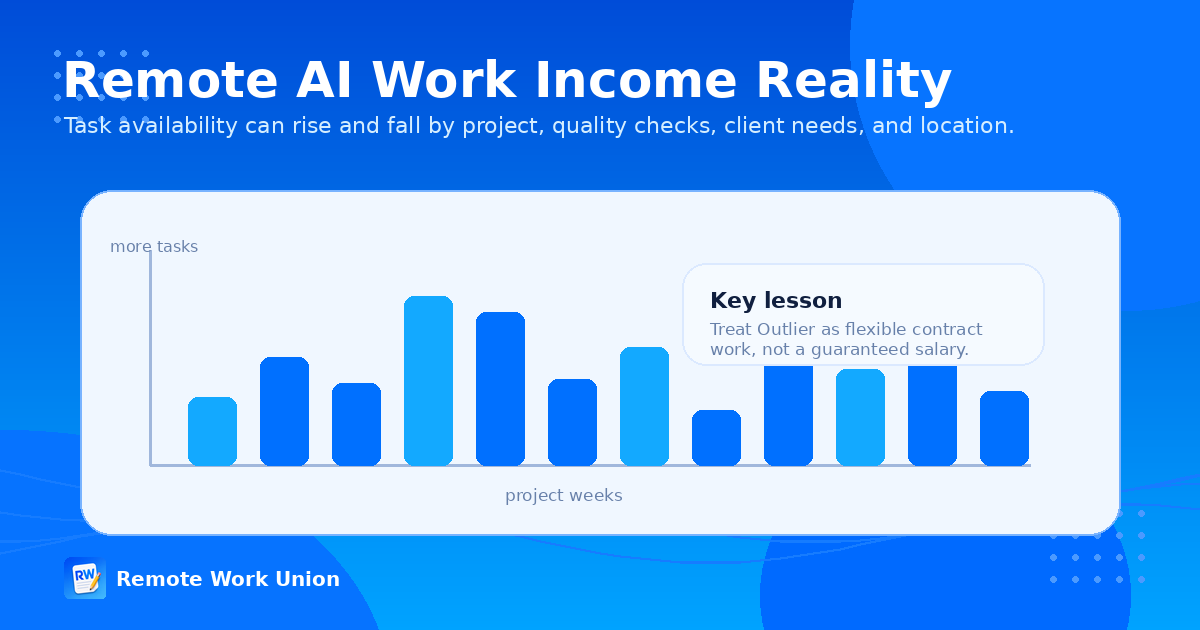
The best income strategy for Outlier-style work is not to chase the highest single rate. It is to qualify for multiple project types, maintain quality scores, and treat the work as one channel in a broader remote income stack. The contractors who earn the most consistently tend to have qualified for several project categories and stay current on platform updates.
How to Avoid Common Mistakes
The most important mistakes to avoid on Outlier and similar AI training platforms:
- Do not assume that passing onboarding means you will always have tasks.
- Do not create multiple accounts.
- Do not copy answers from AI tools when the project expects your independent judgment.
- Do not rush assessments.
- Do not ignore feedback from quality review.
- Do not use the same generic explanation for every ranking decision.
- Do not claim expertise you cannot demonstrate.
- Do not treat Outlier as your only remote work option if you need stable monthly income.
A simple mental model: think of Outlier projects as paid human judgment for AI systems. The model produces content. You test it, rank it, correct it, label it, or explain what went wrong. The platform supplies the project rules. Your value is your ability to apply those rules carefully. That is the core of AI training, model evaluation, RLHF-style feedback, data annotation, and AI response review.
Frequently Asked Questions
What kinds of projects are most common on Outlier?
The most common Outlier AI projects involve response ranking (comparing two AI answers and choosing the better one with written justification), prompt writing (creating questions or instructions for AI models to answer), and answer editing (rewriting or improving weak AI responses). Domain expert review and fact-checking projects are also available and often pay more than general tasks.
Do I need a degree to work on Outlier AI projects?
Not always. Some projects favor advanced degrees or deep professional experience, particularly in math, science, coding, law, or medicine. Other projects value strong writing, analytical reasoning, editing ability, or research skills. The best approach is to present your actual background clearly and apply to projects that match it.
Why am I not getting tasks after passing the Outlier assessment?
Task availability on Outlier depends on current project demand, your location, your profile tags, and whether active projects match your skills. Passing onboarding does not guarantee a task queue. Many contractors wait after qualifying and then see work appear when a new project opens. Applying across multiple AI training platforms reduces the risk of a slow single-platform dashboard.
Can I work on Outlier while using other AI training platforms?
In most cases, yes. Independent contractor work generally allows you to work on multiple platforms simultaneously, but you should read each platform's contractor agreement carefully. Working across Outlier, Mercor, Handshake AI, and similar platforms is a common strategy for remote AI workers who want income stability without depending on one project source.
How does Outlier compare to Mercor and Handshake AI for remote AI work?
Outlier is often associated with task-based AI evaluation, data annotation, prompt writing, and response ranking work through its connection with Scale AI. Mercor is often searched by people seeking expert matching, high-paying AI training contracts, and professional interview-driven onboarding. Handshake AI is associated with fellowship-style expert projects and selective placement. The best platform depends on your skills, country, availability, and income goals.
Bottom Line
Outlier AI projects can be a real path into remote AI training work, especially for people with strong writing, research, coding, math, teaching, analysis, or professional expertise. The work can be flexible and useful, but it is not guaranteed employment. The best approach is to prepare your profile carefully, understand the task types, follow project instructions closely, and apply across multiple legitimate platforms so that one slow dashboard does not stop your entire remote work search.